- +8618603825129
- [email protected]

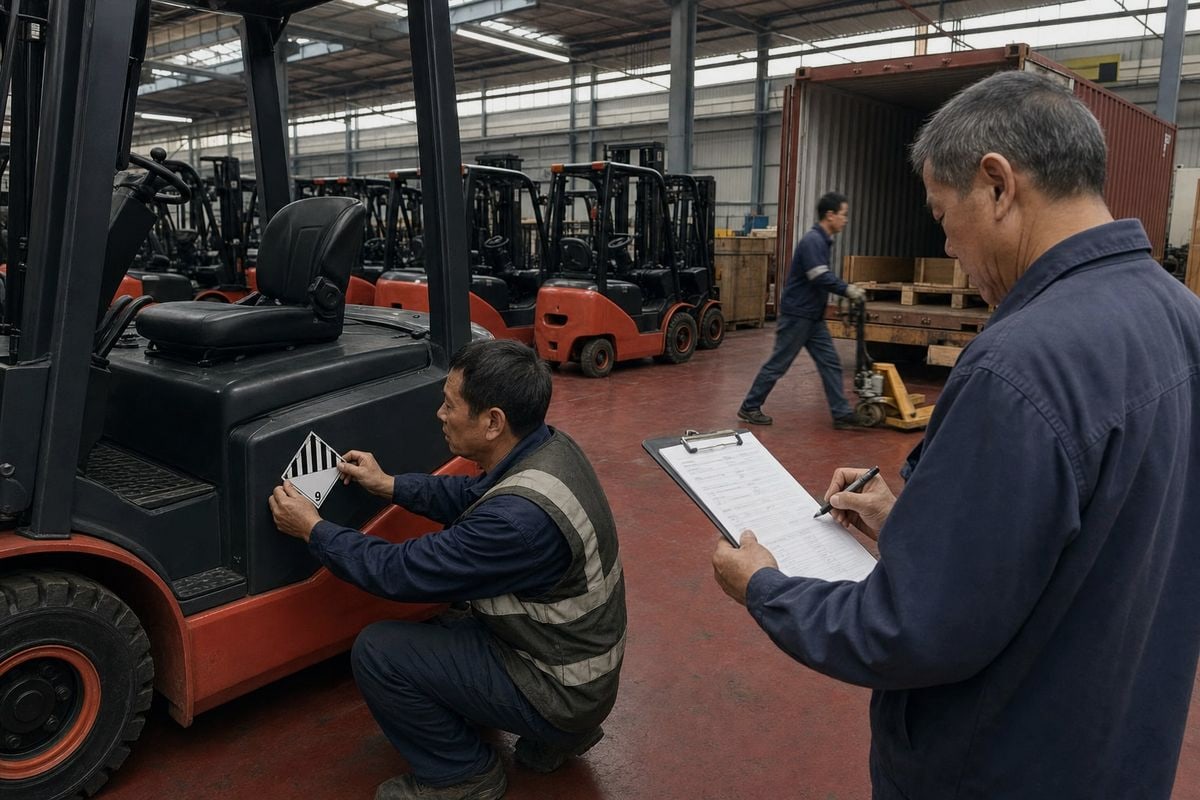
Last month, our team in Zhengzhou watched a client's lithium battery forklift get rejected at port because his previous forwarder declared it as ordinary machinery. That mistake cost him three weeks and heavy storage fees.
To declare a lithium battery forklift for ocean shipping, classify it as Class 9 dangerous goods under UN3171 or UN3556, submit a signed Dangerous Goods Declaration, provide the UN38.3 test summary and SDS, apply IMDG hazard labels, and obtain carrier pre-approval before booking.
That is the short answer. The full process has more steps, and each one can stop your shipment if you get it wrong. Let me walk you through it, document by document.
Every week, our documentation desk checks battery paperwork from Chinese forklift factories before booking. Roughly a third of the files we receive are incomplete on the first pass.
You need a signed Dangerous Goods Declaration, a UN38.3 test summary, a 16-section Safety Data Sheet, a container packing certificate, a commercial invoice, a packing list, and the ocean bill of lading. Some carriers also require a battery specification sheet and pre-approval from their DG desk.
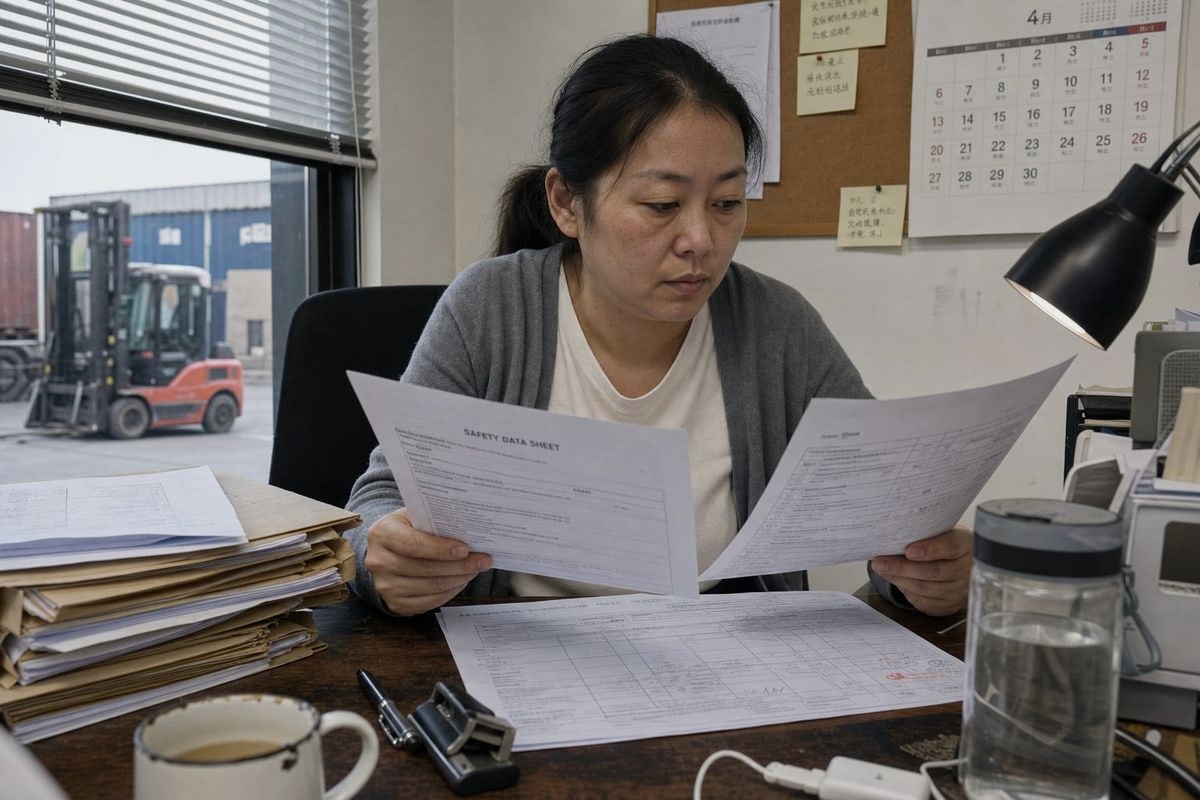
The paperwork for a lithium battery forklift falls into two groups. The first group is standard export paperwork. The second group is dangerous goods paperwork. Most delays we see come from the second group, so I will focus on that.
The Dangerous Goods Declaration, sometimes called the IMO Declaration, is the legal heart of the shipment. It must state the UN number, the proper shipping name 1, the hazard class, the quantity of batteries, and the energy capacity in kWh. It must be signed by the shipper or an authorized party. The carrier will refuse a booking without it.
The UN38.3 test summary proves the battery pack passed altitude, thermal, vibration, shock, and short-circuit tests. Since 2020, this summary must be available on request across the supply chain. We ask the factory for it before we even quote the shipment.
The Safety Data Sheet, or SDS, must follow the standard 16-section format. It should describe the specific battery model, its chemical hazards 2, and emergency response steps. A generic template SDS is a common reason carriers push back.
| Document | Purpose | Who Provides It |
|---|---|---|
| Dangerous Goods Declaration | Legal declaration of Class 9 cargo | Shipper or forwarder |
| UN38.3 Test Summary | Proof of battery transport testing | Battery manufacturer |
| Safety Data Sheet (SDS) | Hazard and emergency information | Battery manufacturer |
| Container Packing Certificate | Confirms proper loading and securing | Packer or forwarder |
| Commercial Invoice & Packing List | Customs valuation and cargo details | Seller |
| Bill of Lading | Ocean transport contract | Carrier |
In our experience shipping forklifts from China to the United States, the smart move is to collect all battery documents from the factory before the forklift leaves the production line. Chasing paperwork after cargo reaches the port is how storage charges pile up.
A US distributor once asked me why his forklift and his spare battery needed two different UN numbers. That question gets to the core of classification.
Classify a forklift with its lithium-ion battery installed as UN3171 (battery-powered vehicle) or UN3556 (lithium-ion battery powered vehicle), Class 9. A spare lithium-ion battery shipped separately falls under UN3480, while batteries packed with equipment use UN3481. The forklift's HS code typically sits under heading 8427.
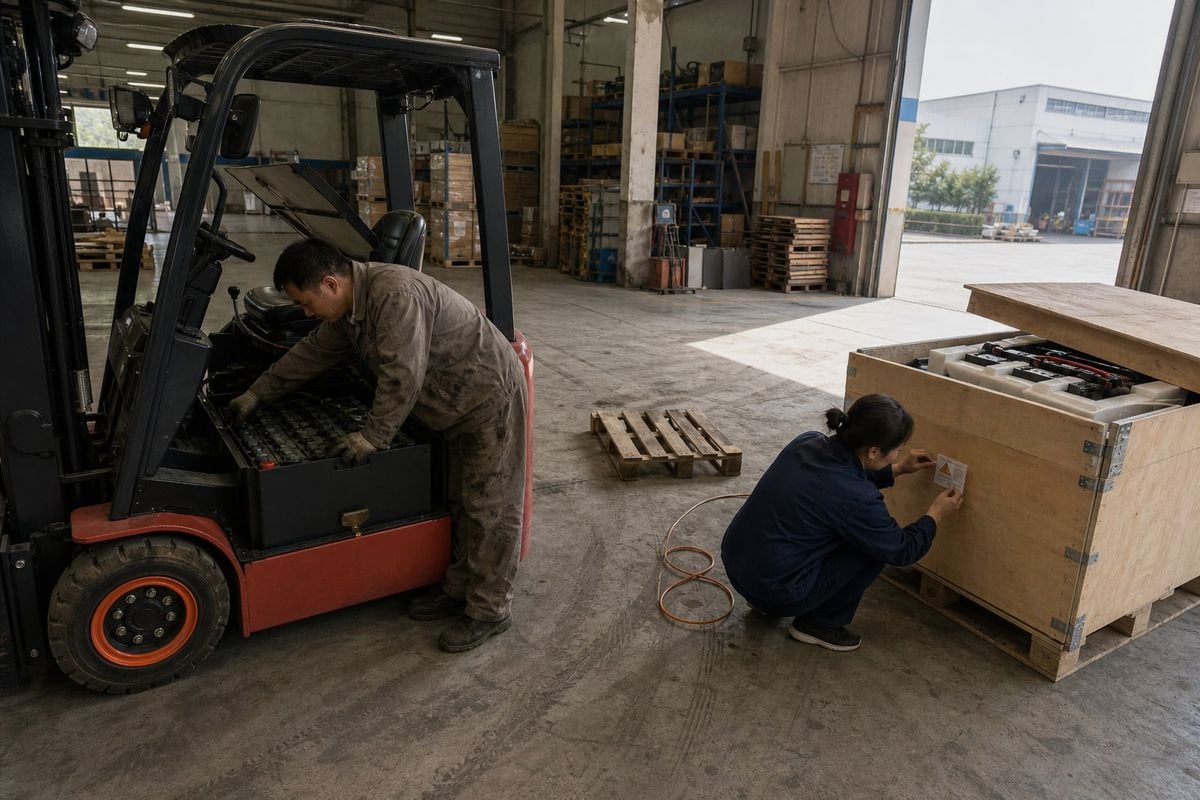
Classification is the first decision, and everything else flows from it. Get the UN number wrong, and the labels, the declaration, and the packing rules will all be wrong too. Ocean logistics guidance repeatedly names misdeclaration as a leading cause of port rejection, and our own files confirm it.
The correct UN entry depends on what exactly is in the container. I always ask clients three questions: Is the battery installed? Is it packed with the forklift? Or is it shipped alone?
| Scenario | UN Number | What It Means |
|---|---|---|
| Battery installed in the forklift | UN3171 or UN3556 | Declared as a battery-powered vehicle, battery secured in its holder |
| Battery packed with the forklift | UN3481 | Lithium-ion batteries packed with equipment, stricter inner packaging |
| Spare battery shipped alone | UN3480 | Standalone lithium-ion battery, tightest packaging and marking rules |
The UN3481 classification also applies when a client buys a forklift from one factory and a battery from another, then consolidates them in one crate. We handle multi-supplier consolidation often, so we check this pairing carefully.
Lithium-ion and lithium metal batteries carry different UN numbers and different documentation needs. Nearly all forklift traction batteries are lithium-ion, usually LiFePO4, but I never assume. I confirm the chemistry on the battery label and the SDS.
Battery condition changes the rules too. New batteries follow the standard path. Damaged or defective batteries face far stricter treatment and are often prohibited from ocean carriage entirely. If a used forklift shows battery faults, resolve them before booking, not at the terminal.
Small batteries can sometimes travel under relaxed rules through Special Provision 188, but forklift traction batteries far exceed the 100 Wh threshold, so they are always fully regulated Class 9 hazardous materials.
Early in our forklift shipping work, a carrier's DG desk held a booking for five days over one missing document. It was the UN38.3 test summary. We never repeat that mistake.
The MSDS and UN38.3 test report prove your battery is safe to transport. The UN38.3 summary confirms the pack passed altitude, thermal, and mechanical stress tests. The SDS gives carriers and emergency responders the hazard data they need. Carriers refuse lithium battery cargo without both.
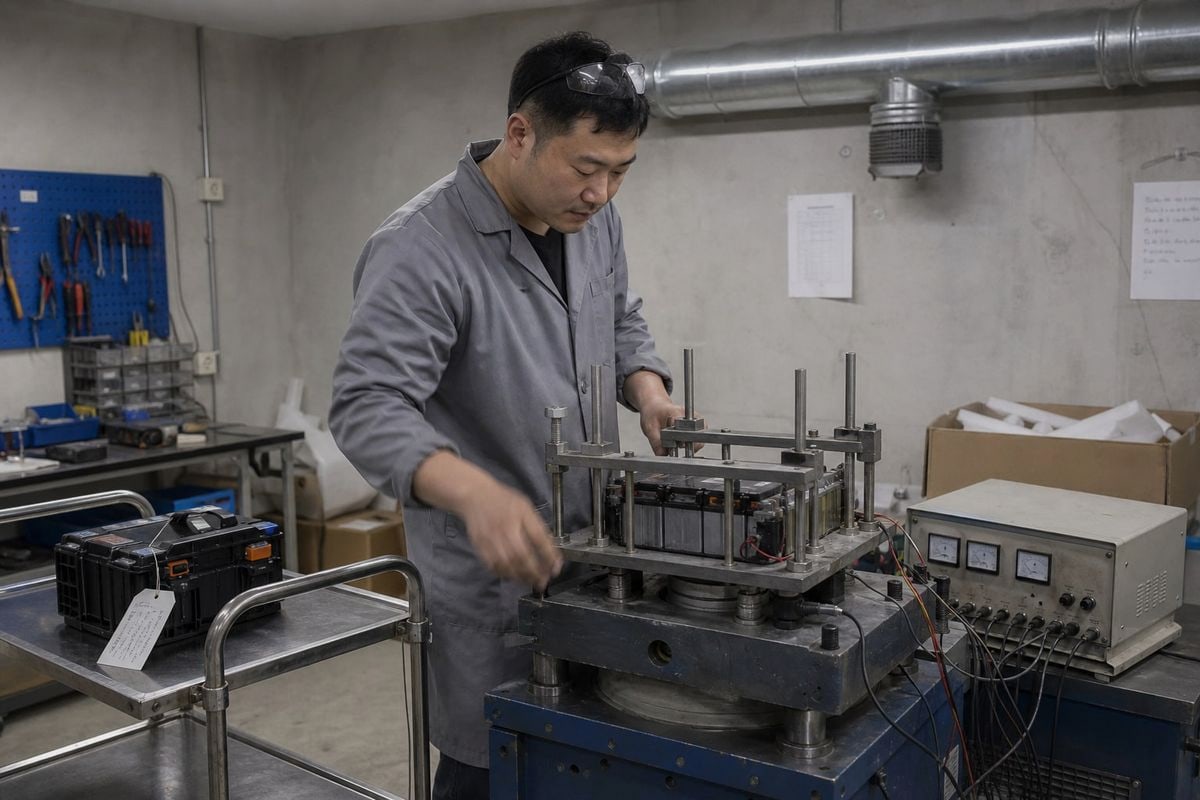
Ocean carriers accept lithium battery forklifts on one condition: proof of safety. These two documents are that proof, and they serve different purposes. Understanding the difference helps you know what to demand from your factory.
UN38.3 is a series of transport tests defined in the UN Manual of Tests and Criteria. A compliant battery pack has survived altitude simulation, thermal cycling, vibration, shock, external short circuit, impact or crush, overcharge, and forced discharge testing. In plain terms, the test simulates the worst physical stress a battery might face during a voyage. The test summary is the shorthand record that carriers, forwarders, and regulators check.
When we coordinate with Chinese forklift factories, we verify three things on the test summary: the battery model matches the one actually installed, the testing lab is identified, and the document covers the full pack, not just the cells. A mismatch between the summary and the installed battery is a classic acceptance failure.
The Safety Data Sheet SDS covers a different risk: what happens if something goes wrong. It documents chemical composition, fire behavior, and emergency response, which supports thermal runaway prevention 3 planning by the carrier and the terminal. A proper SDS has 16 sections and names the specific battery model. Some carriers now also welcome a Battery Management System diagnostic report showing no internal cell imbalances before the container is sealed, and a few advanced ports offer hazardous vehicle staging areas with thermal monitoring. These extras are not universal requirements, but providing them can speed up the carrier's technical review.
My practical advice: request both documents at the purchase-order stage. Factories produce them quickly for a paying customer. They respond much more slowly once your cargo is already sitting at the port.
Here is a trade-off I weigh on every booking: a faster vessel with a strict DG desk, or a slower carrier with smoother dangerous goods acceptance. Speed on paper means nothing if acceptance fails.
Yes. You can avoid most delays by verifying the UN classification before booking, securing carrier DG desk pre-approval, matching every document to the actual battery configuration, applying correct Class 9 labels and IMO hazard labeling, and protecting battery terminals against short circuits before container loading.

Delays with lithium battery forklifts almost never come from one big failure. They come from small mismatches. The invoice says one battery model, the UN38.3 summary says another. The DGD lists the wrong kWh figure. The Class 9 label is missing from the container door. Each mismatch invites inspection, and inspection means days.
Some readers will object here: if the IMDG Code 4 allows it, why would a carrier refuse it? The objection is fair, but the reality is that carrier acceptance policies often exceed baseline IMDG Code compliance. A shipment that is legal on paper can still be declined at booking. Some lines restrict the State of Charge SoC on batteries, cap quantities per container, or demand segregation from incompatible cargo. This is why freight forwarder requirements and carrier pre-approval matter as much as the regulation itself. "Allowed by the code" is not the same as "accepted by this vessel."
| Failure Point | Consequence | Prevention |
|---|---|---|
| Wrong UN number or shipping name | Port rejection, re-declaration | Verify configuration before booking |
| Missing or unsigned DGD | Booking refused | Submit draft DGD for DG desk review |
| Exposed battery terminals | Cargo turned away at packing survey | Insulate with caps or non-conductive tape |
| Documents do not match battery model | Customs inspection and hold | Cross-check all files before cut-off |
| Assuming carrier rules match the code | Last-minute refusal | Confirm carrier-specific acceptance early |
One more trend worth knowing. Air transport rules for lithium batteries have tightened sharply, so ocean freight is now the default route for large industrial battery cargo. That works in your favor on cost, but only if your classification and documentation are disciplined from day one.
Declaring a lithium battery forklift for ocean shipping comes down to correct Class 9 classification, complete dangerous goods documents, proper labeling, and carrier pre-approval. Get these right before booking, and your forklift sails without drama.
1. Official IMO guidance on the classification and documentation required for transporting dangerous goods by sea. ↩︎
2. OSHA's Hazard Communication Standard, which governs how chemical hazards are identified and communicated to workers and transporters. ↩︎
3. Explanation of thermal runaway in batteries, a critical safety risk addressed in shipping regulations. ↩︎
4. The International Maritime Organization's page for the IMDG Code, the global standard for shipping dangerous goods. ↩︎