- +8618603825129
- [email protected]


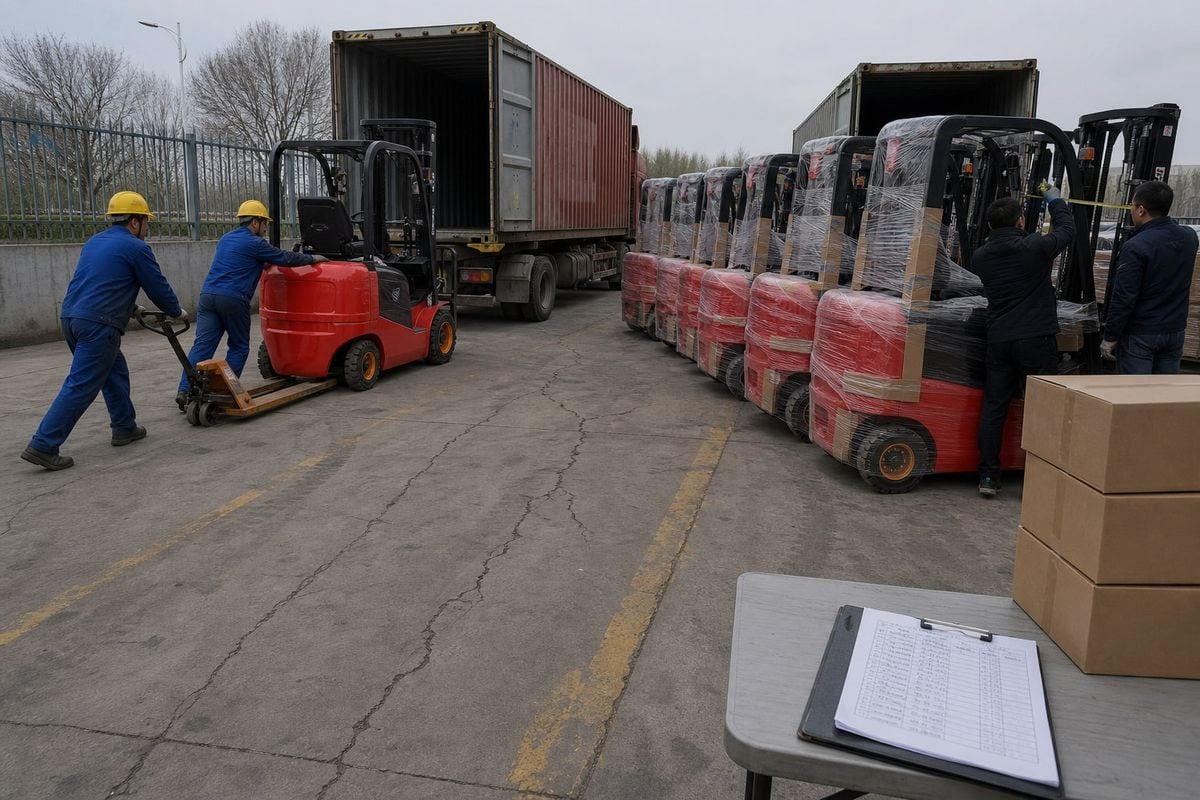
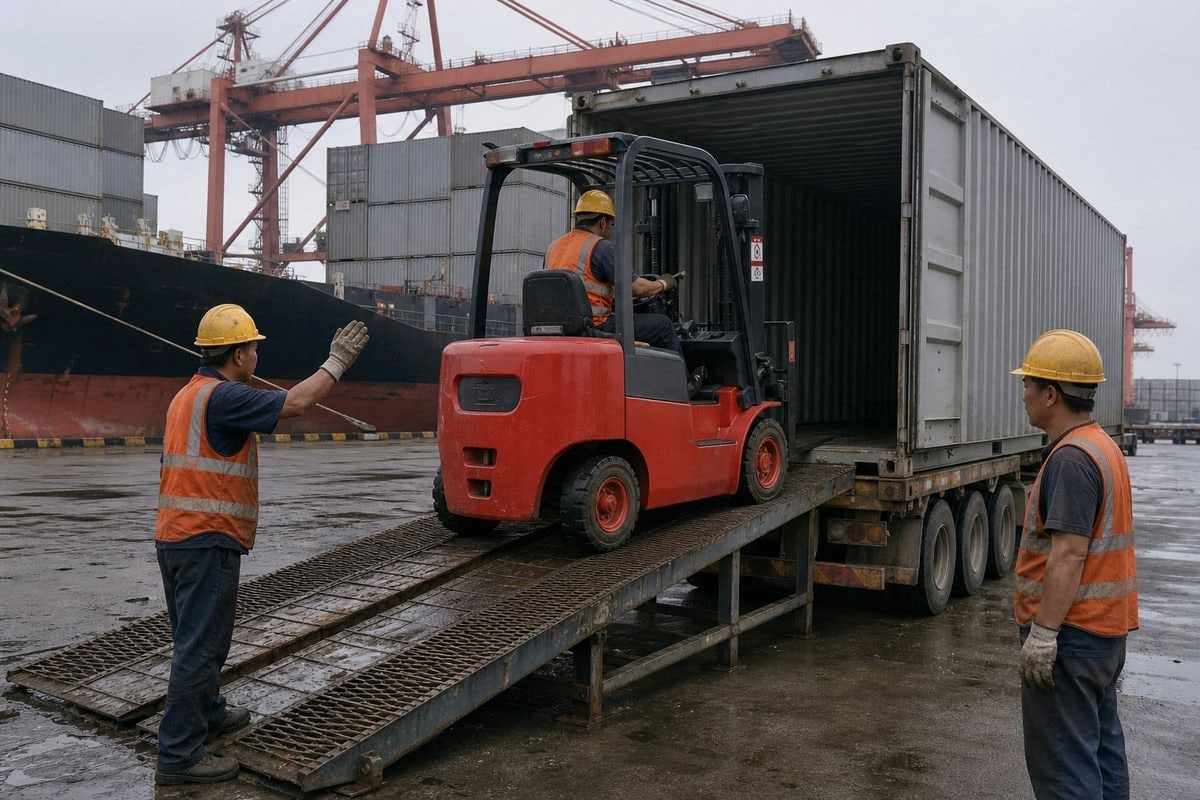
Knowing how to lash a forklift in a container is the difference between safe delivery and a costly insurance claim. At our Zhengzhou loading warehouse, we see the risk weekly. One loose strap on a three-ton machine can destroy the mast, the container walls, and your delivery schedule. That is why our team treats every forklift like cargo, not like equipment that simply drives in and parks.
To lash a forklift in a container, lower the mast fully, center the unit for even load distribution, chock all wheels with timber, and secure the chassis with at least four heavy-duty ratchet straps or grade 70 chains attached at 45-degree angles to structural tie-down points.
That is the short answer. But ocean transit adds vibration, rolling, salt air, and heat. Below, I walk through the full process our team uses on real shipments from China.
Last month, our team loaded a red counterbalance forklift bound for Houston. The buyer asked why we spent two hours on lashing alone. This section explains exactly what we did.
Properly securing a forklift requires a layered restraint system: timber wheel chocks against every wheel, blocking and bracing around the frame, friction mats under the tires, and four or more ratchet straps tensioned at 45-degree angles from structural points to the container's lashing rings.
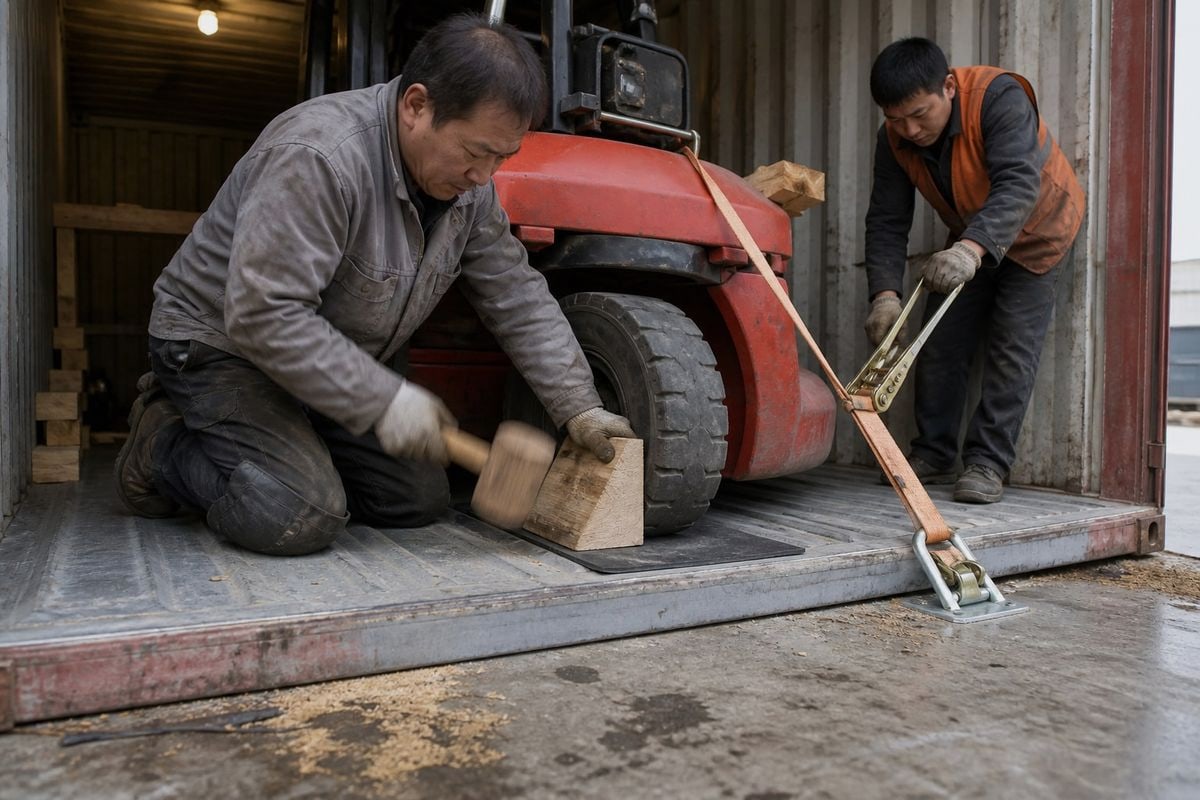
The core principle is direct restraint. Each lashing must oppose a specific movement direction. A container at sea pitches, rolls, and vibrates for weeks. Your securing plan must block forward and backward sliding, side-to-side shifting, and vertical bouncing. One tight-looking strap does not achieve this. Redundancy does.
Here is the process our loading team follows on every forklift shipment, in line with CTU Code compliance principles:
Straps must connect only to structural tie-down points 1 on the chassis or designated lifting eyes. Never attach to hydraulic lines, the steering axle linkage, fuel tanks, or the overhead guard. Distribute tie-down points symmetrically so no single strap carries uneven force. Short, taut lashings outperform long, loose ones every time.
For heavier counterbalance models, we also build a reinforced timber A-frame brace behind the rear counterweight. The counterweight raises the machine's mass concentration at the rear, and the brace prevents fishtailing during heavy sea swells.
A distributor once told me he planned to secure a 2.5-ton forklift with two rope ties from a hardware store. We stopped that shipment before it left the factory.
Forklift lashing requires at least four heavy-duty ratchet straps or grade 70 chains rated around 5,000 lb minimum break strength each, hardwood timber for chocks and dunnage, friction mats, corner protectors, nails or lag screws, and a tension-checking routine before sealing.

There is a real debate in the industry about straps versus chains versus timber blocking. Dealer-style guides often recommend straps plus chocks and stop there. Carrier-grade and P&I guidance leans toward heavier combinations of blocking, bracing, and engineered restraint. In our experience, the answer is a spectrum: the heavier and more valuable the forklift, the more conservative your securing plan should be. A 1.5-ton electric pallet truck can travel safely on straps, chocks, and friction mats. A 5-ton diesel counterbalance unit deserves chains or steel wire rope, full timber cribbing, and a counterweight brace.
| Forklift Weight | Primary Lashing | Blocking | Extras |
|---|---|---|---|
| Under 2 tons | 4 ratchet straps (5,000 lb min) | Timber chocks all wheels | Friction mats, corner protectors |
| 2–4 tons | 4–6 straps or grade 70 chains | Chocks plus lateral timber dunnage | Anti-slip mats, edge protection |
| 4–7 tons | Grade 70 chains or steel wire rope | Full cribbing plus nailed bracing | Rear A-frame brace, load spreaders |
| Over 7 tons | Consider flat rack instead | Engineered securing plan | Surveyor sign-off often required |
Cheap straps stretch. Ocean humidity and temperature swings loosen tension over a 30-day sea freight transit, so we always specify rated, labeled lashing gear that carriers and insurers will accept. Timber must be solid hardwood, and for many destinations, including the United States, it must be ISPM 15 2 heat-treated to pass import inspection. We also add Volatile Corrosion Inhibitor (VCI) capsules inside the electrical cabinets of electric forklifts. Salt-laden container air corrodes control boards, and VCI protection costs almost nothing compared to a damaged controller.
One more point on responsibility: cargo securement rules place the duty on the shipper. The securing method must prevent movement without damaging the cargo or the container itself. Over-tightening a strap across a painted body panel can crack fiberglass covers or crush wiring. Tension firmly, protect edges, and check twice.
Container utilization is the question I get most often from US forklift dealers, because the freight cost per unit drops sharply when a container is loaded efficiently.
A 20-foot container typically fits one to two compact forklifts, while a 40-foot or 40HQ container fits two to four units depending on dimensions, mast height, and weight. Each forklift must be individually chocked, blocked, and lashed with its own tie-down points.

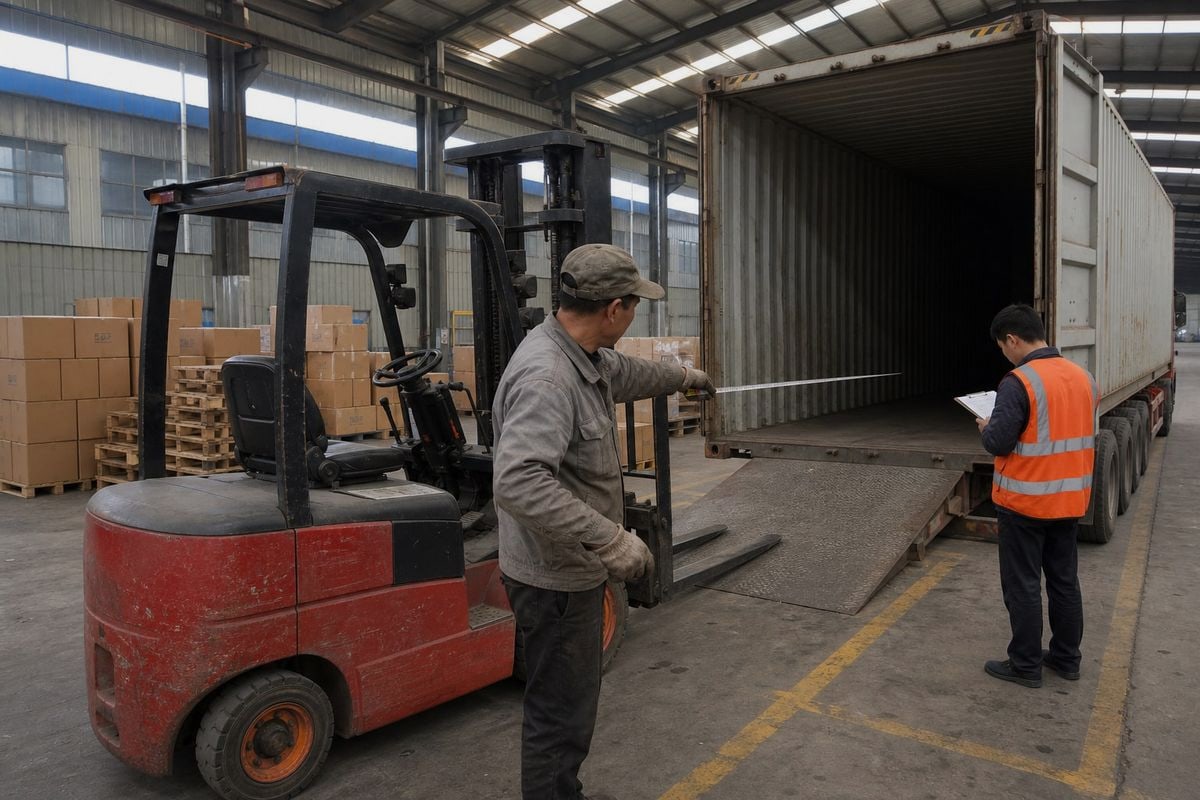
Before we quote any multi-unit shipment, we collect the exact length, width, lowered mast height, and service weight of every forklift. Standard containers only work when the machine fits with clearance on all sides. A forklift that technically fits but touches the ceiling or walls will grind against steel for the entire voyage.
| Container | Internal Dimensions (approx.) | Compact 1.5–2T Forklifts | 2.5–3.5T Counterbalance |
|---|---|---|---|
| 20FT | 5.9m x 2.35m x 2.39m | 1–2 units | 1 unit |
| 40FT | 12.03m x 2.35m x 2.39m | 3–4 units | 2–3 units |
| 40HQ | 12.03m x 2.35m x 2.69m | 3–4 units (taller masts OK) | 2–3 units |
These are planning figures, not promises. Mast height when lowered is usually the deciding constraint, followed by container floor load limits. Concentrated weight from solid rubber tires can stress the floor, so we lay timber load spreaders under heavy axles to distribute the force across more floor bearers.
Loading more units does not mean sharing lashings. Each forklift needs:
We also fill remaining space with chargers, spare parts, and batteries where carrier rules permit. Consolidating forklifts from one factory with chargers from another into a single container is one of the most effective ways our customers cut their landed cost per unit. But every added item must be blocked and braced too. Loose cartons become projectiles in rough seas.
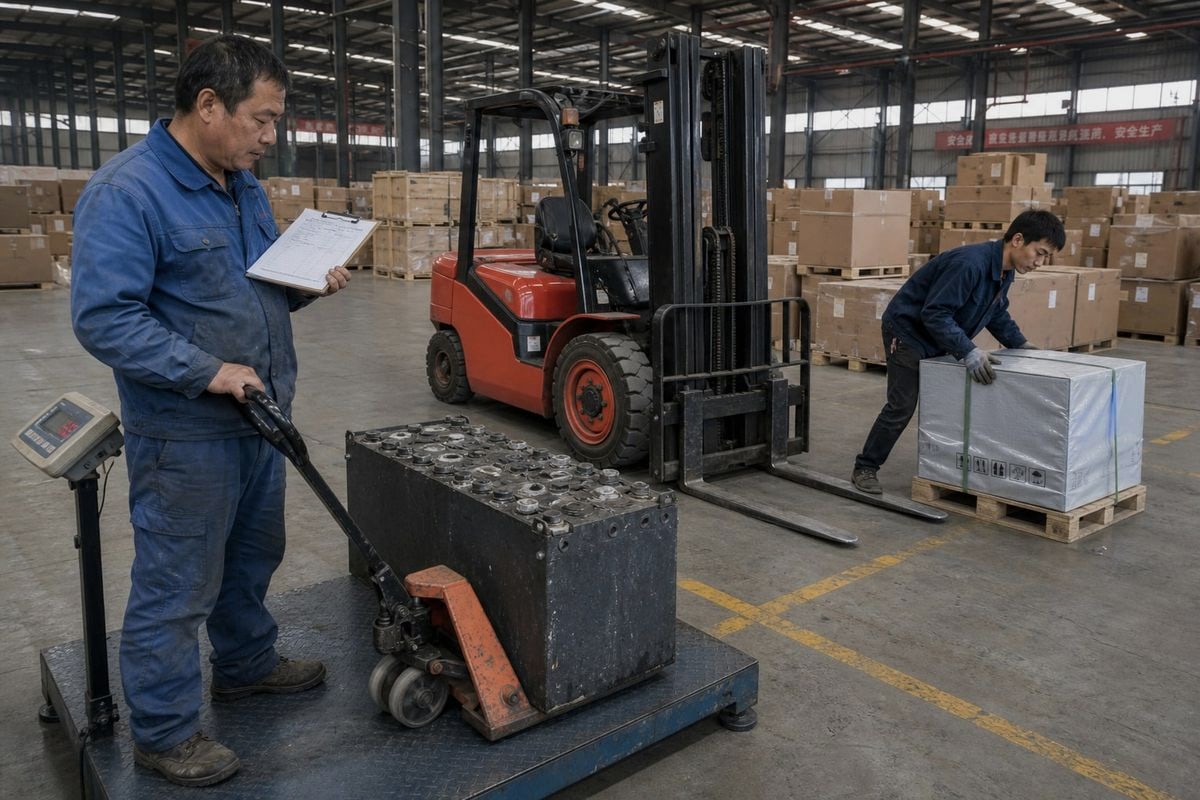
Electric forklifts are now the majority of what moves through our consolidation warehouse, and the mistakes we see with them differ from diesel units in important ways.
Avoid shipping electric forklifts with connected battery terminals, straps on non-structural parts, missing loading photos, slack lashings, and ignored carrier battery rules. Disconnect and isolate the battery, pack chargers separately, and document every stage before the doors close.
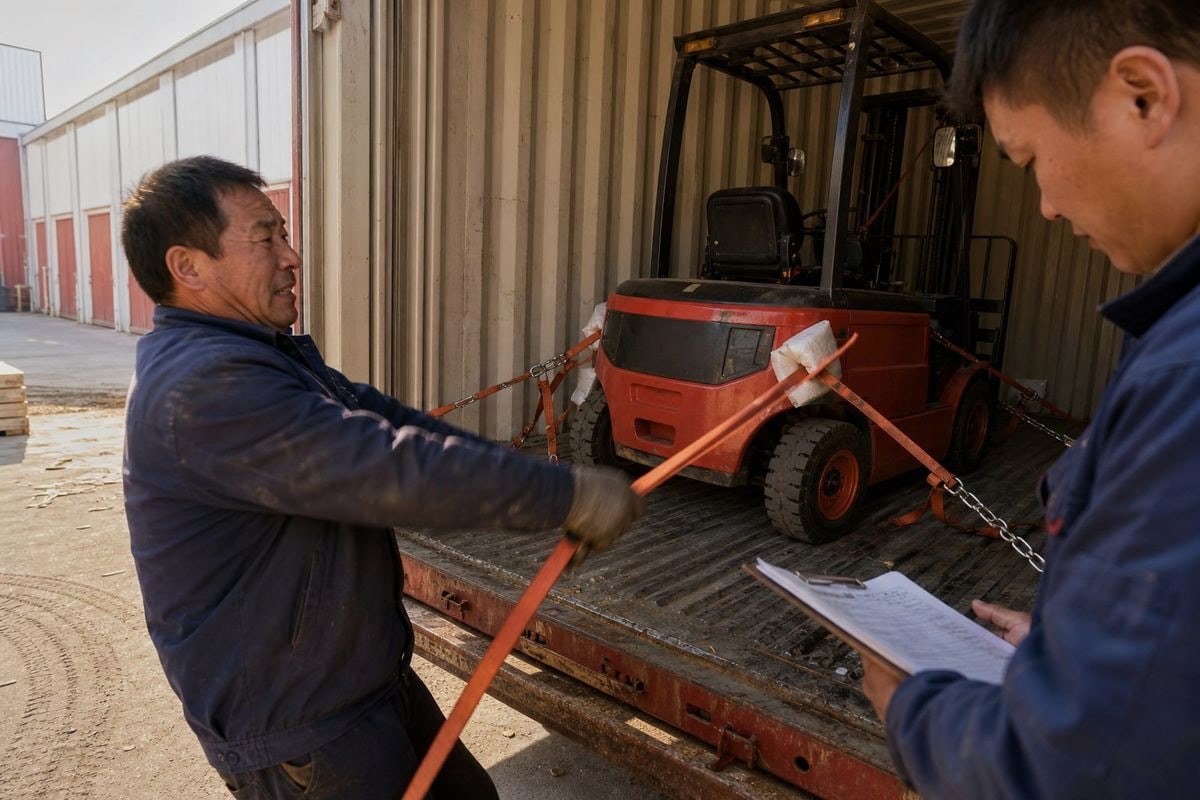
The biggest risk with electric models is the battery, especially lithium. Carriers treat battery-powered heavy machinery transport 3 differently from ordinary cargo, and documentation problems surface at the worst possible moment: after the container reaches the port. We coordinate battery specifications, classification paperwork, and carrier acceptance before pickup, because fixing this at the terminal means delays, storage fees, and sometimes a rejected booking.
| Mistake | Consequence | Prevention |
|---|---|---|
| Battery terminals left connected | Short-circuit and fire risk; carrier rejection | Disconnect and insulate terminals; follow IMDG-aligned prep |
| Straps on hydraulic lines or covers | Torn hoses, cracked panels, fluid leaks | Use chassis tie-down points only |
| Mast left raised | High center of gravity; tipping and ceiling strikes | Lower fully, tilt back to maximum |
| No loading photos | Insurance disputes; no proof of proper stuffing | Photograph empty box, blocking, lashings, closed doors |
| Slack or too few lashings | Progressive shifting over weeks at sea | Four-plus tensioned straps, re-checked before sealing |
| Ignoring carrier stuffing rules | Container refused at the yard | Confirm carrier approval before delivery |
Even electric forklifts carry hydraulic fluid. We leave roughly a 10% air gap in hydraulic reservoirs to absorb thermal expansion when containers pass through hot equatorial zones. For any IC engine units in mixed shipments, fuel must be drained below 25% of tank capacity, and battery terminals disconnected, to align with International Maritime Dangerous Goods 4 safety expectations.
Two smaller tricks also help. Deflating pneumatic tires by 10–15% enlarges the rubber contact patch, which improves friction and gives passive vibration dampening. And as mentioned earlier, VCI capsules in electrical cabinets protect controllers from salty container air.
Finally, do not skip the paperwork discipline. Some carriers now require pre-approval or proof of stuffing before accepting containers with special securing arrangements. This is why generic online advice is not enough; the carrier's instructions, the surveyor's report, and your insurer's expectations override any blog post, including this one. A professional forwarder bridges that gap for you.
Lashing a forklift in a container means layered restraint: chocks, dunnage, friction mats, and tensioned lashings on structural points, backed by photos, carrier approval, and battery preparation. Ship it as cargo, not equipment.
1. Official UNECE portal for the CTU Code, providing global guidelines for cargo transport unit packing. ↩︎
2. Official IPPC standards page for ISPM 15, regulating wood packaging materials in international trade. ↩︎
3. US PHMSA guidance on safety regulations for the transport of lithium batteries and battery-powered equipment. ↩︎
4. The IMO's primary resource for the IMDG Code, governing the safe maritime transport of dangerous goods. ↩︎