
- +8618603825129
- [email protected]


Envío electric forklifts from China 1 to the USA looks simple until the battery paperwork fails. I have watched containers sit at our Zhengzhou warehouse waiting on one missing UN38.3 report. That delay costs storage fees, missed delivery dates, and angry end customers. Our team at MBMLOG built our whole workflow around preventing exactly that scenario.
To ship electric forklifts from China to the USA, book FCL ocean freight, secure UN38.3 and MSDS battery documents, classify under HS Code 8427.10, file ISF before vessel departure, brace the units inside the container, then clear US customs and arrange final trucking to your warehouse.
That is the short version. The details below cover cost, documents, container planning, and the FCL versus LCL decision. Let me walk you through each one.
A buyer from Texas once told me his supplier quoted a "great forklift price." Then the freight, duties, and destination charges arrived. His coste en destino was nearly 40% higher than expected. We now quote landed cost first, always.
Shipping one electric forklift from China to the USA typically costs $2,000–$5,000+ per container for ocean freight, plus a Class 9 dangerous goods surcharge, standard duty under HS Code 8427.10, an additional 25% Section 301 tariff, port handling, customs clearance fees, and inland trucking.
The factory invoice is only the starting point. In our experience coordinating shipments from Chinese forklift factories 2 to US ports, the real number that matters is landed cost. Ocean freight rates from China to the US West Coast move with the market, but the structural costs stay fairly predictable.
Here is how we break down a typical quotation for a US-bound forklift shipment:
| Cost Item | What Drives It | Typical Range |
|---|---|---|
| Forklift FOB price | Factory, spec, battery type | Varies by model |
| Ocean freight (FCL) | Route, season, spot market | Low thousands of USD per container |
| Class 9 DG surcharge | Lithium battery classification | Carrier-dependent extra fee |
| Standard import duty | HS Code 8427.10 classification | Standard rate on customs value |
| Tarifas de la Sección 301 3 | China origin | Additional 25% on top of duty |
| Port and handling charges | Puerto de destino | Hundreds of USD |
| Customs clearance and bond | Broker fees, bond type | Fixed plus filing fees |
| Inland trucking | Distance from port | Distance-based |
| Seguro de carga | Small percentage of cargo value | Roughly 0.2–0.5% |
The Section 301 tariffs hurt the most on high-value units. Some importers use the First Sale valuation rule, paying duties based on the manufacturer's price to the middleman rather than the final resale price. Others ship the chassis and the lithium-ion battery under separate HS codes, since the chassis may qualify for different tariff treatment than the high-capacity battery pack. For large fleet orders, a US Foreign Trade Zone lets you defer import duties and taxes until the equipment actually enters the US market, which improves cash flow. A few of our clients even use a Battery-as-a-Service model: ship the forklift without the battery, avoid Class 9 complexity entirely, and install US-sourced batteries on arrival.
One warning from our side: a cheap freight quote that excludes destination charges is not cheap. We insist on transparent quotations because surprise destination fees are the number one complaint we hear from new clients.
Last year, our team caught a supplier's expired battery test report two weeks before loading. That single check saved the client a month of port delays. Document review is now the first thing we do, not the last.
Lithium battery forklifts require a commercial invoice, packing list, Bill of Lading, Certificate of Origin, UN38.3 certification for the battery, MSDS documentation, an IMDG dangerous goods declaration, ISF filing before vessel departure, and a US customs bond for import clearance.
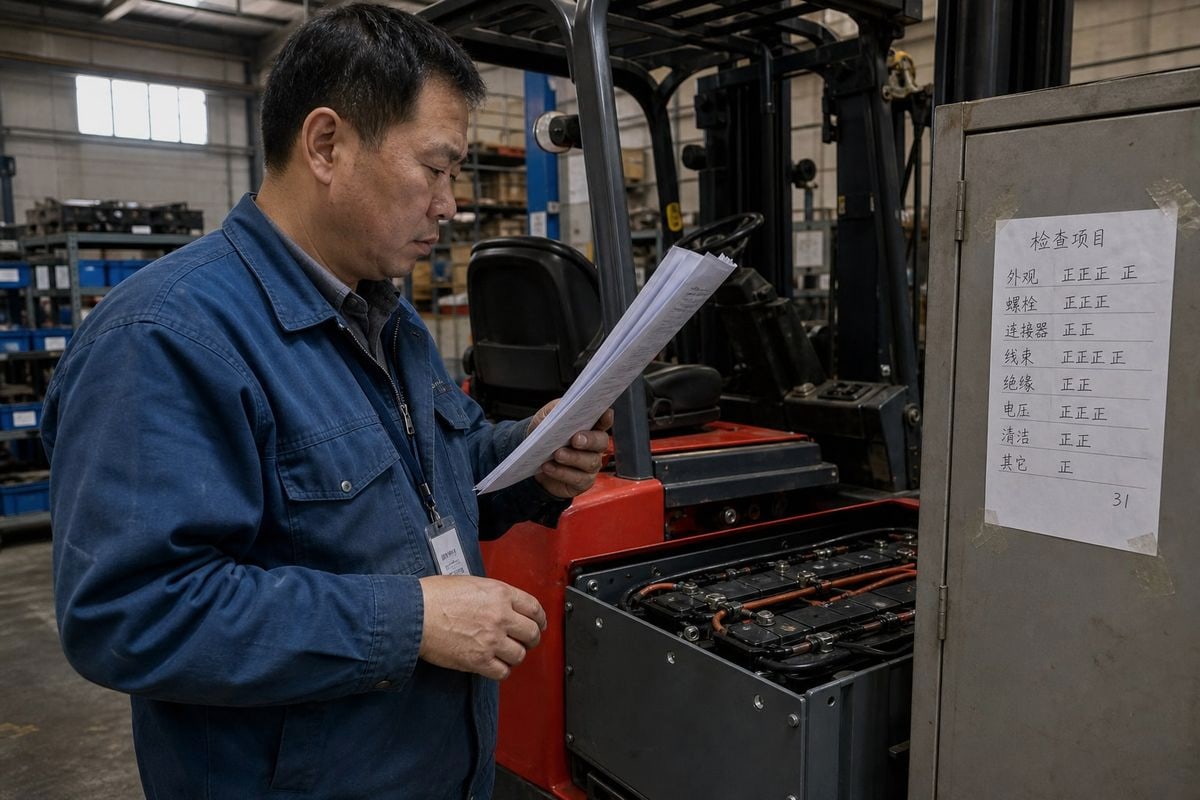
Lithium battery forklifts 4 are not ordinary machinery in the eyes of ocean carriers. Under IMDG regulations 5, they are classified as Class 9 Dangerous Goods. That classification changes everything: the booking process, the paperwork, the carrier acceptance, and the surcharge. We coordinate these lithium-ion battery regulations with suppliers before cargo ever leaves the factory, because fixing battery paperwork at the port is slow and expensive.
Here is the framing I give every new client: if the battery paperwork is wrong, the forklift gets delayed even when the machine itself is perfect. The vessel crossing is the reliable part. The documents are where shipments actually fail. Our freight forwarder services include a pre-departure document audit for exactly this reason. We check that the UN38.3 report matches the actual battery model, that the MSDS is current, and that the charger voltage matches US requirements — a small detail that ruins deliveries when missed.
The trade-off we weigh on every loading plan is simple: more units per container lowers cost per forklift, but overcrowding raises damage risk. Our loading team measures mast height first, because that number decides everything.
A 40FT or 40HQ container typically fits 2–4 counterbalance electric forklifts depending on capacity and mast height, or 6–10+ compact pallet trucks and stackers. Larger counterbalance models often need the mast or overhead guard removed to fit a 40HQ.
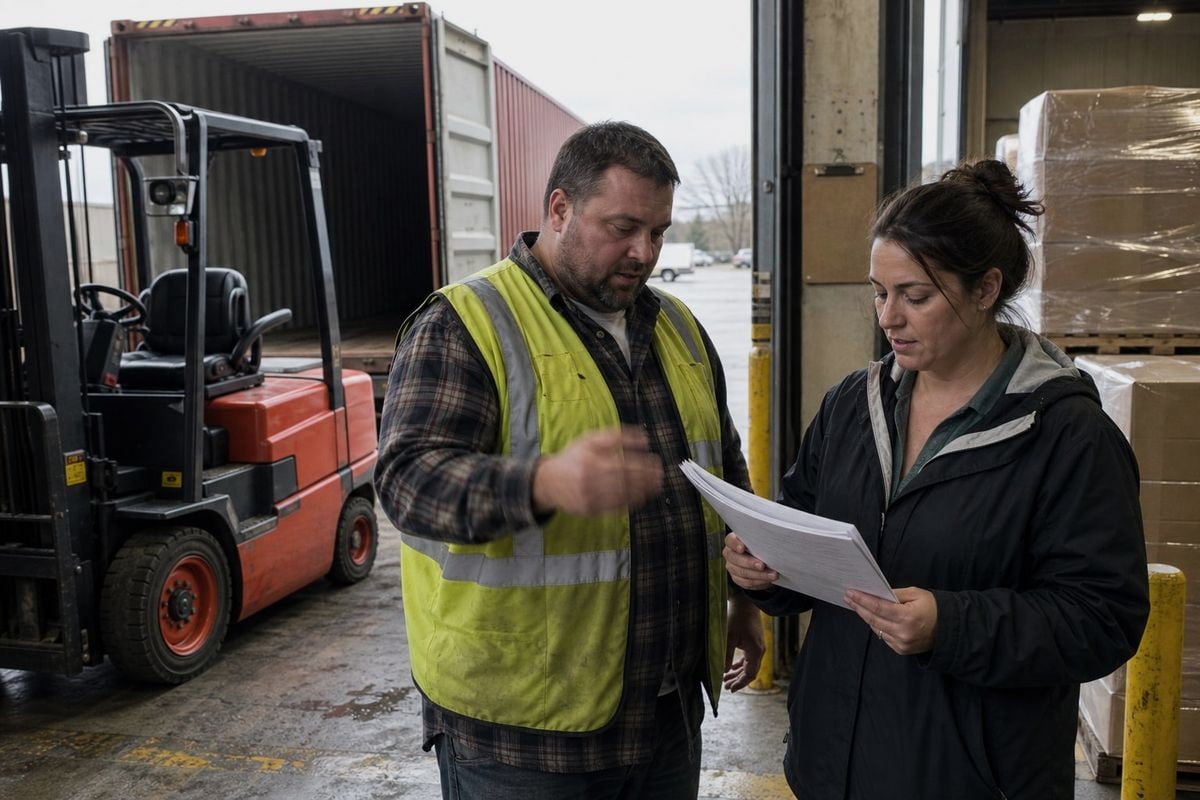
Container planning is where heavy machinery logistics earns its keep. Forklifts are dense, tall, and expensive, so every loading plan balances utilization against safety. In our warehouse consolidation work, we review dimensions, weight, battery specs, and accessories before recommending a container size.
| Equipment Type | 40FT Container | 40HQ Container | Notas |
|---|---|---|---|
| 1.5–2T counterbalance forklift | 2–3 units | 3–4 units | Mast removal often required |
| 3–3.5T counterbalance forklift | 2 units | 2–3 units | Strategic disassembly common |
| Electric pallet trucks | 8–10+ units | 10–12+ units | Stackable with proper crating |
| Electric stackers | 5–7 units | 6–8 units | Mast height is the limit |
| Reach trucks | 2–3 units | 3 units | Tall masts need careful planning |
These are planning figures. Exact counts depend on the specific model, so we always confirm against factory drawings before booking.
Standard counterbalance models frequently exceed container door height. The fix is strategic disassembly: removing the mast or the overhead guard, crating them separately, and reassembling at destination. This is routine work, but it must be coordinated with the factory so the units are drained of hydraulic pressure points correctly and the reassembly hardware is bagged and labeled.
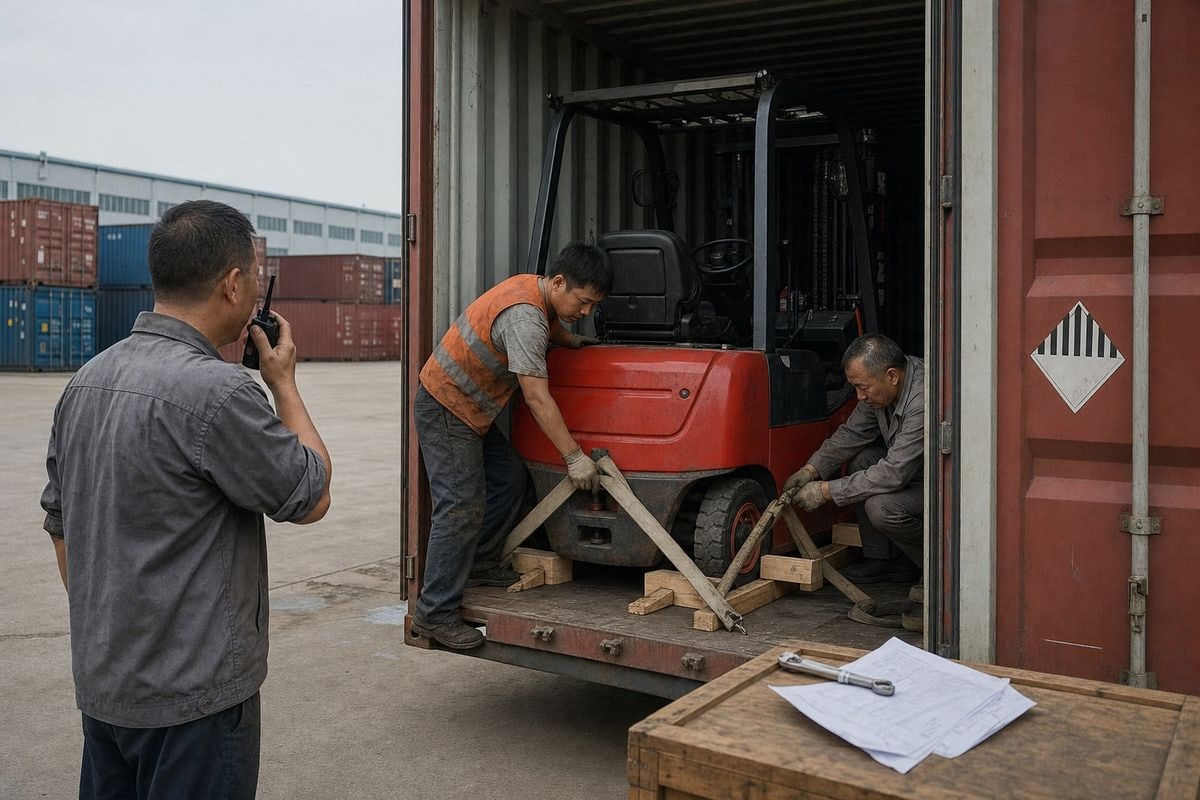
Inside the container, we require blocking, bracing, and lashing on every unit. A 3-ton forklift that shifts during a Pacific crossing will destroy itself and everything near it. We also confirm the battery state of charge before sealing the container, since carriers set limits for lithium packs in transit.
One more tip from our multi-supplier consolidation work: unused container space is free freight. Many of our clients fill gaps with forklift chargers, spare parts, batteries, and attachments from other suppliers. That single decision can cut the average logistics cost per forklift significantly.
A distributor client once insisted on LCL to save money on a single unit. The forklift arrived with a bent mast from co-loaded cargo shifting against it. Since then, my default advice has changed.
Choose FCL for electric forklift shipments whenever possible. FCL protects the mast and hydraulics, avoids extra handling, and costs less per unit for multiple forklifts. LCL suits only small parts and accessories, since shared containers expose heavy equipment to damage from co-loaded cargo.
En FCL vs LCL shipping question comes up in almost every first conversation we have with US importers. Here is the honest comparison, based on what we see across hundreds of shipments.
| Factor | FCL (contenedor completo) | LCL (Consolidation) |
|---|---|---|
| Damage risk | Low — cargo braced, no co-loading | High — mast and hydraulic damage risk |
| Manejo de | Loaded once, sealed until arrival | Multiple touchpoints at CFS warehouses |
| Cost for 2+ forklifts | Cheaper per unit | Usually more expensive per unit |
| Cost for 1 forklift | Higher upfront | Sometimes cheaper, but risky |
| DG acceptance | Straightforward with carrier | Many consolidators refuse Class 9 cargo |
| Transit predictability | Direct routing | Extra consolidation delays |
LCL is not useless. We use LCL consolidation regularly — for chargers, spare parts, small crated attachments, and accessories. Those items tolerate handling well. But a full-size electric forklift with a lithium battery is a different animal. Many consolidators will not even accept Class 9 dangerous goods in a shared container, which quietly removes LCL as an option for most lithium battery forklifts anyway.
Some buyers ask about the Ro-Ro shipping method, which works for drivable machinery on certain routes. For forklifts from China to the USA, containerized FCL remains the dominant and most practical choice, with flat rack reserved for oversized units. Air freight is technically possible for compact equipment, but the cost is prohibitive and lithium battery rules restrict it heavily.
Plan around these numbers: US West Coast arrivals typically take 18–25 days on the water, while East Coast ports require 35–45 days. But the ocean leg is the fast part. From confirmed purchase order to warehouse delivery, expect roughly 10–16 weeks total once you include production, compliance review, booking, loading, the customs clearance process, and inland delivery. Buyers who confuse transit time with total lead time end up disappointing their own customers.
Shipping electric forklifts from China is a compliance project, not just a freight booking. Get the battery documents, HS classification, container plan, and ISF timing right, and delivery becomes predictable. Contact Max at [email protected] for a landed-cost quotation.
1. U.S. Department of Commerce guide detailing import tariffs and trade regulations for goods originating from China. ↩︎
2. Authoritative government guide on China's industrial market challenges and manufacturing landscape. ↩︎
3. Official CBP page detailing the implementation and enforcement of Section 301 tariffs on Chinese goods. ↩︎
4. Official OSHA safety standards and operational requirements for powered industrial trucks including electric forklifts. ↩︎
5. International Maritime Organization standards for the safe maritime transport of dangerous goods and hazardous materials. ↩︎



