- +8618603825129
- [email protected]

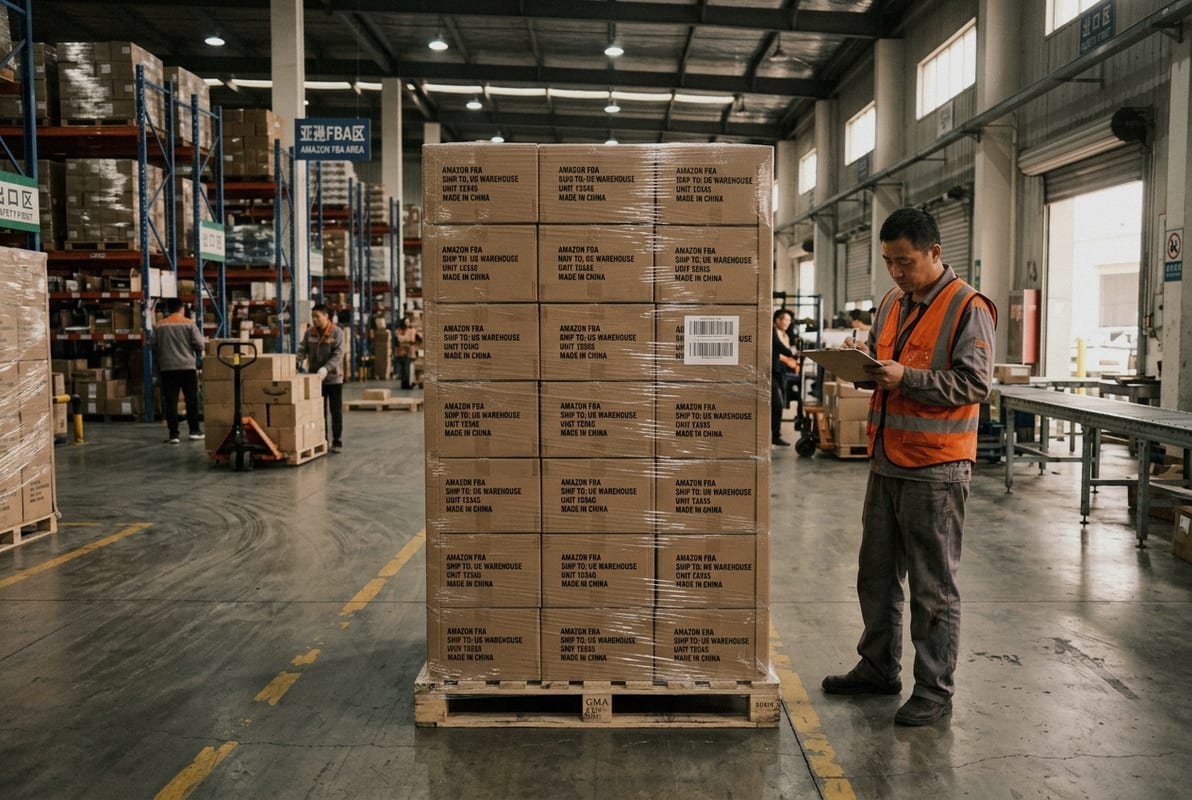
Last month, a client in Ohio had an entire truckload refused at an Amazon fulfillment center because his pallets were wrapped in black stretch film — a small detail that cost him thousands in return freight and storage fees.
Amazon FBA inbound pallet requirements mandate 40x48 inch GMA standard wooden pallets with four-way entry, a maximum height of 72 inches, a weight limit of 1,500 lbs, clear stretch wrap, and FBA pallet labels on all four sides — non-compliance leads to immediate rejection at the warehouse.
This guide breaks down every detail you need — pallet size, material, labeling, stacking, and regional differences — so your next shipment sails through receiving without a hitch.
One lesson we learned early in our logistics operations 1 was that "close enough" never works with Amazon DDP shipping partner 2. A client once shipped goods on 42x42 inch pallets sourced cheaply from a local supplier in Guangzhou, and every single one was turned away at the US fulfillment center gate.
Amazon's US marketplace requires standard 40x48 inch wooden pallets rated GMA Standard Grade B or higher, with four-way forklift entry. Plastic, cardboard, and particle board pallets are prohibited. The pallet must be in good condition with no cracks, mold, or protruding nails.
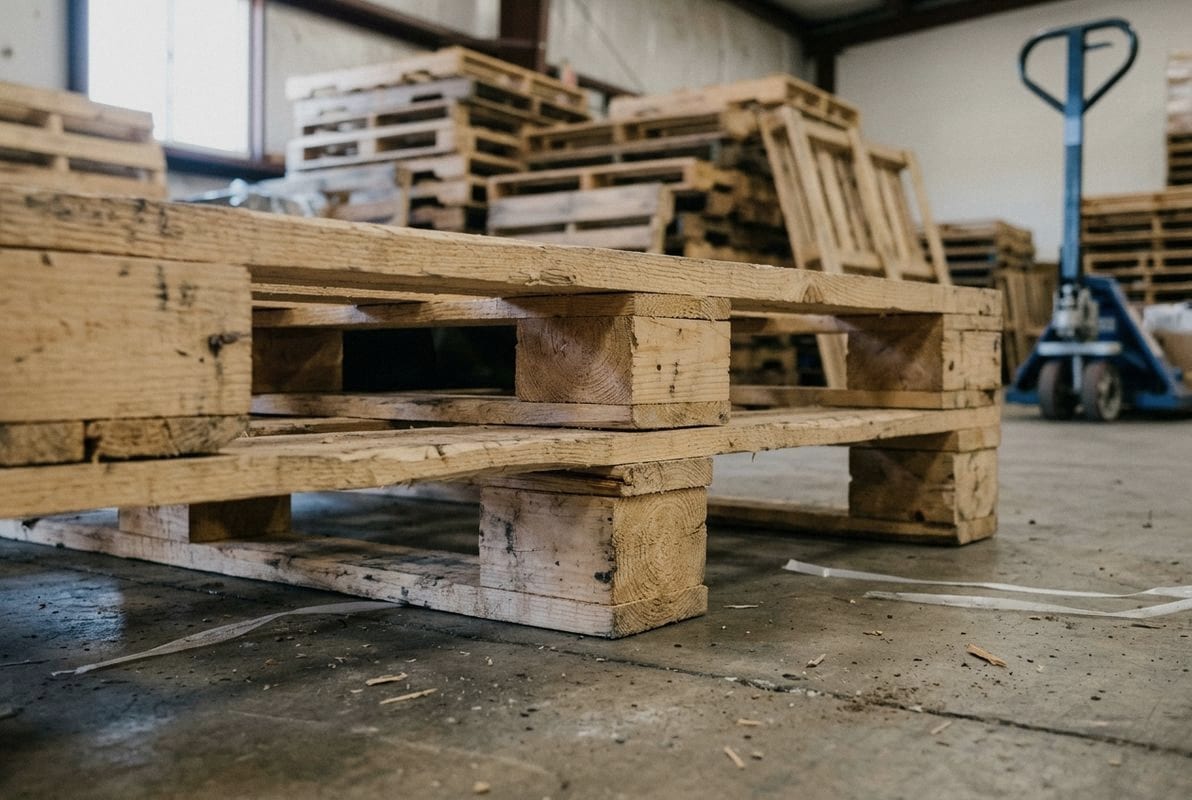
En 40x48 inch pallet 3 is the universal standard for Amazon's US fulfillment centers. This is the same GMA standard pallet 4 used across American retail and warehousing. Amazon insists on Grade B or higher. That means no broken deck boards, no missing blocks, and no visible rot or water damage.
The pallet height limit is 72 inches total. That includes the pallet base itself, which is typically about 6 inches. So your stacked boxes can only reach about 66 inches. The pallet weight limit is 1,500 lbs including the pallet. However, there is a distinction between stackable and non-stackable pallets. Non-stackable pallets can weigh up to 1,500 lbs (about 680 kg). Stackable pallets should stay under 750 lbs (about 340 kg) each.
If you are shipping a single oversized unit that cannot fit on a standard pallet without overhang, Amazon allows a custom-sized pallet. But this is the only exception. Do not assume it applies to regular carton shipments.
When we handle multi-marketplace shipments — say a seller restocking in the US, Canada, and UK simultaneously — the regional differences in pallet specs become critical. Here is a quick reference:
| Requisito | US | REINO UNIDO | EU (excl. UK) | Japón | Australia |
|---|---|---|---|---|---|
| Pallet Size | 40 x 48 in (101.6 x 122 cm) | 100 x 120 cm | 80 x 120 cm (Euro/CHEP) | 110 x 110 cm | 116.5 x 116.5 cm or 121 x 101 cm |
| Material | Wood only | Wood only | Wood (standard or Euro) | Wood | Wood |
| Max Height (incl. pallet) | 72 in (182.5 cm) | 170 cm | 150 cm | 160 cm (150 cm for NRT1) | 180 cm |
| Max Weight | 1,500 lbs (680 kg) | 500 kg | 500 kg | 1,000 kg | 680.4 kg |
| Four-Way Entry | Required | Required | Required | Required | Required |
| Double Stack Allowed | Yes (max 100 in) | Yes (height varies) | Yes (height varies) | Check locally | Check locally |
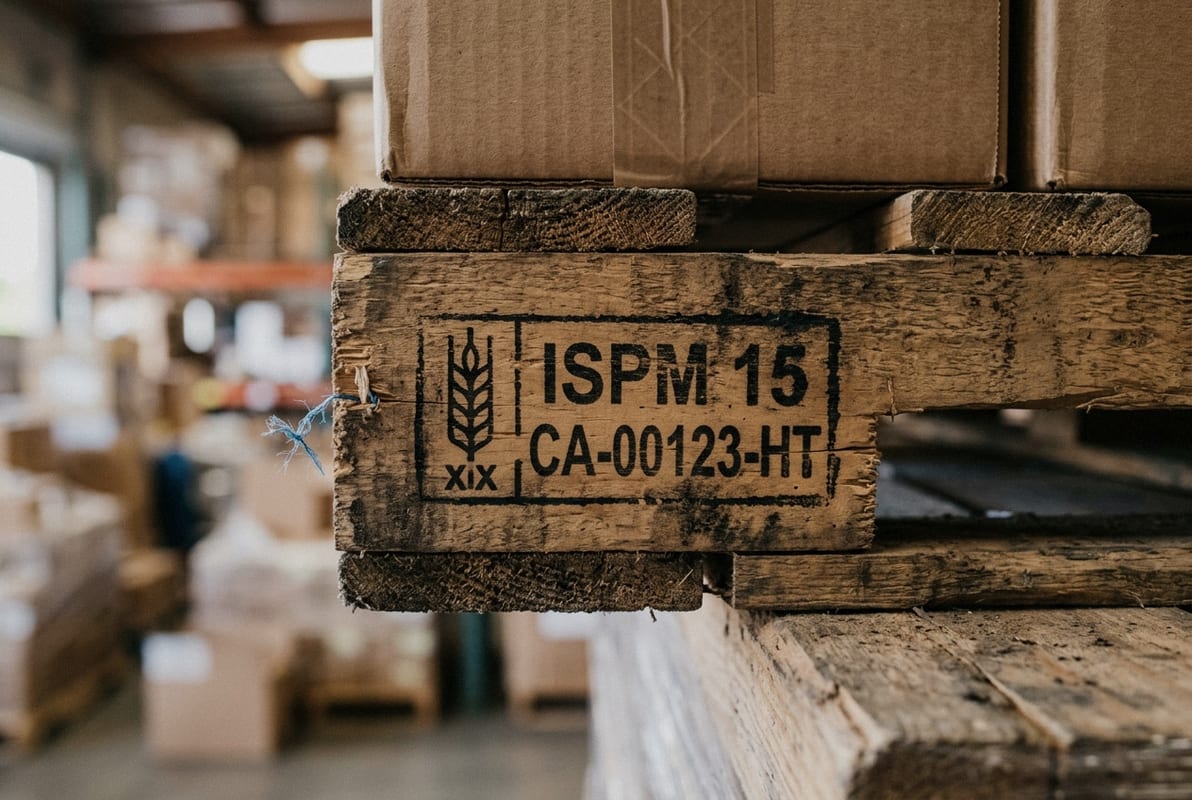
Every wooden pallet crossing an international border must meet the ISPM 15 standard 5. This means the wood has been heat-treated or fumigated to kill pests, and stamped with the official ISPM 15 mark. We have seen shipments held at US ports for weeks because the fumigation stamp was missing or illegible. The port then charges for re-treatment and storage. Those costs fall entirely on the seller. When we prepare pallets at our warehouse in Zhengzhou, ISPM 15 compliance is a non-negotiable step in our process.
This is a common mistake. Some suppliers in China use two-way entry pallets because they are cheaper. Amazon requires four-way entry pallets 6 so forklifts can approach from any direction. If your pallet only has openings on two sides, it will be refused. Always confirm this with your supplier or freight forwarder before shipping.
A buyer we work with regularly told me he lost three days of receiving time because one of his pallet labels was printed on an inkjet printer and smeared during transit. The barcode was unreadable. Amazon set the pallet aside and charged him for manual processing.
Each FBA pallet must display shipment labels on all four sides, affixed on the outside of the clear stretch wrap. Every box on the pallet also needs its own unique FBA Box ID label. As of January 1, 2026, Amazon no longer provides prep or labeling services in the US — sellers must handle all labeling themselves.
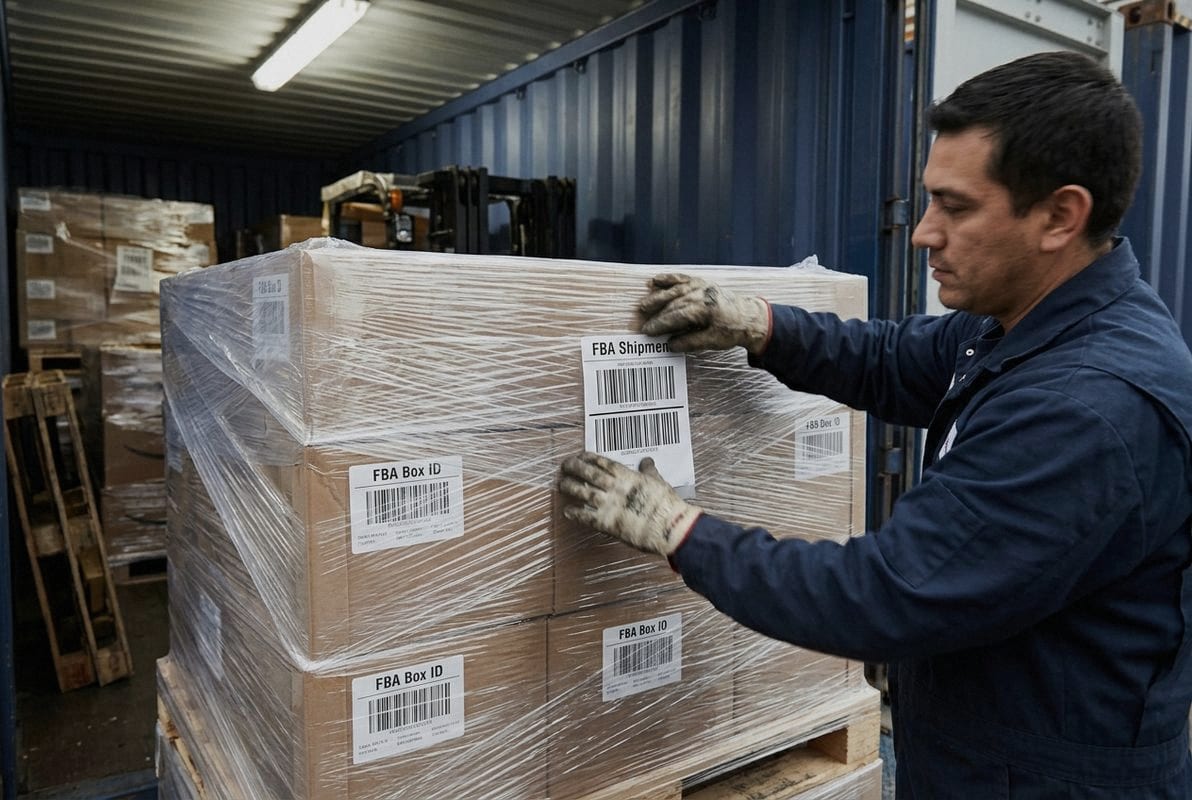
There are multiple label types, and each serves a different purpose. Here is a breakdown:
| Label Type | Where to Place It | How Many | Key Details |
|---|---|---|---|
| Etiqueta de envío FBA | Top center of each pallet side | 4 (one per side) | Contains Shipment ID, warehouse code, tracking info |
| FBA Pallet ID Label | All four sides, outside stretch wrap | 4 | Unique to each pallet; scannable barcode |
| FBA Box ID Label | On each individual carton | 1 per box | Unique per box; must match Seller Central shipment plan |
| FNSKU Product Barcode | On each individual product unit | 1 per unit | Identifies the specific SKU inside the box |
| Single ASIN Pallet Label | Any visible side | 1+ | Required if the pallet contains only one ASIN |
| Mixed SKU Label | Any visible side | 1+ | Required if the pallet contains multiple SKUs |
Starting January 1, 2026, Amazon eliminated its FBA prep and labeling service in the US. This is a major change. Previously, sellers could pay Amazon to label their products and boxes. Now, every FNSKU barcode 8, every box label, and every pallet label must be applied before the shipment arrives at the fulfillment center.
This means your workflow must include labeling at the origin — either at your supplier's factory, at a prep center, or through your logistics partner. In our operations, we handle labeling at our consolidation warehouse. We print labels using laser printers, which produce crisp, smudge-proof barcodes. Inkjet-printed labels can blur when they get damp, and Amazon's scanners cannot read them.
Labels must be flat. No wrinkles, no folds. Do not place a label across the seam where two boxes meet — the scanner cannot read it if the surface is uneven. Labels must not be covered by tape or stretch wrap layers that distort the barcode. That is why Amazon requires pallet labels on the outside of the wrap.
Each label should be printed at 8.5 x 11 inch format. The barcode must be clearly scannable. Place it squarely — not angled, not sideways.
Never put boxes from different shipment IDs on the same pallet. Each pallet must correspond to a single shipment plan created in Seller Central. If you mix shipment IDs, the entire pallet will be rejected. I have seen this happen when sellers rush to consolidate multiple orders into one LTL shipping load. Take the extra time to sort correctly.
The trade-off between speed and precision during palletization is something we think about every day at our warehouse. Rushing to stack boxes saves an hour on the dock. But a single rejected pallet can cost a seller a week of delay and hundreds of dollars in fees.
Stack heavy boxes on the bottom and lighter ones on top. All boxes must sit flush with the pallet edges — no overhang allowed. Wrap the entire pallet tightly with clear plastic stretch wrap. Never use opaque, black, or colored wrap. Pyramid stacking is prohibited because it causes collapse during transit.
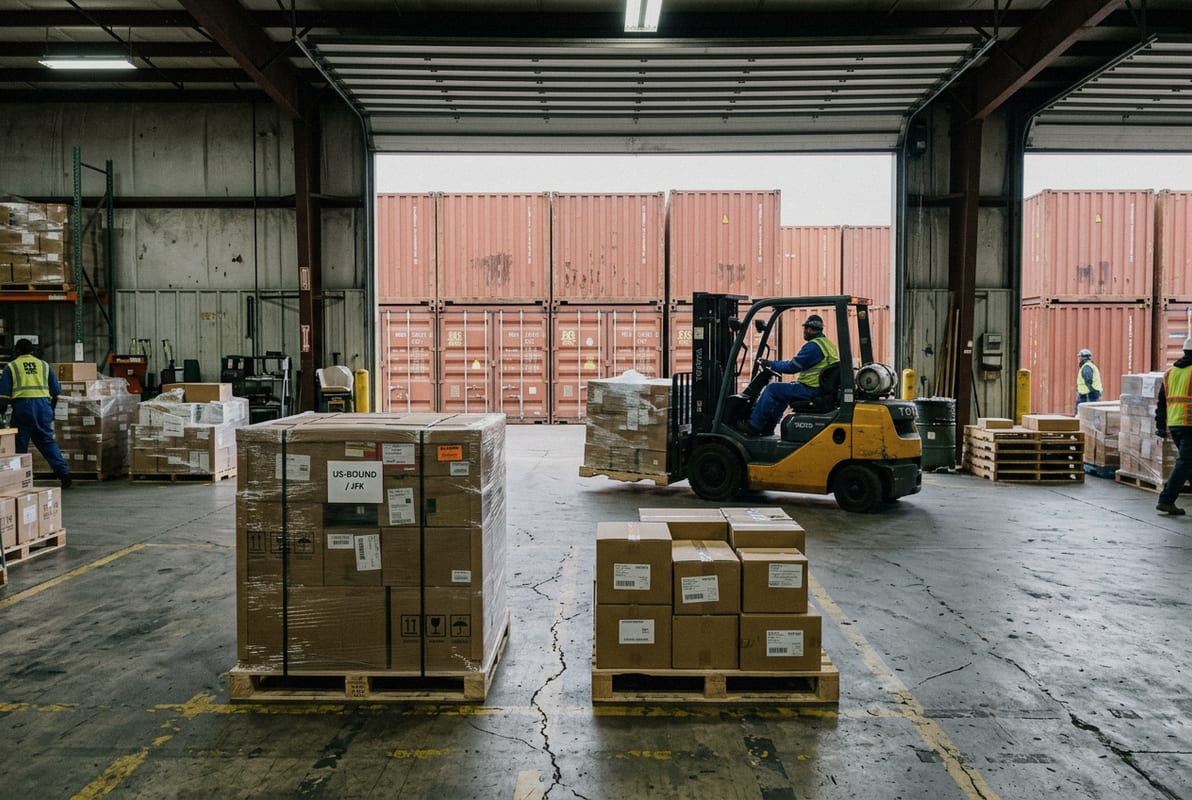
This is one of the most common reasons for rejection. Boxes that stick out past the pallet edge — even by one inch — create instability and prevent proper stacking in Amazon's warehouse. The US site enforces this strictly. Some European sites allow up to 2.5 cm of overhang, but I would not push it. Plan your carton sizes so they tile neatly onto the pallet footprint.
Here is a step-by-step process we follow:
| Requisito | Especificación |
|---|---|
| Wrap Material | Clear plastic stretch wrap 9 (cling film) |
| Prohibited Materials | Black wrap, colored wrap, opaque wrap, rubber bands, rope, straps |
| Application | Wrap tightly around all boxes and the pallet base |
| Visibility | Labels and barcodes must be visible through or on top of the wrap |
| Special Sticker | Apply "Do Not Break Stretch Wrap" notice on the outside |
Opaque wrap is banned because Amazon's receiving team needs to visually verify the contents and scan labels through the wrap. We always use industrial-grade clear stretch film and apply at least four to five layers around the load. The wrap should also anchor to the pallet base itself so the boxes do not shift during trucking.
If your pallet holds multiple products that look similar but have different SKUs, you must label it clearly as "Mixed SKU" or "Mixed ASIN." Separate different SKUs by layer. Use cardboard dividers between groups. Each outer carton still needs its own FNSKU barcode — the pallet label does not replace individual box labels.
Amazon does not negotiate on pallet compliance. If your pallet fails inspection, it gets refused. The truck driver hauls it back. You pay round-trip freight. You pay dock storage. If Amazon decides to fix the pallet for you, they charge a steep manual processing fee. Multiple violations can trigger a suspension of your FBA inbound shipping privileges. We have helped clients recover from this situation, and it is always more expensive than doing it right the first time.
When loading pallets into a container or trailer for LTL shipping or full truckload, leave at least 6 inches of clearance between the top of the pallet and the trailer ceiling. Leave 3 inches of space between adjacent pallets. This prevents crushing and allows airflow.
Also note: as of September 2024, full truckload and intermodal shipments to Amazon must be sealed with ISO 17712-compliant RFID seals 10. Amazon provides approved seals. Using non-compliant seals can result in your shipment being turned away at the gate.
A client based in the US needed to restock Amazon warehouses in the US, Canada, and the UK at the same time. Three different marketplaces, three different pallet standards, three different label formats. He asked us to handle it all — labeling, palletization, wrapping, and shipping. We did, and every shipment cleared receiving on the first attempt.
A DDP shipping partner with Amazon FBA expertise can handle palletization, labeling, stretch wrapping, and compliance at origin — before your goods leave China. This eliminates rejections, avoids rework fees, and ensures your inventory reaches fulfillment centers without delays or hidden costs.
If you wait to palletize at a US warehouse or prep center, you add cost and time. A freight forwarder who understands Amazon's inbound requirements can build compliant pallets in China, at the point of consolidation. This is exactly what we do at MBMLOG. Our team in Zhengzhou receives goods from your supplier, inspects them, applies FNSKU labels and box labels, stacks cartons to Amazon spec, wraps them in clear stretch film, and affixes pallet labels on all four sides.
By the time the shipment reaches the US, it is ready to go straight to the fulfillment center. No re-palletization. No scrambling to print labels at a domestic prep center.
Our DDP (Delivered Duty Paid) service covers the entire chain:
| Escenario | Estimated Cost Impact |
|---|---|
| Pallet rejected, truck returns | $500–$1,500+ in round-trip freight and dock fees |
| Amazon re-palletizes for you | $50–$150+ per pallet in manual handling fees |
| Shipment held at port (no ISPM 15 stamp) | $300–$800+ in fumigation and storage |
| Multiple violations — FBA shipping privileges suspended | Lost sales, ranking drops, inventory shortages |
| Compliant pallets prepared at origin by DDP partner | Included in service fee — no surprise charges |
Amazon's inbound placement fee structure rewards sellers who ship at least five identical cartons or pallets per item. When we plan a shipment, we work with the seller to structure the load so it qualifies for Amazon-optimized inbound routing. This can significantly reduce placement fees. It requires coordination between the seller's Seller Central shipment plan and our physical packing process — something we manage through direct communication and real-time tracking updates.
Not every freight forwarder understands Amazon's requirements. A general shipping company will move your cargo from point A to point B. But they may not know that Amazon requires single ASIN pallet labels, or that box labels cannot cross carton seams, or that an LTL shipment cannot exceed 5,000 boxes. At MBMLOG, Amazon FBA shipping is a core part of our daily operations. We keep up with policy changes — like the 2026 self-labeling mandate and the RFID seal requirement — so our clients do not have to scramble when rules shift.
Our transit times from China to the US typically run 18 to 25 days door to door. Our English-speaking support team is available around the clock. And because we handle customs clearance on both ends, there is one point of contact for the entire journey.
Amazon FBA inbound pallet requirements are strict, detailed, and vary by marketplace — but full compliance is achievable when you plan ahead and work with an experienced DDP logistics partner like MBMLOG.
1. Replaced with a comprehensive explanation of logistics operations from a reputable source. ↩︎
2. Defines Delivered Duty Paid (DDP) Incoterms and the responsibilities of the seller. ↩︎
3. Details the dimensions and common usage of the 40x48 inch pallet standard. ↩︎
4. Explains the specifications and common usage of GMA standard pallets in the US. ↩︎
5. Provides a comprehensive overview of the international standard for wood packaging material. ↩︎
6. Explains the design and advantages of four-way entry pallets for material handling. ↩︎
7. The original URL returned a 404 and now redirects to the main Amazon selling page, which is the most appropriate working URL for 'Seller Central'. ↩︎
8. Explains what an FNSKU barcode is and its importance for Amazon FBA sellers. ↩︎
9. Describes the material and purpose of clear plastic stretch wrap for securing pallet loads. ↩︎
10. Explains the standard for high-security container seals and the integration of RFID technology. ↩︎