- +8618603825129
- [email protected]


Every week, our logistics team handles dozens of urgent calls from sellers whose shipments got held at customs or hit with surprise fees HS codes 1. These are costly mistakes, but they are preventable.
To avoid customs delays, dimensional weight surcharges, and prohibited item seizures with DHL, UPS, and FedEx, you must verify accurate documentation with correct HS codes, optimize packaging to minimize volumetric weight, and cross-check every product against each carrier's restricted and prohibited item lists before booking your shipment.
This guide breaks down every major pitfall we see in China-to-USA shipping and gives you clear, carrier-specific steps to protect your budget and your inventory five-layer corrugated cartons 2. Let's get into it.
In our experience shipping thousands of DDP parcels 3 from Zhengzhou to Amazon warehouses across the US, customs holdups almost always trace back to paperwork errors or unrealistic declared values.
To keep DDP shipments moving through customs, provide complete English-language commercial invoices with accurate product descriptions, correct HS codes, truthful declared values, and full recipient details including company name, phone number, and ZIP code. Work only with a logistics partner who handles both origin and destination clearance.
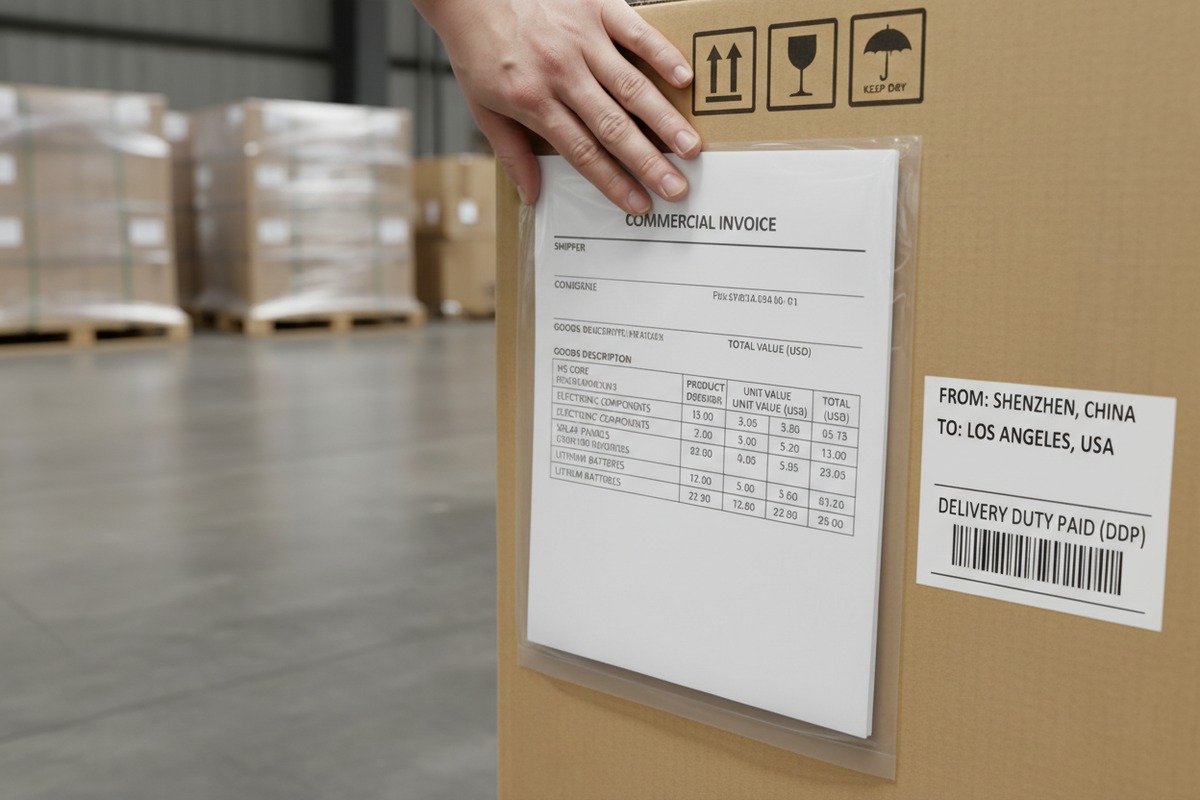
Customs agencies exist to collect duties, enforce trade laws, and block dangerous or counterfeit goods UN38.3 test report 4. When your paperwork is incomplete or suspicious, your shipment gets flagged for manual review. That review can take days or even weeks.
Here are the most common triggers we see:
Many sellers think DDP means zero surprises. But not all DDP quotes are created equal. Some providers exclude certain fees from their DDP price. Here is what to watch for:
| Fee Type | What It Is | Who Typically Pays |
|---|---|---|
| Import Duty | Tax based on HS code and declared value | Included in true DDP |
| Merchandise Processing Fee | U.S. CBP fee on formal entries (>$2,500) | Often hidden |
| Harbor Maintenance Fee | Applies to ocean freight shipments | Sometimes excluded |
| Customs Exam Fee | Random or targeted inspection by CBP | Varies by provider |
| Storage Fees | Charged if goods sit at port/warehouse | Rarely included |
| Address Correction Fee | Triggered by wrong recipient details | Shipper's responsibility |
For shipments valued above $600, we strongly recommend purchasing cargo insurance 7. The small premium is nothing compared to a total loss.
When our warehouse team packs orders, they know that a poorly sized box can cost a client more than the product itself. Dimensional weight 8 is one of the biggest hidden budget killers in international express shipping.
To prevent dimensional weight surcharges, measure every package before shipping, calculate volumetric weight using the formula length × width × height (cm) ÷ 5000, compare it to actual weight, and always use the smallest box that safely protects your product. Right-sizing packaging is the single most effective cost-saving action.
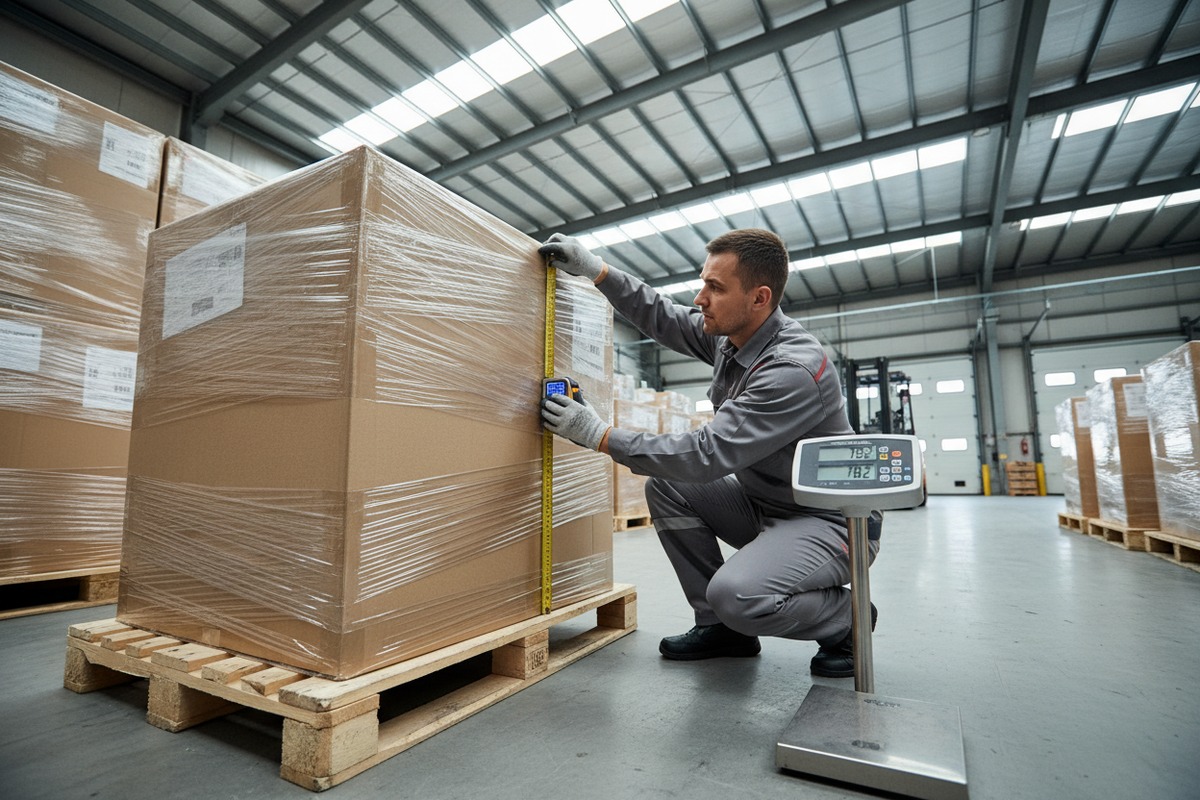
All major carriers — DHL, UPS, and FedEx — charge based on whichever is greater: actual weight or dimensional (volumetric) weight. This means a large, lightweight box costs more than you expect.
The standard formula for international air express 9 is:
Dimensional Weight (kg) = Length (cm) × Width (cm) × Height (cm) ÷ 5000
Let's say you ship a box of plush toys. The box measures 60 cm × 40 cm × 50 cm. Actual weight: 3 kg.
Dimensional weight: 60 × 40 × 50 ÷ 5000 = 24 kg
You will be billed for 24 kg, not 3 kg. That difference can add $60 or more to a single parcel.
The divisor changes depending on the transport mode. Here is a quick reference:
| Shipping Mode | DIM Factor (Divisor) | Example: 120×75×60 cm box |
|---|---|---|
| International Air Express (DHL/UPS/FedEx) | 5,000 | 108 kg |
| Air Freight (General) | 6,000 | 90 kg |
| Rail Freight | 3,000 | 180 kg |
| Sea Freight (LCL) | 1,000 | 540 kg |
As you can see, air express is the most aggressive on dimensional weight. This is exactly why packaging optimization matters so much for DHL, UPS, and FedEx shipments.
Beyond dimensional weight, carriers impose additional fees that catch many sellers off guard:
| Surcharge Type | Trigger | Typical Cost Range |
|---|---|---|
| Overweight Fee | Single piece exceeds carrier weight limit | $15–$75+ per piece |
| Overlength Fee | Any single side exceeds length limit | $20–$90+ per piece |
| Remote Area Surcharge | Delivery ZIP code is in a rural/remote zone | $3–$30+ per piece |
| Residential Delivery Fee | Delivery to a home address, not commercial | $4–$8 per piece |
| Stackable/Non-stackable Fee | Pallet cannot be stacked in transit | Very high, varies |
Our team always pre-measures and pre-weighs every package in our Zhengzhou warehouse before booking. This way, you see the exact billable weight before the shipment leaves China. No surprises.
Before we book a single shipment at our facility, the first checkpoint is always product verification. Liquids, powders, pastes, pure batteries, magnets, flammables, knives, medicines, counterfeit goods, food, and live organisms are almost universally rejected by DHL, UPS, and FedEx.
Check each carrier's official prohibited and restricted items list before shipping. DHL, UPS, and FedEx maintain detailed online databases. Common banned items include pure lithium batteries, flammable liquids, weapons, counterfeit goods, narcotics, and live animals. Products with built-in batteries require MSDS and UN38.3 certification, plus lithium battery labels on the outer box.
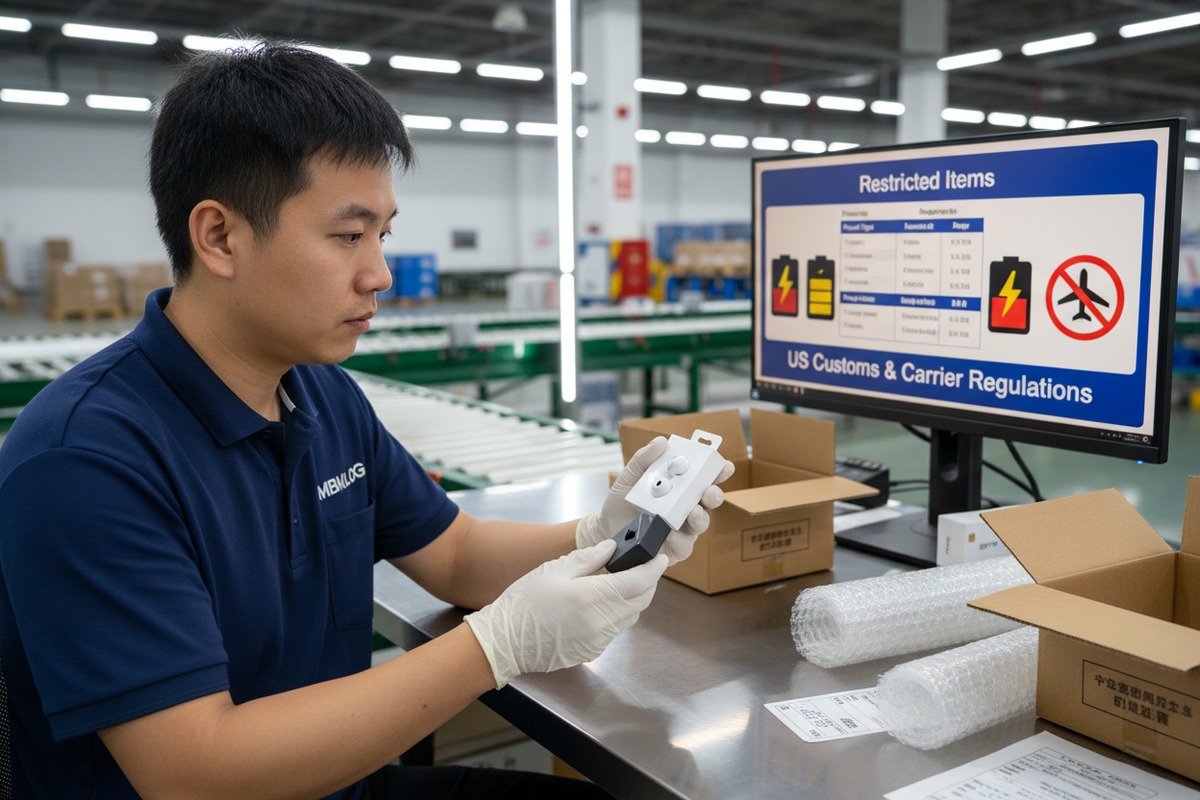
Prohibited items cannot be shipped under any circumstances. Restricted items can be shipped, but only with proper documentation, special packaging, or permits.
For example, a product containing a small built-in lithium battery (like a Bluetooth speaker) is restricted, not prohibited. You can ship it — but only if you provide:
Pure lithium batteries (not installed in a device) are prohibited by most express carriers on most routes.
Here is a quick-reference table of commonly prohibited and restricted items across the three major carriers:
| Item Category | DHL | UPS | FedEx |
|---|---|---|---|
| Pure Lithium Batteries | Prohibited | Prohibited | Prohibited |
| Built-in Lithium Batteries | Restricted (docs required) | Restricted (docs required) | Restricted (docs required) |
| Flammable Liquids/Gases | Prohibited | Prohibited | Prohibited |
| Knives / Weapons | Prohibited | Prohibited | Prohibited |
| Narcotics / Controlled Drugs | Prohibited | Prohibited | Prohibited |
| Counterfeit / Replica Goods | Prohibited | Prohibited | Prohibited |
| Live Animals | Prohibited | Prohibited | Prohibited |
| Tobacco / Vapes | Restricted (country-specific) | Prohibited (US domestic) | Restricted |
| Jewelry (high value) | Restricted (>$100 to US) | Restricted (>$1,000) | Restricted (>$1,000) |
| Ivory / Shark Fins | Prohibited | Prohibited | Prohibited |
| Fireworks / Explosives | Prohibited | Prohibited | Prohibited |
| CBD / Marijuana Products | Prohibited | Prohibited | Prohibited |
| Food / Perishables | Restricted (route-specific) | Restricted | Restricted |
| Currency / Bullion | Prohibited | Prohibited | Prohibited |
Do not assume you can slip something past security. Carriers use X-ray scanning, physical inspections, and even odor detection at their sorting hubs. Suspicious package shapes, unusual weight-to-size ratios, and incomplete descriptions all trigger closer examination.
If a prohibited item is found:
Our team ships to Amazon FBA warehouses across the US every single day. We have learned that FBA compliance failures — wrong labels, oversized boxes, missing appointment bookings — cause just as many delays as customs issues do.
To avoid delays when shipping to Amazon FBA, follow Amazon's strict labeling, packaging, and delivery appointment requirements exactly. Use a logistics partner experienced in FBA prep, ensure each box meets Amazon's weight and dimension limits, book delivery appointments in advance, and confirm your shipment plan in Seller Central before the cargo leaves China.
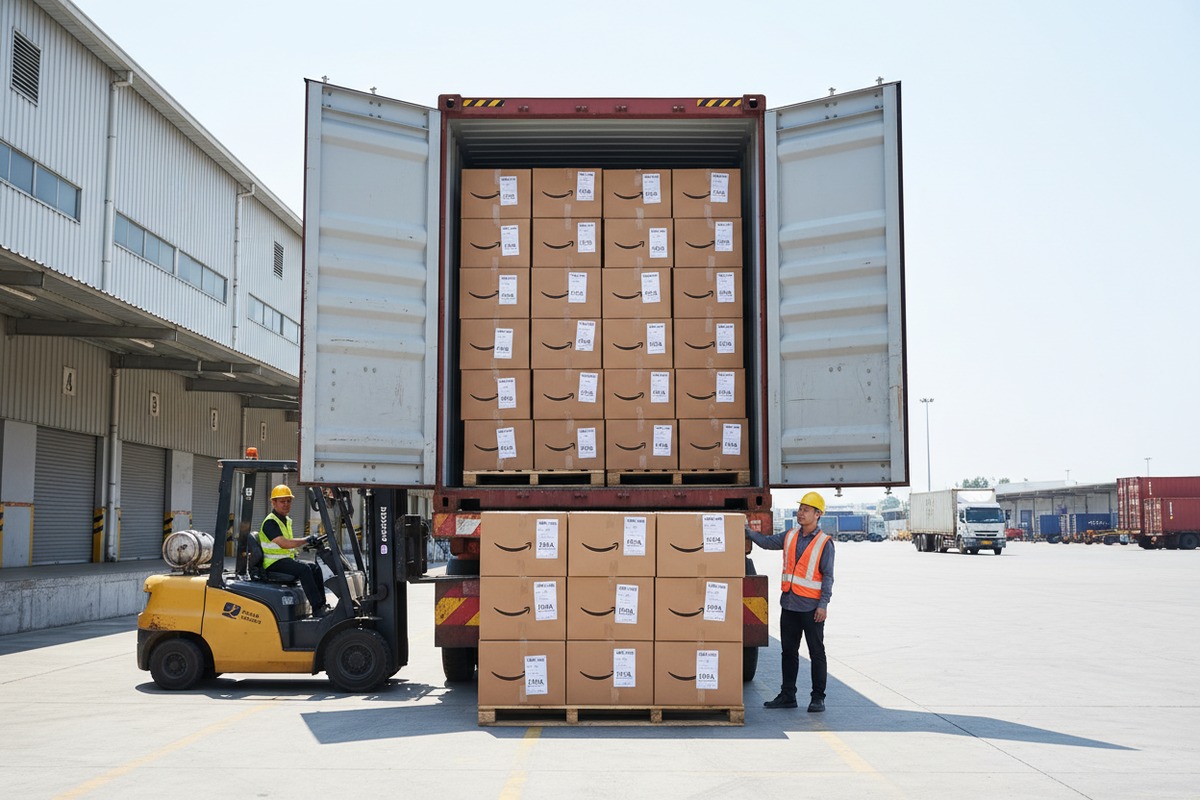
Clearing customs is only half the battle. Amazon warehouses reject shipments that do not meet their prep and delivery standards. Here are the most frequent FBA-related problems we help clients avoid:
Each carrier handles last-mile delivery to Amazon differently. Here is what we have observed:
| Factor | DHL | UPS | FedEx |
|---|---|---|---|
| FBA Delivery Appointment | Requires coordination via freight forwarder | Can book directly for LTL | Can book directly for LTL |
| Small Parcel to FBA | Accepted (SPD shipments) | Accepted (SPD shipments) | Accepted (SPD shipments) |
| Palletized LTL to FBA | Needs third-party trucking partner | Direct LTL available | Direct LTL available |
| Remote FBA Warehouse Access | May incur surcharge | Generally included | Generally included |
| Tracking Integration with Seller Central | Manual entry often needed | API integration available | API integration available |
Before your shipment leaves our warehouse, we verify:
Even experienced sellers overlook simple things. Make sure the product itself is not directly exposed inside the carton. Each item needs its own poly bag or inner box. Fragile products need bubble wrap or foam inserts. The outer carton should be a sturdy five-layer corrugated box — never a reused, crushed, or soft box.
Also, remember that international express carriers default to the recipient paying duties. If you want DDP (duties paid by the shipper), you must specify this in advance and work through a DDP channel. Our MBMLOG DDP service handles all of this so you never get an unexpected duty bill — or worse, have Amazon refuse a COD duty payment at the warehouse door.
Lastly, keep communication lines open. Delays happen. Weather, port congestion, and random customs exams are part of international logistics. The difference between a minor hiccup and a major disaster is how quickly your logistics partner communicates and resolves the issue. That is why our team provides real-time tracking and proactive updates on every shipment.
Customs paperwork, dimensional weight, prohibited items, and FBA compliance are all solvable problems when you prepare properly and work with a logistics partner who handles these details daily.
1. Authoritative government source on HS codes. ↩︎
2. Details the construction and benefits of five-layer corrugated cartons for packaging. ↩︎
3. Explains Delivered Duty Paid (DDP) Incoterms, relevant for international shipping responsibilities. ↩︎
4. Explains the UN38.3 standard for lithium battery transportation safety testing. ↩︎
5. Provides a comprehensive overview of the Harmonized System for product classification. ↩︎
6. Explains the threshold and its recent suspension. ↩︎
7. Defines cargo insurance and its importance for protecting goods during transit. ↩︎
8. Explains dimensional weight calculation and its impact on shipping costs. ↩︎
9. Provides a general definition and context for international air express shipping. ↩︎
10. Official definition and purpose of a Material Safety Data Sheet (MSDS). ↩︎