
- +8618603825129
- [email protected]


Every week, our logistics team in Zhengzhou processes hundreds of shipments headed to Amazon FBA warehouses across the United States Sea freight LCL 1. One question keeps coming back from our clients: why does the freight invoice show a different number than what the bathroom scale says? This confusion has cost sellers thousands of dollars in unexpected charges. The problem is real, the frustration is valid, and the solution starts with understanding how carriers turn your cargo dimensions into billable units.
Carriers calculate chargeable weight by comparing actual gross weight against volumetric weight and billing the higher value. Sea freight LCL uses CBM as the billing unit, air freight divides dimensions by 6,000, and express shipping often divides by 5,000. Each mode applies a different formula, so the same box produces different charges.
Below, we break down the exact formulas, walk through real examples, and explain the exceptions that catch most shippers off guard. Let's get into it section by section.
When we prepare export documents at our Zhengzhou warehouse, one of the first things we calculate is whether a shipment is "heavy cargo 2" or "light cargo." Getting this wrong means your cost estimate is off before the container even leaves port.
Your China-to-USA shipment will be billed by actual weight if the cargo is dense and heavy relative to its size. It will be billed by volumetric weight if the cargo is bulky but light. Carriers always compare both values and charge whichever is greater, ensuring they are compensated for the space your goods occupy.
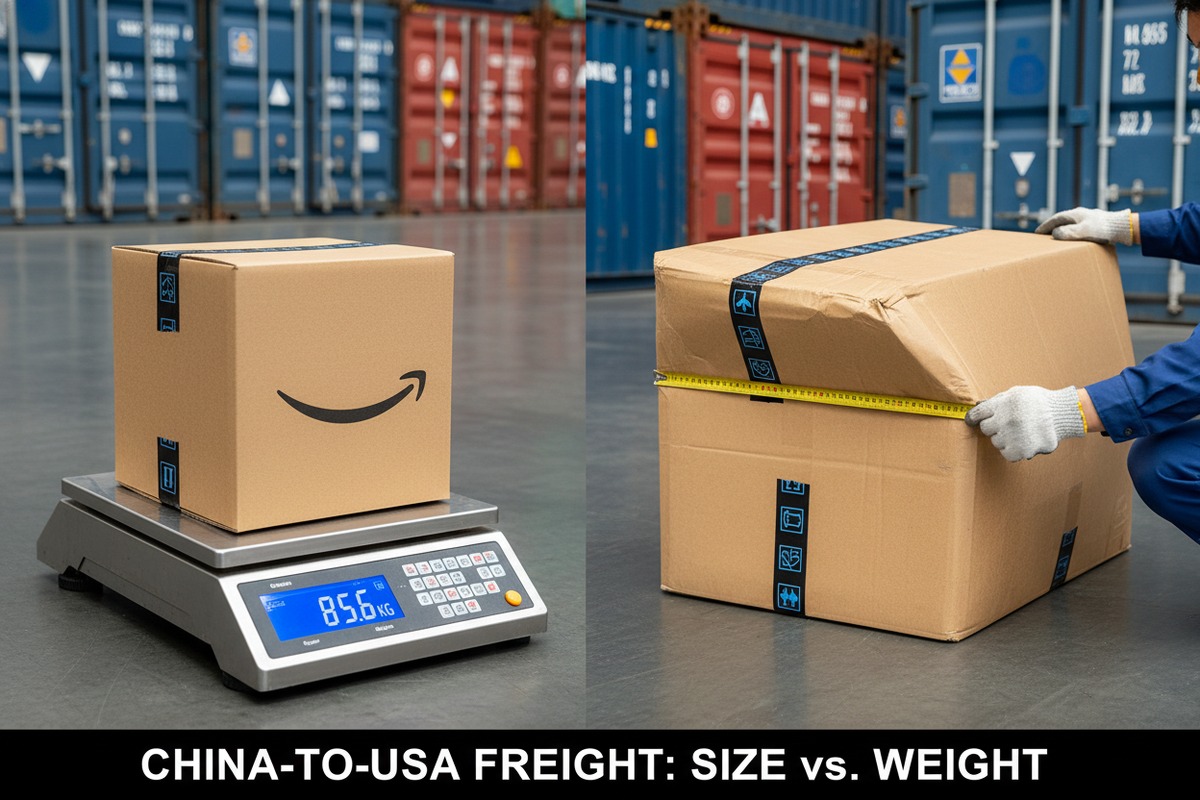
The logic behind freight billing is straightforward. A carrier sells two things: weight capacity and space capacity. If your cargo is small but extremely heavy, it uses up weight capacity. If your cargo is huge but very light, it uses up space capacity. Either way, the carrier needs to get paid for whichever resource your shipment consumes more of.
Here is how it works in practice. You weigh your shipment on a scale. That gives you the actual gross weight 3. Then you measure the length, width, and height of each box. You plug those numbers into a formula that converts volume into a weight equivalent. This result is called volumetric weight 4 or dimensional weight. You compare the two numbers. The bigger one becomes your chargeable weight 5.
In Chinese logistics, we often use the terms "重货" (heavy cargo) and "泡货" (light cargo 6 or volumetric cargo). Heavy cargo means the actual weight exceeds the volumetric weight. Light cargo means the volumetric weight exceeds the actual weight. This distinction matters because it tells you which number drives your cost.
| Cargo Type | Also Called | Condition | Billed By |
|---|---|---|---|
| Heavy Cargo (重货) | Dense Cargo | Actual weight > Volumetric weight | Actual weight |
| Light Cargo (泡货) | Volumetric Cargo | Volumetric weight > Actual weight | Volumetric weight |
If you sell products like ceramic mugs, metal tools, or machine parts, your shipments are likely heavy cargo. The scale weight drives your cost. But if you sell pillows, plastic storage bins, or large but hollow items, your shipments are almost certainly light cargo. The box dimensions drive your cost. Knowing this before you request a quote helps you budget accurately and avoid invoice surprises.
From our experience shipping to US Amazon warehouses, roughly 60% of FBA shipments from China fall into the light cargo category. That means most sellers end up paying based on volume, not weight. This is why packaging optimization is so important. Reducing box dimensions by even a few centimeters across hundreds of cartons can save hundreds of dollars.
Measure one of your cartons. Calculate the volumetric weight using the formula for your chosen shipping mode. Then weigh the carton. If the scale number is higher, you have heavy cargo. If the calculated number is higher, you have light cargo. Do this before requesting quotes so you know what to expect.
Our team handles air freight 7 and express shipments to the US daily. We have seen clients confused when DHL or FedEx invoices show a chargeable weight far exceeding what they expected. The formulas are simple, but the differences between air and express divisors catch people off guard.
For air freight, chargeable weight is calculated as Length × Width × Height (cm) ÷ 6,000 per package, then compared against actual weight. For express shipping, the divisor is often 5,000 instead of 6,000. In both cases, the higher value between actual and volumetric weight becomes the chargeable weight on your invoice.

The standard air freight volumetric weight formula is:
Volumetric Weight (kg) = Length (cm) × Width (cm) × Height (cm) ÷ 6,000
This divisor of 6,000 comes from IATA standards 8. It means that every 6,000 cubic centimeters of space is treated as 1 kilogram for billing purposes. Another way to think about it: if your cargo has a density below 1 kg per 6,000 cm³ (which equals about 167 kg per cubic meter), volume will drive your cost.
Let's use a real example. Say you have a carton that measures 50 cm × 40 cm × 30 cm and weighs 8 kg.
In this case, you pay for 10 kg even though the box only weighs 8 kg. The box is light cargo.
Express couriers like DHL, FedEx, and UPS often use a stricter divisor:
Volumetric Weight (kg) = Length (cm) × Width (cm) × Height (cm) ÷ 5,000
Using the same box from above:
Notice the difference. The same box that was billed at 10 kg via air freight is now billed at 12 kg via express. This is why express shipping 9 can sometimes seem more expensive for bulky items. The stricter divisor penalizes volume more aggressively.
However, not all express carriers use 5,000. Some use 6,000, depending on the service level, destination, or your account terms. Always confirm with your courier or logistics provider before estimating costs.
| Factor | Air Freight | Express Shipping |
|---|---|---|
| Divisor (metric) | 6,000 cm³/kg | 5,000 cm³/kg (common) |
| Divisor (imperial) | 366 in³/lb | Varies by carrier |
| Billing unit | Kilograms (kg) | Kilograms (kg) |
| Example box (50×40×30 cm, 8 kg) | Chargeable = 10 kg | Chargeable = 12 kg |
| Who sets the rule | IATA standard | Carrier-specific |
Some airlines offer a "volumetric split" discount for light cargo. This is common on certain China-to-USA routes. The idea is that if your cargo is extremely light relative to its size, the airline may reduce the effective volumetric weight using a split ratio.
Common split ratios include:
For example, with a 5/5 split on the box above (volumetric 10 kg, actual 8 kg via air):
This saves 1 kg per carton. Across a large shipment, these savings add up quickly. We always check with our airline partners for available split ratios before quoting our clients.
One mistake we see frequently is sellers finalizing their carton sizes without checking the volumetric impact. A carton that is 5 cm taller than necessary could add 1–2 kg of chargeable weight per box. Multiply that by 200 cartons and you are paying for an extra 200–400 kg of phantom weight. Measure your products, choose the tightest-fitting box possible, and avoid excess void fill.
At our consolidation warehouse, we handle LCL sea freight shipments every day. Sea freight billing works very differently from air and express. If you try to apply air freight logic to ocean shipping, your cost estimates will be wrong.
LCL sea freight is billed by CBM (cubic meters) or weight tons, whichever is greater, using the conversion 1 CBM = 1,000 kg. You calculate CBM by multiplying Length × Width × Height in meters. If total weight in metric tons exceeds total CBM, weight becomes the billing unit. FCL shipments are billed by container type, not by weight or volume.
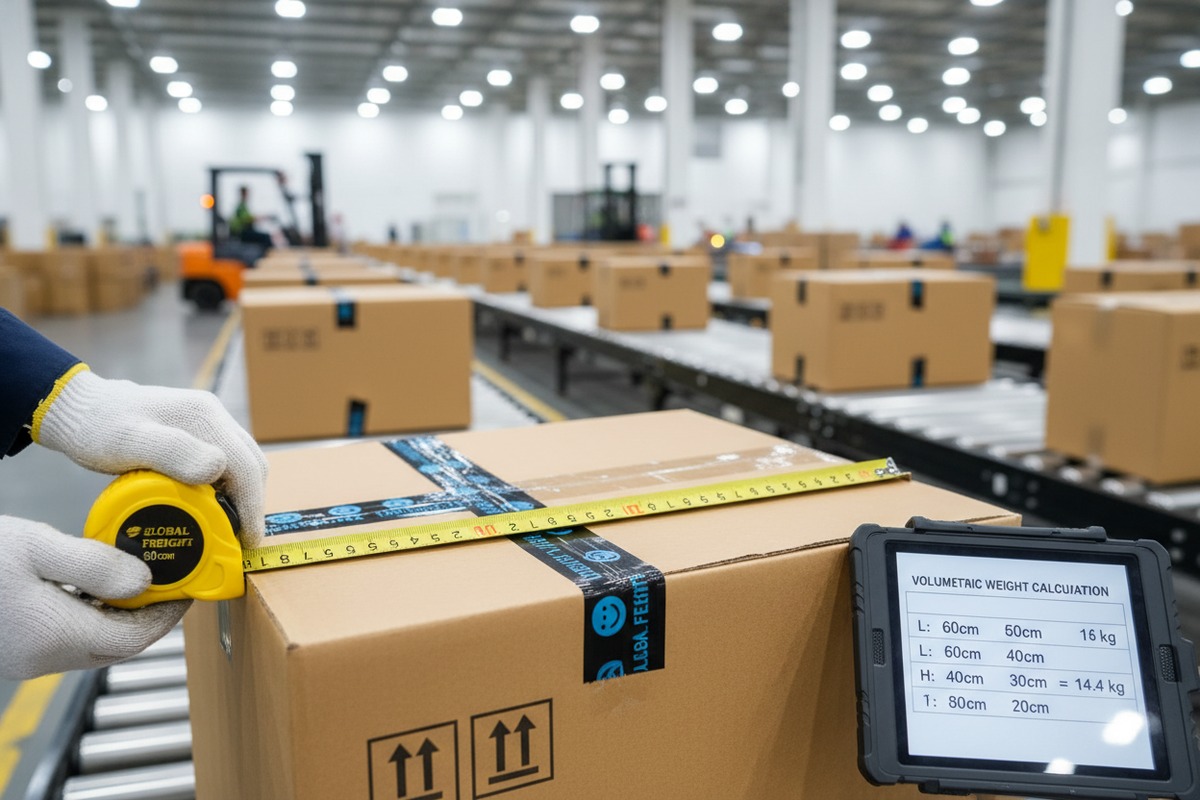
CBM stands for cubic meter. The formula is simple:
CBM = Length (m) × Width (m) × Height (m)
If your measurements are in centimeters, divide each dimension by 100 first. For example, a carton measuring 50 cm × 40 cm × 30 cm:
If you have 100 such cartons:
LCL ocean freight uses the W/M (Weight or Measure) billing system 10. Here is the rule:
Using our example of 100 cartons at 0.06 CBM each, with each carton weighing 8 kg:
You pay for 6 CBM. The cargo is light cargo in ocean terms.
Now imagine each carton weighs 80 kg instead:
You pay for 8 revenue tons. The cargo is heavy cargo.
| Billing Aspect | LCL (Less than Container Load) | FCL (Full Container Load) |
|---|---|---|
| Billing unit | CBM or Weight Ton (W/M) | Container type (20GP, 40HQ, 45HQ) |
| Conversion ratio | 1 CBM = 1,000 kg | Not applicable |
| Volume limit | Shared container space | Full container capacity |
| Best for | Small to medium shipments | Large shipments filling a container |
| Price structure | Per CBM or per W/T | Flat rate per container |
For FCL shipments, you pay a fixed price based on the container size. A 40HQ container has roughly 67.7 CBM of internal space and a weight limit of around 26,000 kg. As long as your cargo fits within both limits, the price stays the same whether you use 50 CBM or 65 CBM of space.
For shipments going to inland US destinations via IPI (Interior Point Intermodal) routing, the second-leg domestic transport sometimes uses a different conversion ratio. Instead of 1 CBM = 1,000 kg, some carriers calculate the inland portion at 1 CBM = 363 kg. This means volumetric cargo gets a higher chargeable weight on the domestic leg.
For example, a 6 CBM shipment weighing 800 kg:
This IPI conversion does not apply to all routes or all carriers. We always confirm the inland billing method with the shipping line before quoting our clients. It is one of those hidden variables that can significantly change the final cost for Amazon sellers shipping to inland FBA warehouses like those in Ohio, Texas, or Illinois.
Pack your cartons as efficiently as possible. Eliminate empty space inside boxes. Stack cartons to maximize pallet height without exceeding warehouse limits. If you are close to the volume threshold for a full container, compare the LCL price against FCL. Sometimes paying for a full 20GP container is cheaper than paying per CBM for a large LCL shipment.
We get this question from clients almost every week. A seller weighs all their boxes, calculates a total, and then receives an invoice showing a much higher number. The reaction is always the same: frustration and suspicion. But the explanation is usually simple math, not dishonest billing.
Your invoice shows a higher chargeable weight because the carrier applied volumetric weight calculations and your cargo is classified as light (bulky) cargo. When volumetric weight exceeds actual weight, the carrier bills the volumetric figure. This is standard practice across air, express, and LCL sea freight modes worldwide.

If your boxes are large relative to their weight, volumetric weight will exceed actual weight. The carrier did not make an error. They applied the standard formula and billed the higher number. This is the most frequent reason for invoice surprises.
Let's look at a concrete scenario. You ship 50 cartons to Amazon FBA. Each carton measures 60 cm × 50 cm × 40 cm and weighs 6 kg.
Your scale said 300 kg. Your invoice says 1,000 kg. That is a 233% difference. This is not fraud. This is how dimensional billing works for light cargo.
Beyond the basic volumetric calculation, several other factors can inflate the chargeable weight on your invoice:
Rounding rules. Many carriers round up each package's dimensions to the nearest centimeter or even the nearest 0.5 kg. If you have 200 packages, small roundups per box compound into a noticeable total increase.
Minimum charge per shipment. Some carriers enforce a minimum chargeable weight. Even if your shipment calculates to 15 kg, the carrier may have a 21 kg minimum for that service.
Re-measurement at the carrier facility. Carriers scan packages with automated dimensioning systems. If your box is slightly bulging or not perfectly flat, the scanner may record larger dimensions than what you measured by hand.
Pallet dimensions replacing box dimensions. If your cargo ships on pallets, some carriers bill based on the pallet footprint and total stack height, not individual box dimensions. A pallet of 60 cm × 40 cm boxes arranged on a 120 cm × 100 cm pallet wastes space around the edges, and the full pallet volume becomes the billable volume.
Follow these steps when you receive a surprising invoice:
Reducing chargeable weight starts at the packaging stage. Use cartons that fit your products snugly. Eliminate unnecessary padding. Consider vacuum-sealing soft goods to compress volume. For Amazon FBA shipments, ensure your case pack quantities match the optimal carton size. A box that is 30% air inside is 30% wasted money on volumetric billing.
We advise our clients to send us their carton dimensions and weights before shipping. Our team runs the calculation across sea, air, and express options so the client can see exactly how each mode will bill the shipment. This prevents surprises and helps sellers choose the most cost-effective option.
Understanding how billing units work across sea, air, and express shipping puts you in control of your logistics budget. Compare actual weight against volumetric weight before booking, optimize your packaging, and confirm each carrier's divisor. If you need help calculating chargeable weight for your next China-to-USA shipment, our team at MBMLOG is ready to walk you through it.
1. Defines LCL shipping as sharing container space with other shippers. ↩︎
2. Defines heavy cargo as shipments exceeding standard weight or size limitations. ↩︎
3. Defines actual gross weight as the total weight of a shipment including product and packaging. ↩︎
4. Explains volumetric weight as a method to determine shipping cost based on package dimensions. ↩︎
5. Explains chargeable weight as the higher of actual or volumetric weight. ↩︎
6. Defines lightweight cargo as shipments large in volume but low in actual weight. ↩︎
7. Explains air freight chargeable weight calculation and the 6,000 divisor. ↩︎
8. Provides access to IATA's Cargo Operations manuals, which set industry standards. ↩︎
9. Defines express shipping as a premium service prioritizing speed of delivery. ↩︎
10. Replaced with a relevant and accessible page that defines the Weight or Measurement (W/M) billing system. ↩︎