
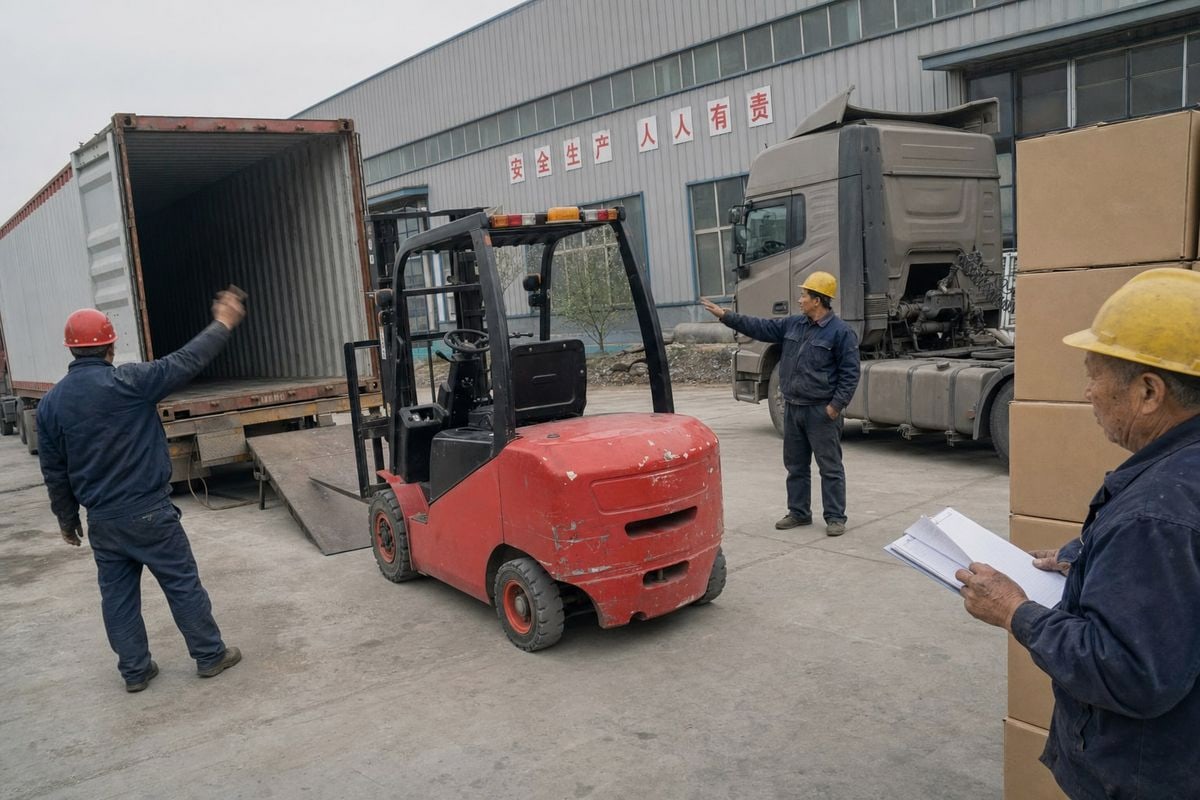
Shipping [electric forklifts from China](https://mbmlog.com/?p=12274) to Spain looks simple until the battery paperwork stalls your container at the port. On our loading docks in Zhengzhou, we see it happen to unprepared buyers every month.
To ship electric forklifts from China to Spain, confirm battery compliance (UN38.3, MSDS), prepare a commercial invoice, packing list, bill of lading, CE Declaration of Conformity, and EORI number, then book FCL sea freight to Valencia or Barcelona, clearing Spanish customs with 21% VAT.
That is the short answer. Now let me walk you through each step, because the details decide whether your forklift arrives on schedule or sits in customs for weeks.
What Documents Do I Need to Ship Electric Forklifts from China to Spain?
Last year, our team held back a container in Shenzhen for six days because the factory forgot the UN38.3 test report. That one missing page taught our client an expensive lesson.
You need a commercial invoice, packing list, bill of lading, certificate of origin, CE Declaration of Conformity, UN38.3 certification, MSDS documentation, and a dangerous goods declaration if required. On the Spain side, you must hold a valid EORI number for customs clearance.

Documentation is where most forklift shipments succeed or fail. In my experience coordinating electric forklift exports, the forklift itself rarely causes delays. The paperwork does. Spanish customs officers are strict, and EU rules add a compliance layer that many first-time importers underestimate.
A Lista de Documentos Essenciais
Here is the full set of documents I ask every client to prepare before we book space with a carrier:
| Documento | Quem Fornece | Por Que Isso Importa |
|---|---|---|
| Fatura comercial | Supplier | Declares value for duties and VAT |
| Lista de embalagem | Supplier | Confirms weights and dimensions |
| Conhecimento de embarque | Despachante | Proof of shipment and cargo ownership |
| Certificado de origem | Supplier / CCPIT | Supports tariff treatment |
| Declaração de Conformidade CE 1 | Fabricante | Mandatory for EU market entry |
| Relatório de Teste UN38.3 | Battery maker | Comprova que a bateria de lítio passou nos testes de segurança para transporte |
| MSDS / SDS | Battery maker | Describes battery chemistry and hazards |
| DG Declaration | Forwarder / shipper | Required if cargo is booked as Class 9 dangerous goods |
| EORI Number | You (the importer) | Mandatory for any business importing into Spain |
CE Marking Is Not Optional
Spanish customs will reject industrial equipment that does not meet European safety standards. So before you pay a deposit, ask the factory for the CE Declaration of Conformity and the technical file. We check this document for every EU-bound shipment we handle, because a missing CE mark means the forklift cannot legally enter the market, no matter how well the freight went.
Get Your EORI Sorted Early
An EORI (Economic Operators Registration and Identification 2) number is a mandatory prerequisite for any business importing goods into Spain from outside the EU. Registration takes time. Start it while the forklift is still in production, not when the vessel is a week from the Port of Valencia.
How Much Does It Cost to Ship an Electric Forklift from China to Spain?
A distributor once told me his forklift quote looked great until the invoice for destination charges arrived. That gap between "freight quote" and "landed cost" is where budgets break.
Total landed cost combines ocean freight, origin charges, destination handling, import duties under HS Code 842710, Spain's 21% VAT (IVA), inland trucking, and insurance. A single forklift in a 20FT container typically costs a few thousand dollars in freight, before duties and taxes.

When we quote electric forklift shipments to Europe, I always break the price into layers. A "lowest quote wins" approach is misleading, because battery paperwork, destination charges, and inland delivery can add substantial costs if they are not included upfront. Here is how I teach clients to build a true landed-cost estimate.
The Seven Cost Layers
| Camada de Custo | O que cobre | Common Surprise |
|---|---|---|
| Factory price | The forklift itself | Charger and battery sometimes quoted separately |
| Origin charges | Pickup, export declaration, port fees in China | DG handling fees for lithium batteries |
| frete marítimo | Port-to-port sea transport | Rates shift with route congestion |
| Destination charges | Terminal handling in Valencia, Barcelona, or Algeciras | Frequentemente excluído de cotações baratas |
| Duties | Based on the TARIC code, typically 8427.10 | Wrong HS classification triggers penalties |
| VAT (IVA) | Spain applies 21% on customs value plus duty and freight | Recoverable for VAT-registered businesses |
| Inland transport + insurance | Trucking to your warehouse, cargo insurance | Unloading a heavy forklift needs the right equipment |
Duties, VAT, and the TARIC Code
Check the TARIC code for your exact forklift type. Most self-propelled electric forklifts fall under HS Code 842710. Get this classification right on the commercial invoice, because Spanish customs clearance runs on it. Then apply Spain's 21% Value Added Tax on top of the customs value plus duty. Many buyers forget that VAT applies to the freight cost too, not just the machine price.
Transit Time Affects Cost Planning
Expect transit times of 30 to 45 days for sea freight to ports like Valencia, Barcelona, or Algeciras. If your project timeline is tight, the China-Europe Railway Express can deliver in approximately 22 days, at a higher rate. Air freight is only realistic for compact units or urgent spare parts, since the cost is far higher. We help clients weigh speed against budget before booking.
Which Incoterm Should You Choose?
- FOB: You control freight and customs. Best for experienced importers.
- CIF: The seller books freight, but you still handle Spanish import clearance.
- DDP: One party manages everything to your door. Simplest, but you depend on the forwarder's customs accuracy.
- EXW: You take over at the factory gate. Only sensible with a China-based forwarder like us handling pickup.
Some providers push DDP as the easiest answer. It often is, especially for smaller importers. But be honest about the trade-off: less visibility and more reliance on your forwarder for import duties and VAT handling. Choose DDP only with a partner who shows you the full cost breakdown.
How Do I Handle Lithium Battery Shipping Requirements for My Electric Forklift?
The hardest question I ask factories is never about the forklift. It is always about the battery. In our experience handling lithium battery cargo, the battery is the hidden complexity of the whole shipment.
Request the UN38.3 certification and MSDS documentation before booking, confirm whether the carrier requires a dangerous goods declaration under Class 9, discharge the lithium battery to around 30% state of charge, and verify the carrier accepts battery-powered machinery on your chosen route.

Here is the truth most first-time importers miss: an electric forklift is not just oversized cargo. If it carries a lithium battery, it can trigger dangerous-goods procedures under lithium battery regulations. Many customs delays come not from the forklift, but from missing battery documentation, or from booking the cargo as non-hazardous when the carrier expects DG handling. We coordinate these requirements before cargo reaches the port, because fixing them afterward means rolled bookings and storage fees.
The Battery Compliance Workflow
Follow this order, and you avoid most battery-related delays:
- Confirm battery chemistry and capacity with the factory. Lithium and lead-acid batteries follow different rules.
- Request the UN38.3 test report for the exact battery pack model. Not a generic one for a similar model.
- Collect the MSDS/SDS from the battery manufacturer.
- Ask your forwarder to check carrier acceptance. Class 9 dangerous goods bookings need pre-approval, and some vessels limit DG slots.
- Discharge the battery to roughly 30% state of charge before crating. This follows the latest maritime safety recommendations for preventing thermal runaway.
- File the dangerous goods declaration if the booking requires it, with packaging and labeling to match.
Watch the Newer Requirements
Carrier rules keep tightening. Some shipping lines now require fire-suppression blankets for electric vehicles and machinery to reduce lithium-ion fire risk 3 during transit, so ask about carrier-specific mandates when booking. Looking further ahead, verify that the forklift's Battery Management System (BMS) aligns with upcoming EU Battery Passport requirements, which will mandate digital tracking of battery health and origin. Buyers importing fleets into Spain should raise this with the manufacturer now, not after the rules land. It is also worth monitoring the EU's Carbon Border Adjustment Mechanism 4 (CBAM), since the high steel content in forklift frames may eventually bring carbon reporting into scope.
Which Shipping Method Should I Choose for FCL or LCL Forklift Delivery to Spain?
One trade-off I weigh on nearly every quote: does the buyer save money with LCL, or save the forklift with FCL? For heavy machinery, that question usually answers itself.
Choose FCL sea freight for one or more standard electric forklifts, because a dedicated container allows proper blocking and bracing. Use LCL only for compact pallet trucks, flat rack containers for oversized units, and Ro-Ro shipping where routes to Spain allow drivable loading.

Sea freight is the standard mode for forklifts, but the container strategy makes a real difference to cost and cargo safety. Here is how the options compare for the China-to-Spain route:
| Método | Melhor para | Prós | Contras |
|---|---|---|---|
| FCL (20FT/40FT/40HQ) | 1+ standard forklifts | Full control, secure bracing, no co-loading damage | You pay for the whole container |
| LCL | Small pallet trucks, stackers, parts | Pay only for space used | More handling, longer consolidation time, damage risk |
| Flat rack | Tall or wide forklifts | Fits units that exceed container doors | Higher cost, weather exposure, special lashing |
| Ro-Ro | Drivable units on limited routes | No container loading needed | Fewer sailings to Spain, battery cargo restrictions |
| Rail (China-Europe Railway Express) | Time-sensitive fleets | Around 22 days transit | Costs more than sea, battery acceptance varies |
| Frete aéreo | Urgent compact parts only | Fastest | Far too expensive for whole forklifts |
Why FCL Usually Wins
For industrial forklifts, FCL sea freight is usually the most realistic and economical choice, especially when battery compliance is involved. A dedicated container lets us position the machine over the container's strong points, chock the wheels, and lash the mast properly. With LCL, your forklift shares space with unknown cargo and gets handled multiple times at consolidation warehouses. For a machine worth thousands of dollars, that risk rarely justifies the modest LCL saving.
Maximize Your Container
A 20FT container often fits one to two compact forklifts. A 40HQ can carry more units or a mix of forklifts, chargers, batteries, and spare parts. We routinely consolidate cargo from multiple factories — forklifts from one supplier, chargers from another, attachments from a third — into a single container. Filling unused space with spare parts lowers the average logistics cost per forklift significantly, which matters when your resale margin depends on landed cost.
Match the Method to the Machine
Measure before you book. If the mast height or counterweight width exceeds standard container openings, a flat rack solves the problem. If your unit is drivable and a Ro-Ro sailing serves Valencia or Algeciras on your timeline, that can work too, though container shipping remains the more common and more predictable choice for electric models with lithium batteries.
Conclusão
Verify battery compliance first, prepare documents early, secure your EORI, calculate the full landed cost, and book FCL sea freight. Do that, and your forklift reaches Spain without surprises.
Notas de Rodapé
1. Official European Commission guide on CE marking requirements for industrial machinery entering the EU single market. ↩︎
2. Official Spanish Tax Agency portal providing mandatory EORI registration and customs identification for businesses importing into Spain. ↩︎
3. International Maritime Organization safety standards for managing fire risks associated with dangerous goods in maritime transport. ↩︎
4. Official European Commission overview of the CBAM regulations affecting carbon-intensive imports into the European Union. ↩︎




