
- +8618603825129
- [email protected]


[Shipping electric forklifts from China to Brazil looks simple](https://mbmlog.com/how-ship-electric-forklifts-china-2026-guide-to/) until the lithium battery paperwork, NCM codes, and RADAR registration hit you. I have watched our Zhengzhou team rescue containers stuck at the Port of Santos because one document was missing. The cost of that mistake? Weeks of storage fees and angry end customers. The good news is that every one of those problems is avoidable with the right preparation.
To ship electric forklifts from China to Brazil, book FCL sea freight to the Port of Santos, prepare UN38.3 and MSDS documents for the lithium battery, classify the cargo under NCM 8427.10.19, register with RADAR/SISCOMEX, and clear customs with a matched invoice, packing list, and bill of lading.
That is the short version. Below, I will break down each step in detail, from freight costs to battery rules to customs documents, so you can plan your first shipment with confidence.
Last quarter, a Brazilian dealer asked our team for a quote and was shocked that the ocean freight was only half his total landed cost. That surprise is common, so let me explain the full picture.
Ocean freight for electric forklifts from China to Brazil typically runs USD 2,550–5,550 per container depending on size and season. Total landed cost adds origin charges, destination handling, Brazilian import duties and taxes, brokerage fees, and inland delivery, which together often exceed the freight itself.
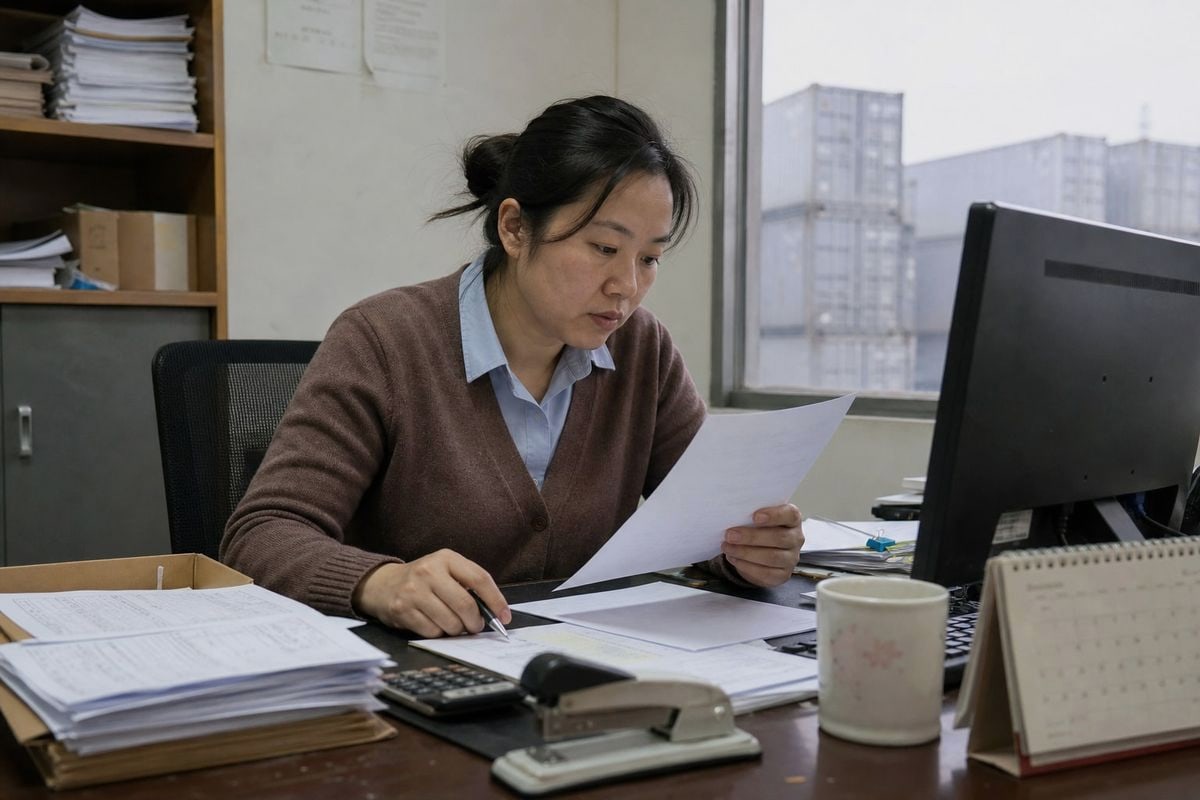
The biggest mistake I see buyers make is comparing supplier quotes on freight alone. Sea freight rates are only one line item. Brazil applies a heavy tax stack on imported machinery, and those taxes are calculated on the Valor CIF 1 of your cargo. So the real question is not "what is the freight?" but "what is my landed cost per forklift?"
Here is how the cost structure usually breaks down for a container of electric forklifts:
| Cost Item | Where It Occurs | Typical Notes |
|---|---|---|
| Factory pickup and trucking | China | Depends on distance to port |
| Origin port and export fees | China | Documentation, handling, DG surcharges |
| frete marítimo | China → Santos | Roughly USD 2,550–5,550 per container |
| Destination port charges | Brasil | Terminal handling, storage |
| Import duty (II) and tax stack | Brasil | II, IPI, PIS, COFINS, ICMS on CIF value |
| Customs brokerage | Brasil | Broker fees plus SISCOMEX fees |
| Inland delivery | Brasil | Truck from Santos to your warehouse |
Brazil offers legal levers that many first-time importers miss. First, the Ex-tarifário regime can reduce the Import Duty (II) to 0% if no equivalent electric forklift is manufactured domestically in Brazil. Applying takes time, but the savings on a multi-unit order are significant. Second, some buyers ship units as Semi-Knocked Down (SKD) kits instead of Completely Built Units (CBU). SKD kits fit more units per container and may qualify for lower "parts" tax rates. We help evaluate both options before booking. Air freight, by contrast, runs around USD 4–10 per kilogram, which makes it impractical for a two-ton machine. We only use air for urgent spare parts and chargers.
A carrier once rejected a booking we inherited from another forwarder because the UN38.3 report covered the wrong battery model. That single mismatch would have cost the buyer three weeks. Battery paperwork is where forklift shipments live or die.
Lithium battery forklifts are classified as Class 9 Dangerous Goods. You need a UN38.3 test report, an MSDS/SDS document, a dangerous goods declaration, and carrier DG booking approval. Batteries must also be shipped at a State of Charge of 30% or less.
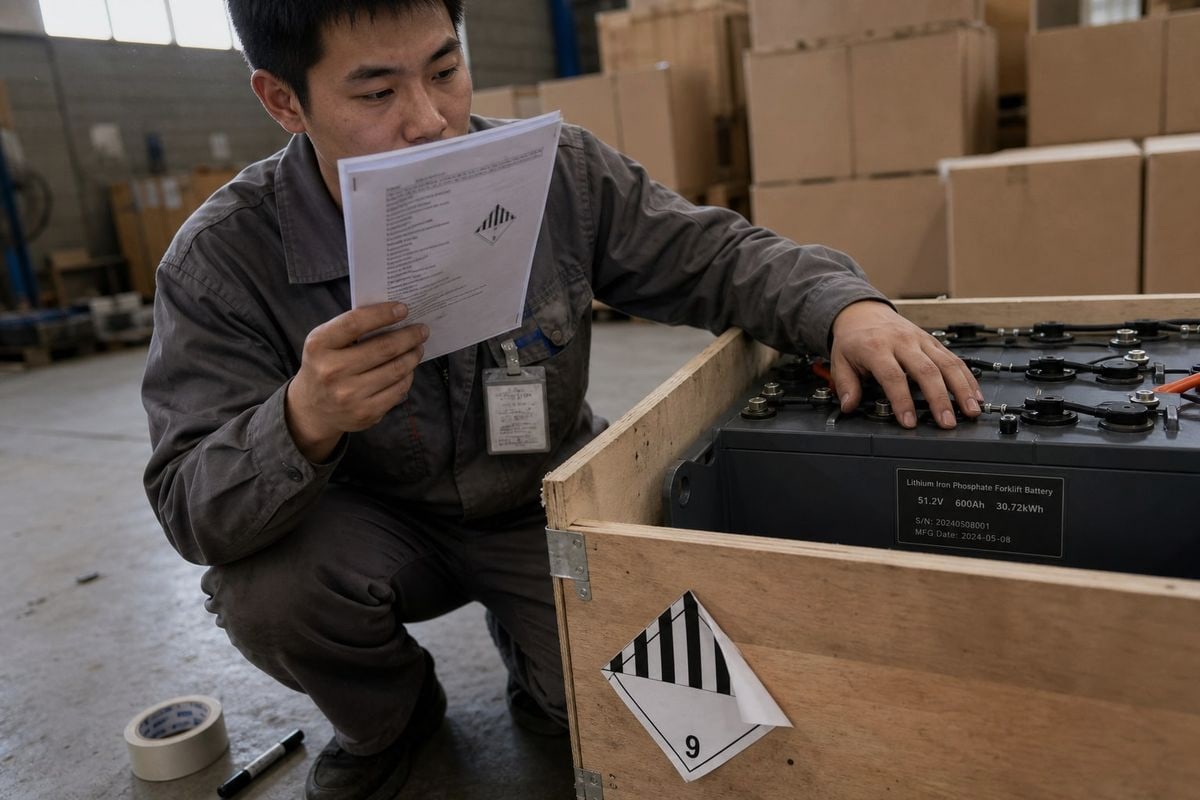
Lithium battery shipping regulations exist for a real reason. A thermal runaway event inside a sealed container on a 45-day equatorial voyage is a worst-case scenario for any carrier. That is why the rules are strict and why carriers enforce them without exceptions.
Here is the sequence we follow on every lithium forklift shipment:
The battery paperwork is not only a transport issue. Brazilian customs reviewers cross-check the MSDS and DG declaration 2 against your invoice description. If your invoice says "electric forklift" but the DG paperwork is missing or inconsistent, the shipment can be pulled for extended inspection. We check the full document set before the cargo ever leaves the factory, because fixing paperwork while a container sits at Santos is far more expensive than fixing it in China. One more practical tip: confirm the charger voltage matches Brazilian power requirements before ordering. A charger mismatch will not stop the shipment, but it will stop your forklift from working after arrival.
The most painful call I ever received came from a buyer whose container was parked in the "Red Channel" at Santos because his packing list showed different serial numbers than the machines inside. Customs clearance Brazil-side is unforgiving about detail.
You need an original bill of lading, a detailed commercial invoice, a matching packing list, a certificate of origin, and the battery DG documents. The importer must hold an active RADAR license, register the operation in SISCOMEX, and declare the correct NCM code, typically 8427.10.19.
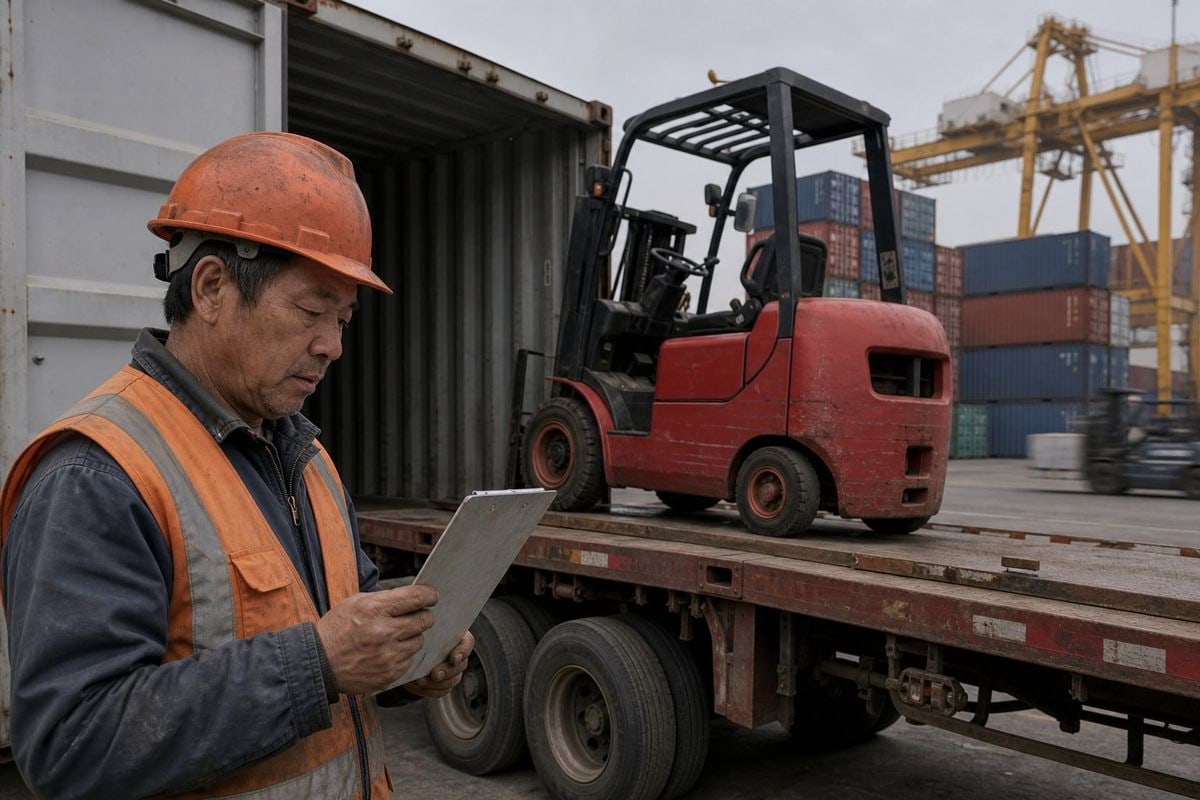
Brazil runs one of the more structured import systems in the world. Every step is digital, traceable, and cross-checked. That works in your favor if your documents are clean, and against you if they are not.
Three concepts matter before your forklift even boards a vessel:
| Requisito | What It Is | Why It Matters |
|---|---|---|
| RADAR license | Your company's authorization to import | It sets the maximum financial volume you can import; no RADAR, no clearance |
| SISCOMEX | Brazil's integrated foreign trade system | All import declarations are registered here by you or your broker |
| NCM code | Brazil's 8-digit tariff classification | NCM 8427.10.19 covers electric counterbalance trucks and drives the entire II, IPI, PIS, COFINS, and ICMS calculation |
| Import License (LI) | Pre-approval for regulated categories | Check whether your specific cargo requires one before shipping |
Brazilian customs assigns shipments to green, yellow, or red channels 3. Document mismatches are the fastest route to a Red Channel physical inspection. Before departure, we verify that the commercial invoice value, product descriptions, serial numbers, and packing data all agree with the actual cargo. My strongest advice: have a Brazilian customs broker review the full document set before the container leaves the factory in China. A broker review costs almost nothing compared with demurrage at Santos. One buyer objection I hear often is that a DDP offer means the seller handles all of this. Be careful. Under Brazilian rules, the importer of record remains responsible for the final import clearance even when a forwarder helps operationally. A "simple all-in" DDP promise does not transfer your legal responsibility. Also worth knowing: companies distributing machinery within Brazil's North and Northeast regions can route shipments through the Manaus Free Trade Zone 4 (ZFM) for federal tax exemptions and internal tax credits. It is a niche strategy, but for the right distribution model it changes the economics entirely.
When our team plans a loading at a forklift factory, the first thing we measure is not the machine. It is the unused space around it, because that space is money you already paid for.
Choose FCL for one or more full-size forklifts because it offers better cargo security, lower per-unit cost, and cleaner customs handling. Choose door-to-door service on top of FCL if you lack a customs broker or local logistics network in Brazil.
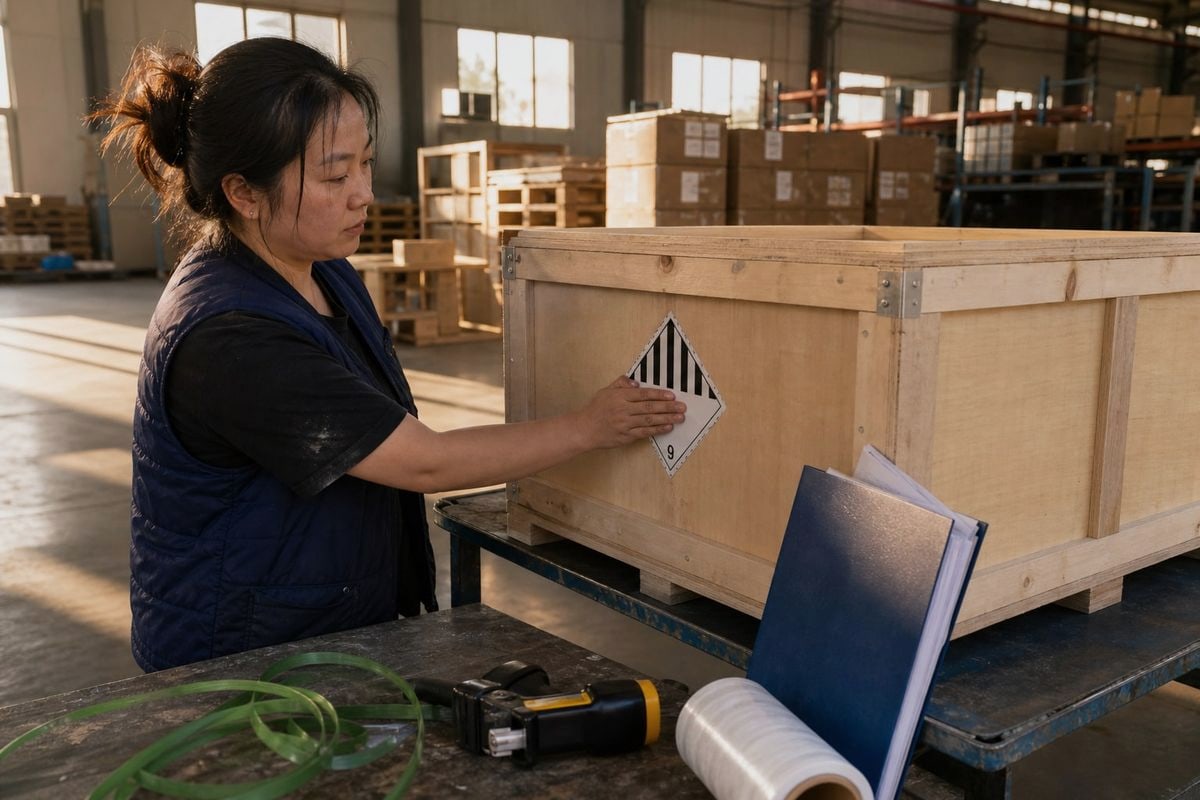
FCL and door-to-door are not competing options. FCL answers "how does my cargo travel?" Door-to-door answers "who manages the journey?" You can, and often should, combine them.
O FCL vs LCL shipping decision is usually easy for forklifts. A standard electric counterbalance unit is heavy, tall, and awkward. LCL consolidation exposes it to extra handling and co-loaded cargo risk. FCL keeps your machines sealed from factory to destination. For oversized masts, flat rack containers or Ro-Ro shipping services exist as niche solutions, but the large majority of importers use standard containers.
| Option | Melhor para | Trade-Off |
|---|---|---|
| 20FT FCL | 1–2 compact forklifts | Lowest freight, limited space for extras |
| 40FT / 40HQ FCL | 2–4 units plus parts and chargers | Best cost per unit, needs a loading plan |
| LCL | Spare parts, single chargers, small accessories | Not recommended for complete forklifts |
| Flat rack / Ro-Ro | Oversized or non-containerizable units | Higher cost, fewer sailings to Brazil |
Smart loading is where landed cost per forklift really drops. We regularly consolidate forklifts from one factory with batteries, chargers, attachments, and spare parts from other suppliers into a single container. Filling dead space with parts inventory can cut your average logistics cost meaningfully. Proper securing matters just as much: a forklift that shifts during six weeks at sea arrives damaged, and repairs plus customer disputes wipe out any freight savings.
Experienced importers usually buy FOB. It gives you control over the freight forwarder China to Brazil, the carrier choice, and the documentation flow. CIF hands freight control to the seller. DDP sounds effortless, but as covered above, the Brazilian importer of record keeps legal clearance responsibility. Our door-to-door service works within that reality: we coordinate factory pickup, loading, ocean freight, and delivery, while your Brazilian broker or ours handles clearance under your RADAR registration. On transit time, plan for 35–50 days port-to-port from Shanghai or Ningbo to the Port of Santos, and add time for export prep, Port of Santos logistics 5, clearance, and inland trucking. Some clients also request IoT-enabled smart containers that monitor battery temperature and humidity throughout the voyage, which helps preserve battery warranty validity on arrival.
Shipping electric forklifts from China to Brazil rewards preparation. Confirm specs, secure UN38.3 and MSDS documents, verify your NCM code and RADAR status, choose FCL wisely, and budget the full landed cost. Get those steps right before the deposit, and your forklifts arrive at Santos without drama. If you want one team to coordinate the entire chain from factory pickup to final delivery, our door at MBMLOG is open.
1. Official source for Incoterms which define the CIF value used for Brazilian tax calculations. ↩︎
2. UN authority providing the regulatory framework for dangerous goods declarations and Class 9 transport. ↩︎
3. Official Brazilian Federal Revenue site explaining customs clearance channels and inspection procedures. ↩︎
4. Official government authority (SUFRAMA) managing the Manaus Free Trade Zone tax incentives. ↩︎
5. Official website of the Port of Santos, the primary gateway for forklift imports into Brazil. ↩︎



