
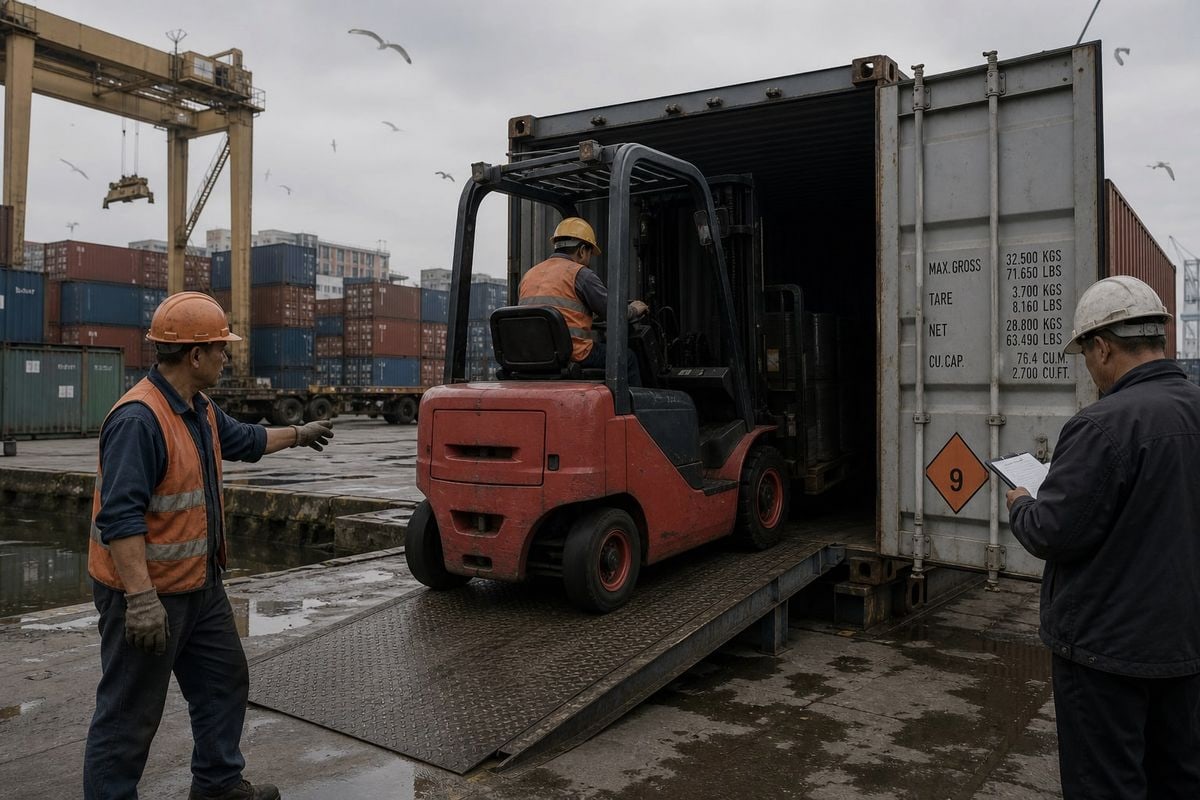
Shipping electric forklifts from China to Germany looks simple until the carrier rejects your lithium battery cargo. I have seen containers sit at Chinese ports for weeks over one missing document. At our Zhengzhou logistics office, we coordinate these shipments daily, and the fix is almost always preparation, not luck.
To ship electric forklifts from China to Germany, book FCL sea freight to Hamburg or Bremerhaven, secure UN38.3 battery certification and CE documentation, declare Class 9 dangerous goods if lithium-powered, clear German customs under HS code 8427.10, and arrange inland trucking. Total transit takes roughly 30–45 days door to door.
Below, I will walk you through the real costs, the paperwork, the timelines, and the FCL versus LCL decision. Each section is based on shipments we actually handle.
How much does it cost to ship an electric forklift from China to Germany?
Last quarter, a German dealer asked us for a quote and was shocked that logistics added nearly 20% to his factory price. Our team broke down every line item for him, and that transparency changed how he budgets.
Shipping one 3-ton electric forklift from China to Germany typically costs $2,000–$5,500 in total logistics fees. This includes ocean freight of $1,500–$4,000, cargo insurance around 0.3% of cargo value, and German port handling plus inland trucking of $300–$800, on top of the forklift's FOB price.

The number that matters is not the freight quote. It is the landed cost. When we prepare quotations for European buyers, we always list every charge so nobody discovers surprise destination fees after the vessel sails. A 3-ton electric forklift usually carries an FOB price of around $8,000–$15,000 from Chinese factories. Logistics can add 15–30% on top of that.
Sample landed cost breakdown
| Cost Item | Typical Range | Notes |
|---|---|---|
| Forklift FOB price (3-ton) | $8,000–$15,000 | Varies by battery type and mast |
| Ocean freight (20FT FCL) | $1,500–$4,000 | Fluctuates with season and route |
| Cargo insurance | ~0.3% of cargo value | Strongly recommended for machinery |
| German port handling | $300–$800 | Combined with local trucking |
| Import duty | Depends on HS code 8427.10 | Verify with a customs broker |
| German VAT (19%) | On CIF value + duty | Recoverable for VAT-registered buyers |
| Inland trucking in Germany | Included in $300–$800 range | Distance from Hamburg matters |
Import duties and taxes deserve special attention. Electric forklifts generally fall under HS code 8427.10, but I always tell buyers to confirm the exact tariff line with their customs broker in Germany, because duty treatment can shift with product specifics.
One more cost trend worth flagging. CBAM, the EU Carbon Border Adjustment Mechanism 1, now requires data collection on the embedded carbon in steel and aluminum components. Some German corporate buyers also request bio-fuel "Green Freight" lanes to satisfy Scope 3 emission reporting. These add administrative work today and may add cost tomorrow. We help suppliers gather the carbon data before shipment so our customers stay compliant.
What documents do I need to ship lithium battery forklifts to Germany legally?
A hard lesson from our early years: a client's lithium forklift reached the port, and the carrier refused it because the UN38.3 test report was missing. We now check every battery document before cargo leaves the factory.
Lithium battery forklifts shipped to Germany require a UN38.3 test report, MSDS/SDS battery safety data sheet, dangerous goods declaration for Class 9 cargo (UN3481), CE Declaration of Conformity under the EU Machinery Directive 2006/42/EC, commercial invoice, packing list, bill of lading, and certificate of origin.

Lithium battery shipping regulations are the single biggest bottleneck in this trade. Suppliers may tell you their forklifts are "easy to ship by any mode." In practice, the ocean carrier decides whether your cargo moves, and carriers demand complete documentation before granting DG booking acceptance. That is the operational reality behind the marketing.
Documents grouped by purpose
Here is how I organize the paperwork for every Germany-bound forklift shipment:
- Battery compliance: UN38.3 certification proving the lithium battery passed transport safety tests, plus the MSDS for electric vehicles and battery packs. Carriers also enforce State of Charge (SoC) limits, so we document the battery charge level before loading.
- Dangerous goods handling: A DG declaration classifying the unit as Class 9 dangerous goods 2 under UN3481 when applicable. Some carriers now request fire-shield container liners to mitigate thermal runaway risk during the long maritime transit.
- EU market compliance: The CE Declaration of Conformity under the Machinery Directive 2006/42/EC 3 is expected for legal operation in Germany. We also remind buyers to confirm the charger works with German VDE electrical standards, because DGUV workplace safety insurance rules apply once the machine enters service.
- Customs clearance Germany: Commercial invoice, packing list, bill of lading, and certificate of origin. Inconsistent values or descriptions across these documents are a leading cause of inspection delays.
My standing advice to buyers: request the UN38.3 report and SDS before you pay the balance to the factory. If the supplier hesitates, that is a red flag worth acting on.
How long does sea freight from China to Germany take for forklift shipments?
Timeline questions come up in almost every first call I take with German dealers. They plan warehouse projects and resale deliveries around arrival dates, so a vague answer is useless to them.
Sea freight from China to Germany takes about 25–32 days port to port, arriving at Hamburg, Bremerhaven, or Rotterdam. Add 3–7 business days for German customs clearance and 2–5 days for inland trucking, giving a realistic door-to-door total of 35–45 days.

Sea freight transit times are only one part of the schedule. When I map out a shipment plan for a customer, I count every stage, because the pre-shipment phase is where most delays actually happen, especially with lithium battery cargo waiting on DG booking acceptance.
Realistic end-to-end timeline
| Stage | Typical Duration | What Happens |
|---|---|---|
| Factory pickup and consolidation | 3–7 days | Collection from Chinese suppliers, warehouse staging |
| Export documents and DG booking | 5–10 days | UN38.3 verification, carrier acceptance for battery cargo |
| Container loading and export declaration | 2–4 days | Securing, bracing, Chinese customs export |
| Ocean transit to Hamburg/Bremerhaven | 25–32 days | Main sea leg to German gateway ports |
| Customs clearance Germany | 3–7 business days | Longer if customs selects the container for inspection |
| Inland trucking to final address | 2–5 days | Depends on distance from the port |
What about rail freight?
Rail freight China to Europe is a genuine alternative worth weighing. The China-Europe rail corridor to Duisburg can cut transit to roughly 18–22 days. But rail capacity for dangerous goods is limited, and lithium battery cargo faces stricter acceptance on many rail lanes. For most standard electric forklift orders, sea freight to Hamburg remains the default, and we position rail as an option for urgent, compliant shipments only.
One planning tip from our operations team: build a one-to-two-week buffer into any downstream commitment. Peak season congestion, vessel rollovers, and customs inspections extend timelines, and your own customers will judge you on the date you promised.
Should I choose FCL or LCL shipping for my electric forklift order?
A buyer once insisted on LCL to save money on a single forklift. We ran the numbers together, and FCL in a 20FT container actually came out cheaper once handling fees and damage risk entered the equation. That comparison convinced him instantly.
Choose FCL for one or more full-size electric forklifts; a 20FT container fits one 3-ton unit and a 40HQ carries multiple smaller machines. LCL suits only spare parts, chargers, or compact pallet trucks, because shared containers raise handling and damage risk for heavy equipment.

The FCL vs LCL shipping decision drives both your cost per unit and your damage risk. Forklifts are heavy, high-value material handling equipment, and every extra touch in an LCL consolidation warehouse is a chance for a dented mast or a bent fork.
Quick comparison of shipping methods
| Method | Best For | Key Advantage | Main Drawback |
|---|---|---|---|
| FCL (20FT/40FT/40HQ) | One or more standard forklifts | Lowest per-unit cost, one loading, sealed door to door | Wasted space if under-loaded |
| LCL consolidation | Spare parts, chargers, small stackers | Pay only for volume used | Extra handling raises damage risk |
| Flat rack | Oversized masts or non-standard units | Handles cargo too tall/wide for containers | Higher cost, weather exposure |
| Ro-Ro shipping services | Heavy-duty industrial models on limited routes | Machine drives on and off, no disassembly | Fewer sailings, less relevant for standard units |
Getting the most from your container
Container loading is where a forwarder earns its fee. Standard forklifts often need the mast tilted or removed and the overhead guard 4 folded to fit container height. The unit then needs blocking, bracing, chains, and dunnage so eleven tons of steel cannot shift at sea. We coordinate this directly with factories before loading day.
FCL also unlocks consolidation. If you buy forklifts from Factory A, batteries from Factory B, and spare parts from Factory C, we can pick up from all three and fill the unused container space. That is how material handling equipment transport becomes efficient: one container, one bill of lading, one customs entry. For buyers without a German customs broker, DDP shipping from China wraps duties, clearance, and delivery into one managed service, which many first-time importers prefer.
Conclusion
Shipping electric forklifts from China to Germany succeeds on preparation: verified UN38.3 and CE documents, DG booking acceptance, FCL loading, and honest landed-cost budgeting. Get those right, and the ocean leg takes care of itself.
Footnotes
1. Official EU portal explaining the Carbon Border Adjustment Mechanism and its reporting requirements for imported industrial goods. ↩︎
2. Official IMO resource for international maritime regulations concerning the transport of hazardous materials and dangerous goods. ↩︎
3. Official European Commission page detailing the safety and compliance requirements for machinery entering the EU market. ↩︎
4. The International Organization for Standardization provides the global safety standards for industrial truck components like overhead guards. ↩︎




