
[Shipping electric forklifts from China](https://mbmlog.com/?p=12274) to Australia looks simple until a lithium battery holds your container at port. Our logistics team in Zhengzhou has watched buyers lose weeks over one missing document.
To ship electric forklifts from China to Australia, book FCL sea freight, declare lithium batteries as Class 9 Dangerous Goods with UN 38.3 test summaries, steam clean the machine for biosecurity, and lodge an import declaration with a ChAFTA Certificate of Origin for 0% duty.
That is the short version. Below, I break down the real costs, the exact documents, the container choice, and how to protect your forklift from factory floor to Australian warehouse.
How much does it cost to ship an electric forklift from China to Australia?
A distributor in Brisbane once asked me why his "cheap" forklift ended up costing 20% more than planned. The answer was hidden destination charges his first freight forwarder never quoted.
Shipping one electric forklift from China to Australia typically costs USD 1,500–4,000 for a 40HQ container by sea, plus USD 300–800 in port handling and trucking. Add 10% GST on the customs value plus freight and insurance, and 0% duty under ChAFTA.
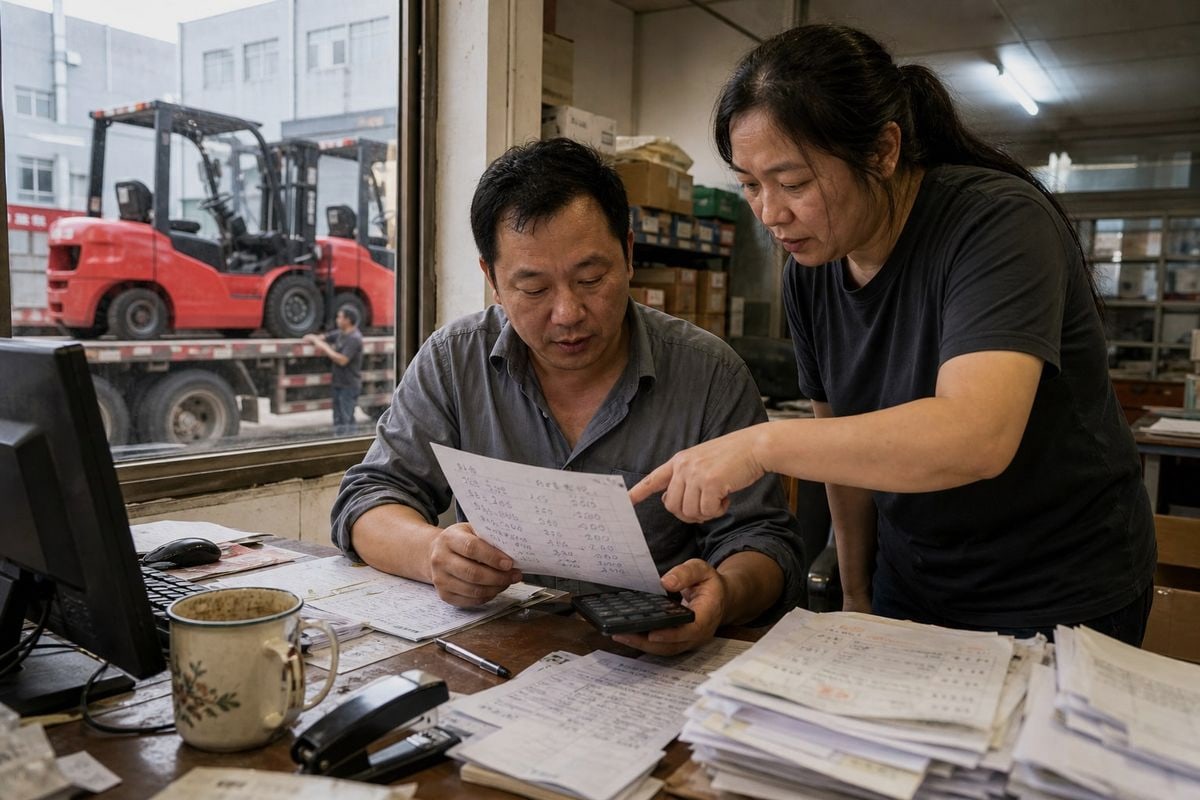
Let me walk through the full picture, because freight is only one slice of your landed cost. When we quote clients, we always split the numbers into China-side costs, ocean freight, and Australia-side costs. That way, nothing surprises you after the vessel departs.
The main cost components
A typical electric forklift has an FOB price of around USD 8,000–15,000 depending on capacity and battery type. On top of that, here is what the logistics side usually looks like:
| Cost Item | Typical Range (USD) | Notes |
|---|---|---|
| Ocean freight (40HQ container 1) | 1,500–4,000 | Varies by season and port pair |
| China trucking and export declaration | 200–500 | Factory pickup and export customs |
| Port handling + local trucking in Australia | 300–800 | Terminal fees, delivery to your site |
| Customs brokerage in Australia | 150–400 | Import declaration lodgement |
| Marine insurance | ~0.3–0.5% of cargo value | Strongly recommended for high-value machinery |
| Import duty | 0% with ChAFTA COO; 5% without | Complete forklifts under HS 8427 |
| GST | 10% | Calculated on customs value + freight + insurance |
Why the ChAFTA certificate matters so much
Without a ChAFTA Certificate of Origin 2, you pay the standard 5% duty. With it, complete electric forklifts qualify for the 0% preferential rate. On a USD 12,000 machine, that certificate saves you USD 600. We always confirm the supplier can issue it before the order is finalized.
One warning from experience: some buyers see duty figures online for forklift parts and assume the same rate applies to complete machines. It does not. Parts and complete forklifts sit under different tariff treatments, so verify your specific HS code with a customs broker before you calculate landed cost.
Also, split freight cost from taxes when you budget. GST at 10% applies to the sum of customs value, international freight, and insurance. A quote that only shows ocean freight is not a landed cost.
What documents and customs requirements do I need for lithium battery forklift shipping to Australia?
The hardest lesson we learned coordinating battery-powered equipment exports was this: carriers can reject a booking at the port if lithium battery paperwork is incomplete. Prevention beats rescue every time.
You need a commercial invoice, packing list, bill of lading, ChAFTA Certificate of Origin, packing declaration, UN 38.3 test summary, MSDS, and a Dangerous Goods declaration classifying lithium batteries as Class 9 (UN 3480/3481). Australia also requires a clean, soil-free machine for biosecurity inspection.
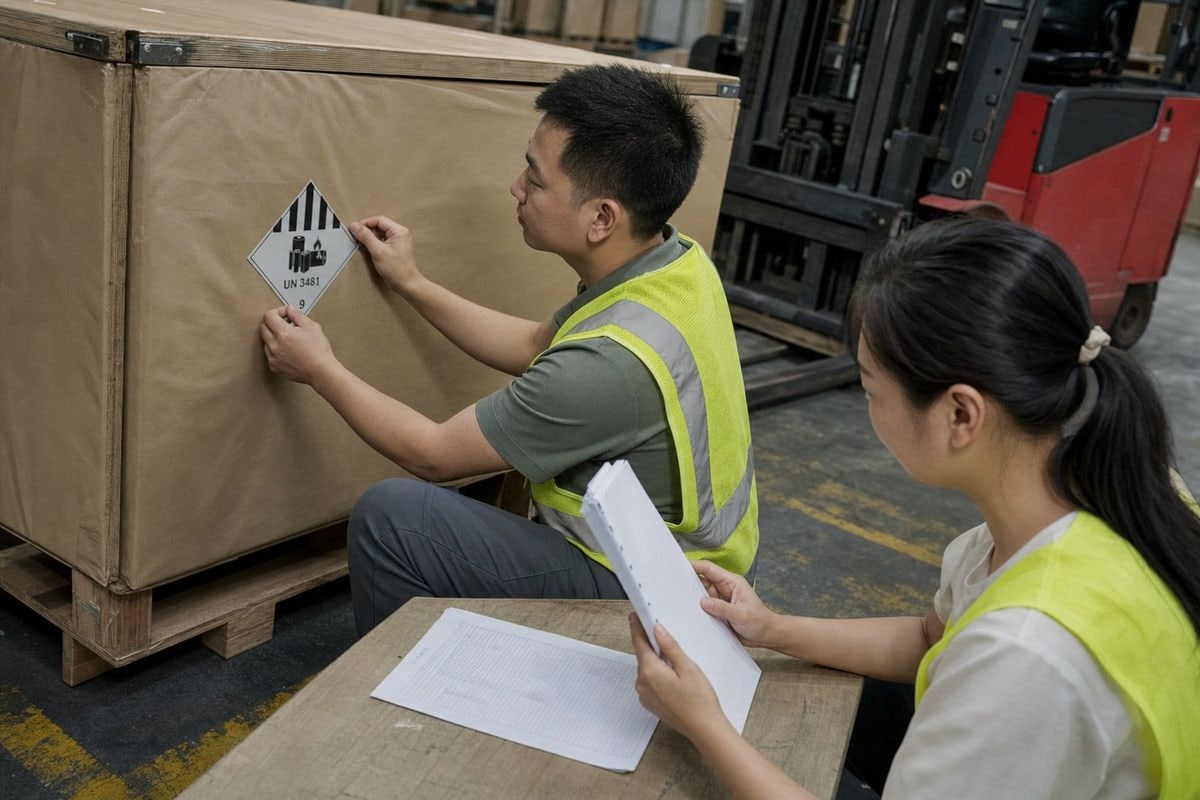
There are two separate compliance tracks here, and buyers often confuse them. One track is battery safety under lithium battery transport regulations. The other is Australian import and biosecurity clearance. You need both to run clean.
Track one: battery and dangerous goods paperwork
Lithium-ion forklift batteries are classified as Class 9 Dangerous Goods 3 under UN 3480 (batteries shipped separately) or UN 3481 (batteries installed in equipment). Before we book any vessel, we collect these from the factory:
| Document | Purpose | Who Provides It |
|---|---|---|
| UN 38.3 test summary | Proves the battery passed transport safety testing | Battery manufacturer |
| MSDS (Material Safety Data Sheet) | Describes battery chemistry and handling risks | Battery manufacturer |
| Dangerous Goods declaration | Formal Class 9 declaration for the carrier | Shipper / freight forwarder |
| Battery state-of-charge confirmation | Confirms safe charge level for transit | Factory before loading |
If any of these are missing, the carrier can refuse the container. We check them during production, not at the port gate.
Track two: Australian customs and biosecurity
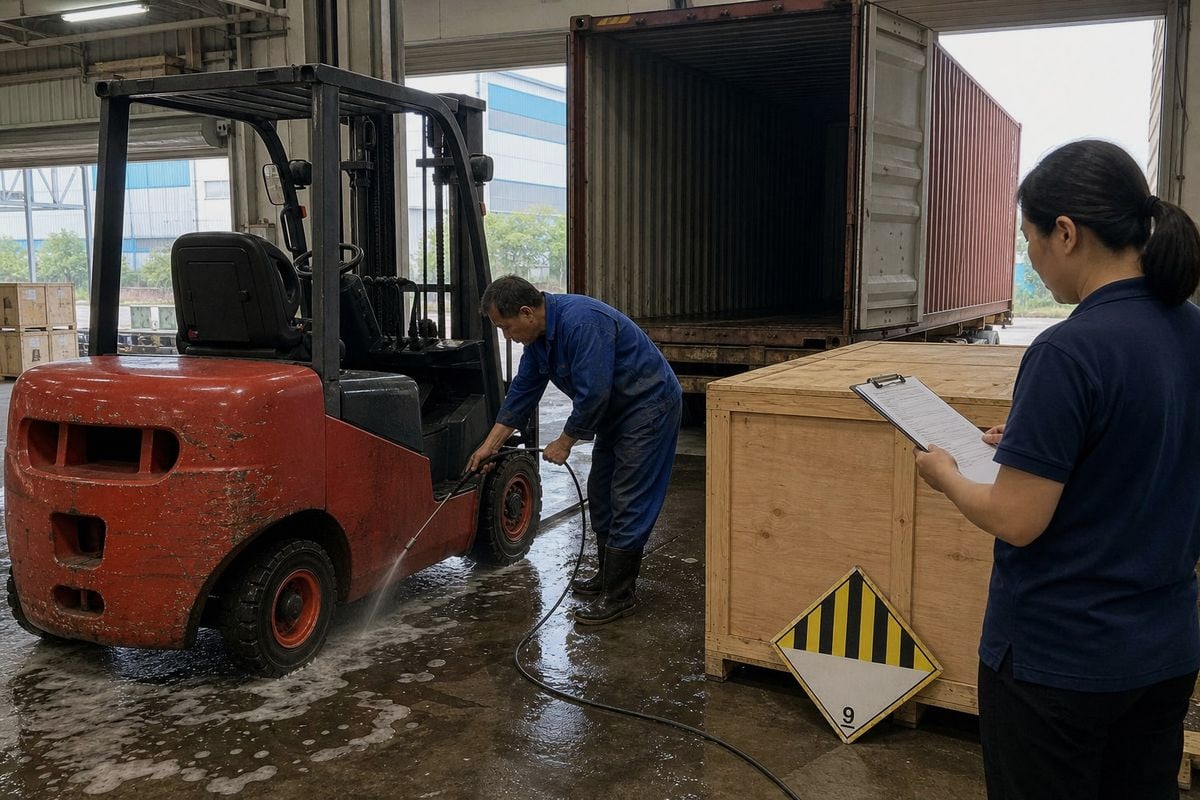
Customs clearance Australia requires an import declaration supported by the commercial invoice, packing list, bill of lading, and a packing declaration for sea freight. But the item that catches most first-time importers is biosecurity. The Department of Agriculture, Fisheries and Forestry (DAFF) enforces a zero-tolerance policy for soil and plant material 4 on machinery. That means thorough steam cleaning of the forklift, including tires, wheel arches, and the underside, before it leaves China.
One smart shortcut: the Offshore Biosecurity Treatment program lets machinery be inspected and certified in China before departure, which helps you bypass lengthy quarantine holds at Australian ports. We also verify that safety decals are in English and load charts are metric to satisfy Australian Standard AS 2359, and that the charger is configured for Australian 3-phase power with AS/NZS 3112 compliant plugs. Fixing a charger plug in Zhengzhou costs almost nothing. Fixing it in Sydney costs time and money.
Should I choose FCL or LCL when shipping my electric forklift to Australia?
Every week, our team weighs the same trade-off with clients: pay for a full container you may not fill, or share space and accept extra handling of a heavy machine.
Choose FCL if you ship one or more full-size forklifts, because it reduces handling risk and cuts per-unit cost. Choose LCL only for compact stackers or pallet trucks. Use a flat rack container or RORO shipping for oversized units that exceed standard container dimensions.
Here is how the main options compare at a glance:
| Method | Best For | Handling Risk | Cost Efficiency |
|---|---|---|---|
| FCL (20FT/40FT/40HQ) | 1+ standard forklifts, plus parts | Low — container sealed at factory | High for full loads |
| LCL consolidation | Small stackers, pallet trucks, spare parts | Higher — shared handling | Good for small cargo only |
| Flat rack container | Tall masts, oversized or overweight units | Moderate — needs expert lashing | Case by case |
| RORO shipping | Self-driving oversized machinery on limited routes | Low for drivable units | Limited route availability |
| Air freight | Urgent compact parts, chargers | Low | Very expensive for whole forklifts |
Why FCL wins for most forklift buyers
A standard 3-ton electric forklift fits inside a 40HQ container, often with the mast lowered or partially disassembled. FCL means the container is loaded and sealed at the factory under supervision, then opened only at your destination. Nobody touches your machine in between. With LCL, your forklift shares space with other cargo and gets handled at consolidation warehouses. For a machine worth USD 8,000–15,000, that extra handling is a real risk.
FCL also improves your unit economics. Two forklifts in one 40HQ container roughly halves the freight cost per machine. We often help buyers fill remaining space with chargers, spare batteries, forks, or parts from other suppliers through multi-supplier consolidation. That dead space becomes free freight.
When the special cases apply
Flat rack containers make sense when the mast height or counterweight width exceeds standard container door openings. RORO shipping works for machinery that can be driven on and off the vessel, but routes from China to Australia are limited, so treat it as a fallback rather than the default. Air freight is realistic only for parts and accessories, not complete electric forklifts.
How can I ensure my electric forklift arrives safely and on schedule in Australia?
After coordinating hundreds of container loadings, I can tell you that most cargo damage happens in the first and last hundred meters, not on the ocean.
Secure the forklift with blocking, bracing, chains, and dunnage during container loading, arrange a pre-shipment inspection, buy marine insurance, and prepare all battery and biosecurity documents before departure. Expect 15–25 days of sea transit, plus 2–5 days for clearance and delivery.
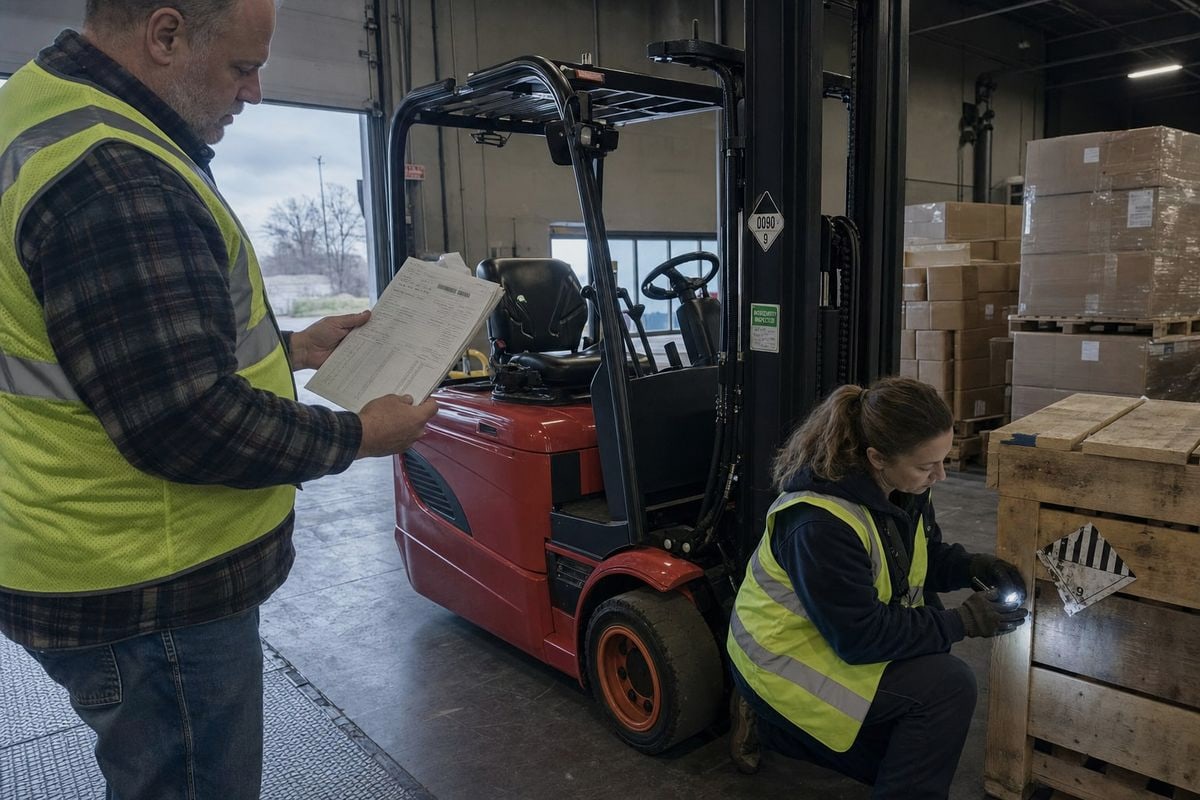
Safe arrival is not luck. It is a sequence of decisions made weeks before the vessel sails. Here is the process we follow on every forklift shipment.
Step one: verify before the container closes
A third-party pre-shipment inspection confirms the correct model, capacity rating, battery specification, charger voltage, label compliance, and packaging condition before the container is sealed. Once that seal goes on, you lose your last easy chance to catch a wrong-spec machine. We also photograph the loading process so there is a condition record if an insurance claim ever becomes necessary.
Step two: load and secure properly
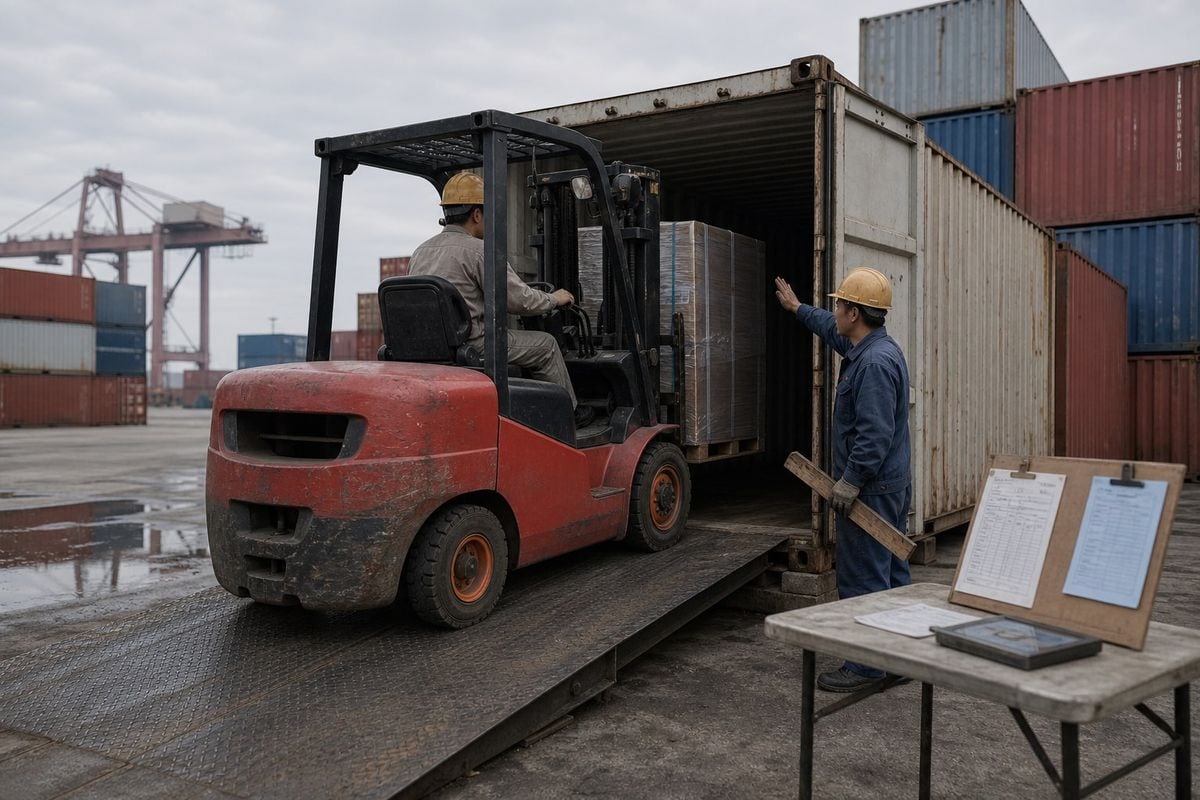
Forklifts are heavy, top-loaded machines with concentrated weight in the counterweight. Proper loading means checking weight distribution across the container floor, then locking the machine in place with wheel chocks, wooden blocking, lashing chains, and dunnage. The battery state of charge should be confirmed and recorded. For high-capacity lithium models, active IoT telematics can monitor battery cell temperature and state-of-health throughout the 15–25 day sea transit, which gives both buyer and insurer real data instead of guesswork.
Step three: protect the schedule, not just the cargo
Delays usually come from paperwork, not weather. So we clear the Dangerous Goods declaration with the carrier before booking, submit biosecurity cleaning evidence early, and pre-lodge customs documents so clearance starts before the vessel berths. Marine insurance covers the residual risk that no planning can remove. Finally, plan the last mile: your site needs a truck with suitable unloading equipment, or a loading dock and ramp, because a 3-ton forklift cannot be lifted off a flatbed by hand. One experienced freight forwarder coordinating all of these stages beats five separate vendors pointing fingers at each other.
Conclusion
Shipping electric forklifts from China to Australia rewards preparation: correct battery paperwork, ChAFTA documentation, clean machines, FCL loading, and one coordinated freight partner from factory to your door.
Footnotes
1. Overview of standard shipping container types and dimensions used in international freight. ↩︎
2. Official guide to the China-Australia Free Trade Agreement and its preferential duty rates. ↩︎
3. International Maritime Organization standards for the safe transport of hazardous materials by sea. ↩︎
4. Australian government requirements for importing machinery to prevent biosecurity risks and contamination. ↩︎




