
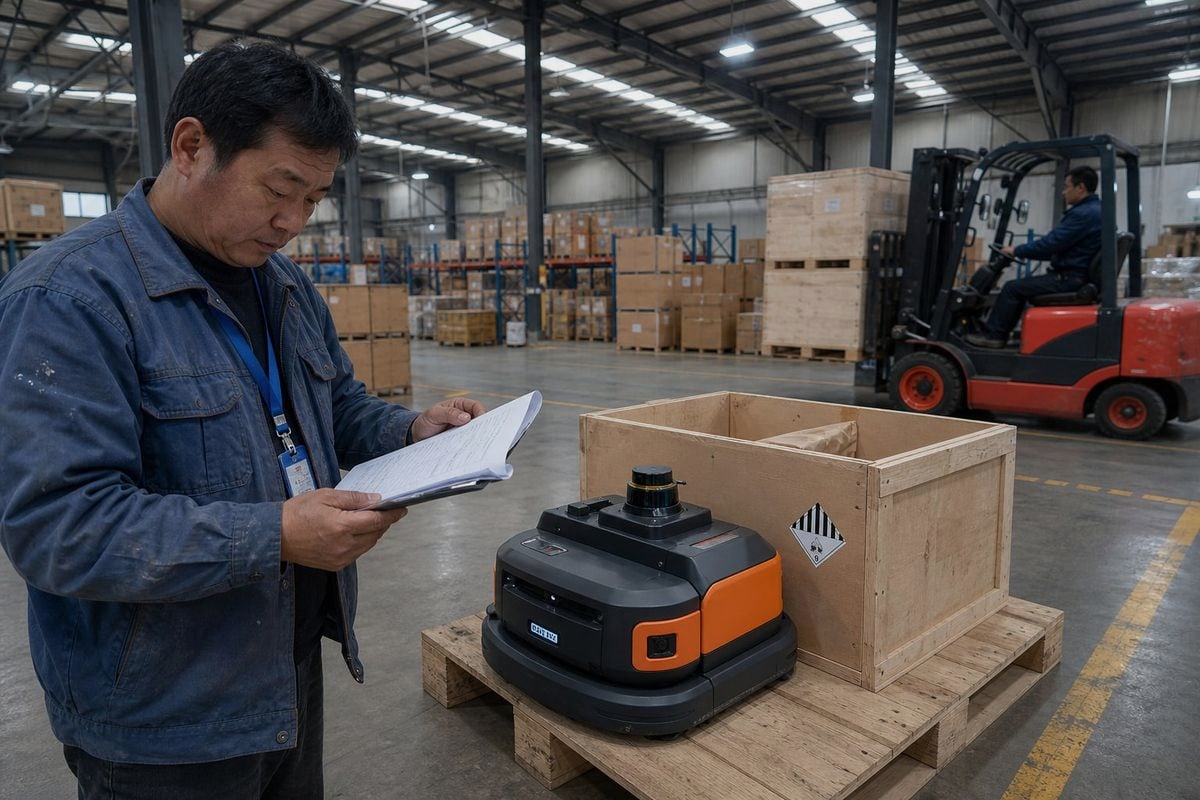
Shipping battery-powered warehouse robots from China looks simple until the battery paperwork stops your cargo at the port. I have watched that happen from our Zhengzhou operations floor more than once. A buyer pays for a robot, the factory finishes production, and then the shipment sits for weeks because nobody classified the lithium battery 1 correctly. The good news is that every one of those delays is preventable when you plan the battery compliance, documentation, and freight mode before the robot leaves the factory.
To ship battery-powered warehouse robots from China, classify the lithium battery under UN3481, obtain UN38.3 test summaries and MSDS documentation, discharge batteries to 30% state of charge for air freight, use UN-certified export crates, and book sea freight FCL for full-size units to control costs.
That is the short answer. The full picture involves battery chemistry, dangerous goods rules 2, customs codes, and freight economics. Let me walk you through each step the way we handle it for real shipments.
How Do I Prepare Battery-Powered Warehouse Robots for International Shipping from China?
A client once asked me why his AMR arrived with a dead battery that would not accept a charge. The robot had drained itself during a 40-day ocean transit. Our team now checks transit mode settings on every battery-powered unit we load.
Prepare warehouse robots for shipping by confirming the exact battery chemistry and capacity, discharging lithium-ion packs to 30% state of charge, activating a transit mode or physical isolation switch, securing sensors with anti-resonance mounting, and packing units in UN-certified reinforced wooden crates.
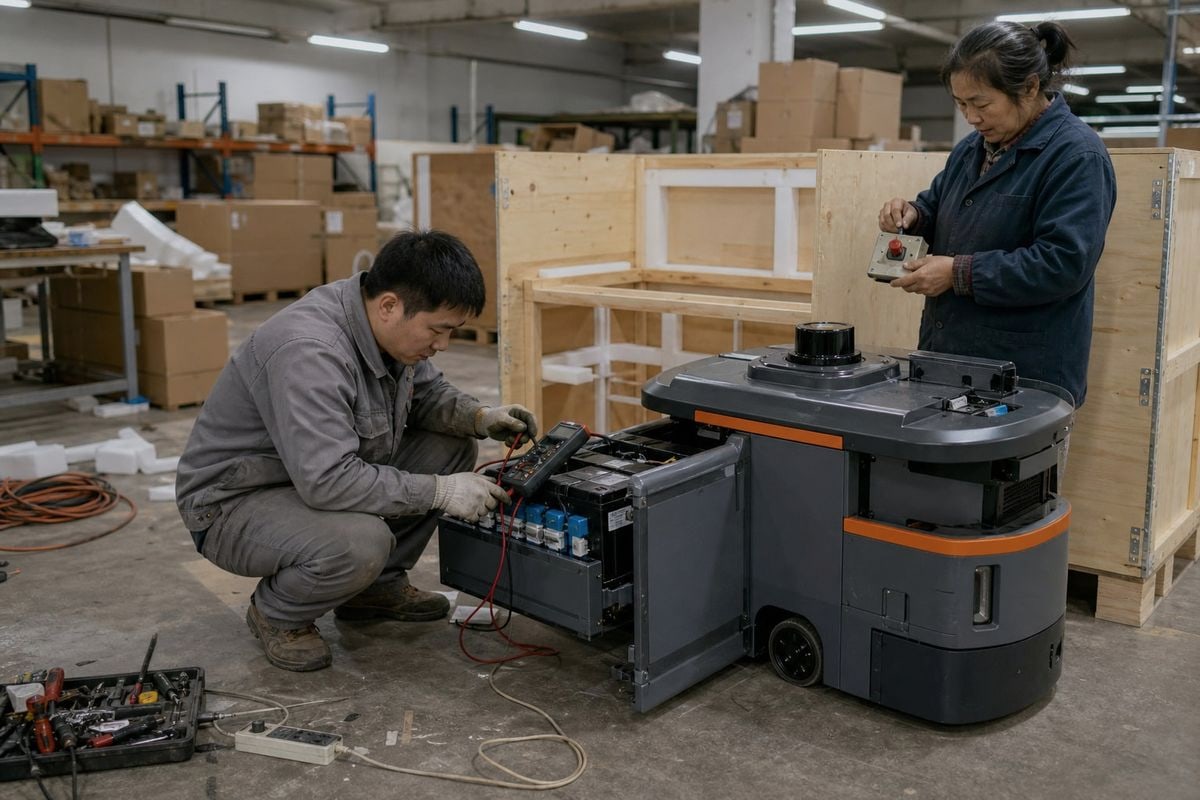
Preparation starts with the battery, not the box. Most Chinese warehouse robots run on lithium-ion 3 or lithium iron phosphate (LiFePO4) packs. Common configurations include 24V/36Ah, 48V/30Ah, and 40Ah packs, with runtimes around 6 to 12 hours and charging times from roughly 1.1 to 5 hours depending on the model. These numbers matter because battery capacity drives the dangerous goods classification and the packing method.
Battery State of Charge and Transit Mode
If any leg of the journey involves air freight, the battery must be discharged to a maximum 30% state of charge. This is a factory-level task. The supplier needs a controlled discharge protocol before packing, not a guess. But a 30% charge creates a second risk. Modern Autonomous Mobile Robots (AMR) have onboard computers, LiDAR units, and communication modules that draw parasitic power even when "off." Over a long sea transit, that drain can push the battery below its safe voltage floor and permanently brick it. The fix is a physical battery isolation switch or a software-triggered transit mode. We ask every factory to confirm one of the two in writing before pickup.
Sensor Protection During Ocean Transit
Standard impact foam is not enough for high-precision LiDAR. Container ships produce low-frequency vibration profiles that can decollimate sensitive sensors over weeks at sea. Anti-resonance internal mounting inside the crate prevents this. When we coordinate container loading and cargo securing in China, we check the internal bracing, not just the outer crate.
Pre-Shipment Checklist
- Confirm battery chemistry, voltage, capacity, and whether the pack is integrated or removable.
- Verify the 30% SoC discharge if air freight is possible.
- Confirm transit mode or isolation switch activation.
- Inspect crate design, anti-resonance mounting, and short-circuit protection.
- Photograph and video the unit before crating for insurance records.
What Documentation Do I Need for Shipping Lithium Battery Robots from China?
The hardest lesson in my early forwarding years came from a single missing test summary. The carrier rejected the booking two days before the vessel cut-off. Since then, our documentation review happens weeks before cargo ever reaches the port.
You need three core battery documents: a UN38.3 test summary, a current-year MSDS, and the Identification and Classification Report for Safe Transport of Goods. Add a commercial invoice, packing list, dangerous goods declaration, and battery specification sheet for full customs clearance.

Carriers and Chinese customs both treat lithium battery cargo strictly. The three pillars of battery documentation are non-negotiable. The UN38.3 certification proves the battery passed the required transport safety tests. The MSDS documentation must be issued for the current year, because carriers routinely reject expired sheets. The Identification and Classification Report, issued by an approved Chinese testing body, confirms how the goods must be classified for safe transport. Without all three, most carriers will refuse the booking outright.
The Full Documentation Stack
| Dokument | Formål | Hvem der leverer det |
|---|---|---|
| UN38.3 testoversigt | Dokumenterer at batteriet har bestået sikkerhedstest ved transport | Battery maker via robot factory |
| MSDS (current year) | Chemical safety data for carrier acceptance | Battery maker via robot factory |
| Identification & Classification Report | Chinese transport classification for export | Approved testing institute |
| Kommerciel faktura | Declared value for customs | Leverandør |
| Pakkeliste | Crate dimensions, weights, contents | Supplier / forwarder |
| Erklæring om farligt gods | Formal DG shipping paper | Afsender / speditionsfirma |
| Battery Specification Sheet | Voltage, capacity, chemistry details | Robot factory |
Classification: UN3481 vs UN3480
Classification determines cost and complexity. A robot shipped as a complete machine with the battery installed falls under UN3481, lithium-ion batteries contained in equipment. This path is significantly cheaper and simpler than shipping batteries separately as standalone UN3480 cargo, which faces tighter carrier restrictions. When buyers order swap packs or spare batteries, we advise shipping them installed or packed with equipment where the rules allow it.
Emerging Requirements
Two newer rules deserve attention. First, the EU Battery Passport under Regulation 2023/1542 4 requires a digital twin and QR-coded serial data for robot batteries exceeding 2kWh entering the European market. Second, high-specification AMRs with advanced mapping or swarming capabilities may trigger MOFCOM dual-use export controls in China, and that government license can add around six weeks to the timeline. We flag both risks during the quotation stage, not after booking.
How Can I Reduce Shipping Costs When Importing Warehouse Robots from China?
Every quotation we prepare involves the same trade-off conversation: speed versus landed cost versus risk. One US distributor cut his per-unit logistics cost sharply just by letting us consolidate robots, chargers, and spare parts from three factories into one container.
Reduce costs by booking sea freight FCL instead of air, classifying robots under UN3481 with batteries installed, using HS code 8479.50 for industrial robots, consolidating multi-supplier cargo into one container, and requesting DDP shipping terms with all destination charges quoted upfront.

Freight for a low-cost robot may look like a small line item. Chinese warehouse robots list from roughly US$7,000 to US$9,880 for entry models, and much more for heavy units. But for full-size machines shipped internationally, logistics can materially move the landed cost. Here is where the savings actually come from.
Choose the Right Customs Classification
Using HS code 8479.50 for industrial robots 5 is the most effective way to standardize the customs clearance process and manage destination tariff risk, including US Section 301 duties on Chinese goods. An inconsistent HS code between the invoice, packing list, and declaration is a classic trigger for customs holds, storage fees, and demurrage. As a freight forwarder China buyers work with daily, we verify the code against the product spec sheet before export declaration.
Consolidate and Fill the Container
Robots rarely fill a container efficiently on their own. Charging docks, spare batteries, chargers, and parts from other suppliers can fill the unused space. We routinely pick up cargo from multiple Chinese factories, consolidate it at our warehouse, and load one optimized container.
Compare the Cost Levers
| Cost Lever | Typical Impact | What to Ask For |
|---|---|---|
| Sea FCL vs air freight | Largest single saving on full-size robots | FCL quote with DG handling included |
| UN3481 klassifikation | Avoids standalone battery surcharges | Battery installed in equipment |
| Multi-leverandør konsolidering | Lower cost per unit shipped | One forwarder managing all pickups |
| Correct HS code (8479.50) | Avoids holds, fines, re-classification duty | Code confirmed before declaration |
| DDP shipping terms | No surprise destination charges | Duties and delivery in one quote |
Plan Around Production Lead Times
Standard robot models typically take 15 to 30 days to produce, and customized units can take 45 to 60 days. Start the shipping plan during production, not after. Battery documents and crate design should be finalized while the robot is still on the line. That timing alone prevents most last-minute air freight upgrades, which are the single most expensive mistake in this trade.
Which Shipping Method Should I Choose for Battery-Powered Robots from China?
Buyers often open our first call with one question: sea or air? My answer depends on three things I always ask back — battery size, unit weight, and how urgent the deployment date really is.
Choose sea freight FCL for full-size warehouse robots because it tolerates larger batteries and avoids weight-based dangerous goods air surcharges. Use air freight only for urgent small AMRs discharged to 30% SoC, and express courier for parts, chargers, and small spares.

Here is the honest comparison we give clients before every booking:
| Metode | Bedst til | Battery Constraints | Cost Profile | Typical Transit |
|---|---|---|---|---|
| Hav FCL | Full robots, fleets, heavy units | Most tolerant of large packs | Lowest per kg for bulky cargo | 25–45 days to US/EU |
| Hav LCL | 1–2 small units plus accessories | Same rules, DG acceptance varies | Moderate, per-CBM pricing | 30–50 days |
| Luftfragt | Urgent small AMRs, samples | 30% SoC mandatory, capacity limits | High, plus DG surcharges by weight | 5–10 dage |
| Ekspresbud | Parts, chargers, small spares | Strict lithium limits per parcel | High per kg, fine for small items | 3–7 days |
Sea freight FCL is the industry standard for industrial-scale deployments. The reason is simple: air carriers levy weight-based dangerous goods surcharges under Class 9 hazardous materials rules, and a several-hundred-kilogram robot makes those surcharges prohibitive. Ocean carriers accept properly documented Class 9 cargo with far fewer capacity restrictions, provided the crate carries the correct Class 9 labeling and passes the UN packaging requirements, including the 1.2-meter drop test standard for battery cargo.
When Air Freight Still Makes Sense
Air works for compact AMRs under urgent deadlines, replacement controllers, or a sample unit before a fleet order. Remember the constraints: lithium-ion battery regulations impose the 30% SoC limit, and some carriers cap battery capacity per package. Your factory must execute the discharge protocol before packing, and the dangerous goods declaration must match the actual battery state.
Do Not Let Freight Outrun Site Readiness
One caution from experience: the fastest shipping option is not always the best one. A robot arriving before your warehouse Wi-Fi upgrade, charging dock installation, or WMS integration is finished just sits in storage. We encourage buyers to align vessel schedules with site commissioning dates. Under DDP shipping terms, we can hold delivery timing to match the installation window, which often saves more money than any freight discount.
Konklusion
Shipping battery-powered warehouse robots from China succeeds when battery compliance, documentation, and freight mode are planned before production ends. Get the classification right, and everything else follows smoothly.
Fodnoter
1. Official UN regulations governing the international transport of dangerous goods, including lithium batteries. ↩︎
2. Industry standard guidelines for the safe air transport of lithium batteries and dangerous goods. ↩︎
3. Comprehensive technical overview of lithium-ion battery chemistry, safety, and common industrial applications. ↩︎
4. Official EUR-Lex page for the regulation; replaces the broken European Commission topic page. ↩︎
5. Official US Harmonized Tariff Schedule for classifying industrial robots and determining applicable import duties. ↩︎




