
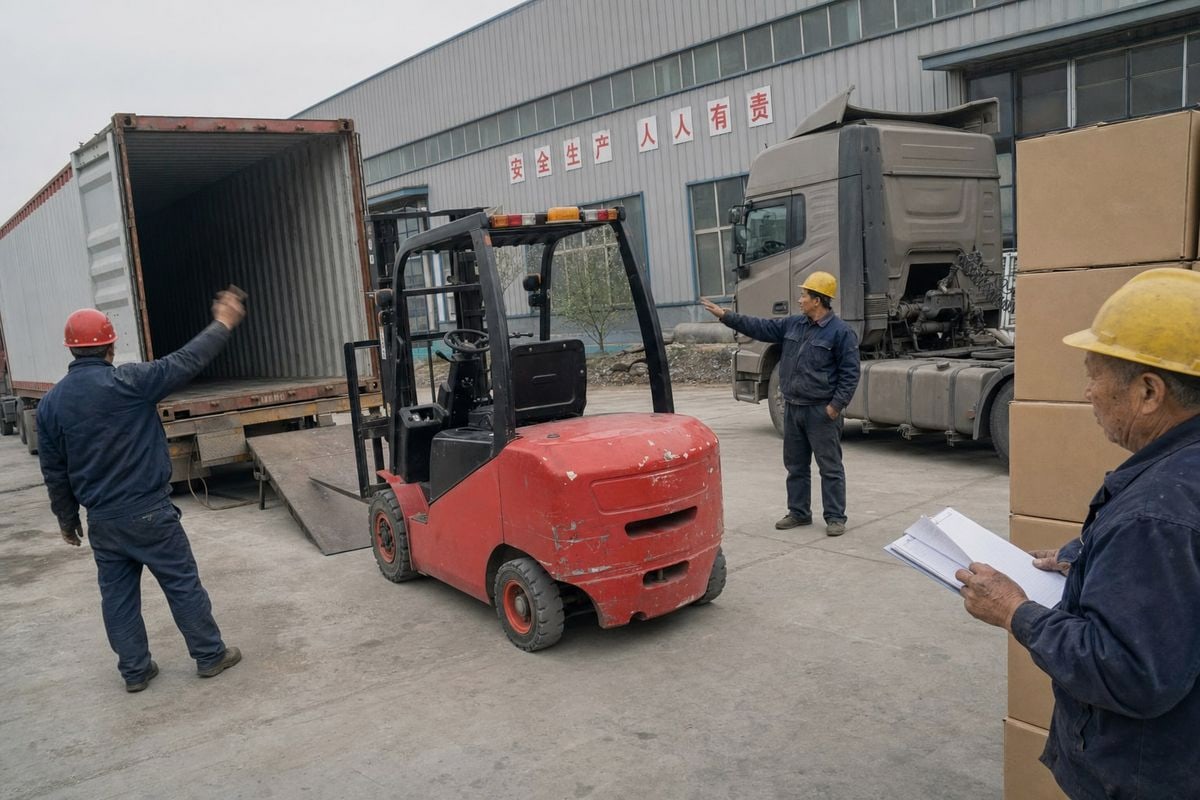
Shipping [electric forklifts from China](https://mbmlog.com/?p=12274) to Spain looks simple until the battery paperwork stalls your container at the port. On our loading docks in Zhengzhou, we see it happen to unprepared buyers every month.
For at sende elektriske gaffeltrucks fra Kina til Spanien, bekræft batterikompatibilitet (UN38.3, MSDS), forbered en kommerciel faktura, pakkeliste, fragtbrev, CE-overensstemmelseserklæring og EORI-nummer, og book derefter FCL skibsfart til Valencia eller Barcelona, mens du klarer spansk told med 21% moms.
Det er det korte svar. Lad mig nu guide dig gennem hvert skridt, for detaljerne afgør, om din gaffeltruck ankommer til tiden eller sidder i tolden i flere uger.
Hvilke dokumenter har jeg brug for at sende elektriske gaffeltrucks fra Kina til Spanien?
Sidste år tilbageholdte vores team en container i Shenzhen i seks dage, fordi fabrikken glemte UN38.3 testrapporten. Den manglende side lærte vores kunde en dyr lektion.
Du har brug for en kommerciel faktura, pakkeliste, fragtdokument, oprindelsescertifikat, CE-erklæring om overensstemmelse, UN38.3 certificering, MSDS-dokumentation og en erklæring om farligt gods, hvis det er nødvendigt. På den spanske side skal du have et gyldigt EORI-nummer til toldklarering.

Dokumentation er hvor de fleste gaffeltruckforsendelser lykkes eller fejler. I min erfaring med at koordinere eksporter af elektriske gaffeltrucker, er det sjældent gaffeltrucken selv, der forårsager forsinkelser. Det er papirarbejdet. Spanske toldere er strikse, og EU-regler tilføjer et compliance-lag, som mange førstegangsimportører undervurderer.
Tjekliste for kerndokumenter
Her er det fulde sæt dokumenter, jeg beder hver kunde om at forberede, før vi booker plads hos en transportør:
| Dokument | Hvem der leverer det | Hvorfor det betyder noget |
|---|---|---|
| Kommerciel faktura | Leverandør | Angiver værdi for told og moms |
| Pakkeliste | Leverandør | Bekræfter vægte og dimensioner |
| Fragtbrev | Speditør | Bevis for forsendelse og vareejerskab |
| Oprindelsescertifikat | Leverandør / CCPIT | Understøtter toldbehandling |
| CE-overensstemmelseserklæring 1 | Producent | Obligatorisk for EU-markedsadgang |
| UN38.3 Testrapport | Batteriproducent | Beviser at lithiumbatteriet bestod transport sikkerhedstest |
| MSDS / SDS | Batteriproducent | Beskriver batterikemi og farer |
| DG-erklæring | Speditør / afsender | Nødvendig hvis lasten er booket som Klasse 9 farlige godser |
| EORI-nummer | Du (importøren) | Obligatorisk for enhver virksomhed, der importerer til Spanien |
CE-mærkning er ikke valgfri
Spanske toldmyndigheder vil afvise industriel udstyr, der ikke opfylder europæiske sikkerhedsstandarder. Så før du betaler et depositum, skal du bede fabrikken om CE-overensstemmelseserklæringen og den tekniske fil. Vi tjekker dette dokument for hver EU-bunden forsendelse, vi håndterer, fordi en manglende CE-mærkning betyder, at gaffeltrucken ikke lovligt kan træde ind på markedet, uanset hvor godt fragten gik.
Få dit EORI ordnet tidligt
Et EORI (Økonomiske operatørers registrering og identifikation 2) nummer er en obligatorisk forudsætning for enhver virksomhed, der importerer varer til Spanien fra uden for EU. Registrering tager tid. Begynd det, mens gaffeltrucken stadig er i produktion, ikke når skibet er en uge fra havnen i Valencia.
Hvor meget koster det at sende en elektrisk gaffeltruck fra Kina til Spanien?
En distributør sagde engang til mig, at hans tilbud på gaffeltrucks så fantastisk ud, indtil fakturaen for destinationsafgifterne kom. Det gap, der er mellem "fragt tilbud" og "landede omkostninger", er hvor budgetterne bryder sammen.
De samlede landede omkostninger kombinerer havfragt, oprindelsesafgifter, håndtering ved destinationen, importafgifter under HS-kode 842710, Spaniens 21% moms (IVA), indenlandsk transport og forsikring. En enkelt gaffeltruck i en 20FT container koster typisk nogle tusinde dollars i fragt, før afgifter og skatter.

Når vi laver tilbud på elektriske gaffeltruckforsendelser til Europa, opdeler jeg altid prisen i lag. En tilgang som "det laveste tilbud vinder" er misvisende, fordi batteridokumentation, destinationsafgifter og indenlandsk levering kan tilføje betydelige omkostninger, hvis de ikke er inkluderet fra starten. Her er, hvordan jeg lærer kunder at lave et ægte estimat for landede omkostninger.
De Syv Omkostningslag
| Omkostningslag | Hvad den dækker | Almindelig overraskelse |
|---|---|---|
| Fabrikspris | Gaffeltrucken selv | Lader og batteri tilbydes nogle gange separat |
| Oprindelsesafgifter | Afhentning, eksportdeklaration, havneafgifter i Kina | DG håndteringsgebyrer for lithiumbatterier |
| Oceanfragt | Havneskib transport fra havn til havn | Priser ændrer sig med ruteoverbelastning |
| Destinationsafgifter | Terminalhåndtering i Valencia, Barcelona eller Algeciras | Ofte udelukket fra billige tilbud |
| Duties | Based on the TARIC code, typically 8427.10 | Wrong HS classification triggers penalties |
| VAT (IVA) | Spain applies 21% on customs value plus duty and freight | Recoverable for VAT-registered businesses |
| Inland transport + insurance | Trucking to your warehouse, cargo insurance | Unloading a heavy forklift needs the right equipment |
Duties, VAT, and the TARIC Code
Check the TARIC code for your exact forklift type. Most self-propelled electric forklifts fall under HS Code 842710. Get this classification right on the commercial invoice, because Spanish customs clearance runs on it. Then apply Spain's 21% Value Added Tax on top of the customs value plus duty. Many buyers forget that VAT applies to the freight cost too, not just the machine price.
Transit Time Affects Cost Planning
Expect transit times of 30 to 45 days for sea freight to ports like Valencia, Barcelona, or Algeciras. If your project timeline is tight, the China-Europe Railway Express can deliver in approximately 22 days, at a higher rate. Air freight is only realistic for compact units or urgent spare parts, since the cost is far higher. We help clients weigh speed against budget before booking.
Which Incoterm Should You Choose?
- FOB: You control freight and customs. Best for experienced importers.
- CIF: The seller books freight, but you still handle Spanish import clearance.
- DDP: One party manages everything to your door. Simplest, but you depend on the forwarder's customs accuracy.
- EXW: You take over at the factory gate. Only sensible with a China-based forwarder like us handling pickup.
Some providers push DDP as the easiest answer. It often is, especially for smaller importers. But be honest about the trade-off: less visibility and more reliance on your forwarder for import duties and VAT handling. Choose DDP only with a partner who shows you the full cost breakdown.
Hvordan håndterer jeg kravene til forsendelse af lithiumbatterier til min elektriske gaffeltruck?
The hardest question I ask factories is never about the forklift. It is always about the battery. In our experience handling lithium battery cargo, the battery is the hidden complexity of the whole shipment.
Request the UN38.3 certification and MSDS documentation before booking, confirm whether the carrier requires a dangerous goods declaration under Class 9, discharge the lithium battery to around 30% state of charge, and verify the carrier accepts battery-powered machinery on your chosen route.

Here is the truth most first-time importers miss: an electric forklift is not just oversized cargo. If it carries a lithium battery, it can trigger dangerous-goods procedures under lithium battery regulations. Many customs delays come not from the forklift, but from missing battery documentation, or from booking the cargo as non-hazardous when the carrier expects DG handling. We coordinate these requirements before cargo reaches the port, because fixing them afterward means rolled bookings and storage fees.
The Battery Compliance Workflow
Follow this order, and you avoid most battery-related delays:
- Confirm battery chemistry and capacity with the factory. Lithium and lead-acid batteries follow different rules.
- Request the UN38.3 test report for the exact battery pack model. Not a generic one for a similar model.
- Collect the MSDS/SDS from the battery manufacturer.
- Ask your forwarder to check carrier acceptance. Class 9 dangerous goods bookings need pre-approval, and some vessels limit DG slots.
- Discharge the battery to roughly 30% state of charge before crating. This follows the latest maritime safety recommendations for preventing thermal runaway.
- File the dangerous goods declaration if the booking requires it, with packaging and labeling to match.
Watch the Newer Requirements
Carrier rules keep tightening. Some shipping lines now require fire-suppression blankets for electric vehicles and machinery to reduce lithium-ion fire risk 3 during transit, so ask about carrier-specific mandates when booking. Looking further ahead, verify that the forklift's Battery Management System (BMS) aligns with upcoming EU Battery Passport requirements, which will mandate digital tracking of battery health and origin. Buyers importing fleets into Spain should raise this with the manufacturer now, not after the rules land. It is also worth monitoring the EU's Carbon Border Adjustment Mechanism 4 (CBAM), since the high steel content in forklift frames may eventually bring carbon reporting into scope.
Hvilken forsendelsesmetode skal jeg vælge til FCL eller LCL levering af gaffeltrucks til Spanien?
One trade-off I weigh on nearly every quote: does the buyer save money with LCL, or save the forklift with FCL? For heavy machinery, that question usually answers itself.
Choose FCL sea freight for one or more standard electric forklifts, because a dedicated container allows proper blocking and bracing. Use LCL only for compact pallet trucks, flat rack containers for oversized units, and Ro-Ro shipping where routes to Spain allow drivable loading.

Sea freight is the standard mode for forklifts, but the container strategy makes a real difference to cost and cargo safety. Here is how the options compare for the China-to-Spain route:
| Metode | Bedst til | Fordele | Ulemper |
|---|---|---|---|
| FCL (20FT/40FT/40HQ) | 1+ standard forklifts | Full control, secure bracing, no co-loading damage | You pay for the whole container |
| LCL | Small pallet trucks, stackers, parts | Pay only for space used | More handling, longer consolidation time, damage risk |
| Flat rack | Tall or wide forklifts | Fits units that exceed container doors | Higher cost, weather exposure, special lashing |
| Ro-Ro | Drivable units on limited routes | Ingen containerlastning nødvendig | Fewer sailings to Spain, battery cargo restrictions |
| Rail (China-Europe Railway Express) | Time-sensitive fleets | Around 22 days transit | Costs more than sea, battery acceptance varies |
| Luftfragt | Urgent compact parts only | Fastest | Far too expensive for whole forklifts |
Why FCL Usually Wins
For industrial forklifts, FCL søfragt is usually the most realistic and economical choice, especially when battery compliance is involved. A dedicated container lets us position the machine over the container's strong points, chock the wheels, and lash the mast properly. With LCL, your forklift shares space with unknown cargo and gets handled multiple times at consolidation warehouses. For a machine worth thousands of dollars, that risk rarely justifies the modest LCL saving.
Maximize Your Container
A 20FT container often fits one to two compact forklifts. A 40HQ can carry more units or a mix of forklifts, chargers, batteries, and spare parts. We routinely consolidate cargo from multiple factories — forklifts from one supplier, chargers from another, attachments from a third — into a single container. Filling unused space with spare parts lowers the average logistics cost per forklift significantly, which matters when your resale margin depends on landed cost.
Match the Method to the Machine
Measure before you book. If the mast height or counterweight width exceeds standard container openings, a flat rack solves the problem. If your unit is drivable and a Ro-Ro sailing serves Valencia or Algeciras on your timeline, that can work too, though container shipping remains the more common and more predictable choice for electric models with lithium batteries.
Konklusion
Verify battery compliance first, prepare documents early, secure your EORI, calculate the full landed cost, and book FCL sea freight. Do that, and your forklift reaches Spain without surprises.
Fodnoter
1. Official European Commission guide on CE marking requirements for industrial machinery entering the EU single market. ↩︎
2. Official Spanish Tax Agency portal providing mandatory EORI registration and customs identification for businesses importing into Spain. ↩︎
3. International Maritime Organization safety standards for managing fire risks associated with dangerous goods in maritime transport. ↩︎
4. Official European Commission overview of the CBAM regulations affecting carbon-intensive imports into the European Union. ↩︎




