

When we [ship electric pallet jacks from China](https://mbmlog.com/?p=12366) for our clients, one truth stands out: this is a battery, compliance, and machinery project. Get one part wrong, and costs explode fast.
To ship electric pallet jacks from China, classify the lithium battery under UN3480 or UN3481, prepare a UN38.3 test report and MSDS, use ISPM 15 certified packaging, book FCL or LCL sea freight, then clear customs under HS code 8427.10 with correct duties paid.
That is the short version. Below, I break down the costs, the documents, the container math, and the FCL versus LCL decision so you can plan your shipment step by step.
How much does it cost to ship electric pallet jacks from China to the US?
Last month, a Texas dealer sent me a supplier quote that looked great. Then we ran the landet omkostning together at our Zhengzhou office. His face changed on the video call.
Shipping electric pallet jacks from China to the US typically costs $1,800–$5,500 for ocean freight per container, plus Section 301 tariffs of up to 25%, standard import duties, destination handling, and inland trucking. Total landed cost depends on battery classification, container size, and delivery location.

I always tell buyers the same thing: the freight quote is only one line in your landed cost. Electric pallet jacks are heavy, battery-powered material handling equipment. That means several cost layers stack on top of the base ocean rate. Let me walk through each one.
The main cost drivers
First, ocean freight itself. Rates change with the season, the carrier, and the destination port. A 40FT container to the US West Coast costs less than one going to the East Coast or an inland ramp.
Second, tariffs and import duties and taxes. Electric pallet jacks classified under HS code 8427.10 1 face standard duty. US-bound shipments from China also face afsnit 301-told 2, which can add an additional 25% ad valorem duty on Chinese-origin industrial machinery. This is often the biggest surprise for first-time importers. I have seen buyers budget for freight but forget this line entirely.
Third, battery-related costs. Lithium battery cargo may carry a dangerous goods surcharge, extra documentation fees, and stricter carrier acceptance. Not every vessel accepts Class 9 cargo on every sailing.
Fourth, destination charges. These include port handling, customs clearance process fees, bond fees, and final trucking.
| Omkostningskomponent | Typical Range (Indicative) | Noter |
|---|---|---|
| Ocean freight (40FT, FCL) | $1,800–$5,500 | Varies by season and destination port |
| Sektion 301 told | Up to 25% of cargo value | Applies to Chinese-origin machinery |
| Standard importafgift | Based on HS 8427.10 | Confirm with your customs broker |
| DG handling surcharge | $150–$500 | For lithium battery cargo |
| Destination + trucking | $800–$2,500 | Port fees, clearance, last mile |
Fifth, insurance. Pallet jacks are high-value cargo. Skipping cargo insurance to save a small premium is a bet I never recommend.
My advice: model the full door-to-door cost under at least two Incoterms, such as FOB and DDP shipping from China, before you pay the supplier. We do this modeling for our clients before booking, because the cheapest headline rate is rarely the lowest total landed cost.
What documents do I need for lithium battery pallet jack shipping compliance?
A buyer once asked me why his cargo sat at Shanghai port for nine days. The answer was simple. His invoice said one battery spec. His UN38.3 report said another.
Lithium battery pallet jack shipping requires a UN38.3 test summary, MSDS documentation, a dangerous goods declaration, commercial invoice, packing list, bill of lading, certificate of origin, and export declaration. Battery specifications must match exactly across every document to pass customs and carrier checks.
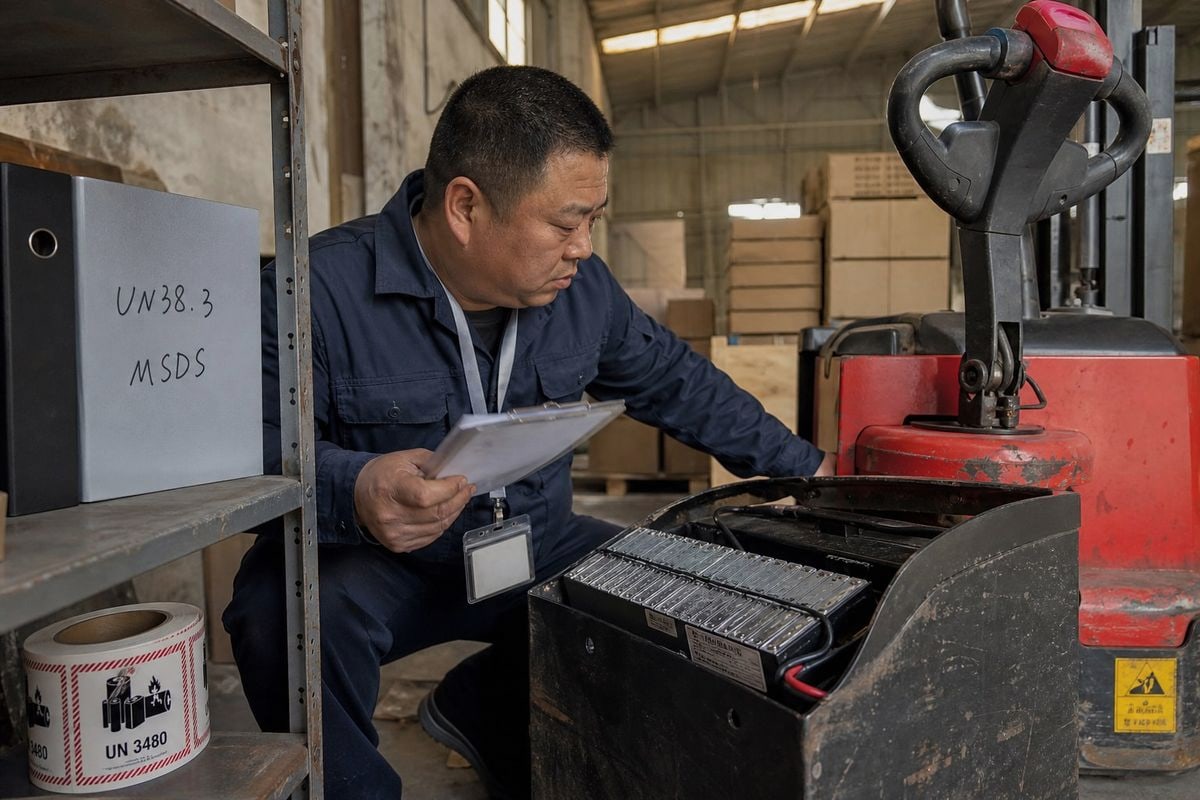
Document consistency is the single most important compliance point in this whole guide. Lithium battery shipping regulations treat installed batteries 3 (UN3481) differently from batteries shipped alone (UN3480). The classification decides your routing options, your paperwork, and your cost. So we confirm the battery configuration with the factory before production, not after the cargo is packed.
Tjekliste for kerndokumenter
Here is what we check for every battery-powered pallet jack shipment:
- Kommerciel faktura — supplied by the factory. Must state the correct product description and value.
- Pakkeliste — must show accurate crate dimensions and gross weight.
- Konnossement — issued by the carrier or forwarder after loading.
- Oprindelsescertifikat — needed for duty assessment at destination.
- UN38.3 testrapport — proves the lithium battery passed transport safety testing. The factory or battery maker provides this.
- MSDS dokumentation — the Material Safety Data Sheet must be current and match the battery chemistry on the invoice.
- Erklæring om farligt gods — required for Class 9 cargo bookings by sea or air.
- Export declaration — handled on the China side before departure.
The consistency rule
Watt-hours, voltage, battery type, and UN number must match across the invoice, packing list, UN38.3 report, and MSDS. One mismatch can trigger a customs hold, storage charges, and demurrage. In our experience exporting to the US, forwarders and brokers reject inconsistent files before carriers even see them. That is why we review every document set before pickup, while there is still time to fix errors cheaply.
One more practical point from the field: ask the factory to physically disconnect the Battery Management System before packing. A live BMS creates parasitic power drain, and over a 40–60 day shipping window it can deplete the cells completely. A dead battery on arrival turns a compliance win into a warranty dispute.
How many electric pallet jacks can I fit in one shipping container?
Before we book any container, our loading team asks the factory three questions: packed dimensions, gross weight, and whether the forks detach. Those answers decide everything about container utilization.
A 20FT container typically fits 8–14 electric pallet jacks, a 40FT fits 18–28, and a 40HQ fits 20–32 units, depending on packed dimensions, stacking method, and whether forks or handles are detached. Weight limits, not floor space, often cap the final count.
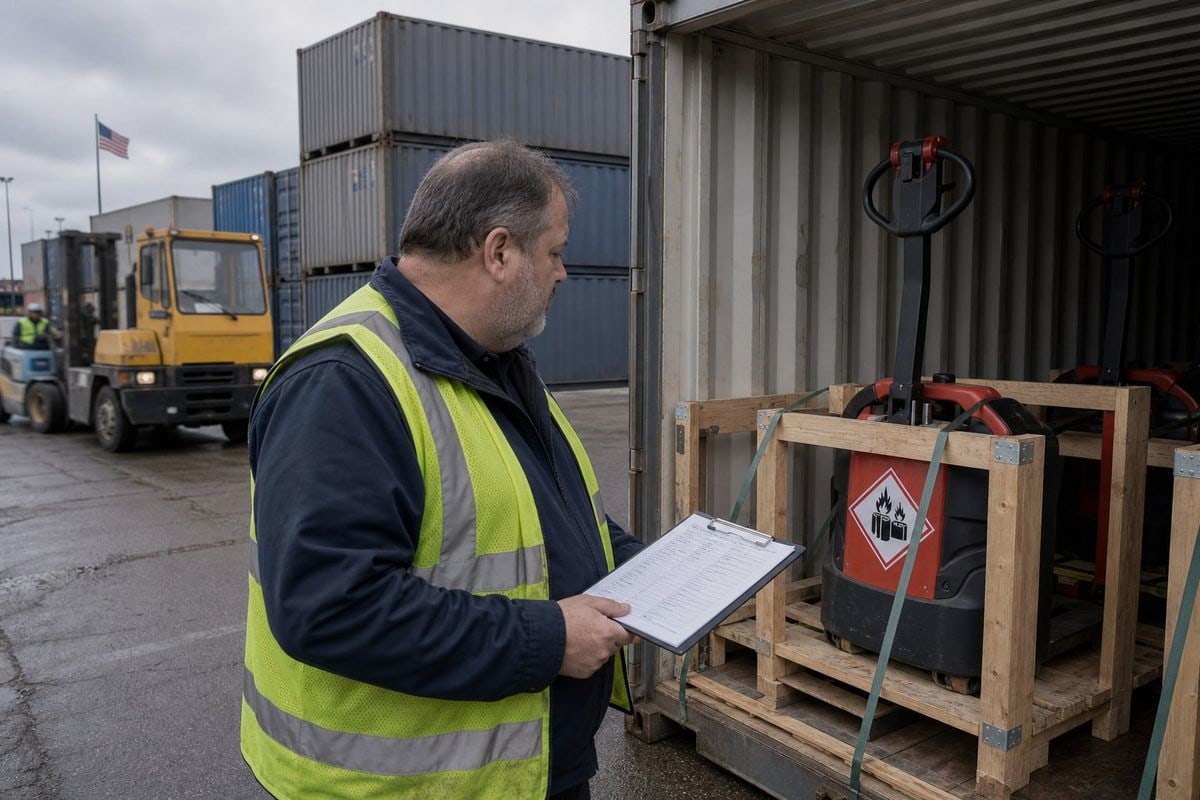
Container math for material handling equipment logistics 4 is never one-size-fits-all. A compact walkie pallet jack packs very differently from a ride-on model with a mast or overhead guard. Still, some planning rules hold for almost every shipment we handle out of Zhengzhou and the coastal ports.
Start with packed dimensions, not product dimensions
Factories quote product size. Carriers charge for packed size. Export crating, pallet bases, and moisture wrapping add centimeters in every direction. We collect the packed carton and crate data from the supplier early, before payment when possible, so the loading plan is real and not a guess.
Watch the weight limit
A 20FT container carries roughly 21,000–25,000 kg of payload depending on the route. Electric pallet jacks with lead-acid batteries are heavy. You can hit the weight ceiling with floor space still empty. Lithium models are lighter, which sometimes lets you load more units or fill the gap with chargers and spare parts.
| Container | Typical Capacity | Best Use Case |
|---|---|---|
| 20FT | 8–14 units | Small orders, heavy lead-acid models |
| 40FT | 18–28 units | Mid-size dealer restocking orders |
| 40HQ | 20–32 units | High-volume orders, mixed cargo with parts |
Fill dead space with accessories
Unused space is wasted freight money. We regularly consolidate chargers, spare forks, batteries, and parts from multiple suppliers into the same container. One client buys pallet jacks from one factory and chargers from another. Consolidating both into one 40HQ cut his per-unit logistics cost noticeably compared to two separate shipments.
Two loading details matter for safety. First, secure every unit with strapping and blocking so nothing shifts at sea. Second, request VCI shrink-wrapping for the hydraulic assembly. Salt air during long maritime transit causes oxidation and piston pitting, and a corroded hydraulic pump is an expensive first impression for your customers.
Should I choose FCL or LCL for shipping my electric pallet jacks from China?
The trade-off I weigh most often for buyers is simple: LCL looks cheaper on paper for one or two units, but every extra handling point adds risk for heavy equipment.
Choose FCL if you ship four or more electric pallet jacks, because it reduces handling damage, offers faster sea freight transit times, and lowers per-unit cost. Choose LCL only for one to three units or spare parts, and accept extra handling risk and consolidation delays.
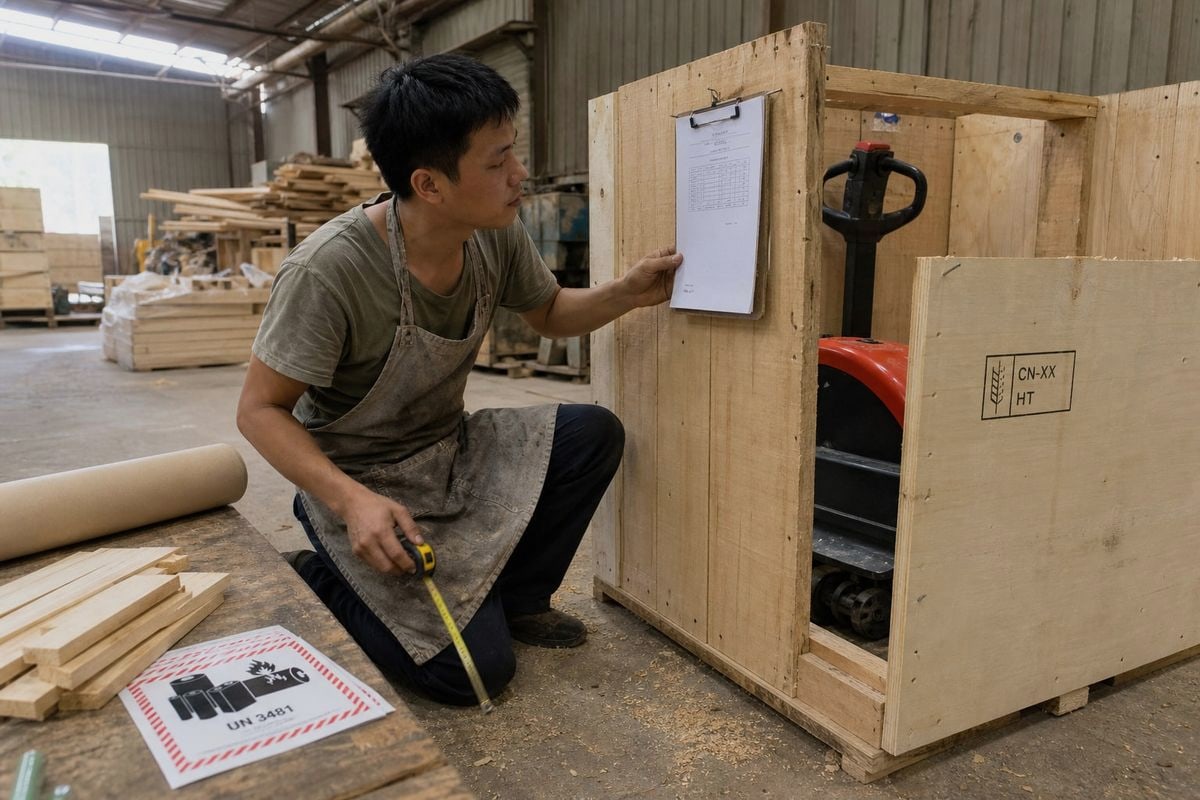
De FCL vs LCL forsendelsesbeslutning shapes your damage risk, your schedule, and your budget. Let me lay out how we guide clients through it.
Quick comparison
| Faktor | FCL | LCL |
|---|---|---|
| Handling points | Loaded once, sealed at origin | Multiple touches at consolidation warehouses |
| Skaderisiko | Lower | Higher for heavy machinery |
| Sea freight transit times | Mere forudsigelig | Slower, waits for consolidation |
| Omkostningslogik | Fast container rate | Charged per cubic meter |
| Bedst til | 4+ units or mixed equipment orders | 1–3 units, chargers, spare parts |
Why FCL usually wins for pallet jacks
Consolidated cargo passes through multiple warehouses. Each transfer is a chance for a forklift operator who does not know your cargo to mishandle a 400 kg machine. With FCL, we load and secure the container at the factory or our consolidation warehouse, seal it, and it stays sealed until your destination. For structural protection alone, I prioritize FCL whenever the volume justifies it.
FCL also clears customs faster in many cases, because your cargo is not tied to other shippers' documents. One bad document set in an LCL container can delay everyone inside it.
When LCL still makes sense
Some buyers only need one demo unit or a batch of spare parts. Paying for a full container makes no sense there. In those cases, we use LCL but insist on export-grade crating, ISPM 15 certified and stamped wooden packaging to avoid quarantine holds, and clear hazard labeling for the battery.
Do not forget the last mile
Whichever mode you pick, plan the final delivery early. Pallet jacks have low ground clearance, so they cannot roll down standard loading ramps. If your warehouse has no dock, pre-book a delivery truck with a heavy-duty liftgate rated for at least 1,500 kg. As part of our freight forwarder services, we arrange this in advance, because a truck stuck at your gate with no way to unload is a bottleneck nobody budgets for.
Konklusion
Shipping electric pallet jacks from China is a compliance project, not just a freight booking. Classify the battery early, align every document, choose FCL wisely, and plan delivery ahead.
Fodnoter
1. Official USITC database for identifying HS codes and determining applicable import duty rates for machinery. ↩︎
2. Official USTR resource for Section 301 trade actions and specific tariff lists for Chinese industrial goods. ↩︎
3. Government safety guidelines for the transport and classification of lithium battery-powered equipment. ↩︎
4. Industry association providing standards and resources for the global material handling and logistics sector. ↩︎




