- +8618603825129
- [email protected]


Forklift container stuffing looks simple until a mast clips a container roof. I have watched it happen at our Zhengzhou consolidation warehouse, and the repair bill made the buyer wince. One rushed load can wreck a $10,000 machine before it ever reaches the port. That is exactly why our MBMLOG team treats stuffing as a planned process, not a five-minute drive-in job.
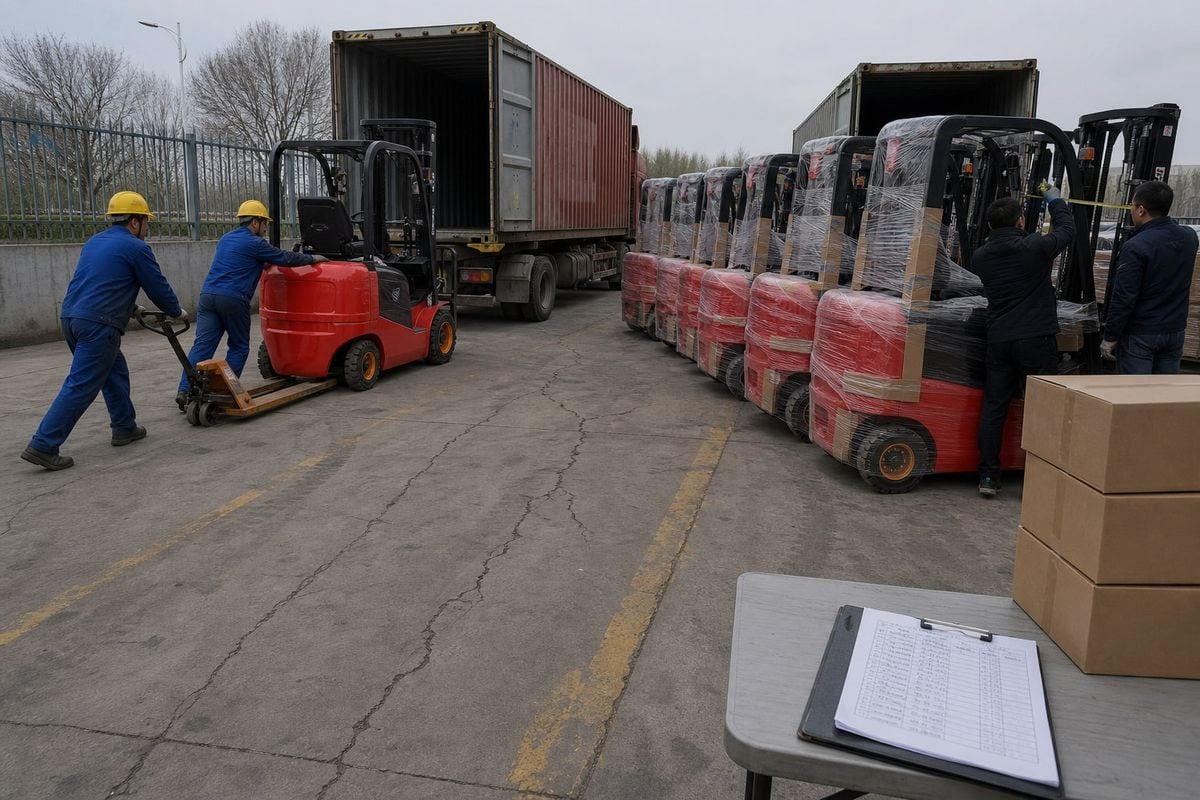
Forklift container stuffing at a China warehouse means driving or loading electric forklifts into an export container over a container loading ramp, positioning them by a load plan, securing them with lashing, blocking, and dunnage, then weighing, sealing, and documenting the container for ocean freight.
That short answer hides a lot of steps. Below, I will walk you through each stage the way we actually run it. I will cover unit counts, securing methods, consolidation, and the checks we do before the container leaves the warehouse.
Last spring, a US dealer asked me to quote six 2-ton electric forklifts in one 40HQ. We measured, ran the load plan optimization software, and fit five safely. The sixth would have blocked the doors. Numbers matter more than hope here.
Most standard 2- to 3-ton electric forklifts fit two to three units in a 20FT container and four to six units in a 40FT or 40HQ container, depending on mast height, counterweight length, overhead guard height, and whether batteries and spare parts share the space.
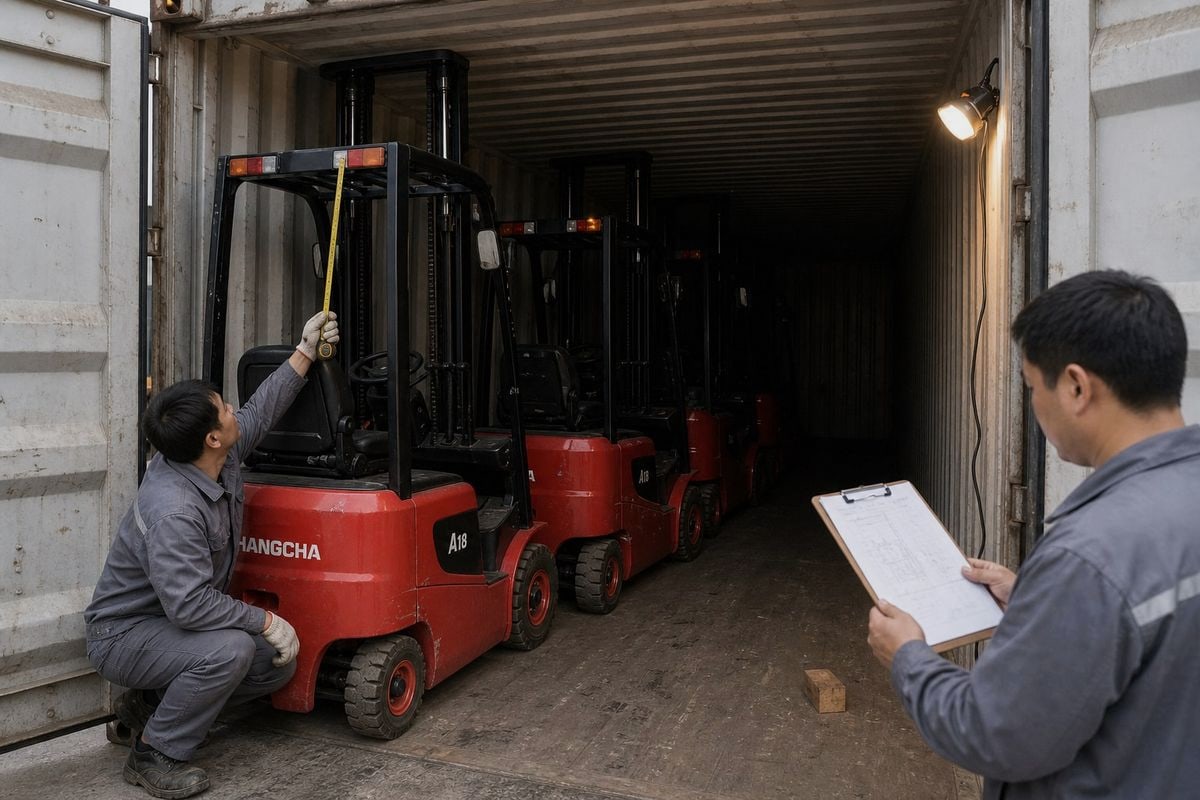
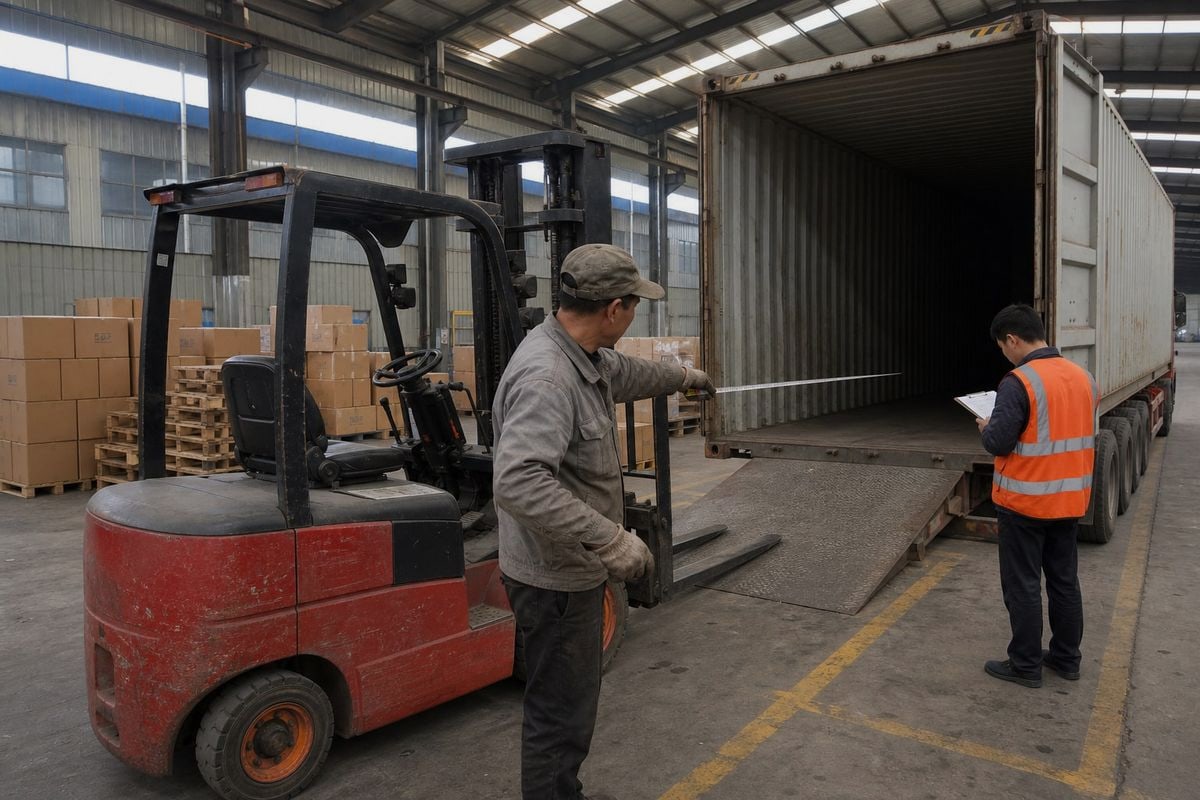
The honest answer to "how many fit" is always: it depends on dimensions, not on marketing brochures. When we plan a Full Container Load 1 (FCL) for forklifts, we ask the factory for three numbers before anything else: overall length with forks, width, and height to the top of the overhead guard. A container door opening on a standard 40FT is about 2.28 meters high. Many electric forklifts with a fixed overhead guard sit at 2.1 to 2.2 meters. That leaves only centimeters of clearance, which is why we sometimes ask factories to remove or lower the guard before pickup.
| Container | Interne Länge | Typical Electric Forklifts (2–3 ton class) | Anmerkungen |
|---|---|---|---|
| 20FT | ~5.9 m | 2–3 units | Best for small orders; heavy floor loading |
| 40FT | ~12.0 m | 4–5 units | Good balance of cost per unit |
| 40HQ | ~12.0 m, extra height | 4–6 units | Extra height helps taller masts and stacked parts cartons |
Compact pallet trucks and electric stackers change the math completely. We have loaded over a dozen electric pallet trucks in a single 40HQ because they are short and can be arranged nose-to-tail. Reach trucks, on the other hand, often have tall masts that cannot be lowered enough, so per-container counts drop.
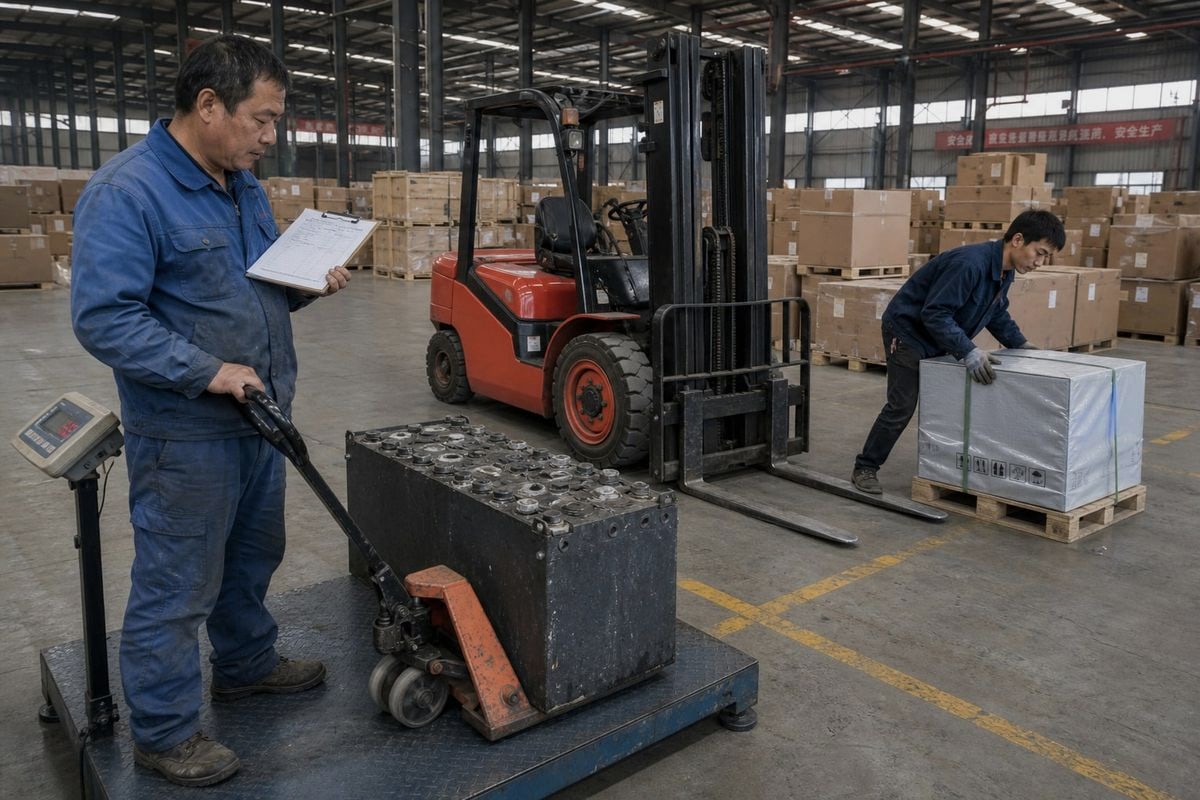
Weight matters as much as space. A 3-ton electric forklift can weigh 4,000 to 4,500 kg with its battery. Stack five of those in a 40FT and you approach the container payload limit before you run out of floor. Our load plan optimization always checks weight distribution first, then cube. As a rule practiced across Chinese export warehouses, roughly 60% of total cargo weight should sit within the front 40% of the container length to keep the load balanced for vessel stability and road transport.
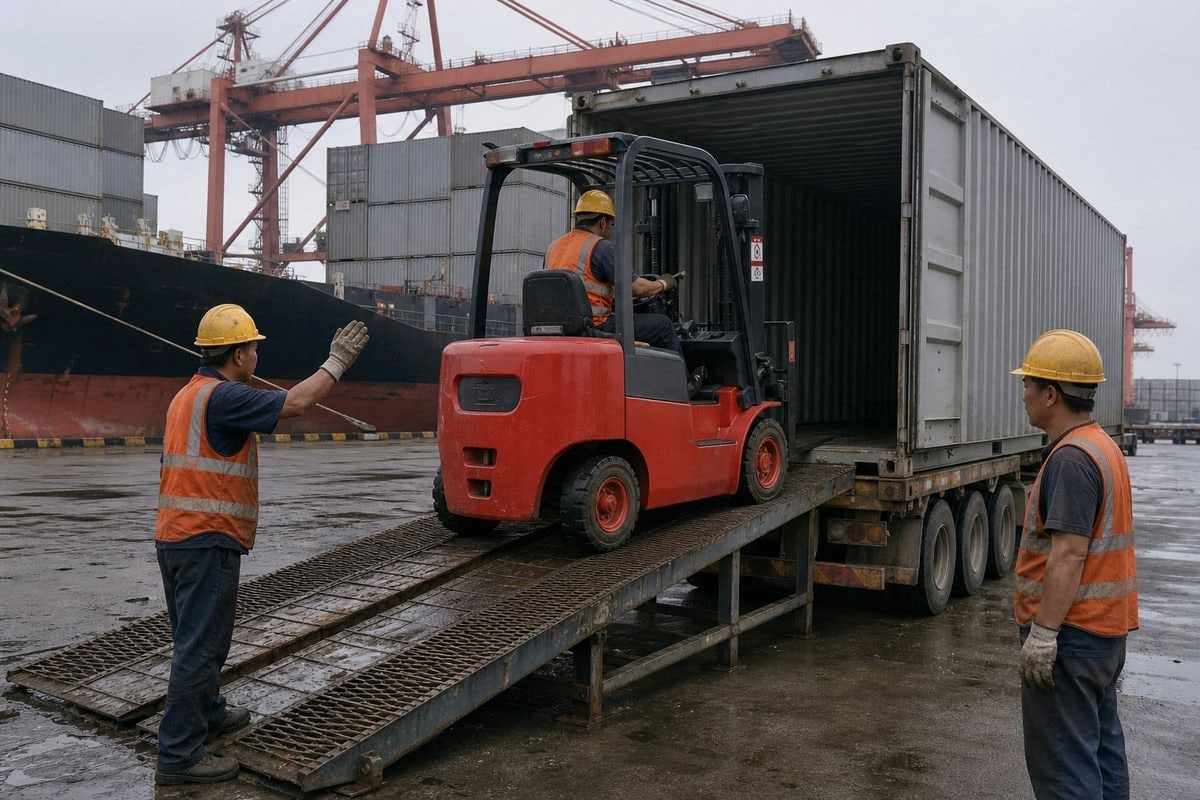
One more factor: the container loading ramp. Our warehouse uses mobile yard ramps 2 to bridge the gap between the floor and the container bed, so forklifts can be driven straight in under their own power or carried in by a larger warehouse forklift. Driving them in saves time, but each machine still needs turning and positioning room, which slightly reduces the theoretical maximum count.
The tightest lashing job I ever supervised followed a claim on someone else's shipment: a forklift that shifted mid-Pacific and crushed its own charger cartons. Since then, our loading teams over-secure by default, and I do not apologize for it.
Forklifts are secured with heavy-duty cargo lashing and bracing: wheels are chocked and blocked with timber nailed to the container floor, ratchet straps anchor the chassis to lashing rings, forks are lowered flat, batteries are disconnected, and dunnage air bags fill remaining void spaces.
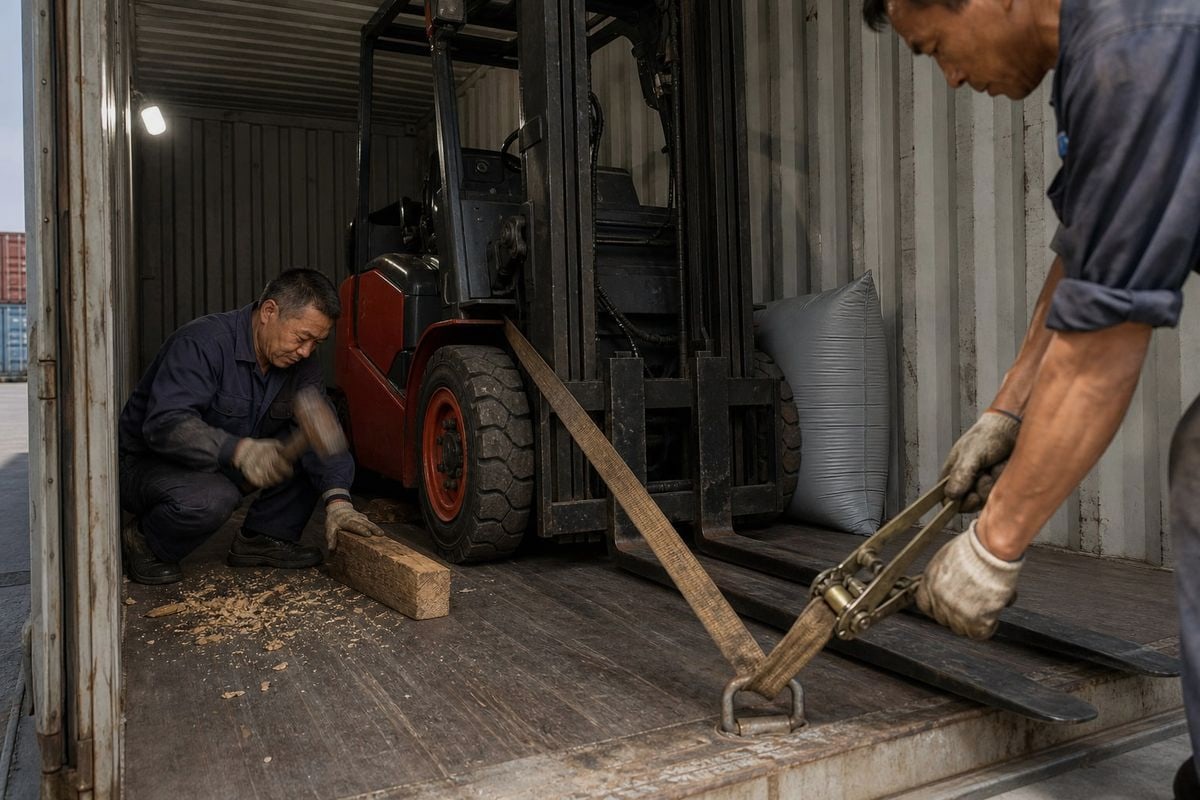
Ocean transit is violent. A container ship rolls, pitches, and slams for two to five weeks. An unsecured 4-ton machine becomes a battering ram. So securing is not one action; it is a layered system, and each layer covers a different failure mode.
| Risk during ocean transit | Primary countermeasure |
|---|---|
| Fore-aft sliding | Timber wheel blocking nailed to the floor |
| Tipping during vessel roll | Crossed ratchet lashings to floor rings |
| Vibration loosening components | Lowered forks, disconnected battery, tightened straps |
| Void-space impact | Dunnage air bags and timber bracing |
| Moisture and condensation | Light-tested container, desiccants, plastic covering |
One trade-off I raise honestly with buyers: aggressive cube utilization can fight against safety. Squeezing one more unit in sometimes means weaker lashing angles. When those two goals conflict, we sacrifice the extra unit, because a damage claim costs far more than the freight savings.
A distributor in Texas once had forklifts coming from one factory, chargers from another, and attachments from a third. He was quoted three separate LCL shipments. We consolidated everything at our warehouse into one 40HQ and cut his logistics cost per unit sharply.
Yes. A China consolidation warehouse can combine forklifts, spare batteries, chargers, attachments, and spare parts from multiple suppliers into one container, provided lithium batteries are properly declared and documented, parts are palletized separately, and nothing is stacked on the machines.
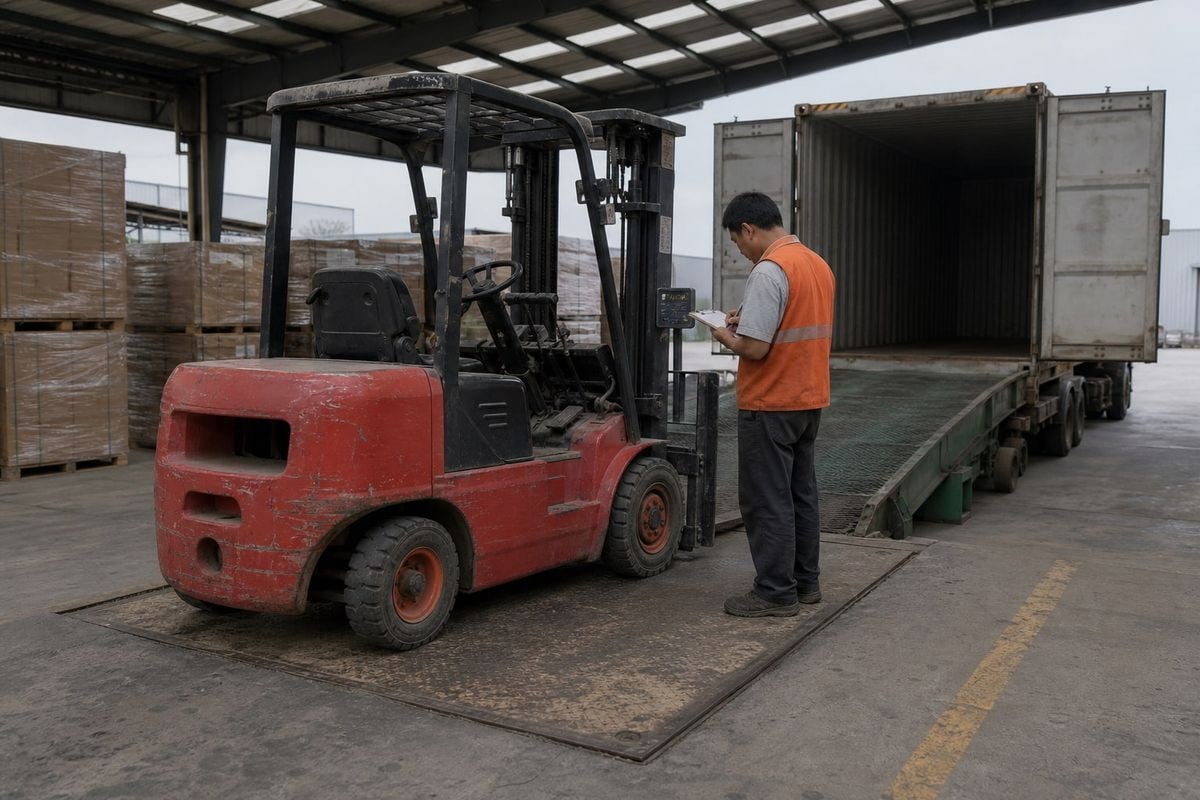
Multi-supplier export consolidation is one of the biggest cost levers available to forklift importers, and it is a core service of any serious 3PL logistics provider in China. A forklift-only container almost always leaves usable space: the gaps above lowered masts, the corridor near the doors, the voids between counterweights. Filling that space with palletized parts turns dead air into shipped inventory. The economics are straightforward: the container costs the same whether it is 70% full or 95% full.
The process starts before the container arrives. Cargo from each factory is picked up, received into our warehouse, checked against packing lists, and labeled. Following palletization standards, loose cartons of spare parts get shrink-wrapped onto standard pallets with fork openings facing the door direction for easy destuffing later. In major export hubs, warehouses use pre-stuffing consolidation zones to sort mixed-supplier cargo by density, so heavy items never end up stacked on lighter cartons — we apply the same logic: heavy goods low and forward, light goods high and rear.
| Cargo type | Can consolidate? | Key condition |
|---|---|---|
| Electric forklifts | Yes | Secured individually; forks down, battery disconnected |
| Lithium-Batterien 3 (installed) | Yes | Correct DG classification, UN38.3 support documents, carrier acceptance |
| Spare lithium batteries | Yes, with care | Declared separately; packaging and documentation must meet dangerous goods rules |
| Chargers and electronics | Yes | Palletized, kept off the floor if moisture risk exists |
| Attachments (side-shifters, clamps) | Yes | Heavy forklift attachments blocked and braced like machines |
| Spare parts cartons | Yes | Palletized, never stacked directly on forklift bodies |
The one objection I hear often: "Won't mixing batteries with machines cause customs trouble?" It can — if the paperwork is sloppy. Lithium battery cargo demands correct classification and documents before the container reaches the port. In our experience shipping electric forklifts to the US, the shipments that get stuck are the ones where battery details surfaced late. We collect battery specifications from every supplier during pickup coordination, precisely so nothing surprises the carrier at booking.
One genuine limitation: some fragile or contaminating cargo should not share a box with machinery. Anything leaking oil, or anything odor-sensitive, gets partitioned or excluded. Consolidation saves money only when it does not create claims.
Buyers sitting in the US cannot stand at our loading bay in Zhengzhou. I learned early that the fix is simple: document everything, timestamp everything, and send it before the buyer has to ask. Our loading reports now go out the same day the seal goes on.
A correctly loaded container is verified through a photo and video loading report, a tally of every unit and carton against the packing list, confirmation of lashing and bracing, a recorded seal number, and a Verified Gross Mass (VGM) weight submitted before the container enters the port.
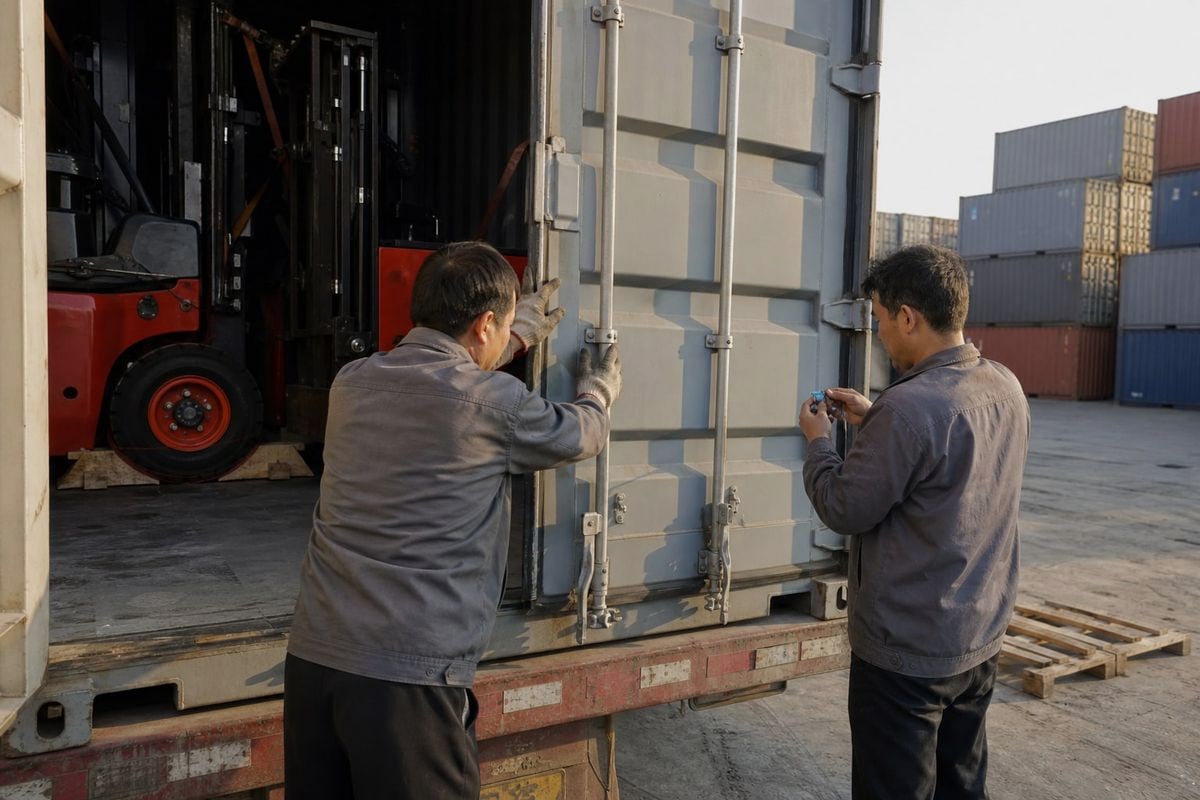
Trust here should never rest on a promise. It should rest on evidence, and a professional China warehouse produces that evidence as a standard part of the stuffing workflow. Here is the verification chain we build for every forklift container, and what each piece proves to you.
Photos before loading. You should receive images of the empty container interior — floor condition, walls, and door seals. This proves the box passed inspection, including the light test for pinholes, before your equipment went in.
Photos and video during loading. Each forklift entering over the ramp, each pallet placed, each strap tensioned. These images later become your proof of condition at origin if a damage claim ever arises. Some advanced Chinese logistics hubs go further, integrating forklift telemetry with the WMS to log the time and placement of every pallet — a digital audit trail insurers love. Our own standard is a WMS-tracked tally sheet plus full photo documentation.
The tally against the packing list. Every serial number, every carton count, checked and signed before the doors close. If you consolidated from five suppliers, this is the moment all five packing lists reconcile into one container manifest.
The seal. After the final photo of the loaded container, a high-security bolt seal 4 is applied and its number is photographed and recorded on the bill of lading instructions. If the seal number at destination matches, nobody opened the box in transit.
The VGM. Under international maritime safety rules, every packed container must have its Verified Gross Mass 5 weighed and submitted before the port will accept it. This is mandatory in China, not optional. It also protects you: an accurate VGM confirms the load plan's weight distribution assumptions were real, not estimated.
The document handoff. Packing list, commercial invoice, battery documentation, and export declaration all cross-checked before departure. Documentation errors cause more destination delays than storms do, so we treat this final check as part of loading, not an afterthought.
If a warehouse cannot show you this trail, that itself is your answer.
Forklift container stuffing at a China warehouse is planning, loading, securing, weighing, sealing, and proving — in that order. Skip a step and you risk damage, delays, or claims. Do it properly, and your forklifts arrive exactly as they left. If you want one team managing that whole chain from factory pickup to your door, that is precisely what we do at MBMLOG.
1. Industry definition of FCL shipping logistics. ↩︎
2. OSHA standards for powered industrial trucks and related loading equipment like ramps. ↩︎
3. US DOT safety regulations for the transport of lithium batteries. ↩︎
4. US Customs guidance on ISO 17712 standards for high-security container seals. ↩︎
5. Cites the international maritime safety authority mandating VGM submission for containers. ↩︎