
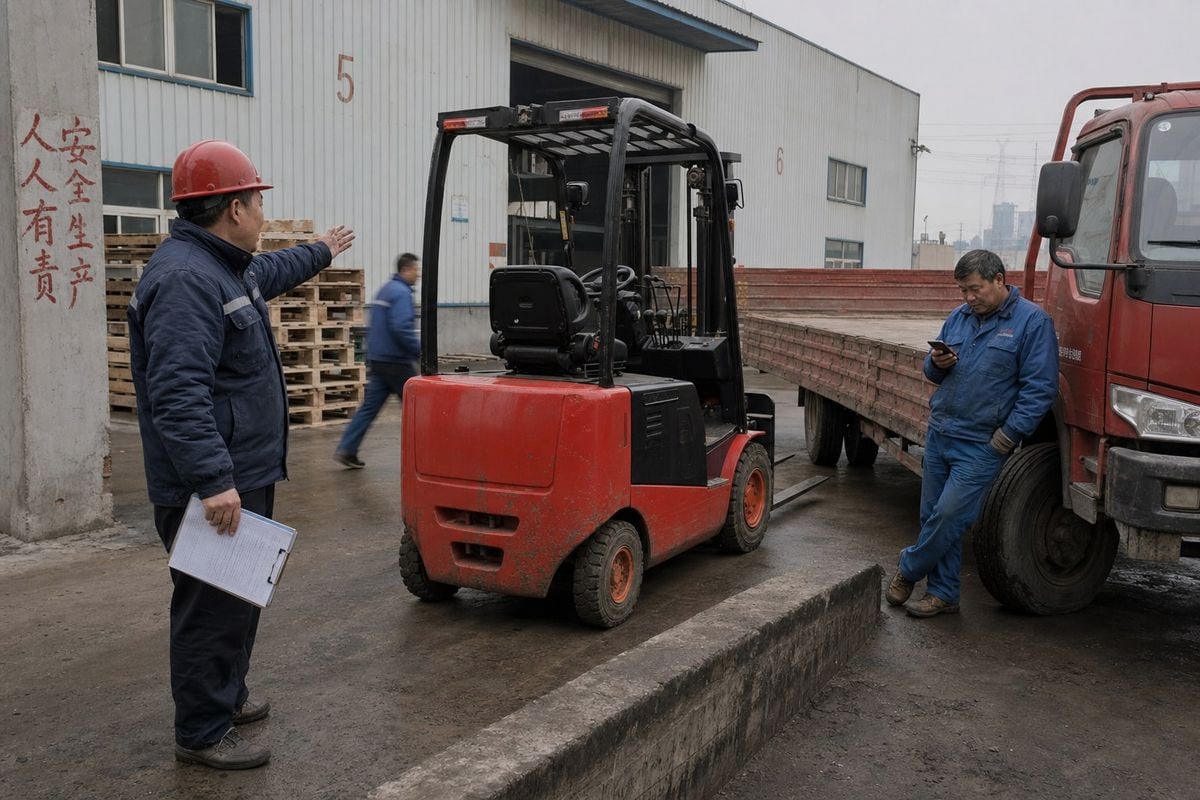
Einen Abholservice für elektrisch betriebene Gabelstapler in China zu erhalten, klingt einfach, bis unser Team den Anruf erhält: Der Lkw steht am Tor, aber der Gabelstapler ist nicht bereit. Dokumentenunstimmigkeiten, Ladeverzögerungen und Liegegebühren beginnen zu steigen. Ich habe gesehen, wie Käufer Tage und Tausende von Dollar aufgrund eines verpassten Details verlieren. Die gute Nachricht ist, dass ein strukturierter Abholprozess fast alles davon verhindert.
Um einen Abholservice für elektrisch betriebene Gabelstapler in China zu erhalten, kaufen Sie zu EXW- oder FOB-Bedingungen, beauftragen Sie einen in China ansässigen Spediteur wie MBMLOG, bestätigen Sie das Versanddatum der Fabrik, überprüfen Sie die Ladeausrüstung und die Exportdokumente und planen Sie dann den zertifizierten Inlandsverkehr vom Werk zum Hafen oder zur Lagerhalle.
Das ist die kurze Antwort. Im Folgenden werde ich Ihnen erläutern, wie die Abholung tatsächlich funktioniert, welche Informationen Sie vorbereiten müssen, wie die Konsolidierung bei mehreren Lieferanten funktioniert und wie Sie Verzögerungen bei der Einsatzbereitschaft vermeiden können.
Wie funktioniert die Abholung im Werk, wenn man elektrisch betriebene Gabelstapler aus China versendet?
Letzten Frühling koordinierte unser Team in Zhengzhou eine Abholung in Hefei, Anhui — einem der wichtigsten Gabelstaplerproduktionsstandorte Chinas — und der gesamte Ablauf dauerte weniger als 48 Stunden, da jeder Schritt im Voraus bestätigt wurde.
Die Abholung im Werk bedeutet, dass der Lieferant den Gabelstapler in seinem Betrieb bereitstellt und Ihr Spediteur ihn mit einem Lkw abholt, ihn mit der Rampe oder dem Kran des Werks lädt und ihn zu einem Hafenlager für die Containerverladung und den Export transportiert. Die Abholung ist nicht die Lieferung; die Exportlogistik bleibt in der Verantwortung des Käufers.

Die Unterscheidung zwischen Abholung und Lieferung ist wichtiger, als die meisten erstmaligen Importeure realisieren. Unter EXW-Versandbedingungen deckt der Preis, den Sie an die Fabrik zahlen, die Maschine am Werktor ab. Alles danach — Innlandstransport, Exportdeklaration, Seefracht, Zollabfertigungsdokumentation — liegt bei Ihnen oder Ihrem beauftragten Spediteur. Das ist der Punkt, an dem ein Frachtführer-Partner in China seine Gebühr verdient.
Der schrittweise Abholprozess
Hier ist der Prozess, den wir für die Abholung von elektrischen Gabelstaplern durchführen:
- Bestätigen Sie, dass der Lieferant eine echte Fabrik und kein Handelsunternehmen ist, und sichern Sie die Spezifikation.
- Vereinbaren Sie die Incoterms. EXW gibt Ihnen die volle Kontrolle über Abhol- und Logistikkosten; FOB bedeutet, dass die Fabrik die Lieferung zum Hafen übernimmt.
- Holen Sie sich die Produktionsvorlaufzeit. Nach unserer Erfahrung können Standardlagerartikel in der Nebensaison innerhalb von 15 Arbeitstagen bereitgestellt werden, während Spitzenzeiten oder maßgeschneiderte Builds oft etwa einen Monat in Anspruch nehmen.
- Fordern Sie Abschlussinspektionsfotos oder -videos vor dem Versand an.
- Planen Sie den Lkw gemäß dem von der Fabrik bestätigten Versanddatum.
- Überprüfen Sie, ob die Fabrik Rampen oder einen Kränen für das Verladen auf einen Flachbetten oder in einen Container besitzt.
- Bewegen Sie die Einheit zu einem Hafen- oder Zolllager zur Konsolidierung und zum Export.
Vergleich FOB vs EXW
| Faktor | EXW (ab Werk) | FOB (Frei an Bord) |
|---|---|---|
| Wer arrangiert die Abholung | Spediteur des Käufers | Fabrik |
| Inland-Transportkosten | Zahlung durch Käufer | Im Preis enthalten |
| Ausfuhranmeldung | Spediteur des Käufers | Vertreter des Unternehmens |
| Kostentransparenz | Hoch — Sie sehen jede Gebühr | Niedriger — in den Einheitspreis integriert |
| Kontrolle über den Zeitplan | Vollständig | Begrenzt |
| Am besten für | Multi-Lieferanten-Konsolidierung | Einzelfabrik-, Einfuhrbestellungen |
Wir empfehlen in der Regel EXW, wenn Sie bei mehreren Lieferanten kaufen, da es einem Spediteur ermöglicht, alle Abholungen zu synchronisieren. Eine Bestellung aus einer einzigen Fabrik, die von einem nahegelegenen Hafen versendet wird, funktioniert oft gut auf FOB.
Welche Informationen muss ich bereitstellen, bevor ich eine Abholung im Werk plane?
Ein Käufer in Texas fragte mich einmal, warum sein Abholdienst um drei Tage verzögert wurde. Die Antwort: Niemand hatte der Spedition mitgeteilt, dass der Gabelstapler 4,2 Tonnen wog, und das falsche Fahrzeug kam an.
Vor der Terminierung der Abholung geben Sie bitte den Namen und die Adresse der Fabrik, das Gabelstaplermodell, die Menge, die Abmessungen, das Bruttogewicht, den Batterietyp und die Kapazität, das Versanddatum, die Packmethode, die Handelsrechnung, die Packliste und den Zielhafen an. Lithium-Ionen-Einheiten benötigen außerdem Batteriezertifizierungsdokumente.

Unvollständige Informationen sind die größte Ursache für Abholverzögerungen, die wir beobachten. Die Spedition benötigt genaue Abmessungen und Gewichte, um das richtige Plateau zu senden. Die Exporterklärung benötigt eine Handelsrechnung und eine Packliste, die exakt mit der Ladung übereinstimmen. Und wenn der Fahrer mit Dokumenten am Werkstor ankommt, die nicht mit dem übereinstimmen, was die Sicherheit erwartet, wartet der Lkw. Wir synchronisieren immer die Unterlagen mit dem Abholdienstfahrer vor dem Versand, um genau dieses Szenario zu vermeiden.
Die Checkliste für die Kerninformationen
| Kategorie | Was bereitzustellen ist | Warum es wichtig ist |
|---|---|---|
| Lieferantendetails | Fabrikname, Adresse, Ansprechpartner | Trucking dispatch and gate access |
| Cargo specs | Model, quantity, dimensions, gross weight | Correct truck type and container plan |
| Battery data | Chemistry (lead-acid or lithium-ion), voltage, capacity, certifications | Carrier acceptance and DG compliance |
| Documents | Commercial invoice, packing list, sales contract | Export declaration and customs clearance documentation |
| Schedule | Confirmed ready-to-ship date | Avoids storage fees and truck detention |
| Reiseziel | Port, final address, Incoterms | Routing and quotation accuracy |
Why battery details deserve extra attention
Lithium-ion battery technology changes the pickup itself, not just the ocean leg. High-capacity lithium batteries can require Dangerous Goods certified inland transportation under Chinese regulations. If we do not know the battery chemistry 1 before booking the truck, we may book the wrong one. Lead-acid units are simpler, but we still confirm the battery is secured and, where required, disconnected for transit.
Inspection before the truck arrives
We strongly recommend a pre-delivery inspection 2 at the factory site. A third-party inspector can verify the forklift's specifications, test the lift and drive functions, and check battery condition before loading. Once the unit leaves the factory gate, claims become far harder to argue. Photos and video of the machine, the nameplate, and the packing state should be in your hands before the truck rolls.
Kann MBMLOG die Abholung von mehreren Gabelstapleranbietern in China koordinieren?
The trade-off we weigh most often is distance versus consolidation savings. Suppliers cluster in Anhui, Shandong, and Zhejiang, and pulling cargo from three provinces into one container takes planning — but it usually pays off.
Yes. MBMLOG arranges pickups from multiple Chinese forklift factories, battery suppliers, and parts vendors, then consolidates everything at a single warehouse near the export port. Cargo is loaded into one FCL container or an LCL shipment, cutting per-unit freight cost and simplifying documentation.

This is the situation we handle most for US forklift distributors. A typical order looks like this: forklifts from a factory in Hefei, lithium batteries from a second supplier, chargers from a third, and spare parts from a fourth. Managed separately, that is four pickups, four sets of paperwork, and possibly four shipments. Consolidated, it becomes one container and one bill of lading.
How multi-supplier consolidation works
Our team sequences the pickups so all cargo arrives at the consolidation warehouse 3 within a tight window. We verify each supplier's cargo against the packing list on arrival, then plan the container load. Forklifts go in first with proper weight distribution. Chargers, batteries, and spare parts fill the remaining space. Nothing rides loose. Container loading supervision matters here because forklifts carry sensitive electronic controllers; we lash and block every unit, and for high-value shipments, buyers can add shock-sensor monitoring devices to confirm the electronics survive the road transit intact.
For buyers exporting through major port cities, a bonded warehouse pickup strategy 4 can also help consolidate multiple orders efficiently and support export tax rebate handling on the supplier side. And for companies with ESG commitments, green logistics options using electric heavy-duty trucks for the inland leg are increasingly available in China's coastal regions — a nice match for a product that is itself battery-powered material handling equipment.
Container planning for consolidated forklift shipments
| Container | Typical fit | Best use case |
|---|---|---|
| 20FT | 2–3 compact electric forklifts | Small orders, heavy cargo, short masts |
| 40FT | 4–5 forklifts plus accessories | Mixed forklift and parts orders |
| 40HQ | 4–6 units plus pallet trucks and stackers | Full multi-supplier consolidation |
| LCL | Single forklift or parts only | Trial orders, spare parts replenishment |
Efficient loading directly lowers your landed cost per forklift, which is often the difference between a profitable resale margin and a thin one.
Wie kann ich sicherstellen, dass mein Gabelstapler und die Batterie abholbereit sind, ohne Verzögerungen?
One lesson our operations team learned early: never book the truck off a verbal promise. A factory once told us "ready Friday," and Friday meant the paint was still drying.
Confirm readiness with dated inspection photos or video, verify the battery is certified and properly packed, match the pickup date to the factory's confirmed ready-to-ship date, check loading equipment availability, and ensure the invoice and packing list match the physical cargo before the truck departs.

Readiness has two halves: the machine and the paperwork. Both must be complete on the same day, or you pay for one waiting on the other.
Machine readiness
Start with lead time reality. Custom builds — nonstandard mast heights, fork lengths, or battery capacities — take longer than stock units. Peak-season production can stretch to about a month, while off-season stock orders often ship within 15 workdays. Build your pickup schedule from the factory's confirmed date, not the sales quote. Then, before dispatch, require final inspection evidence: the machine running, the serial nameplate, the battery installed or packed, and the export packing in place. A pre-delivery inspection by a third party is worth its modest cost on any order above a single unit — for context, some factory-direct electric forklift listings run around US $9,999–11,325 per unit FOB, so one damaged or wrong-spec machine erases far more than the inspection fee.
Battery and packing readiness
For lithium-ion units, confirm the battery's certification and transport classification before pickup day, not at the port. Verify the packing protects the mast, forks, and controller from road vibration. Ask whether the battery ships installed or crated separately, because that changes the packing list and sometimes the truck type.
Paperwork readiness
The commercial invoice, packing list, and any battery documents must be finalized and shared with the pickup driver in advance. Mismatched paperwork at the factory gate is a classic, avoidable delay. We cross-check every document against the cargo before we release the truck — a habit that has saved our warehouse logistics solutions clients countless detention charges over the years of industrial equipment sourcing from China.
Schlussfolgerung
Factory pickup service works when terms, documents, batteries, and schedules align before the truck rolls. Get one wrong and delays multiply. Our team at MBMLOG coordinates all four — from factory gate to your warehouse door.
Fußnoten
1. Official US Department of Energy resource detailing different battery chemistries and their applications in modern vehicles. ↩︎
2. WTO overview of international agreements and standards governing pre-shipment inspection services in global trade. ↩︎
3. Authoritative .gov source defining a Container Freight Station, the technical term for a consolidation warehouse. ↩︎
4. Official US Customs and Border Protection guide to the operation and benefits of bonded warehouses. ↩︎




