

Every week at our Zhengzhou office, importers ask us how to ship counterbalance forklifts from China. Most learn too late that the forklift price is the easy part.
To ship counterbalance forklifts from China, confirm the unit's weight, dimensions, and battery type, choose FCL, flat rack, or RoRo shipping, prepare the commercial invoice, packing list, Bill of Lading, and UN38.3 documents for lithium models, then clear customs and arrange final delivery.
That is the short version. The long version decides whether your forklift arrives on schedule and undamaged, or sits at a port racking up storage fees. Let me walk you through each step, the real costs, container loading math, documentation, and how lithium batteries change everything.
How much does it cost to ship a counterbalance forklift from China to the US?
Last year, a Texas dealer showed me a supplier's "free shipping estimate" that missed destination charges entirely. His real landed cost ran thousands higher. Our team rebuilt his quote line by line.
Shipping a counterbalance forklift from China to the US typically costs between $1,500 and $6,000 per unit, depending on container type, forklift weight, port of loading, destination charges, import duties and taxes, insurance, and inland trucking. FCL shipping with multiple units lowers the per-unit cost significantly.
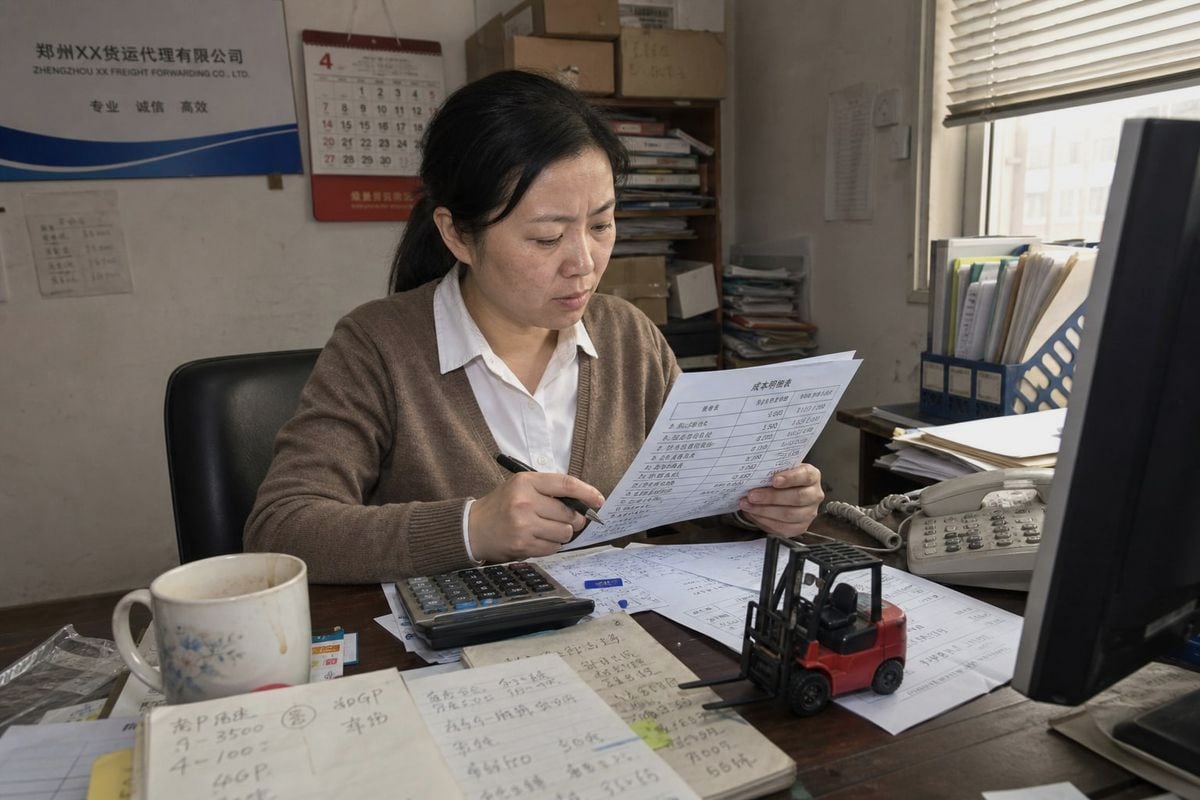
The honest answer is that no single number fits every shipment. What I can give you is the structure of the cost, because once you understand the structure, you can pressure-test any quote a freight forwarder in China sends you.
Die Hauptkostenbestandteile
Every forklift shipment we handle breaks down into the same buckets. Here is what a typical single-unit shipment from a Chinese factory to a US warehouse looks like:
| Kostenkomponente | Typische Preisspanne (USD) | Anmerkungen |
|---|---|---|
| Factory pickup & inland trucking in China | $200 – $600 | Depends on distance to port of loading |
| Export declaration & port handling | $150 – $350 | Includes export customs in China |
| Ocean freight (FCL, 20FT/40FT) | $1,000 – $3,500 | Route and season dependent |
| DG surcharge (lithium battery units) | $200 – $800 | Applies to Class 9 cargo booking |
| Marine insurance (all-risk) | 0.2% – 0.5% of cargo value | Strongly recommended for heavy equipment |
| US-Zielgebühren | $400 – $900 | Port fees, ISF, handling |
| Einfuhrzölle und Steuern | Variiert je nach HS-Code | 8427.10 electric / 8427.20 IC engine |
| Endlieferungs-Transport | $300 – $1,500 | Depends on distance and unloading equipment |
Why a Cheap FOB Price Can Still Cost You More
Here is the trap I see most often. A supplier offers a very low FOB unit price. But the forklift is slightly overwidth, so it needs a flat rack container instead of a standard box. Flat rack shipping triggers out-of-gauge surcharges that can double the ocean freight. Suddenly the "cheap" forklift has the highest landed cost.
For US importers, one lever worth discussing with your Zollmakler 1 is the First Sale valuation rule. It can allow duties to be calculated on the manufacturer's price rather than a distributor's marked-up invoice, which matters when a trading company sits between you and the factory.
My advice: never compare forklift quotes on unit price alone. Ask for a full landed-cost estimate covering factory-to-door before you sign the purchase order.
How many counterbalance forklifts can I fit into a 40FT or 40HQ container?
Container math is where our loading team earns its keep. We once reworked a factory's loading plan for a US distributor and fit an extra stacker plus two pallets of spare parts into the same 40HQ.
A 40FT or 40HQ container typically fits two to four counterbalance forklifts, depending on capacity class. Two 3–3.5 ton units fit comfortably; three to four 1.5–2 ton units fit with mast tilting or partial disassembly. A 20FT container holds one 3-ton unit.
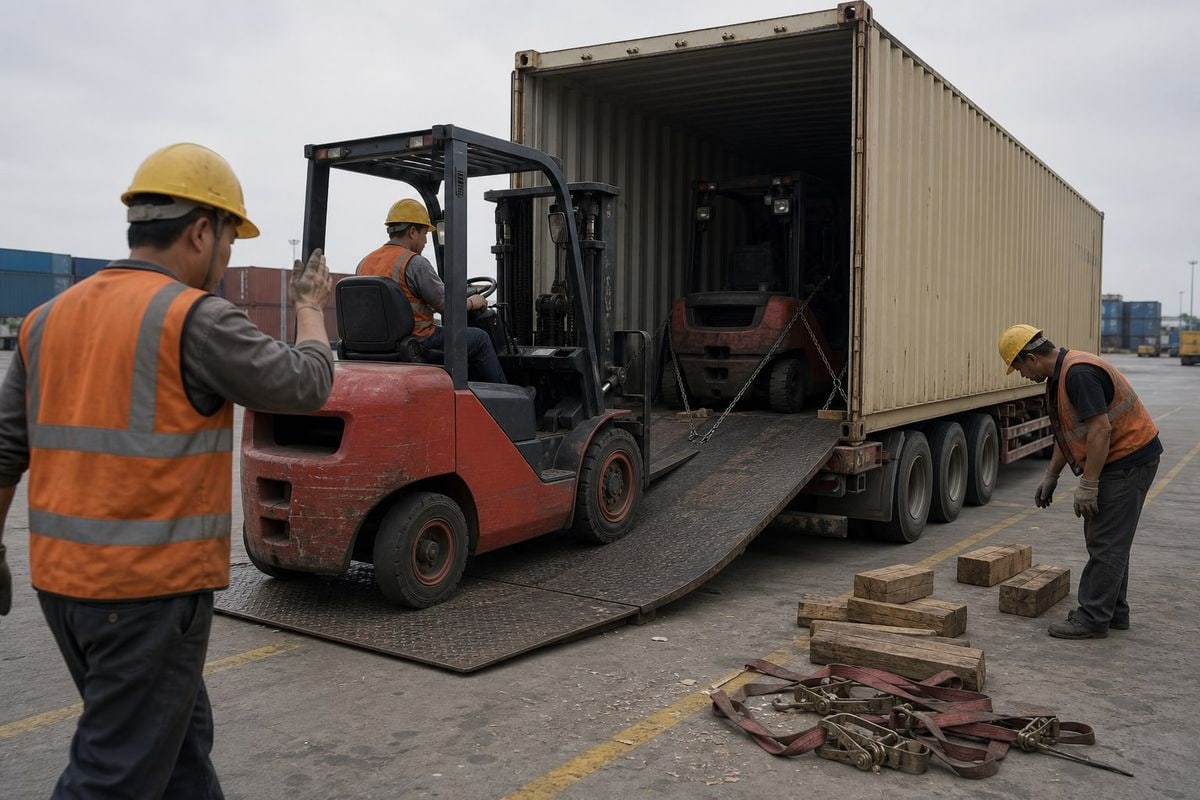
The limiting factor is rarely floor space alone. It is the combination of mast height, machine weight, and the container's payload limit. Let me break down how we plan a real loading.
Container Fit by Forklift Class
| Container | Internal Dimensions (approx.) | Typical Loading | Key Constraint |
|---|---|---|---|
| 20FT | 5.9m × 2.35m × 2.39m | 1 × 3-ton counterbalance unit | Length and payload |
| 40FT | 12.03m × 2.35m × 2.39m | 2 × 3–3.5 ton units, or 3 × smaller units | Door height for mast |
| 40HQ | 12.03m × 2.35m × 2.69m | 2–4 units depending on class, plus parts | Weight distribution |
| Flachbettcontainer | Open top/sides | 1 oversized or overweight unit | OOG surcharges apply |
Disassembly Is Not Just About Fit
A standard counterbalance mast often exceeds container door height. So factories lower the mast, tilt it back, or remove it entirely along with the overhead guard. In our experience coordinating FCL container shipping, partial disassembly does three jobs at once. It gets the machine through the door. It lowers the center of gravity, which reduces shifting damage at sea. And it frees vertical space for chargers, batteries, or spare parts.
We also run loading plans before booking. Some forwarders now use 3D volumetric loading simulations for mixed forklift models, and the gains are real — often reclaiming 10–15% more container space compared with a factory's manual loading plan. When a customer buys forklifts from Factory A and chargers from Factory B, we consolidate everything at our warehouse first, then load once.
A Quick Loading Checklist
- Confirm exact machine dimensions with mast lowered.
- Verify total weight against container payload limits.
- Check the forklift's center of gravity for positioning.
- Confirm tie-down points and lashing materials.
- Photograph the machine from all angles before doors close.
- Plan reassembly of masts and guards at destination.
What documents and customs requirements do I need for shipping a counterbalance forklift?
A single wrong digit in an HS code once held a customer's forklifts at a US port for over a week. Since then, our documentation team cross-checks every file against the Bill of Lading before departure.
You need a commercial invoice, packing list, Bill of Lading, certificate of origin, and China export declaration. Classify electric forklifts under HS code 8427.10 and internal combustion units under 8427.20. Lithium battery models also require UN38.3 test summaries, MSDS, and a dangerous goods declaration.
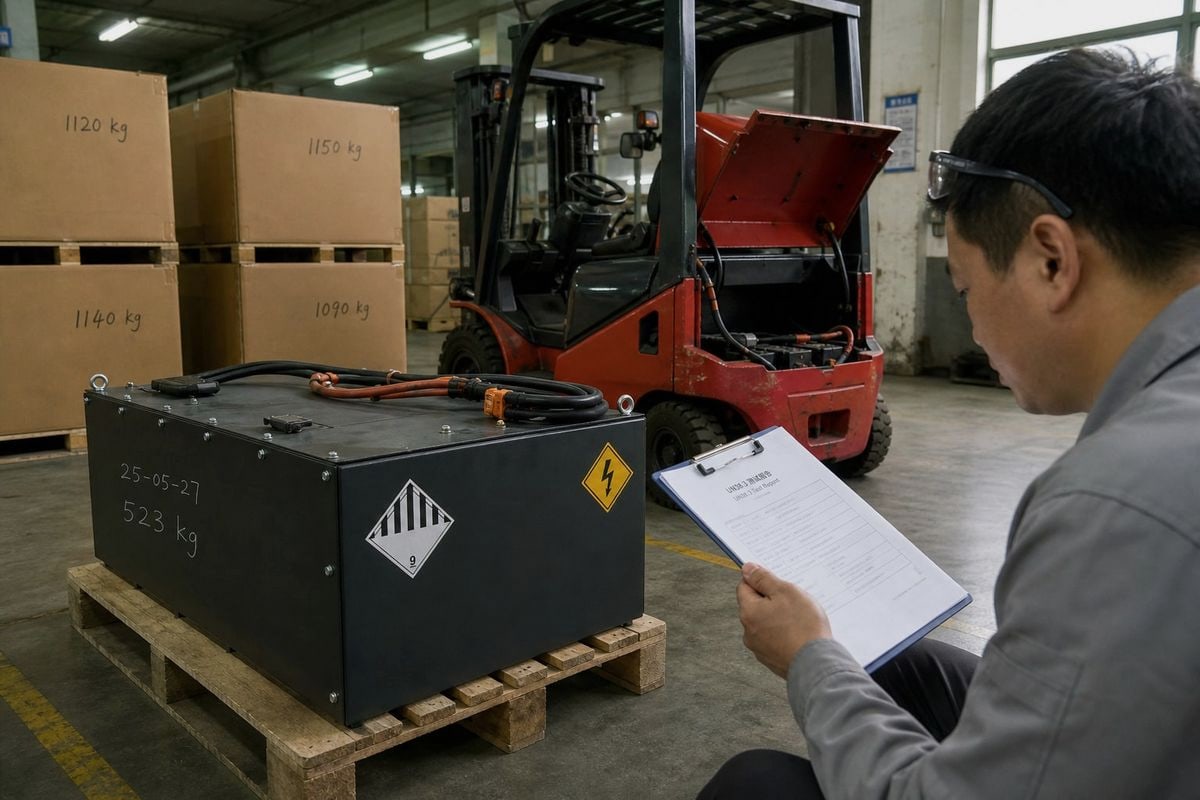
Documentation is where forklift shipments most often go wrong, and the frustrating part is that the errors are almost always avoidable. Let me explain what each document does and where importers stumble.
Core Document Set
| Dokumentieren | Zweck | Häufiger Fehler |
|---|---|---|
| Handelsrechnung | Wert für Zölle deklarieren | Value inconsistent with contract |
| Packliste | Details weight, dimensions, quantity | Missing disassembled parts |
| Konnossement | Title and carriage contract | Consignee details wrong |
| Ursprungszeugnis | Duty treatment at destination | Not requested before departure |
| Ausfuhranmeldung | China customs clearance | Filed with wrong HS code |
| UN38.3 Testzusammenfassung | Lithium battery safety proof | Missing for installed batteries |
| Sicherheitsdatenblatt (SDB) | Battery chemical data | Outdated version supplied |
Why the HS Code for Forklifts Matters So Much
The HS code drives everything downstream: your duty rate 2, regulatory treatment, and whether customs flags the shipment for inspection. Self-propelled electric forklifts fall under 8427.10, while internal combustion counterbalance units fall under 8427.20. Verify the code with your customs broker before the export declaration is filed, because inconsistency between the invoice, the export declaration, and the import entry is a classic trigger for holds and penalties.
Destination-Specific Compliance
Customs requirements vary by market. For the US, EPA compliance can apply to internal combustion engines. For Europe, CE marking is expected, and emerging EU rules are pushing toward battery traceability — some carriers and importers are already integrating Digital Battery Passports into shipping records to prepare. Under normal conditions, customs clearance takes roughly 3–7 business days, but incomplete paperwork stretches that fast. Our rule at MBMLOG: no container leaves the port of loading until every document has been checked against every other document.
How can I ship a counterbalance forklift with a lithium battery safely and without delays?
The trade-off we weigh most often with buyers is this: lithium forklifts sell better, but they ship harder. One missing test summary can get a booking rejected days before the vessel cuts off.
Ship a lithium battery counterbalance forklift by booking it as Class 9 dangerous goods, providing the UN38.3 test summary and MSDS to the carrier before booking, securing and disconnecting the battery, applying proper DG labels, and confirming charger voltage matches the destination market.
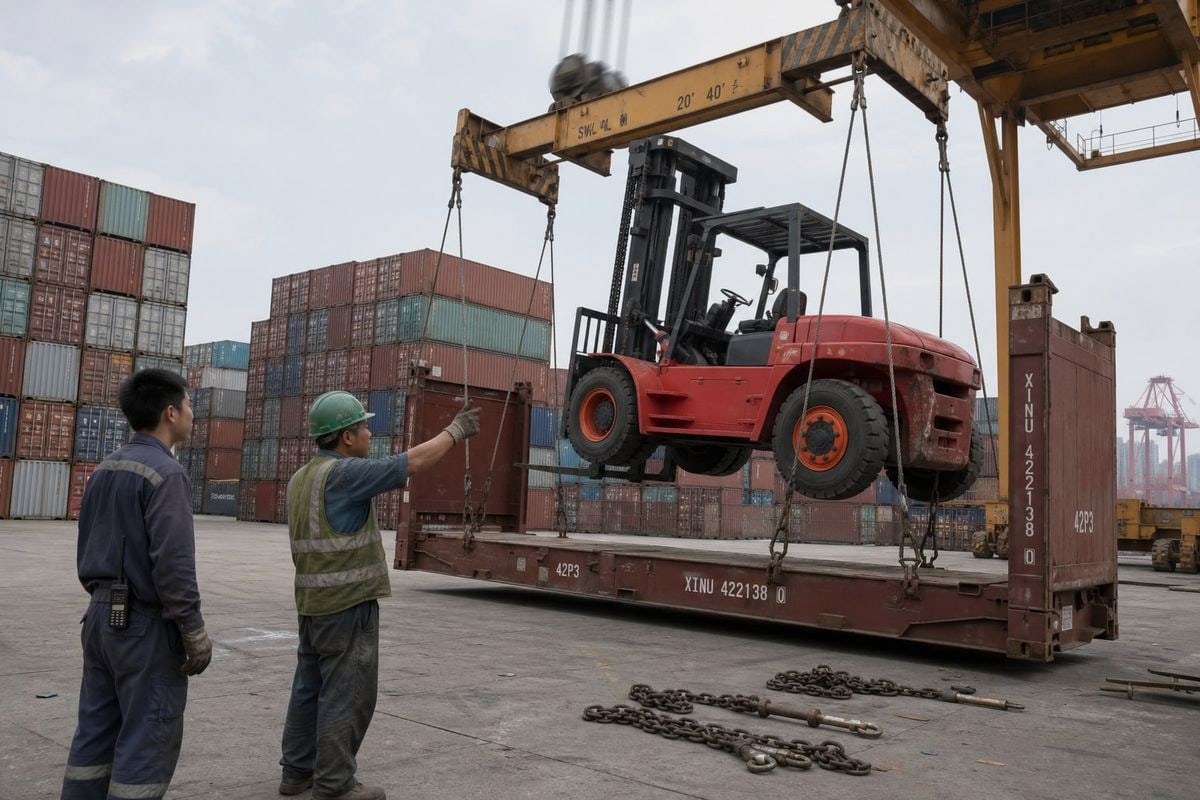
Battery shipping regulations are the single biggest difference between shipping an electric counterbalance forklift and a diesel or LPG unit. Get this wrong and the problem is not a surcharge — it is a rejected booking or a cargo hold at the port.
Why Lithium Changes the Booking Process
A forklift with an installed lithium battery is classified as Klasse 9 gefährliche Güter 3 under maritime rules. That means the ocean carrier must formally accept the cargo before booking is confirmed. Carriers will not accept it without a valid UN38.3 test summary proving the battery passed transport safety testing, plus an MSDS describing the battery chemistry. In our experience handling lithium battery cargo, the fatal mistake is booking first and gathering documents later. We collect battery documentation from the factory before we even request carrier space.
Our Pre-Shipment Battery Workflow
- Request UN38.3 test summary and MSDS from the supplier at order confirmation, not at shipment time.
- Confirm battery specifications match the nameplate on the actual machine.
- Verify charger voltage suits the destination country's grid.
- Check for destination conformity documents such as CE or UL-related certification where required.
- Submit the DG declaration to the carrier and wait for written acceptance.
- Ensure the battery is secured, disconnected where required, and the unit is properly labeled before loading.
Lead-Acid and Internal Combustion Units Are Simpler — But Not Effortless
Traditional lead-acid electric units and diesel or LPG forklifts avoid most lithium scrutiny. For internal combustion models, the focus shifts to fuel residue removal, fluid draining documentation, and engine emissions compliance at destination. Simpler, yes. Paperwork-free, no.
One more planning note: build the DG acceptance step into your timeline. Ocean transit runs roughly 18–40 days port to port, but total factory-to-door time is typically 4–10 weeks once pickup, DG booking, customs, and delivery are included. Lithium units sit at the longer end when documents arrive late.
Schlussfolgerung
Shipping counterbalance forklifts from China is manageable when you control four things: cost structure, container loading, documentation, and battery compliance. Get those right, and your machines arrive safely, legally, and on schedule.
Fußnoten
1. Official U.S. Customs and Border Protection page explaining the role and licensing of customs brokers. ↩︎
2. Official government guidance on how import duty rates are determined and applied to cargo. ↩︎
3. International Maritime Organization page regarding the IMDG Code and classification of dangerous goods. ↩︎




