
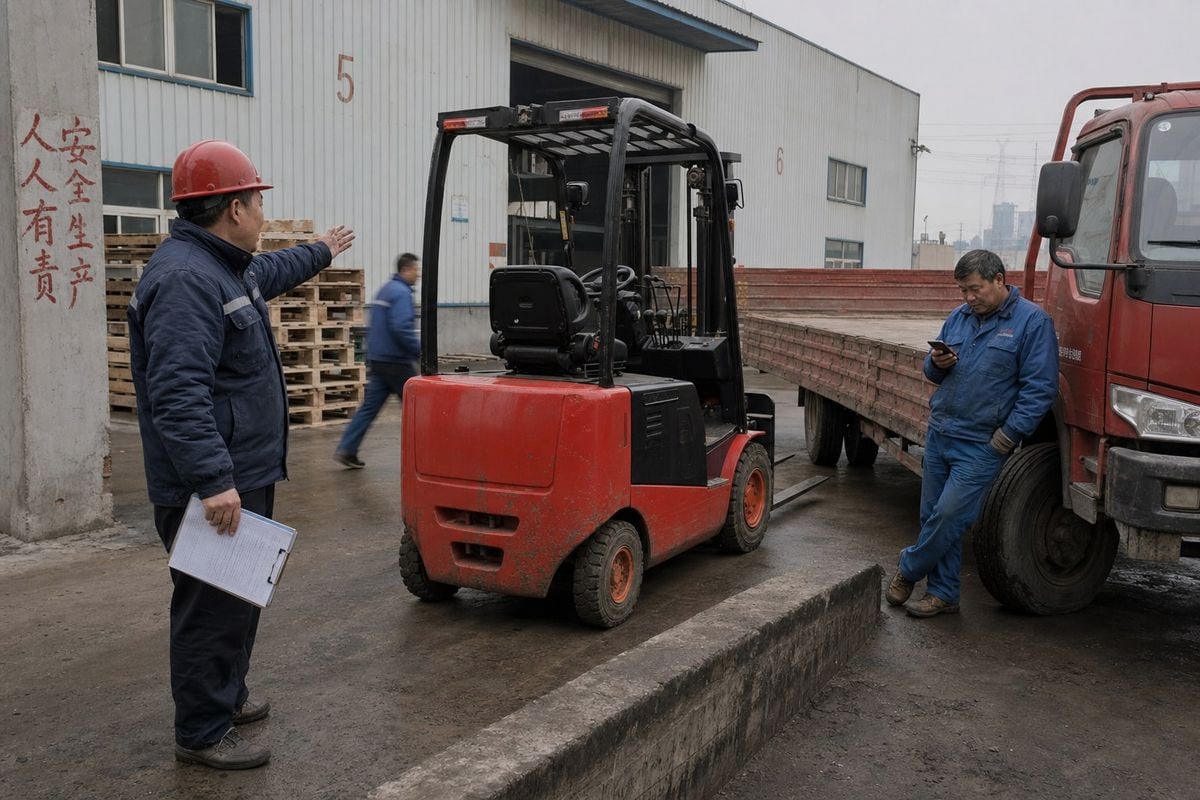
Getting factory pickup service for electric forklifts in China sounds simple until our team gets the call: the truck is at the gate, but the forklift is not ready. Documents mismatch, loading stalls, and detention fees start climbing. I have watched buyers lose days and thousands of dollars over one missed detail. The good news is that a structured pickup process prevents almost all of it.
To get factory pickup service for electric forklifts in China, buy on EXW or FOB terms, appoint a China-based freight forwarder like MBMLOG, confirm the factory's ready-to-ship date, verify loading equipment and export documents, then schedule certified inland trucking from the factory to the port or warehouse.
That is the short answer. Below, I will walk you through how pickup actually works, what information you must prepare, how multi-supplier consolidation works, and how to avoid readiness delays.
How does factory pickup work when shipping electric forklifts from China?
Last spring, our Zhengzhou team coordinated a pickup in Hefei, Anhui — one of China's main forklift production bases — and the entire flow took under 48 hours because every step was pre-confirmed.
Factory pickup means the supplier makes the forklift available at its facility, and your freight forwarder collects it with a truck, loads it using the factory's ramp or crane, and moves it to a port warehouse for container loading and export. Pickup is not delivery; export logistics remain the buyer's responsibility.

The distinction between pickup and delivery matters more than most first-time importers realize. Under EXW shipping terms, the price you pay the factory covers the machine at the factory gate. Everything after that — inland trucking, export declaration, ocean freight, customs clearance documentation — sits with you or your appointed forwarder. That is where a freight forwarder China partner earns its fee.
The step-by-step pickup flow
Here is the process we run for electric forklift pickups:
- Confirm the supplier is a real factory, not a trading company, and lock the specification.
- Agree on Incoterms. EXW gives you full control over pickup and logistics costs; FOB means the factory handles delivery to the port.
- Get the production lead time. In our experience, standard-stock units can be ready within 15 workdays off-season, while peak-season or customized builds often take about a month.
- Request final inspection photos or video before dispatch.
- Schedule the truck against the factory's confirmed ready-to-ship date.
- Verify the factory has ramps or an overhead crane for loading onto a flatbed or into a container.
- Move the unit to a port-side or bonded warehouse for consolidation and export.
FOB vs EXW comparison
| Factor | EXW (Ex Works) | FOB (franco a bordo) |
|---|---|---|
| Who arranges pickup | Buyer's forwarder | Fábrica |
| Inland trucking cost | Paid by buyer | Included in price |
| Declaración de exportación | Buyer's forwarder | Factory's agent |
| Cost transparency | High — you see every charge | Lower — bundled into unit price |
| Control over schedule | Full | Limited |
| Lo mejor para | Multi-supplier consolidation | Single-factory, single-port orders |
We generally recommend EXW when you buy from multiple suppliers, because it lets one forwarder synchronize all pickups. A single-factory order shipping from a nearby port often works fine on FOB.
What information do I need to provide before scheduling a factory pickup?
A buyer in Texas once asked me why his pickup was delayed three days. The answer: nobody had told the trucking company the forklift weighed 4.2 tons, and the wrong vehicle arrived.
Before scheduling pickup, provide the factory name and address, forklift model, quantity, dimensions, gross weight, battery type and capacity, the ready-to-ship date, packing method, commercial invoice, packing list, and the destination port. Lithium-ion units also need battery certification documents.

Incomplete information is the single biggest cause of pickup delays we see. The trucking company needs accurate dimensions and weight to send the right flatbed. The export declaration needs a commercial invoice and packing list that match the cargo exactly. And if the driver arrives at the factory gate with documents that do not match what security expects, the truck waits. We always synchronize the paperwork with the pickup driver before dispatch to avoid exactly that scenario.
The core information checklist
| Categoría | What to provide | Why it matters |
|---|---|---|
| Supplier details | Factory name, address, contact person | Trucking dispatch and gate access |
| Cargo specs | Model, quantity, dimensions, gross weight | Correct truck type and container plan |
| Battery data | Chemistry (lead-acid or lithium-ion), voltage, capacity, certifications | Carrier acceptance and DG compliance |
| Documentos | Commercial invoice, packing list, sales contract | Export declaration and customs clearance documentation |
| Schedule | Confirmed ready-to-ship date | Avoids storage fees and truck detention |
| Destino | Port, final address, Incoterms | Routing and quotation accuracy |
Why battery details deserve extra attention
Lithium-ion battery technology changes the pickup itself, not just the ocean leg. High-capacity lithium batteries can require Dangerous Goods certified inland transportation under Chinese regulations. If we do not know the battery chemistry 1 before booking the truck, we may book the wrong one. Lead-acid units are simpler, but we still confirm the battery is secured and, where required, disconnected for transit.
Inspection before the truck arrives
We strongly recommend a pre-delivery inspection 2 at the factory site. A third-party inspector can verify the forklift's specifications, test the lift and drive functions, and check battery condition before loading. Once the unit leaves the factory gate, claims become far harder to argue. Photos and video of the machine, the nameplate, and the packing state should be in your hands before the truck rolls.
Can MBMLOG coordinate pickup from multiple forklift suppliers in China?
The trade-off we weigh most often is distance versus consolidation savings. Suppliers cluster in Anhui, Shandong, and Zhejiang, and pulling cargo from three provinces into one container takes planning — but it usually pays off.
Yes. MBMLOG arranges pickups from multiple Chinese forklift factories, battery suppliers, and parts vendors, then consolidates everything at a single warehouse near the export port. Cargo is loaded into one FCL container or an LCL shipment, cutting per-unit freight cost and simplifying documentation.

This is the situation we handle most for US forklift distributors. A typical order looks like this: forklifts from a factory in Hefei, lithium batteries from a second supplier, chargers from a third, and spare parts from a fourth. Managed separately, that is four pickups, four sets of paperwork, and possibly four shipments. Consolidated, it becomes one container and one bill of lading.
How multi-supplier consolidation works
Our team sequences the pickups so all cargo arrives at the consolidation warehouse 3 within a tight window. We verify each supplier's cargo against the packing list on arrival, then plan the container load. Forklifts go in first with proper weight distribution. Chargers, batteries, and spare parts fill the remaining space. Nothing rides loose. Container loading supervision matters here because forklifts carry sensitive electronic controllers; we lash and block every unit, and for high-value shipments, buyers can add shock-sensor monitoring devices to confirm the electronics survive the road transit intact.
For buyers exporting through major port cities, a bonded warehouse pickup strategy 4 can also help consolidate multiple orders efficiently and support export tax rebate handling on the supplier side. And for companies with ESG commitments, green logistics options using electric heavy-duty trucks for the inland leg are increasingly available in China's coastal regions — a nice match for a product that is itself battery-powered material handling equipment.
Container planning for consolidated forklift shipments
| Contenedor | Typical fit | Best use case |
|---|---|---|
| 20 pies | 2–3 compact electric forklifts | Small orders, heavy cargo, short masts |
| 40FT | 4–5 forklifts plus accessories | Mixed forklift and parts orders |
| 40HQ | 4–6 units plus pallet trucks and stackers | Full multi-supplier consolidation |
| LCL | Single forklift or parts only | Trial orders, spare parts replenishment |
Efficient loading directly lowers your landed cost per forklift, which is often the difference between a profitable resale margin and a thin one.
How do I ensure my forklift and battery are pickup-ready without delays?
One lesson our operations team learned early: never book the truck off a verbal promise. A factory once told us "ready Friday," and Friday meant the paint was still drying.
Confirm readiness with dated inspection photos or video, verify the battery is certified and properly packed, match the pickup date to the factory's confirmed ready-to-ship date, check loading equipment availability, and ensure the invoice and packing list match the physical cargo before the truck departs.

Readiness has two halves: the machine and the paperwork. Both must be complete on the same day, or you pay for one waiting on the other.
Machine readiness
Start with lead time reality. Custom builds — nonstandard mast heights, fork lengths, or battery capacities — take longer than stock units. Peak-season production can stretch to about a month, while off-season stock orders often ship within 15 workdays. Build your pickup schedule from the factory's confirmed date, not the sales quote. Then, before dispatch, require final inspection evidence: the machine running, the serial nameplate, the battery installed or packed, and the export packing in place. A pre-delivery inspection by a third party is worth its modest cost on any order above a single unit — for context, some factory-direct electric forklift listings run around US $9,999–11,325 per unit FOB, so one damaged or wrong-spec machine erases far more than the inspection fee.
Battery and packing readiness
For lithium-ion units, confirm the battery's certification and transport classification before pickup day, not at the port. Verify the packing protects the mast, forks, and controller from road vibration. Ask whether the battery ships installed or crated separately, because that changes the packing list and sometimes the truck type.
Paperwork readiness
The commercial invoice, packing list, and any battery documents must be finalized and shared with the pickup driver in advance. Mismatched paperwork at the factory gate is a classic, avoidable delay. We cross-check every document against the cargo before we release the truck — a habit that has saved our warehouse logistics solutions clients countless detention charges over the years of industrial equipment sourcing from China.
Conclusión
Factory pickup service works when terms, documents, batteries, and schedules align before the truck rolls. Get one wrong and delays multiply. Our team at MBMLOG coordinates all four — from factory gate to your warehouse door.
Notas al pie
1. Official US Department of Energy resource detailing different battery chemistries and their applications in modern vehicles. ↩︎
2. WTO overview of international agreements and standards governing pre-shipment inspection services in global trade. ↩︎
3. Authoritative .gov source defining a Container Freight Station, the technical term for a consolidation warehouse. ↩︎
4. Official US Customs and Border Protection guide to the operation and benefits of bonded warehouses. ↩︎




