- +8618603825129
- [email protected]


Last month, one of our shipping clients had an entire container of third-party branded components seized at Rotterdam Substances of Very High Concern (SVHC) 1. The reason? Missing authorization documents and incomplete CE marking paperwork 2. That single mistake cost weeks of delay and thousands in storage fees.
Factories exporting third-party component products to the EU need two core documentation pillars: intellectual property authorization files to prevent customs seizure and destruction, and CE/environmental safety compliance documents including technical files, EU Declaration of Conformity, REACH/RoHS proof, and risk assessment documentation to prevent market surveillance recalls.
This guide breaks down every document category step by step. Whether you source components from one supplier or five, you will know exactly what to collect, verify, and present at customs.
A buyer we work with recently asked me to ship a mixed container of electronic control boards and mechanical housings to Germany. Each component type fell under a different EU directive, and figuring out the right CE marking path for each one nearly derailed the shipment timeline.
To determine which CE certificates your third-party components need, identify the applicable EU directives by product type, check whether a Notified Body assessment is required, confirm the correct conformity assessment module, and verify that each component carries valid CE marking with a traceable EU Declaration of Conformity.
The first step is always identifying the correct Código del Sistema Armonizado (SA) 3 for each component. The HS code determines which EU import regulations apply and which directives govern the product. Get this wrong, and every downstream document becomes invalid.
When we handle customs declarations for clients, we see errors here more than anywhere else. A motor controller classified as a "general electronic part" instead of under the Low Voltage Directive (LVD) 4 or EMC Directive will trigger a red flag at customs.
Different component types fall under different directives. Here is a quick reference:
| Component Type | Primary EU Directive | Notified Body Required? | Common Assessment Module |
|---|---|---|---|
| Electrical/electronic parts | Low Voltage Directive (LVD) 2014/35/EU | Usually no (self-certification) | Module A |
| Radio/wireless modules | Radio Equipment Directive (RED) 2014/53/EU | Often yes | Module B + C |
| Pressure vessels/fittings | Pressure Equipment Directive (PED) 2014/68/EU | Yes, for Category II+ | Module B + D/F |
| Mechanical components | Machinery Directive 2006/42/EC | For Annex IV items | Module A or B + C |
| Medical device parts | Medical Device Regulation (MDR) 2017/745 | Sí | Varies by class |
Each directive specifies which conformity assessment procedure the factory must follow. Module A means the manufacturer can self-certify. Module B + C or higher means a Notified Body must review the technical file 5 and issue a certificate.
Not all CE certificates are equal. I have seen forged certificates, expired certificates, and certificates issued by bodies that lost their Notified Body status. Here is what to check:
This is a critical distinction. Many third-party components are "partly completed machinery" or sub-assemblies. They may not need full CE marking themselves but do require a Declaration of Incorporation under the Machinery Directive, or a manufacturer's declaration stating which essential requirements have been met. The factory assembling the final product then takes responsibility for the remaining requirements.
When we coordinate shipments containing sub-assemblies, we always advise clients to request both the supplier's Declaration of Incorporation and the technical documentation proving partial compliance. Without these, the importer's authorized representative in the EU cannot complete the final conformity assessment.
During a recent shipment of power supply units bound for the Netherlands, we learned the hard way that having a CE mark on the product label means nothing without the full technical file behind it. The Dutch market surveillance authority requested the file within weeks of arrival, and our client scrambled to get it from the factory.
Request the complete technical file from your factory, including design drawings, risk assessment documentation, test reports against harmonized standards, a bill of materials, manufacturing process descriptions, and the signed EU Declaration of Conformity — all traceable to the specific component model and production batch.

The technical file (sometimes called a "technical dossier") is the single most important compliance document for EU import. It proves that the factory actually performed the conformity assessment. CE marking without a technical file is like a diploma without attending school — authorities will not accept it.
Here is what a complete technical file must contain:
| Document | Purpose | Who Provides It |
|---|---|---|
| General product description | Defines the component, its intended use, and variants | Fábrica |
| Design and manufacturing drawings | Shows how the product is built | Factory engineering team |
| Bill of materials (BOM) | Lists all sub-components and raw materials | Fábrica |
| Risk assessment documentation | Identifies hazards and mitigation measures per the directive | Factory or consultant |
| Test reports | Proves compliance with harmonized standards | Accredited test lab or factory lab |
| Harmonized standards list | Identifies which standards were applied | Factory or Notified Body |
| Quality control procedures | Demonstrates consistent production | Factory QA department |
| EU Declaration of Conformity 6 (DoC) | Legal statement of compliance, signed by manufacturer | Factory or authorized representative |
| Labels and marking details | Shows CE mark placement, Notified Body number 7 if applicable | Fábrica |
The risk assessment is not a generic checklist. Under the Machinery Directive, for example, it must follow EN ISO 12100 methodology 8: identify hazards, estimate risk, evaluate risk, and document risk reduction measures. For electrical components under LVD, the product safety standards referenced in the harmonized standards effectively serve as the risk assessment framework.
I always tell our clients to ask the factory for the actual risk assessment document — not just a statement that one was performed. If the factory cannot produce it, that is a red flag.
Factories sometimes provide in-house test reports. While this is technically allowed under Module A self-certification, EU market surveillance authorities give far more weight to reports from accredited third-party labs (ISO/IEC 17025 accredited). If the component is high-value or high-risk, invest in third-party testing. It can save you from a costly recall later.
EU regulations require that technical documentation be available for at least ten years after the last unit is placed on the market. If your factory closes or changes ownership, you lose access. I recommend that importers keep their own copies of the full technical file, stored digitally with clear version control.
One trade-off we weigh constantly in our logistics operations is speed versus verification. A client once handed us a Declaration of Conformity from their Tier 1 supplier, assuming it covered sub-components sourced from three different Tier 2 factories in Guangdong. It did not. The DoC only covered final assembly, and the sub-components had zero compliance documentation.
You cannot blindly rely on your supplier's Declaration of Conformity for parts sourced from outside vendors. The DoC only covers what the signing entity manufactured or assembled. You must independently verify that each sub-component meets EU product safety standards, has its own compliance evidence, and is traceable through a complete authorization chain.
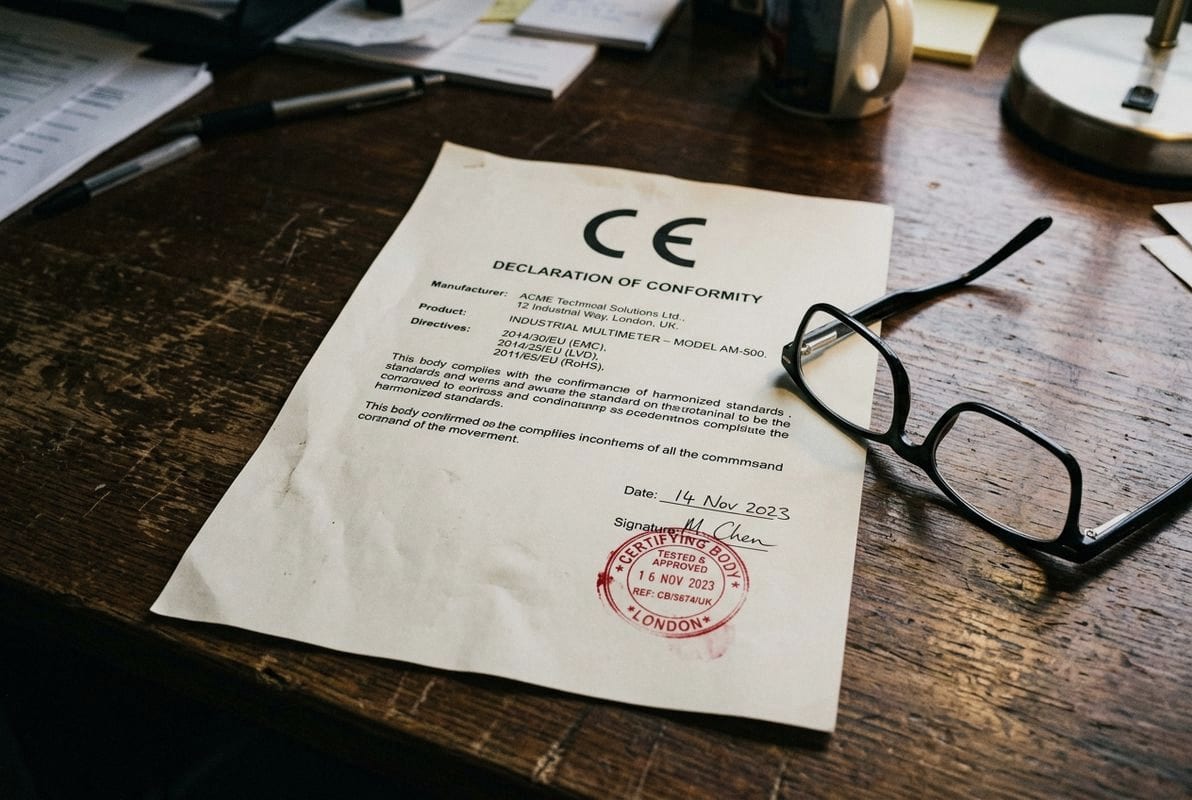
The EU Declaration of Conformity is a legal document. The entity that signs it accepts full legal responsibility for the product's compliance. When a supplier signs a DoC, they declare that their product meets the applicable directives. But here is the catch: if their product contains third-party sub-components, the DoC does not automatically certify those sub-components individually.
Think of it this way. A power supply manufacturer signs a DoC for their finished power supply. Inside, there is a capacitor from Vendor A and a transformer from Vendor B. The DoC covers the finished power supply as a whole — including those parts — but only in the context of how they function within that specific assembly. If you pull out that capacitor and sell it separately in the EU, it needs its own compliance path.
This is where our experience handling customs clearance across dozens of EU-bound shipments becomes critical. Beyond CE and safety compliance, there is a major intellectual property dimension that many exporters overlook.
If your product contains third-party branded components, EU customs officers check for trademark authorization first. Here is the authorization chain you need:
Here is what I recommend to every client before we book their shipment:
| Escenario | Risk Level | Action Required |
|---|---|---|
| Supplier made all components in-house | Bajo | Verify their DoC and technical file |
| Supplier assembled with Tier 2 parts, has test reports for all | Medio | Review Tier 2 test reports, confirm BOM match |
| Supplier assembled with Tier 2 parts, no sub-component documentation | Alta | Stop shipment, request full documentation before export |
| Third-party branded components, no authorization chain | Critical | Do not ship — customs will seize goods |
A lesson we learned early in our logistics business: CE marking and REACH/RoHS compliance are separate tracks, and passing one does not mean you pass the other. We once coordinated a shipment of LED driver modules that had perfect CE documentation but were flagged at the German border because the factory could not provide a REACH SVHC declaration for a specific plasticizer in the housing material.
To satisfy EU REACH and RoHS requirements, collect Substances of Very High Concern (SVHC) declarations, full material composition data, RoHS test reports from accredited labs, and SCIP database notifications for each third-party component — then verify that all restricted substance concentrations fall below regulatory thresholds.
Many people confuse REACH and RoHS 9. They overlap in some areas but serve different purposes and have different requirements.
REACH (Registration, Evaluation, Authorisation and Restriction of Chemicals) applies to virtually all products containing chemical substances sold in the EU. The key obligation for component exporters is Article 33: if any component contains a Substance of Very High Concern (SVHC) above 0.1% weight by weight, you must communicate this information down the supply chain and notify the SCIP database maintained by the European Chemicals Agency (ECHA).
RoHS (Restriction of Hazardous Substances) targets specific substances in electrical and electronic equipment. It restricts lead, mercury, cadmium, hexavalent chromium, PBB, and PBDE to strict maximum concentration values.
For every third-party component in your product, gather the following:
From our experience coordinating hundreds of EU-bound shipments, these are the mistakes we see most often:
For electronics and battery components, the EU is rolling out Digital Product Passport (DPP) 10 requirements. This means factories will need to collect and digitally link detailed material composition data, recycling information, and environmental impact metrics for each component. While full enforcement is still phased in, forward-thinking factories are already building these data systems. If your components include batteries or complex electronics, start asking your factory about DPP readiness now.
The broader trend is clear: the EU is moving toward full supply chain transparency. Risk assessment documentation, environmental compliance data, and ESG due diligence are no longer optional extras — they are becoming baseline requirements for market access.
Exporting third-party component products to the EU demands rigorous documentation across intellectual property authorization, CE conformity assessment, technical files, and REACH/RoHS compliance — get every link right to keep your goods moving through customs smoothly.
1. Provides access to the official and regularly updated list of Substances of Very High Concern by ECHA. ↩︎
2. Provides official information on CE marking, its purpose, and requirements for products in the EU. ↩︎
3. Explains the international system for classifying goods and its use in EU customs. ↩︎
4. Links to the official legal text of the EU's Low Voltage Directive. ↩︎
5. Replaced with the official 'Your Europe' portal from the European Union, providing comprehensive information on technical documentation for CE marking. ↩︎
6. Explains the legal responsibility of manufacturers for issuing the Declaration of Conformity. ↩︎
7. Provides access to the official EU database for identifying Notified Bodies. ↩︎
8. Links to the official ISO standard for risk assessment and reduction in machinery design. ↩︎
9. Provides official information on the REACH regulation, its scope, and purpose in the EU. ↩︎
10. Introduces the EU's initiative for digital product passports to enhance transparency and sustainability. ↩︎