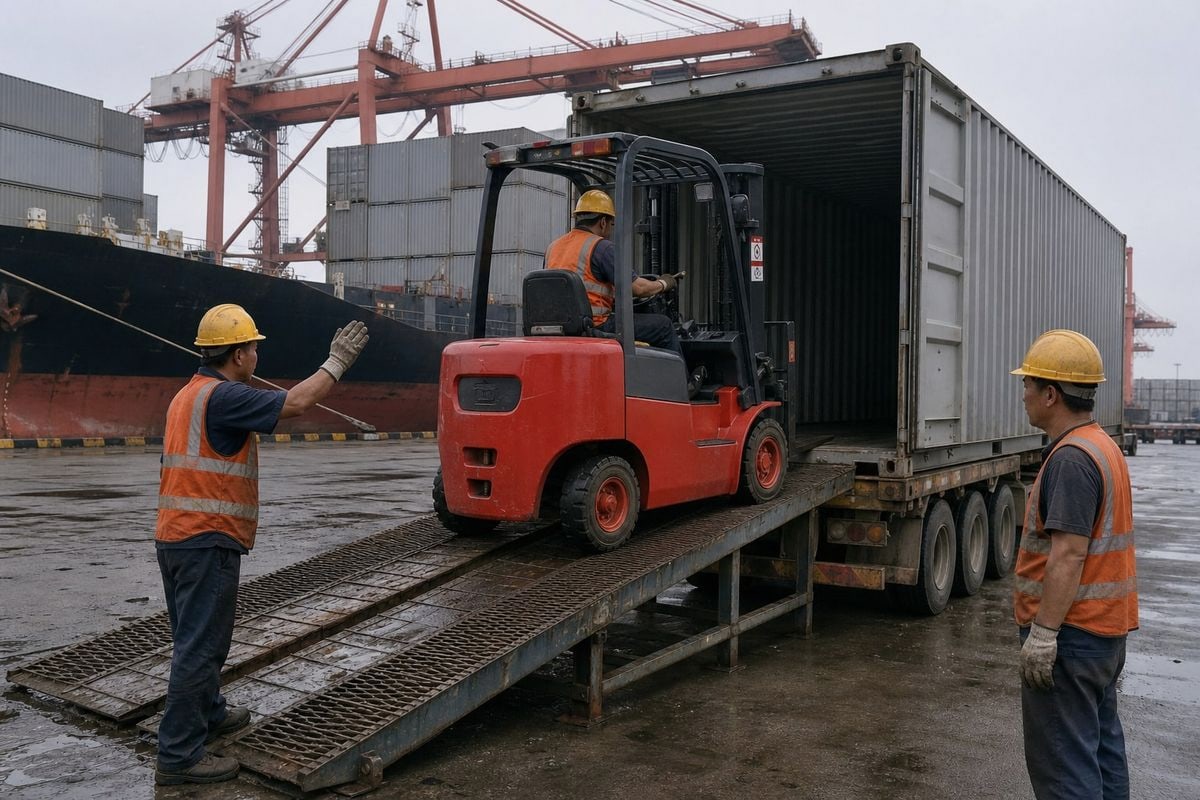
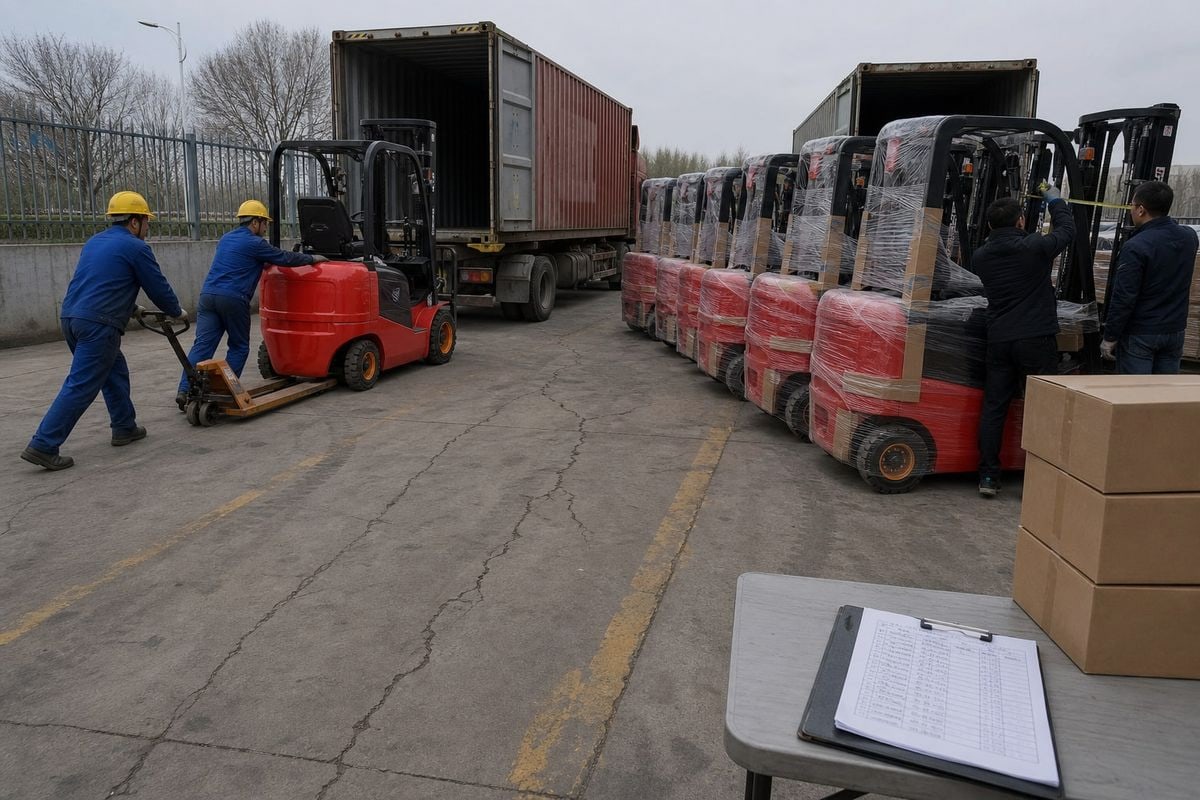
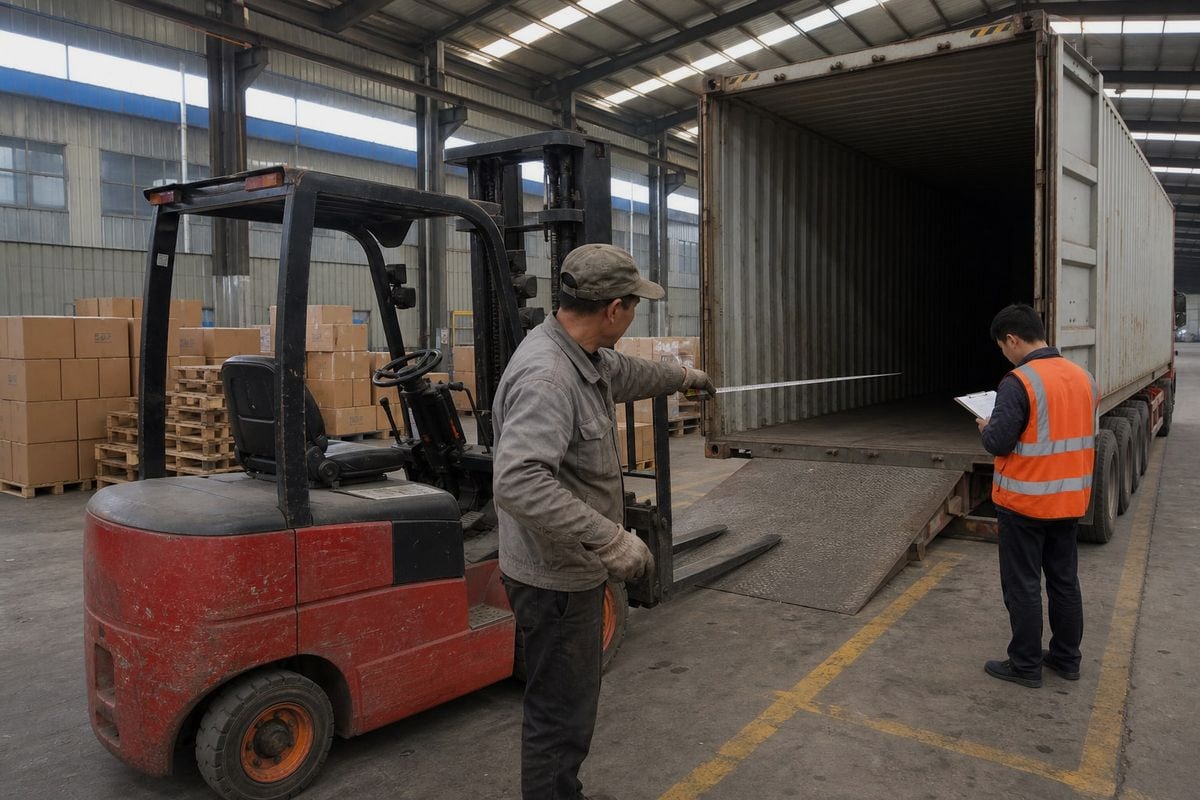
Saber cómo bloquear y asegurar montacargas para el envío marítimo es lo que distingue una llegada segura de una pesadilla de reclamaciones. En nuestro almacén de carga de Zhengzhou, vemos la diferencia semanalmente.
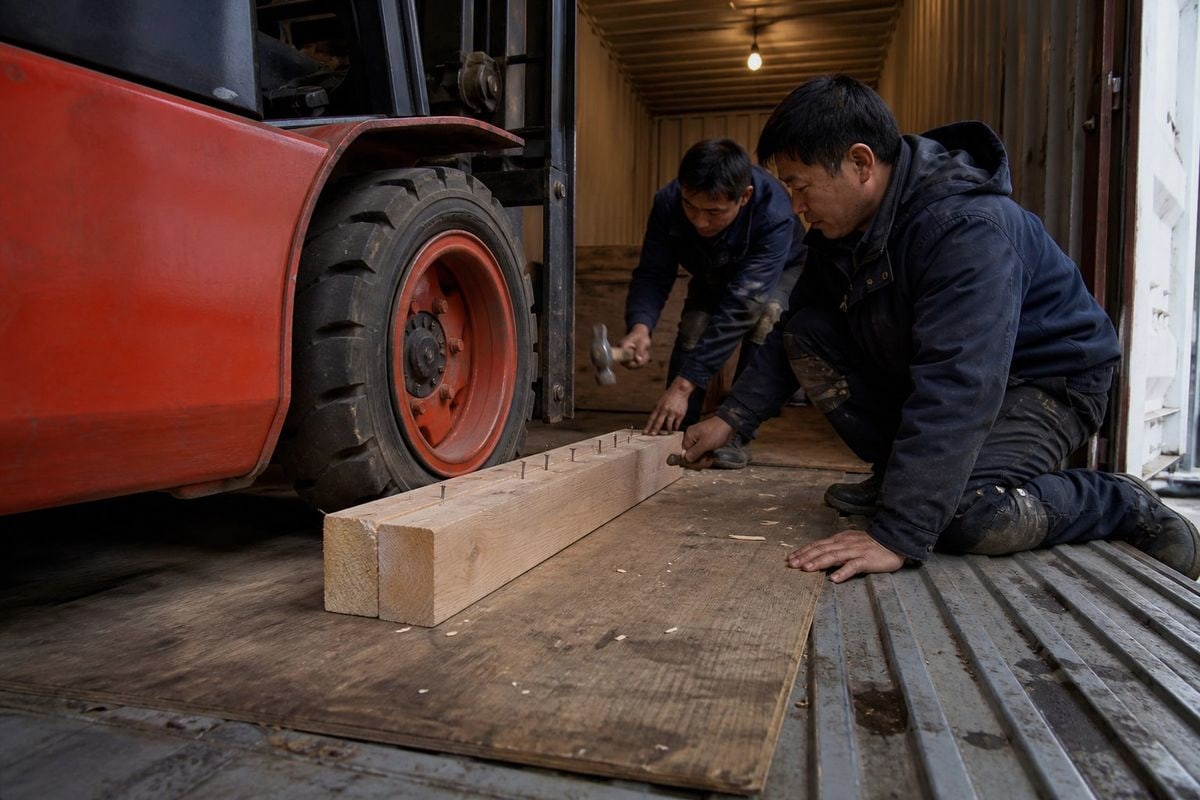
Para bloquear y asegurar un montacargas para el envío marítimo, baje el mástil, coloque contrachapado de 3/4 de pulgada debajo de las ruedas, clave bloques de madera laminada de 2x6 alrededor de las cuatro llantas con clavos de 16d que penetren en el suelo al menos 1 pulgada, luego agregue correas de trinquete de cuatro puntos atadas en ángulos de 45 grados.
Esa es la respuesta corta. Pero los detalles importan enormemente en el mar. A continuación, explicaré los materiales, manejo de baterías de litio, selección de contenedores y los errores que le cuestan dinero real a los importadores.
¿Qué materiales necesito para bloquear y asegurar correctamente mi montacargas para el envío marítimo?
Un comprador en Texas una vez me preguntó por qué gastamos dinero en madera y contrachapado antes de que su montacargas salga de China. Le envié fotos de la carga desplazada de un competidor. Nunca volvió a preguntar.
Necesitas hojas de contrachapado de 3/4 de pulgada, madera dura laminada de 2x6 o 4x4, clavos de 16d, cuñas para ruedas, correas de trinquete con una capacidad de 5,000 lb, materiales de dunnage como bolsas de aire o rellenos de panal, alfombrillas de fricción y protección VCI para electrónicos y barras hidráulicas.
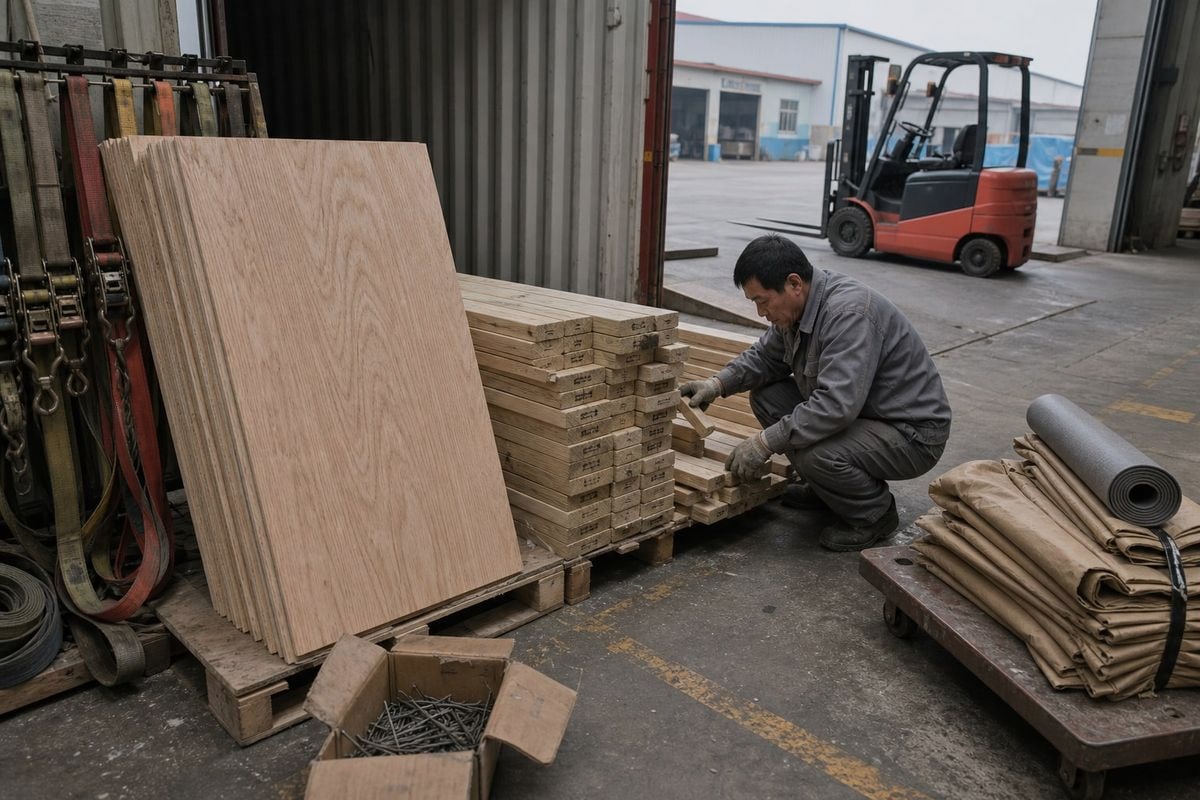
Déjame desglosar esto de la manera en que nuestro equipo de carga realmente lo piensa. El bloqueo detiene el deslizamiento horizontal. El refuerzo previene el vuelco y el rebote vertical. Las correas de sujeción complementan ambos. Necesitas que los tres funcionen juntos, porque el tránsito oceánico expone el contenedor a rodar, balancearse y agitarse al mismo tiempo.
La lista de materiales fundamentales
| Material | Objetivo | Especificación clave |
|---|---|---|
| Planchas de suelo de contrachapado | Distribuir el peso del eje | Grosor de 3/4 de pulgada bajo las ruedas |
| Madera laminada | Cuna de bloqueo de ruedas | 2x6 o 4x4, tratado térmicamente según ISPM-15 |
| Clavos | Fijar bloqueo al suelo | 16d o más grande, penetración mínima en el suelo de 1 pulgada |
| Correas de trinquete | Cruzado | Clasificado para 5,000 lb, de cuatro puntos a 45 grados |
| Bolsas de aire de dunnage | Llenar huecos | Dimensionado para espacios laterales y longitudinales |
| Mats de fricción | Aumentar la adherencia | Colocado debajo del bloqueo y neumáticos |
| Emisores VCI | Protección contra la corrosión | Aplicado a paneles de control y varillas de cilindro |
El paso de contrachapado es uno que los importadores evitan con mayor frecuencia. Un montacargas concentra varias toneladas en cuatro pequeñas parches de contacto de llantas 1. Sin contrachapado, las llantas pueden perforar o deformar el suelo de contrachapado marino del contenedor, y la línea naviera te cobrará por la reparación.
La técnica de clavar es tan importante como la madera misma. La resistencia del bloqueo del suelo aumenta directamente con el número de clavos usados. Usamos un patrón de clavo escalonado y desfasado cada 4 a 6 pulgadas en lugar de una línea recta, que podría dividir la madera a lo largo de la veta. Las piezas laminadas de 2x6 se colocan en los lados de cada rueda, además de en la parte frontal de las llantas delanteras y en la parte trasera de las llantas traseras, para que la máquina no pueda moverse en ninguna dirección.
Un punto más sobre la madera. Todos madera maciza 2 utilizada para exportación desde China debe llevar el sello de tratamiento térmico ISPM-15. Algunos de nuestros clientes ahora solicitan en su lugar sistemas de bloqueo compuestos reciclados, que eliminan el riesgo de plagas que perforan la madera y el documentación fitosanitaria 3 por completo. Ambos enfoques funcionan; la opción compuesta cuesta más pero simplifica la aduana en destinos con estrictas normas de bioseguridad como Australia.
¿Cómo aseguro un montacargas eléctrico con baterías de litio dentro de un contenedor de envío?
Los montacargas de batería de litio ahora constituyen la mayor parte de lo que enviamos de China a los EE. UU., y el trabajo de aseguramiento comienza mucho antes de que se coloque la primera correa.
Verifique la certificación de batería UN38.3, reduzca el estado de carga de la batería según los requisitos del transportista, desconecte e aisle los terminales de la batería, baje el mástil completamente, bloque las cilindros hidráulicos, luego aplique la misma cuna de bloqueo clavado más un amarre cruzado de cuatro puntos a los puntos de amarre del contenedor.

Electric forklifts add a compliance layer on top of physical securement. IMO dangerous goods regulations govern carga de baterías de litio 4 at sea, and carriers will reject a booking if the documentation is incomplete. In our experience coordinating lithium battery cargo handling from Chinese factories, the battery paperwork causes more port delays than the securing work itself.
The Battery Preparation Sequence
- Confirm the battery has a valid UN38.3 test summary from the factory before pickup.
- Check the carrier's declaration requirements for the specific battery chemistry and watt-hour rating.
- Disconnect the battery and insulate exposed terminals to prevent short circuits and electrical fires during the long transit.
- Secure or remove any spare batteries; loose batteries shipping alongside the forklift need their own compliant packaging.
- Photograph everything for the shipping file.
Para internal combustion units 5 mixed into the same shipment, the equivalent rule is draining fuel to less than 25 percent of tank capacity and disconnecting the battery. Either way, the machine must be inert before it enters the box.
Physical Securement Specific to Electric Models
Electric forklifts carry a heavy battery pack low in the chassis, which actually lowers the center of gravity compared to some IC counterterparts. That helps stability, but the counterweight still makes the machine rear-heavy. We position the unit centered over the container's transverse midline where possible, then build the blocking cradle around the wheels.
The mast deserves special attention. We install locking collars or a dead-stick bar on the hydraulic lift cylinders. Without them, thermal expansion and vibration can cause the mast to creep upward mid-voyage, snapping the lashing straps that run over it. We also apply VCI emitters or shrink wrap to the control panel and exposed cylinder rods, because the salt-air humidity inside a container over a three-to-five-week Pacific crossing will produce white rust on unprotected electronics and chrome.
Finally, the four-point cross-lashing runs from the chassis lashing points to the container's D-rings at roughly 45-degree angles, using 5,000-lb rated ratchet straps. This geometry counteracts the vessel's multi-axis movement in roll, pitch, and heave simultaneously.
¿Debo usar un contenedor de 20 pies, 40 pies o 40HQ al bloquear y reforzar mi montacargas?
The trade-off we weigh on every quote is simple: a smaller box costs less, but a fuller box secures better because there are fewer voids to manage.
Use a 20FT container for one or two forklifts, a 40FT for three to five standard units, and a 40HQ when mast height exceeds roughly 2.28 meters or when consolidating forklifts with chargers and spare parts. Oversized units may need a flat rack container instead.
Container choice directly affects how much blocking and bracing work you need. Here is the comparison we walk clients through before booking.
| Contenedor | Altura interior | Typical Forklift Load | Blocking Consideration |
|---|---|---|---|
| 20 pies | ~2,39 m | 1–2 units | Compact load, small voids, easiest to brace |
| 40FT | ~2,39 m | 3–5 units | Longitudinal voids need dunnage between units |
| 40HQ | ~2,69 m | 3–5 taller units + parts | Extra height for masts; more void-filling required |
| Flat rack | Open top/sides | Oversized units | Relies entirely on chains and lashing, no walls |
How Height Drives the Decision
Mast height is the first filter. A standard container door opening is about 2.28 meters. If the lowered mast clears that, a standard box works. If not, the 40HQ gives roughly 30 centimeters more clearance. When even a high cube cannot fit the machine, we move to a flat rack container, which changes the securement approach completely: with no walls to block against, everything depends on chains, ratchet straps, and welded or bolted restraints, engineered to CTU Code compliance standards for open-deck exposure.
How Voids Drive the Cost
A 40FT with two forklifts inside leaves large empty spaces. Empty space lets a machine gain momentum during heavy sea swells before it hits anything. So a lightly loaded big box actually needs more lumber, more dunnage air bags, and more lashing than a tightly packed small one. This is why we often recommend filling unused space with chargers, forklift spare parts, or batteries from other suppliers through multi-supplier consolidation. It lowers your cost per unit and improves maritime cargo safety at the same time, because a full container is an inherently more stable container.
Weight limits rarely bite before volume does. Most 2.5 to 3.5-ton electric forklifts weigh 3 to 5 tons each, so even a 20FT stays comfortably within payload limits with two units aboard.
¿Qué errores debo evitar al cargar y asegurar mi montacargas para la exportación desde China?
The costliest lesson I learned early in this business came from a container where the factory "saved time" by skipping the nailed blocking. The forklift arrived with a bent mast and a punctured container wall.
Avoid relying on straps alone, using unfixed or makeshift wheel chocks, skipping plywood floor protection, leaving voids unfilled, forgetting mast lock-down, using non-ISPM-15 lumber, and failing to photograph and inspect the securement before the container doors close.

Most damage claims trace back to a handful of repeated errors. I will go through the big ones and how our team prevents each.
The Seven Mistakes We See Most
| Mistake | Consecuencia | Prevención |
|---|---|---|
| Straps only, no blocking | Straps loosen; unit slides | Nailed lumber cradle first, lashing second |
| Loose or improvised chocks | Chocks kick out in swells | Fixed blocking on all four wheel faces |
| No plywood underlay | Floor punch-through charges | 3/4-inch plywood under each wheel path |
| Unfilled voids | Machine gains momentum | Dunnage air bags or honeycomb fillers |
| Mast not locked | Cylinder creep snaps lashings | Locking collars or dead-stick bars |
| Untreated lumber | Quarantine holds at destination | ISPM-15 stamped wood or composite blocking |
| Dirty undercarriage | Biosecurity inspection failure | Deep-clean chassis before loading |
A few of these deserve more explanation. Chocking wheels with random scrap wood is not acceptable securement; a chock that is not fixed to the floor becomes a projectile the first time the vessel rolls hard. Similarly, a single line of nails along the grain splits the lumber, so staggered nailing every 4 to 6 inches is non-negotiable in our loading standard.
The biosecurity point surprises many first-time importers. Soil and organic matter on the chassis can fail a phytosanitary inspection at US or European ports, triggering cleaning orders, storage fees, and delays. We coordinate a decontamination wash at the factory before pickup.
Finally, document everything. We photograph the blocking, the tie-down points, the strap tension, and the closed doors with the seal number. Some clients also deploy impact-activated IoT sensors on the frame to record 3-axis G-force data during transit. That digital audit trail distinguishes between a bracing failure and genuine carrier negligence, which matters enormously when an insurance claim is on the table. A pre-closure inspection takes fifteen minutes. A disputed damage claim takes months.
Conclusión
Fixed lumber blocking, plywood floor protection, four-point lashing, filled voids, and battery-compliant preparation together keep a forklift safe at sea. Get one wrong, and the ocean finds it.
Notas al pie
1. ISO standards for freight containers account for concentrated loads on tire contact patches to prevent floor damage. ↩︎
2. The IPPC sets international standards for solid wood packaging materials to prevent the spread of forest pests. ↩︎
3. The World Customs Organization streamlines the processing of phytosanitary paperwork and customs documentation for international trade. ↩︎
4. The IMO regulates the maritime transport of lithium battery cargo to ensure vessel safety and fire prevention. ↩︎
5. UNECE provides regulations for the transport of internal combustion units and vehicles containing flammable liquid fuels. ↩︎