- +8618603825129
- [email protected]


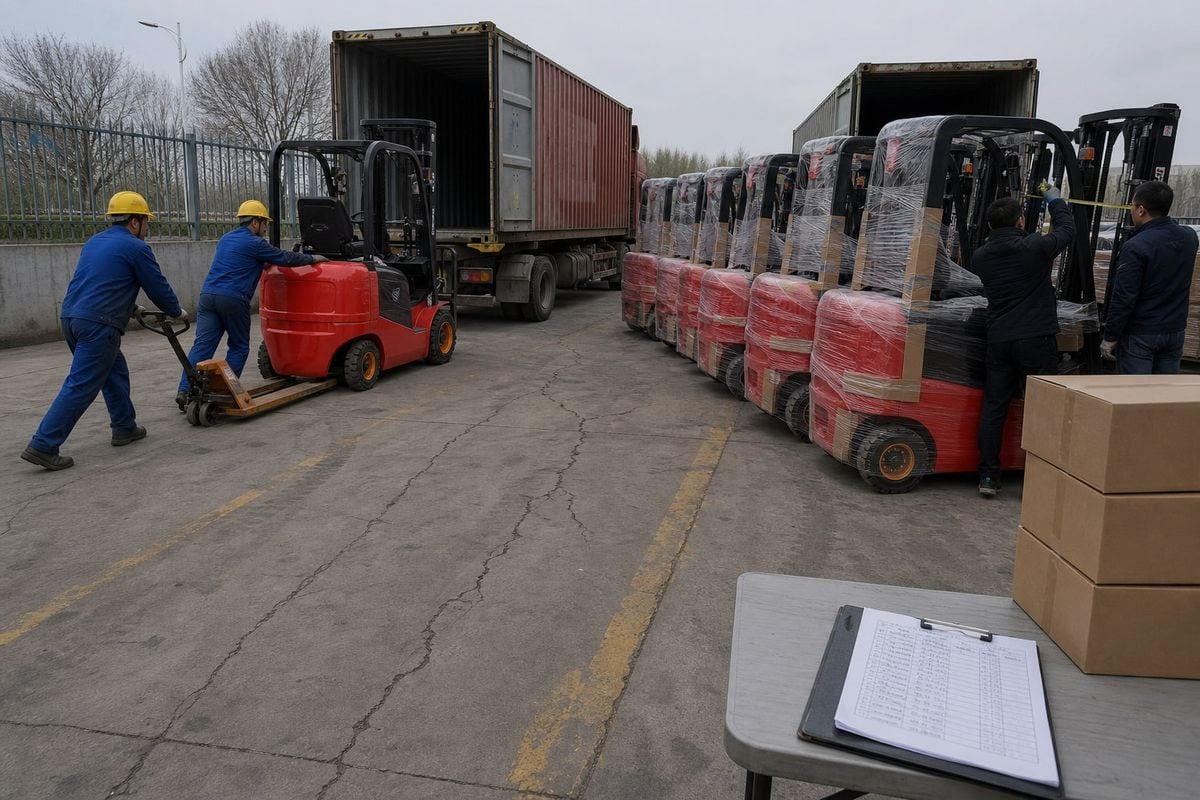
Knowing how to block and brace forklifts for ocean shipping is what separates a safe arrival from a claims nightmare. At our Zhengzhou loading warehouse, we see the difference weekly.
To block and brace a forklift for ocean shipping, lower the mast, place 3/4-inch plywood under the wheels, nail laminated 2x6 lumber blocking around all four tires with 16d nails penetrating the floor at least 1 inch, then add four-point ratchet strap lashing at 45-degree angles.
That is the short answer. But the details matter enormously at sea. Below, I will walk through materials, lithium battery handling, container selection, and the mistakes that cost importers real money.
A buyer in Texas once asked me why we spend money on lumber and plywood before his forklift even leaves China. I sent him photos of a competitor's shifted load. He never asked again.
You need 3/4-inch plywood floor sheets, laminated 2x6 or 4x4 hardwood lumber, 16d nails, wheel chocks, 5,000-lb rated ratchet straps, dunnage materials like air bags or honeycomb fillers, friction mats, and VCI protection for electronics and hydraulic rods.
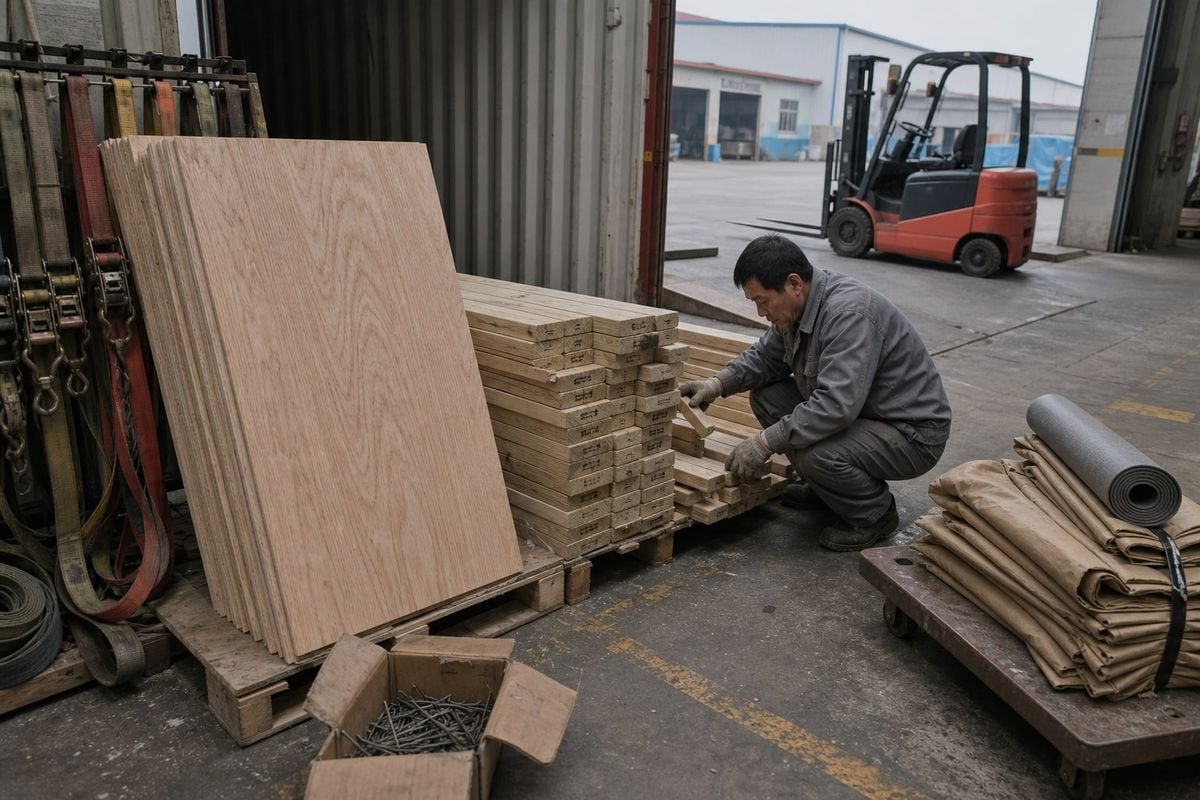
Let me break this down the way our loading team actually thinks about it. Blocking stops horizontal sliding. Bracing prevents tipping and vertical bounce. Lashing and securing straps supplement both. You need all three working together, because ocean transit exposes the container to roll, pitch, and heave at the same time.
| Material | Objetivo | Key Specification |
|---|---|---|
| Plywood floor sheets | Distribute axle weight | 3/4-inch thickness under wheels |
| Laminated lumber | Wheel blocking cradle | 2x6 or 4x4, ISPM-15 heat-treated |
| Nails | Fix blocking to floor | 16d or larger, 1-inch minimum floor penetration |
| Ratchet straps | Cross-lashing | 5,000-lb rated, four-point at 45 degrees |
| Dunnage air bags | Fill voids | Sized to lateral and longitudinal gaps |
| Friction mats | Increase grip | Placed under blocking and tires |
| VCI emitters | Corrosion protection | Applied to control panels and cylinder rods |
The plywood step is one importers skip most often. A forklift concentrates several tons on four small tire contact patches 1. Without plywood, the tires can punch through or warp the container's marine-grade plywood flooring, and the shipping line will bill you for the repair.
Nailing technique matters just as much as the lumber itself. The strength of floor blocking increases directly with the number of nails used. We use a staggered, offset nail pattern every 4 to 6 inches rather than a single straight line, which would split the wood along the grain. Laminated 2x6 pieces go on the sides of each wheel, plus the fronts of the front tires and the backs of the rear tires, so the machine cannot creep in any direction.
One more point on lumber. All solid wood 2 used for export from China must carry the ISPM-15 heat-treatment stamp. Some of our clients now request recycled composite blocking systems instead, which eliminate wood-boring pest risk and the phytosanitary paperwork 3 entirely. Both approaches work; the composite option costs more but simplifies customs at biosecurity-strict destinations like Australia.
Lithium battery forklifts now make up most of what we ship from China to the US, and the securing job starts long before the first strap goes on.
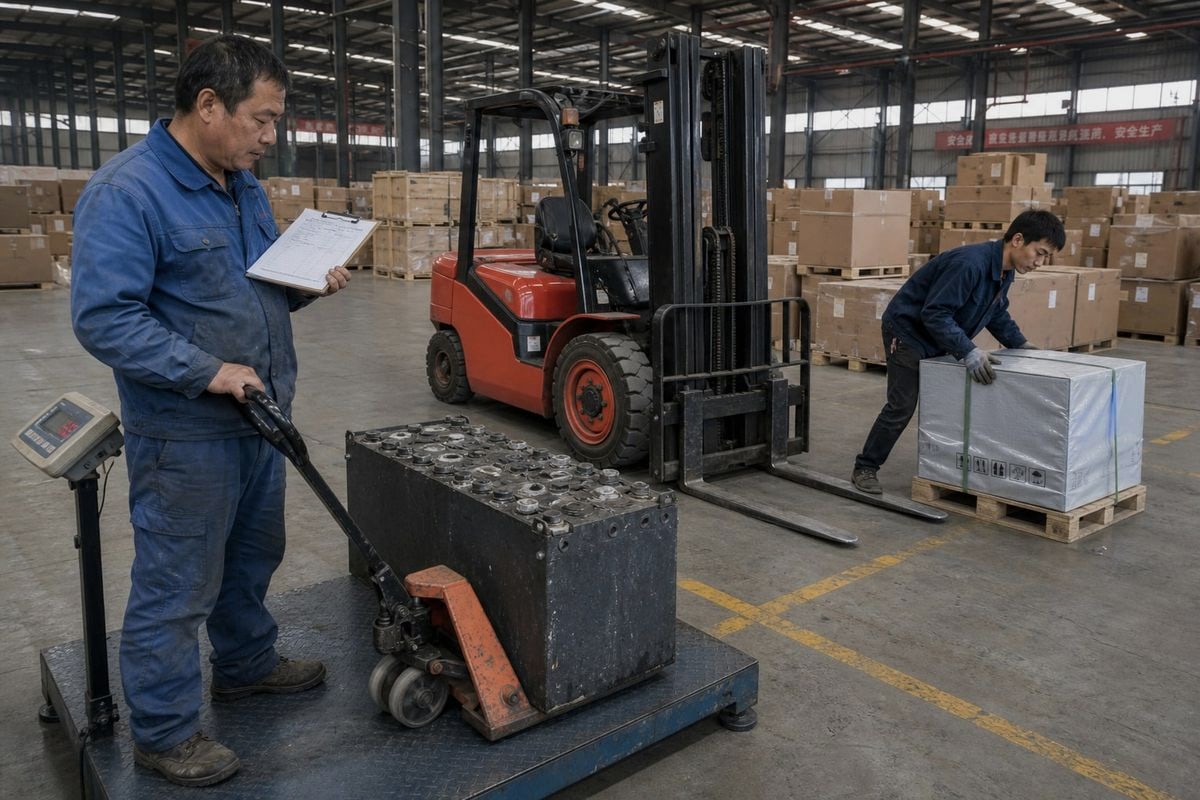
Verify UN38.3 battery certification, reduce the battery's state of charge per carrier requirements, disconnect and insulate the battery terminals, lower the mast fully, lock the hydraulic cylinders, then apply the same nailed blocking cradle plus four-point cross-lashing to the container's tie-down points.

Electric forklifts add a compliance layer on top of physical securement. IMO dangerous goods regulations govern lithium battery cargo 4 at sea, and carriers will reject a booking if the documentation is incomplete. In our experience coordinating lithium battery cargo handling from Chinese factories, the battery paperwork causes more port delays than the securing work itself.
Para internal combustion units 5 mixed into the same shipment, the equivalent rule is draining fuel to less than 25 percent of tank capacity and disconnecting the battery. Either way, the machine must be inert before it enters the box.
Electric forklifts carry a heavy battery pack low in the chassis, which actually lowers the center of gravity compared to some IC counterterparts. That helps stability, but the counterweight still makes the machine rear-heavy. We position the unit centered over the container's transverse midline where possible, then build the blocking cradle around the wheels.
The mast deserves special attention. We install locking collars or a dead-stick bar on the hydraulic lift cylinders. Without them, thermal expansion and vibration can cause the mast to creep upward mid-voyage, snapping the lashing straps that run over it. We also apply VCI emitters or shrink wrap to the control panel and exposed cylinder rods, because the salt-air humidity inside a container over a three-to-five-week Pacific crossing will produce white rust on unprotected electronics and chrome.
Finally, the four-point cross-lashing runs from the chassis lashing points to the container's D-rings at roughly 45-degree angles, using 5,000-lb rated ratchet straps. This geometry counteracts the vessel's multi-axis movement in roll, pitch, and heave simultaneously.
The trade-off we weigh on every quote is simple: a smaller box costs less, but a fuller box secures better because there are fewer voids to manage.
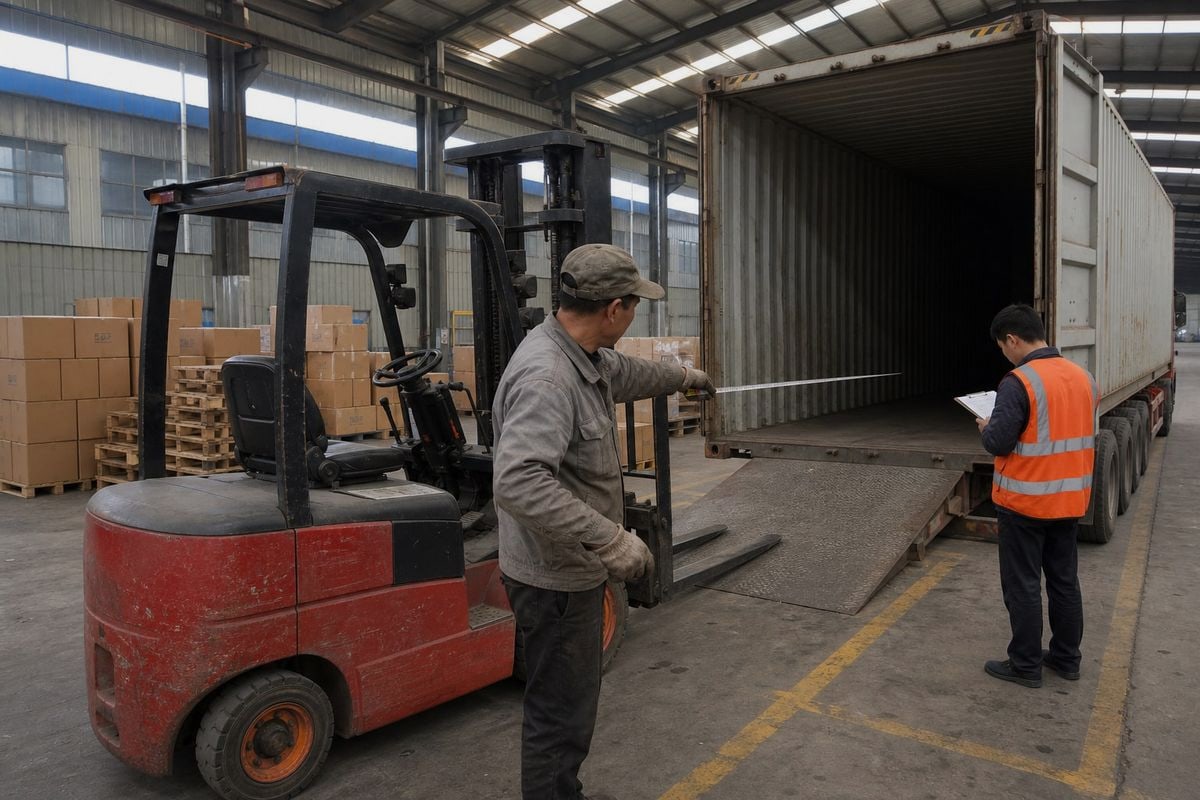
Use a 20FT container for one or two forklifts, a 40FT for three to five standard units, and a 40HQ when mast height exceeds roughly 2.28 meters or when consolidating forklifts with chargers and spare parts. Oversized units may need a flat rack container instead.
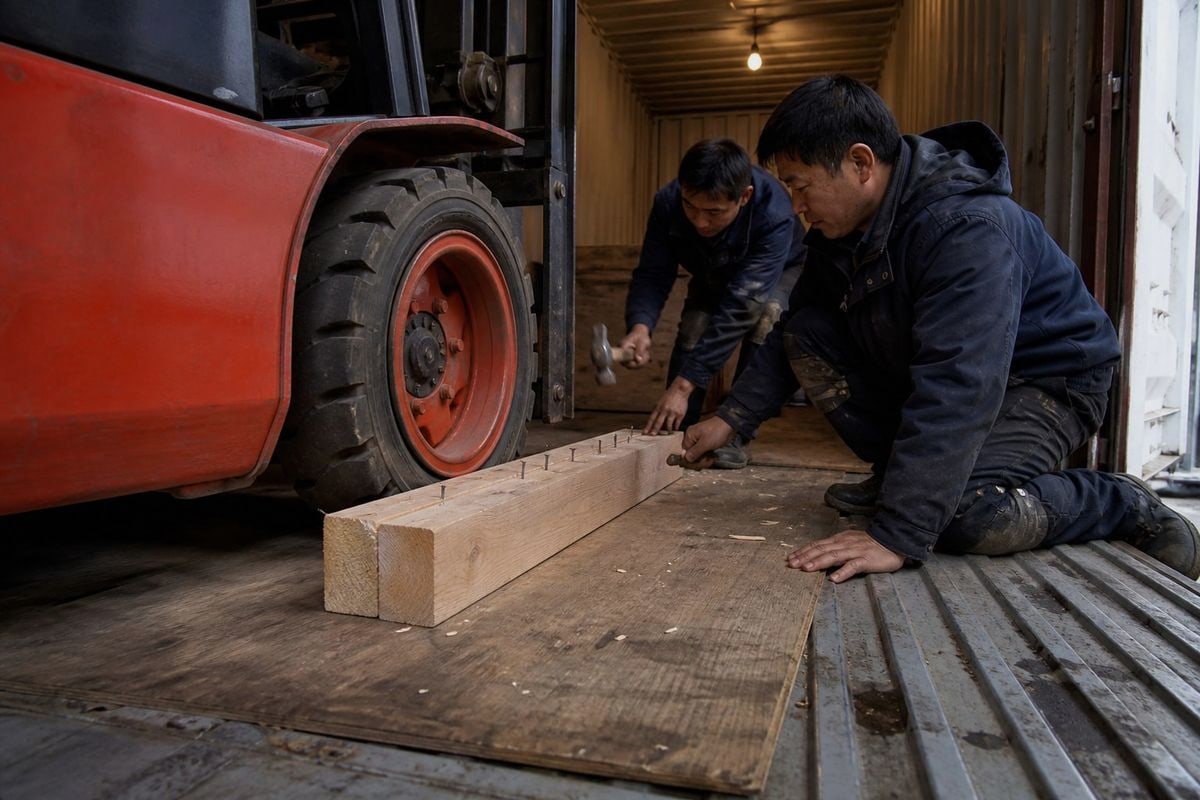
Container choice directly affects how much blocking and bracing work you need. Here is the comparison we walk clients through before booking.
| Container | Altura interior | Typical Forklift Load | Blocking Consideration |
|---|---|---|---|
| 20FT | ~2.39 m | 1–2 units | Compact load, small voids, easiest to brace |
| 40FT | ~2.39 m | 3–5 units | Longitudinal voids need dunnage between units |
| 40HQ | ~2.69 m | 3–5 taller units + parts | Extra height for masts; more void-filling required |
| Flat rack | Open top/sides | Oversized units | Relies entirely on chains and lashing, no walls |
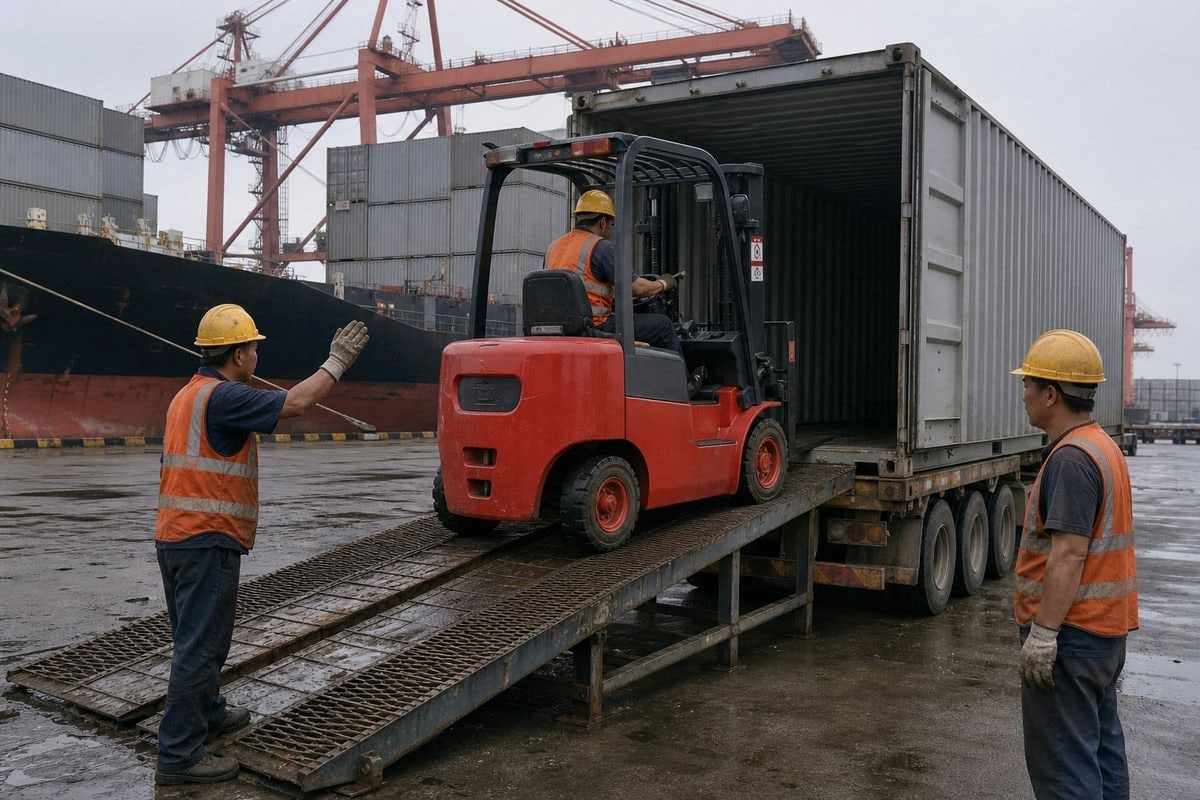
Mast height is the first filter. A standard container door opening is about 2.28 meters. If the lowered mast clears that, a standard box works. If not, the 40HQ gives roughly 30 centimeters more clearance. When even a high cube cannot fit the machine, we move to a flat rack container, which changes the securement approach completely: with no walls to block against, everything depends on chains, ratchet straps, and welded or bolted restraints, engineered to CTU Code compliance standards for open-deck exposure.
A 40FT with two forklifts inside leaves large empty spaces. Empty space lets a machine gain momentum during heavy sea swells before it hits anything. So a lightly loaded big box actually needs more lumber, more dunnage air bags, and more lashing than a tightly packed small one. This is why we often recommend filling unused space with chargers, forklift spare parts, or batteries from other suppliers through multi-supplier consolidation. It lowers your cost per unit and improves maritime cargo safety at the same time, because a full container is an inherently more stable container.
Weight limits rarely bite before volume does. Most 2.5 to 3.5-ton electric forklifts weigh 3 to 5 tons each, so even a 20FT stays comfortably within payload limits with two units aboard.
The costliest lesson I learned early in this business came from a container where the factory "saved time" by skipping the nailed blocking. The forklift arrived with a bent mast and a punctured container wall.
Avoid relying on straps alone, using unfixed or makeshift wheel chocks, skipping plywood floor protection, leaving voids unfilled, forgetting mast lock-down, using non-ISPM-15 lumber, and failing to photograph and inspect the securement before the container doors close.

Most damage claims trace back to a handful of repeated errors. I will go through the big ones and how our team prevents each.
| Mistake | Consequence | Prevención |
|---|---|---|
| Straps only, no blocking | Straps loosen; unit slides | Nailed lumber cradle first, lashing second |
| Loose or improvised chocks | Chocks kick out in swells | Fixed blocking on all four wheel faces |
| No plywood underlay | Floor punch-through charges | 3/4-inch plywood under each wheel path |
| Unfilled voids | Machine gains momentum | Dunnage air bags or honeycomb fillers |
| Mast not locked | Cylinder creep snaps lashings | Locking collars or dead-stick bars |
| Untreated lumber | Quarantine holds at destination | ISPM-15 stamped wood or composite blocking |
| Dirty undercarriage | Biosecurity inspection failure | Deep-clean chassis before loading |
A few of these deserve more explanation. Chocking wheels with random scrap wood is not acceptable securement; a chock that is not fixed to the floor becomes a projectile the first time the vessel rolls hard. Similarly, a single line of nails along the grain splits the lumber, so staggered nailing every 4 to 6 inches is non-negotiable in our loading standard.
The biosecurity point surprises many first-time importers. Soil and organic matter on the chassis can fail a phytosanitary inspection at US or European ports, triggering cleaning orders, storage fees, and delays. We coordinate a decontamination wash at the factory before pickup.
Finally, document everything. We photograph the blocking, the tie-down points, the strap tension, and the closed doors with the seal number. Some clients also deploy impact-activated IoT sensors on the frame to record 3-axis G-force data during transit. That digital audit trail distinguishes between a bracing failure and genuine carrier negligence, which matters enormously when an insurance claim is on the table. A pre-closure inspection takes fifteen minutes. A disputed damage claim takes months.
Fixed lumber blocking, plywood floor protection, four-point lashing, filled voids, and battery-compliant preparation together keep a forklift safe at sea. Get one wrong, and the ocean finds it.
1. ISO standards for freight containers account for concentrated loads on tire contact patches to prevent floor damage. ↩︎
2. The IPPC sets international standards for solid wood packaging materials to prevent the spread of forest pests. ↩︎
3. The World Customs Organization streamlines the processing of phytosanitary paperwork and customs documentation for international trade. ↩︎
4. The IMO regulates the maritime transport of lithium battery cargo to ensure vessel safety and fire prevention. ↩︎
5. UNECE provides regulations for the transport of internal combustion units and vehicles containing flammable liquid fuels. ↩︎