- +8618603825129
- [email protected]

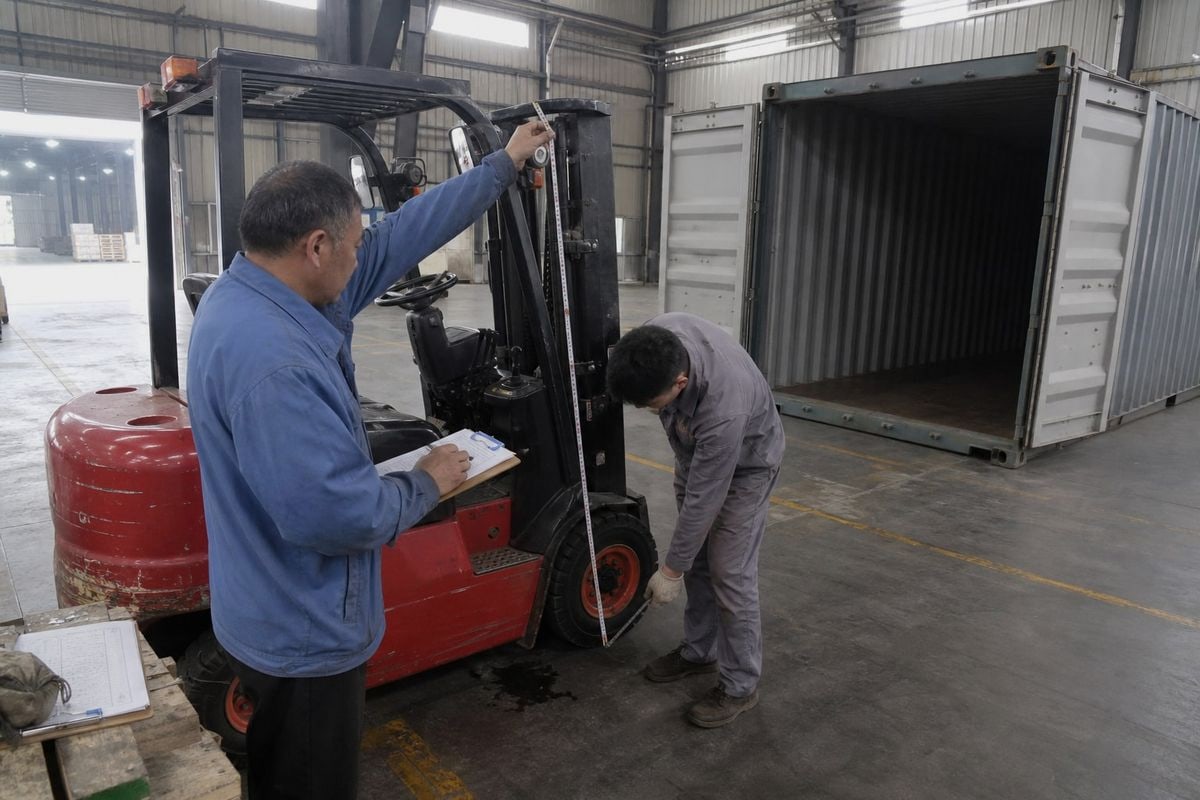
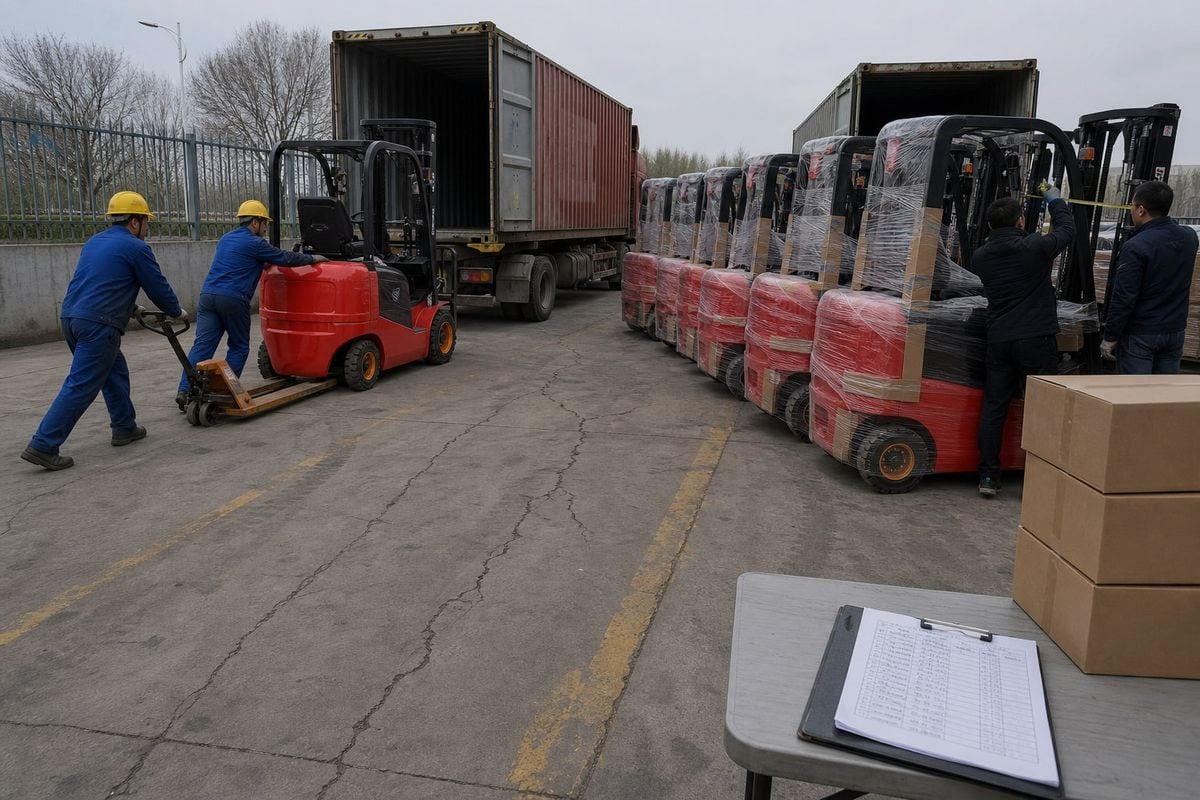
Every week at our Zhengzhou loading warehouse, a forklift arrives that the buyer swears will "definitely fit." Sometimes it does not. That mistake costs money, time, and sometimes a damaged mast — and it is completely avoidable.
Most forklifts fit through a shipping container door only if their collapsed mast height is 2.28 meters (7'6") or less and their overall width is under 2.34 meters (7'8"). Larger machines need a high cube, open-side, open-top, or flat rack container instead.
The door opening is the real gatekeeper, not the container's outside size. Below, I will walk you through clearance numbers, container choices, oversized options, and how to measure correctly before you book.
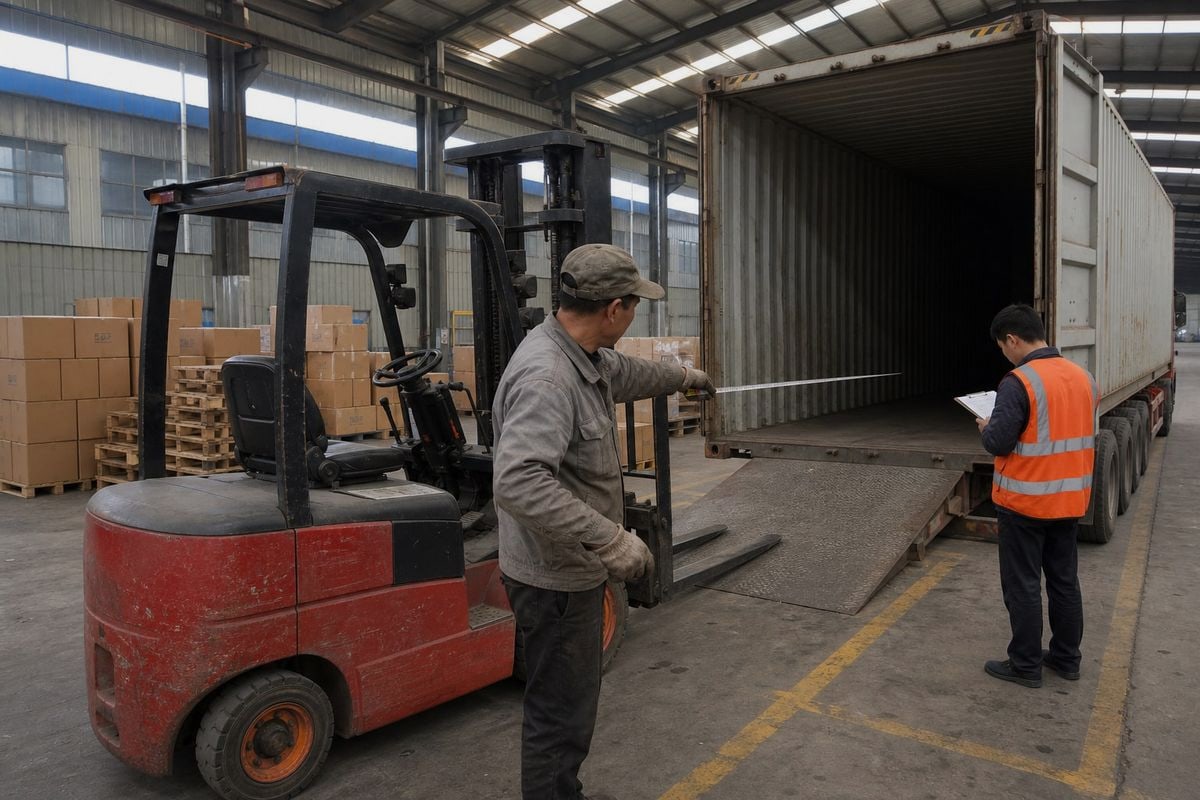
When our loading team plans stuffing and stripping for electric forklifts, we never trust a spec sheet alone. We put a tape measure on the actual machine before it goes anywhere near the container door.
You need at least 50–80 mm of vertical clearance between the forklift's collapsed mast height and the container door opening, which is roughly 2,292 mm (7'6¼") high and 2,340 mm (7'8⅛") wide on a standard dry container. Practically, keep the mast at or below 2,260–2,280 mm.
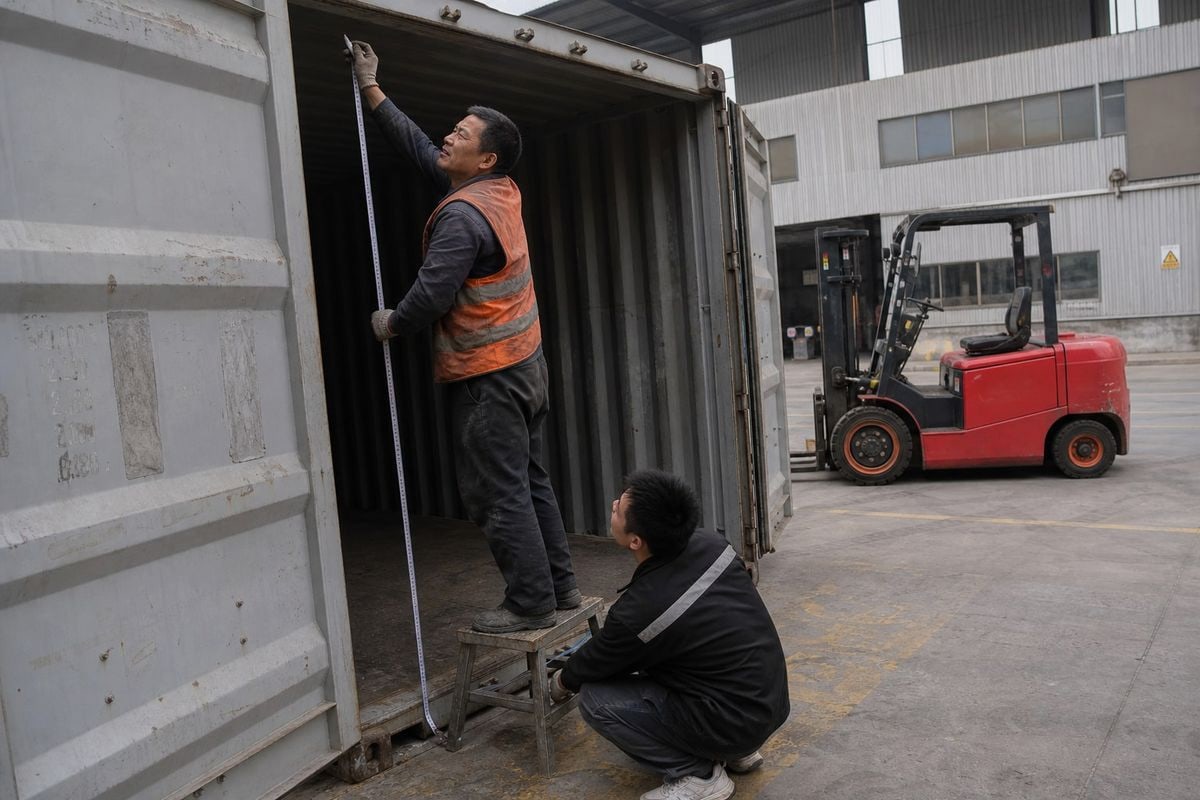
Here is the detail most first-time importers miss. A standard container's interior ceiling is taller than its door. A 20-foot container has an internal height of about 7'10¼", but the door opening is only about 7'6¼" because of the structural top rail 1. So the door — not the ceiling — sets your limit.
| Measurement | Standard 20FT / 40FT Dry Container |
|---|---|
| Door opening width | 2,340 mm (7' 8⅛") |
| Door opening height | 2,292 mm (7' 6¼") |
| Internal height | 2,393 mm (7' 10¼") |
| Internal width | 2,352 mm (7' 8⅝") |
| Recommended max collapsed mast height 2 | 2,260–2,280 mm |
Width sounds generous at 2,340 mm, but real clearance shrinks fast. Mirrors, a low profile overhead guard that still protrudes, a side shift attachment, wide tire stance, and steering geometry all eat into that margin. A machine that technically clears the standard door opening width can still scrape a frame during the turn-in.
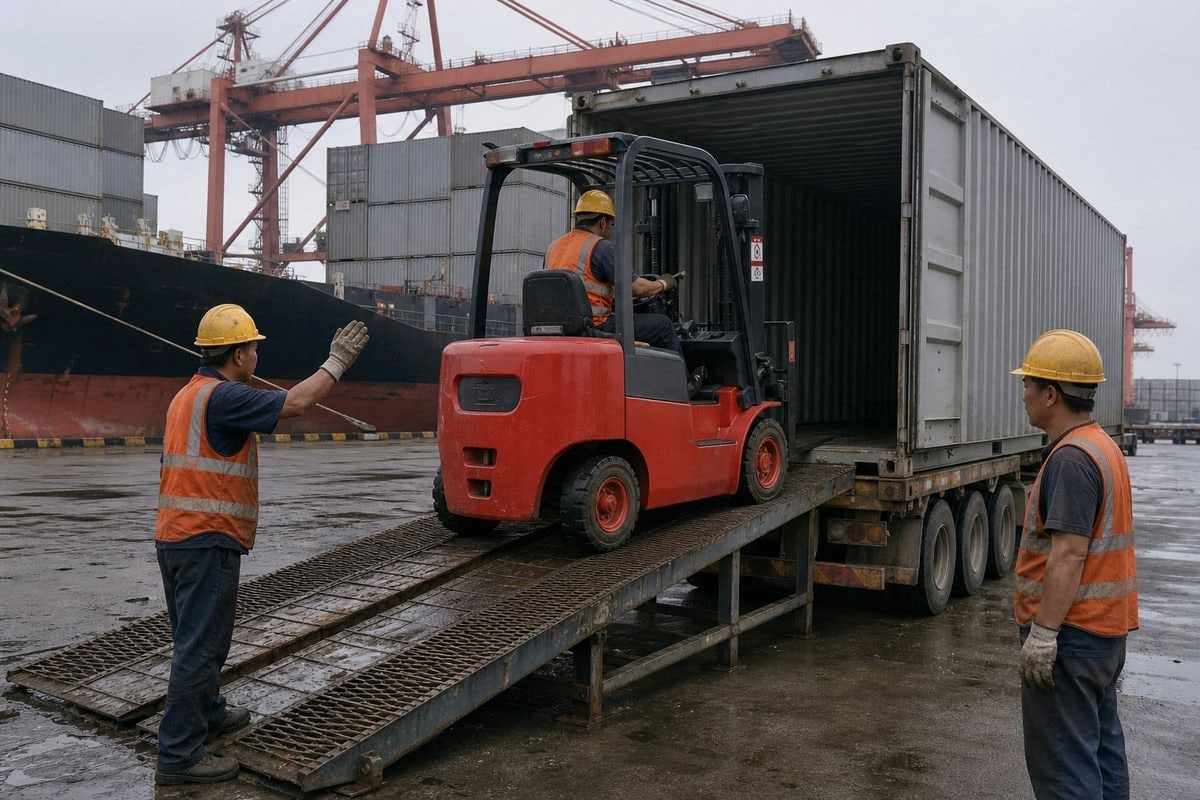
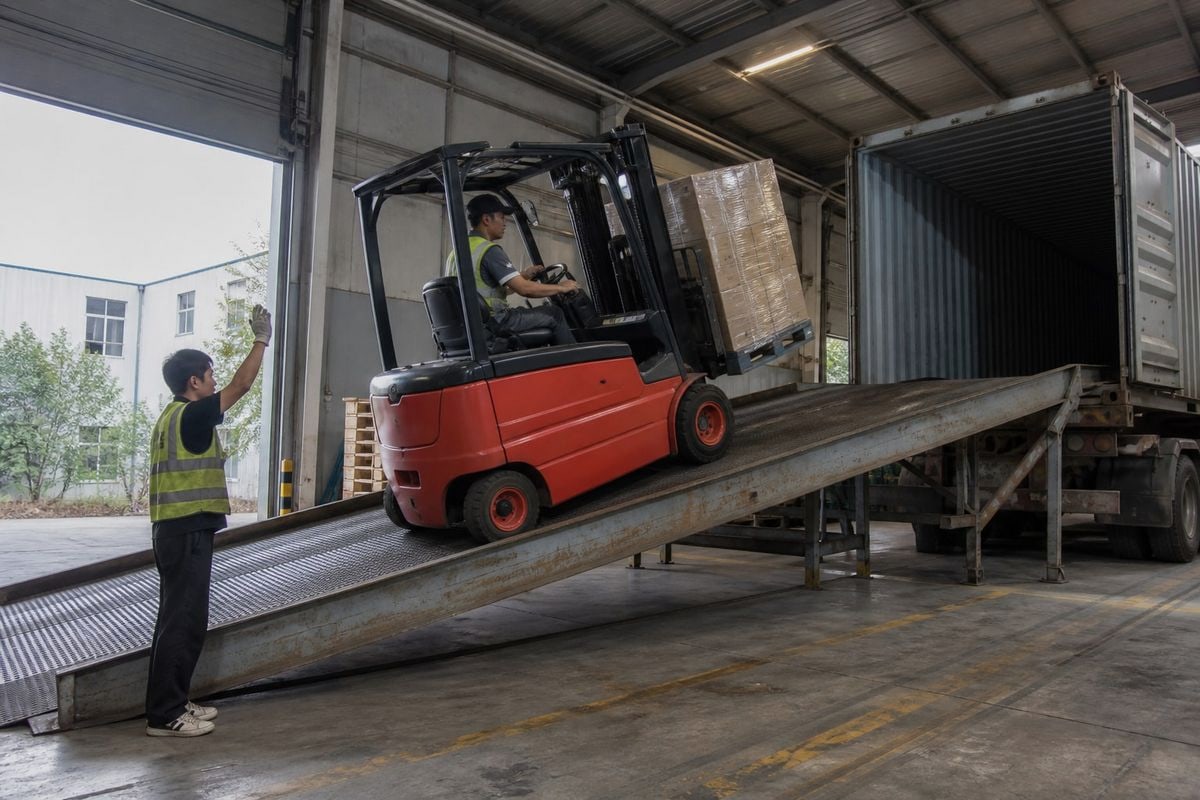
There is one more hazard almost nobody warns you about: the ramp transition. When a forklift drives up a forklift ramp for containers, the apex angle temporarily tilts the machine and raises the highest point of the mast. A forklift that clears the header on level ground can strike it mid-ramp. That is why we insist on a long, rated ramp with a gentle angle and a level container sitting on firm ground.
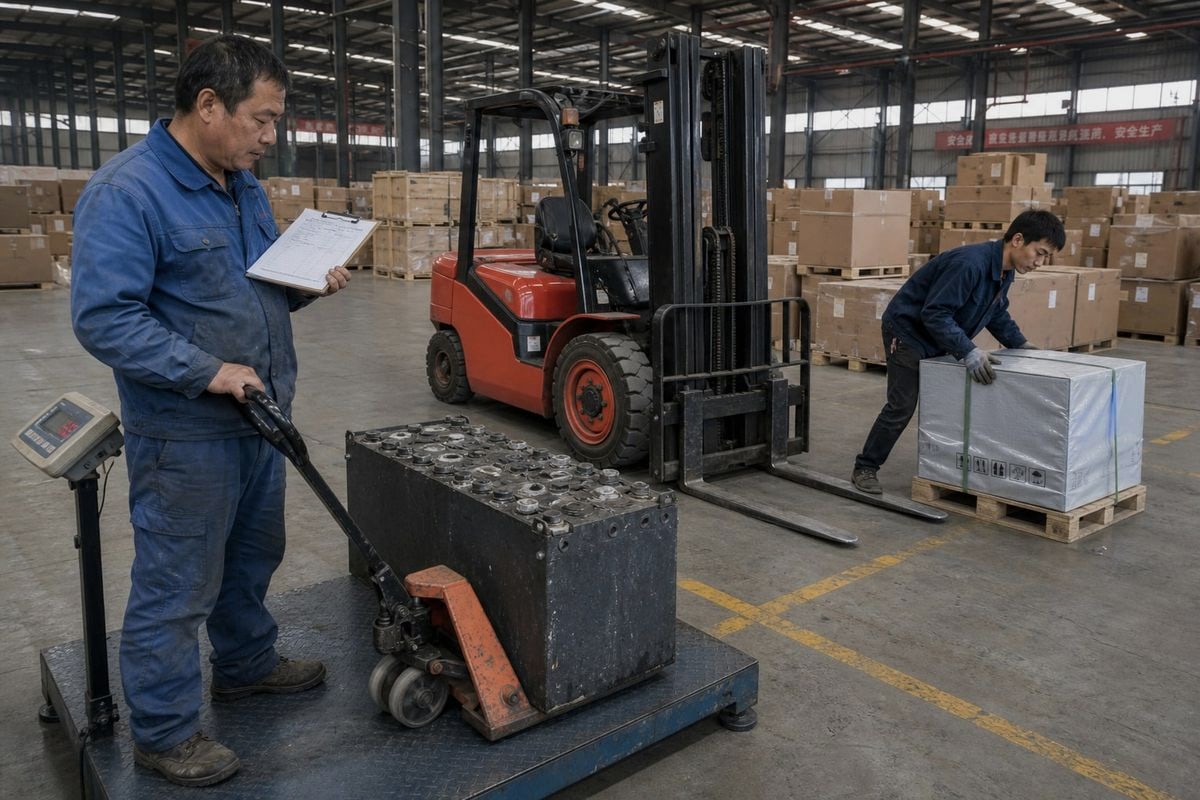
Also remember weight. The container's floor load capacity 3 is designed for cargo, not for every rolling load. A forklift concentrates several tons onto four small wheel contact points, so axle load must be checked against the floor rating — especially with lithium-ion electric models, which pack dense weight over a compact footprint.
A forklift dealer in Texas once asked us to ship six rough-terrain units in standard 40-foot boxes. The collapsed mast height was 2,450 mm. We stopped the booking and re-planned before a single truck left the factory.
Choose a 40HQ high cube container if the mast exceeds standard door height by up to 130 mm, an open-side container for wide machines needing full-length access, or an open-top or flat rack container for forklifts that exceed door dimensions entirely.
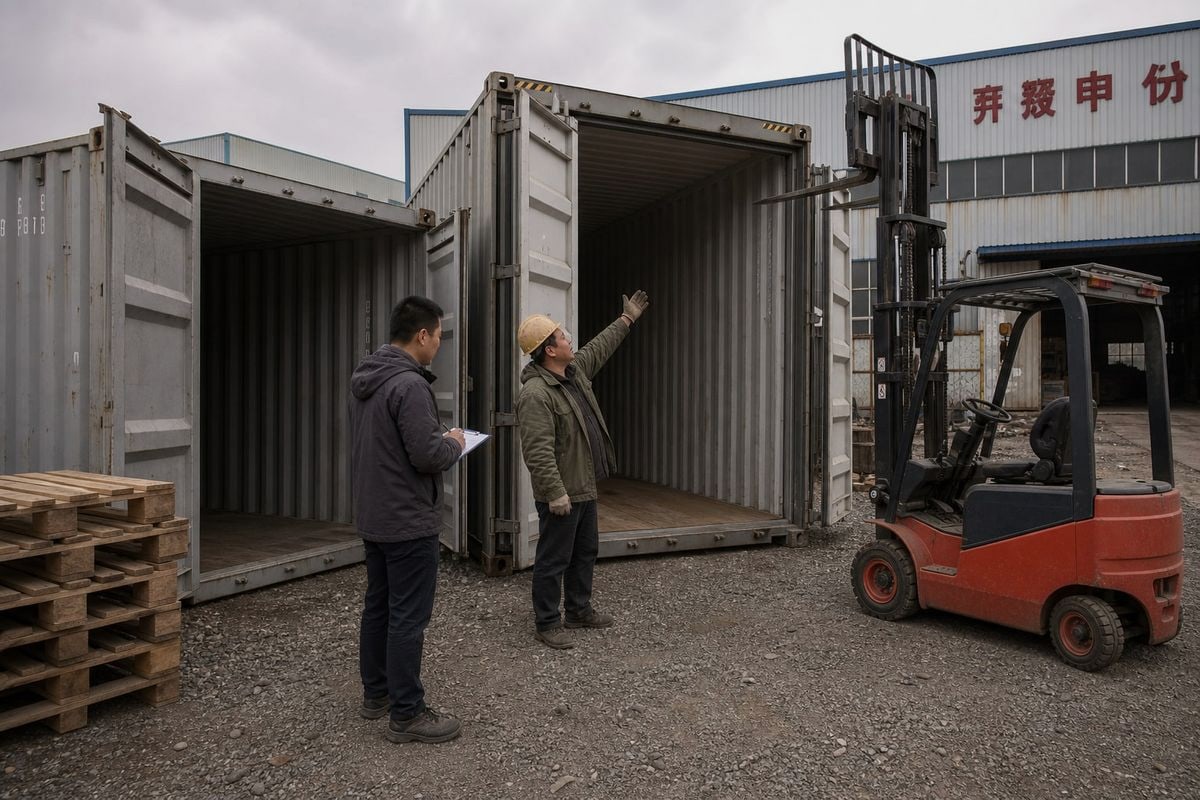
Let me break down the realistic options, because each one changes your freight cost and loading method.
| Tipo de contenedor | Door / Access Height | Lo mejor para | Cost Impact |
|---|---|---|---|
| Standard 20FT / 40FT | ~2,292 mm door | Compact electric forklifts, pallet trucks, stackers | Baseline |
| 40HQ High Cube | ~2,585 mm door | Masts between 2,280–2,500 mm | Slightly higher |
| Open-Side | Full side opening via bi-fold doors | Wide machines, awkward turning radius, side loading | Premium, limited availability |
| Open-Top | Loaded by crane from above | Tall masts that cannot be lowered | Higher, OOG surcharges possible |
| Flat Rack | No walls or roof | Very large or heavy forklifts | Highest, OOG shipment |
High cube container 4 dimensions solve most borderline cases. The extra roughly 30 cm of door height covers many mid-size electric forklifts that fail the standard test. In our experience shipping from China to the US, the price difference between a 40FT and a 40HQ is usually small compared to the risk of a failed loading day.
Open-side containers deserve special mention. Their bi-fold doors span the long wall, so you eliminate the narrow end-door bottleneck completely. A machine with a wide stance or a tight turning radius can be placed straight in from the side. The trade-off is availability and cost — not every carrier stocks them on every route.
One contrast case worth knowing: refrigerated containers generally do not have enough height for forklift entry at all. A forklift can load product at a reefer's door, but driving inside is usually off the table. If someone quotes you a reefer for forklift transport, ask more questions.
Cost trade-offs drive this decision more than physics does. When we quote an oversized unit, we always price two paths side by side: ship it whole on a flat rack, or partially lower the mast and use a cheaper standard box.
Yes, an oversized forklift can ship fully assembled using an open-top container, flat rack, or roll-on/roll-off (RoRo) service. However, partially lowering or removing the mast often lets the machine fit a standard container and cuts freight cost significantly.
Here is how I usually frame the decision for buyers.
Many "oversized" forklifts are only oversized by 100–200 mm at the mast. Factories can often lower the container mast fully, remove the beacon light, or fold down parts of the overhead guard. A mast with good free lift design helps here too — a full free lift mast raises forks up to about 1.5 meters without the mast sections extending, which is exactly why container-spec forklifts are built with triple-stage masts and lower guards.
Some buyers push back: "Dismantling risks damage and warranty issues." That is a fair objection. Our answer is that mast removal should only be done by the factory before pickup, documented with photos, and matched with reassembly instructions. Done that way, the risk is low and the savings on a standard 40HQ versus a flat rack are usually substantial. Done by an untrained warehouse crew at destination, the objection becomes valid — so we coordinate it on the China side, where the manufacturer's own technicians handle it.
A lesson I learned the hard way: a buyer once sent us catalog dimensions, and the actual unit arrived with an aftermarket beacon and taller pneumatic tires. It missed door clearance by 40 mm. Now we require photos of a tape measure on the real machine.
Measure the collapsed mast height from the ground to the mast's highest point with forks fully lowered, the overall width including tires and attachments, the total length with forks, and the service weight. Then compare each figure against the container's door opening with a 50–80 mm safety buffer.
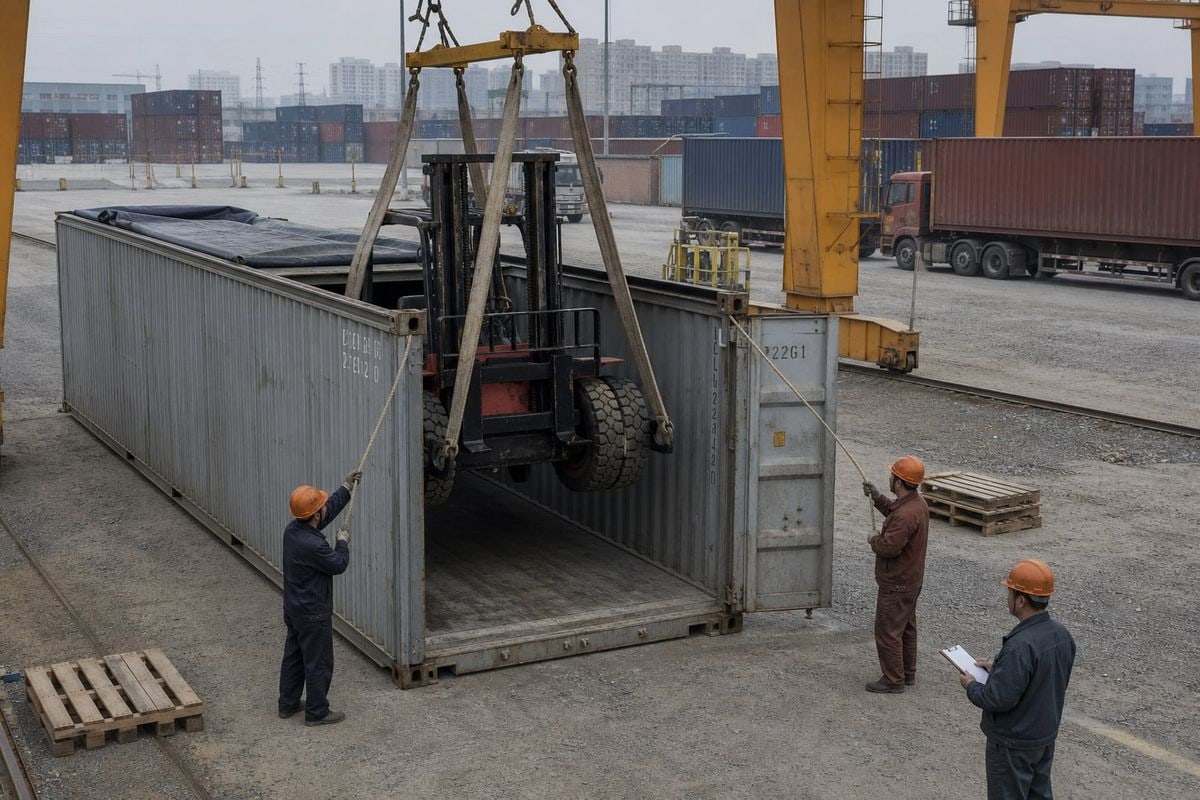
Follow this sequence, and measure the actual unit that will ship — not the brochure.
| Step | What to Measure | Error común |
|---|---|---|
| 1 | Collapsed mast height, forks fully down | Using catalog specs instead of the real machine |
| 2 | Highest point overall (guard, beacon, exhaust) | Forgetting the amber warning light on top |
| 3 | Overall width including tires and side shift attachment | Measuring the chassis only |
| 4 | Total length, forks included | Assuming forks will be removed |
| 5 | Service weight and axle loads | Ignoring battery weight on electric models |
| 6 | Turning radius | Assuming it can straighten inside the box |
Two details deserve extra care. First, tires. Tire wear and pneumatic pressure changes can shift vertical clearance by up to two inches. Measure with the tires that will actually be on the machine at loading, at working pressure. Second, weight distribution. Lithium battery forklifts concentrate heavy mass low and central, so we plan wheel paths over the container's steel cross-members and use dunnage plates where the floor load capacity is in doubt.
Then send everything to your forwarder before booking. When our team receives dimensions, we check them against the door opening, plan the ramp angle, confirm floor loading, and decide between a 20FT, 40FT, or 40HQ. For multiple units, we also calculate how machines nest — sometimes one forklift with forks removed and another loaded in reverse orientation saves an entire container. Getting the measurements right the first time is the cheapest logistics decision you will ever make.
The shipping container door — not the container itself — decides whether your forklift ships easily or expensively. Measure the collapsed mast height first, then width, weight, and ramp.
If the numbers are tight, do not gamble on loading day. A 40HQ, open-side, or flat rack solves most problems, and partial mast lowering solves the rest at lower cost. Our team at MBMLOG checks these dimensions on every forklift shipment before booking, coordinates directly with Chinese factories, and plans the safest loading method from Zhengzhou to your door. Send us your machine's real measurements, and we will tell you exactly what fits — before you commit to a container.
1. The World Shipping Council is the primary industry authority for global container shipping standards and structural specifications. ↩︎
2. OSHA provides authoritative safety and technical standards for powered industrial trucks, including forklift mast and height regulations. ↩︎
3. The IMO sets international safety regulations regarding the structural integrity and floor load limits of shipping containers. ↩︎
4. Provides a comprehensive technical overview of various intermodal container types, including high cube and open-top specifications. ↩︎