
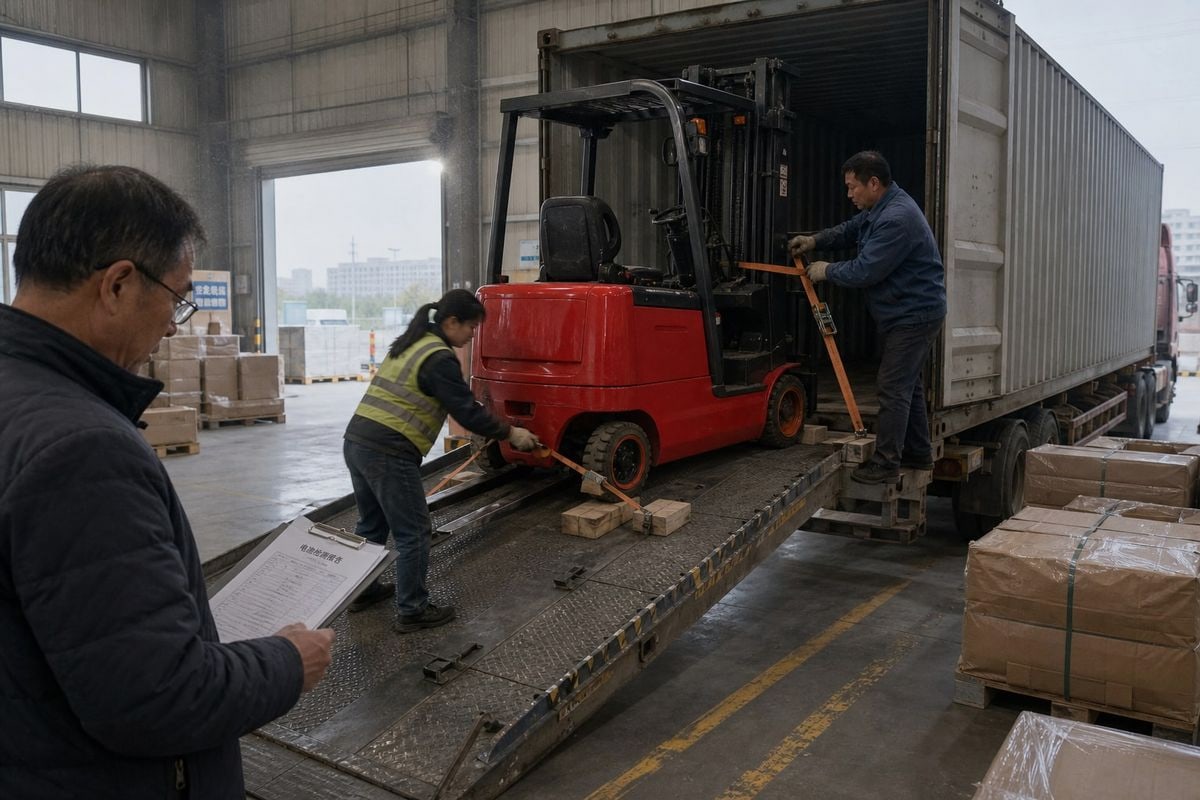
Shipping electric forklifts from China to the Netherlands looks simple until the lithium battery paperwork stops your booking. I have watched containers sit at origin because our team received a UN38.3 report two days too late. That delay costs more than the freight itself. The good news? With the right preparation, our loading crews move these red counterbalance trucks through the Port of Rotterdam 1 smoothly, month after month.
To ship electric forklifts from China to the Netherlands, confirm the battery type and UN38.3 certification, book FCL sea freight with a dangerous-goods-approved forwarder, prepare CE and customs documents, ship via the Port of Rotterdam, then clear Dutch import duties and 21% VAT before final delivery.
That is the short answer. But each step hides details that can save you money or cost you weeks. Let me walk you through the documents, the costs, the battery rules, and the container choice, in that order.
What Documents Do I Need to Import an Electric Forklift into the Netherlands?
Last spring, a Dutch distributor sent us a forklift order where the supplier had no EC Declaration of Conformity 2 on file. We caught it before loading. Our documentation team now checks the CE file before we ever schedule a factory pickup.
To import an electric forklift into the Netherlands, you need a commercial invoice, packing list, bill of lading, CE Declaration of Conformity, UN38.3 test report, Material Safety Data Sheet, a dangerous goods declaration for the battery, a Dutch EORI number, and the correct HS code.

Documentation is where most first-time importers stumble. The freight booking itself is easy. The paperwork behind it is not. I break the documents into three groups so my clients can assign responsibility clearly.
The Three Document Groups
The supplier owns some documents. Your freight forwarder China to Netherlands handles others. And a few sit with you, the Dutch importer. Here is how we split them on every shipment we manage:
| Documento | ¿Quién lo proporciona? | Por qué es importante |
|---|---|---|
| Factura comercial | Proveedor | Basis for customs value, duty, and VAT |
| Lista de embalaje | Proveedor | Confirms weights, dimensions, and units |
| Conocimiento de embarque | Transitario | Proof of shipment and cargo control |
| CE Declaration of Conformity | Proveedor | Mandatory for EU machinery compliance |
| informe de prueba UN38.3 | Battery maker via supplier | Proves the lithium battery is safe to transport |
| MSDS / SDS | Proveedor | Required for dangerous goods booking |
| Declaración de DG | Forwarder with supplier data | Needed for carrier acceptance under IMDG |
| EORI number | You, the importer | Required for any Dutch customs entry |
| Certificado de origen | Supplier, on request | Supports tariff treatment where applicable |
CE Marking Is Not Optional
Every forklift must carry a physical CE plate and be backed by an EC Declaration of Conformity under the EU Machinery Directive. Dutch customs and market surveillance authorities take this seriously. CE certification is not a sticker your supplier adds at the last minute. It reflects a full technical file. We ask suppliers for the declaration before the deposit is paid, not after the container is loaded.
The New EU Battery Regulation
There is one more layer many importers miss. EU Battery Regulation 2023/1542 3 requires a carbon footprint declaration for industrial batteries over 2kWh. And a mandatory Digital Battery Passport arrives in 2027. If you plan to import forklifts regularly, ask your supplier now whether their battery maker is preparing for these rules. In my experience, the factories that answer quickly are the ones worth working with.
How Much Does It Cost to Ship an Electric Forklift from China to the Netherlands?
A buyer once told me his forklift quote looked fantastic until the invoice for destination charges arrived. That conversation changed how our team quotes. We now present landed cost, not just ocean freight, on every quotation we send.
Shipping an electric forklift from China to the Netherlands typically involves ocean freight for a 20FT or 40FT container, plus Chinese export charges, dangerous goods surcharges, Dutch port handling, customs duty, 21% import VAT, and inland trucking. Total landed cost depends on model, battery type, and season.

I never publish fixed freight rates in articles because they change with the season and the trade lane. What stays constant is the structure of the cost. If you understand the structure, you can compare quotes intelligently and spot the ones that hide charges.
The Full Landed Cost Checklist
Here is the checklist we walk through with every Dutch buyer before they confirm an order:
| Componente de costo | Notas |
|---|---|
| Forklift purchase price | EXW or FOB, confirm which one |
| China inland pickup | From factory to port, included in FOB |
| Export declaration fees | Handled at the Chinese port |
| Transporte marítimo | Varies by container size and season |
| DG surcharge | Applies to lithium battery cargo |
| Seguro de carga | Small cost, large protection |
| Rotterdam port handling | Terminal and documentation fees |
| Customs duty | Based on código HS 4 and customs value |
| Import VAT | 21% in the Netherlands |
| Inland trucking | Rotterdam to your warehouse |
Duty, VAT, and the Article 23 License
Electric forklifts are generally classified under HS code 8427.10 for self-propelled electric trucks. This HS code for forklifts determines your duty rate, so classification errors are expensive. On top of duty, the Netherlands charges 21% import VAT.
Here is the cash flow tip I share with every regular importer: apply for a Dutch Article 23 VAT deferral license. It lets you defer the 21% import VAT to your periodic tax return instead of paying it upfront at the border. For a distributor bringing in several forklifts a year, this dramatically improves working capital.
Why the Cheapest Quote Is Rarely the Cheapest
Some forwarders quote low ocean freight and recover margin through destination charges you never saw coming. I have helped buyers unpick invoices where destination fees exceeded the original freight quote. Ask for import duties and VAT estimates, port charges, and trucking in writing before you book. A transparent quotation is worth more than a low headline number.
What Should I Know About Shipping Lithium Batteries with My Forklift?
The trade-off we weigh most often is speed versus compliance. A client wants the forklift on the next vessel. But the battery file is incomplete. Every time, we hold the booking, because a rejected DG shipment costs far more than a one-week delay.
Lithium battery forklifts are classified as Class 9 dangerous goods under IMDG rules for sea freight. You need a UN38.3 test report, a Material Safety Data Sheet, and a dangerous goods declaration. Book with a forwarder approved to handle lithium battery cargo, and ship at 30–40% charge.

This is the section that separates electric forklift shipping from ordinary machinery shipping. Diesel forklifts move with a drained fuel tank and basic paperwork. Lithium battery forklifts trigger a whole regulatory framework, and lithium battery shipping regulations are enforced strictly at Chinese ports.
Why Class 9 Classification Changes Everything
Under the IMDG Code 5, forklifts with lithium-ion batteries are typically treated as Class 9 dangerous goods. That means the carrier must formally accept the cargo as DG before loading. Not every shipping line accepts every battery configuration on every vessel. Our team submits the UN38.3 certification and MSDS to the carrier at booking stage. If we skip this, the container can be rejected at the terminal gate, and the forklift sits at origin accruing storage fees.
State of Charge Matters More Than You Think
Here is a detail most first-time importers never hear: ship the forklift at a 30–40% state of charge. The sea freight transit time runs 30 to 45 days, and containers passing through the Suez Canal see extreme temperature swings. A battery shipped nearly empty risks deep discharge, which permanently damages the cells. A battery shipped full carries higher thermal risk. The 30–40% window protects the battery's long-term state of health.
Emerging Option: BMS Monitoring in Transit
Some logistics providers now offer smart containers that let importers remotely monitor the forklift's Battery Management System during the voyage. You can watch for temperature spikes or voltage drops mid-ocean. It adds cost, so I usually recommend it only for high-value fleet shipments. For a single standard unit, correct charge level and proper securing do the job.
One More Check: The Charger
If the charger ships with the forklift, confirm it matches Dutch voltage before departure. We have seen buyers receive perfect forklifts with unusable chargers. It is a thirty-second question that avoids a very awkward arrival day.
Should I Choose FCL or LCL for My Forklift Shipment to the Netherlands?
A Rotterdam-based dealer once asked me to quote LCL for a single 2.5-ton counterbalance truck to save money. I quoted it, then showed him the handling risk side by side. He chose a 20FT container, and I still believe it was the right call.
Choose FCL for full-size electric forklifts shipping to the Netherlands. A dedicated container protects the battery and electronics from extra handling and salt-air exposure. LCL suits only small units like pallet trucks. Ro-Ro shipping and air freight are niche options for specific cases.

The FCL vs LCL decision drives cost, risk, and timing. Let me lay out all four realistic options first, because comparison is the fastest way to decide:
| Método | Lo mejor para | Main Advantage | Main Downside |
|---|---|---|---|
| FCL sea freight | Most full-size forklifts | Best balance of cost, safety, and control | 30–45 day transit time |
| LCL sea freight | Single compact unit or stacker | Lower entry cost for small cargo | More handling, higher damage risk |
| Transporte aéreo | Urgent parts or very compact units | Fastest transit | Usually far too expensive for forklifts |
| Ro-Ro shipping | Larger self-propelled machinery | No container loading needed | Limited route availability to Rotterdam |
Why FCL Wins for Electric Units
Electric forklifts carry sensitive electronics and a battery pack. Every extra touch in an LCL consolidation warehouse is a chance for damage. Salt-air exposure during multiple handlings adds corrosion risk to connectors and control boards. With FCL, the forklift is loaded once at origin and unloaded once at your warehouse. That is why FCL sea freight is the industry standard for electric units on this route.
Securing the Load Correctly
Here is something our loading teams handle differently for electric models. Electric forklifts have a highly concentrated low center of gravity because of the battery mass. That changes how the unit behaves in heavy sea swells. We use floor-bolted timber bracing engineered around the center of gravity, plus blocking around the mast and counterweight, to prevent the unit from breaching its restraints mid-voyage. Some models also need partial disassembly of the mast or overhead guard to fit a standard container.
Filling the Container Pays for Itself
One practical tip: if you book a 40FT or 40HQ, fill the remaining space. We regularly consolidate chargers, spare forks, batteries, and parts from multiple Chinese suppliers into the same container as the forklift. That consolidation drops your average logistics cost per unit. It also lets you compare DDP shipping terms against buyer-managed import honestly, because your forwarder sees the complete cargo picture. DDP is simpler for occasional buyers, but regular importers usually get better visibility into true landed cost by managing the Dutch entry themselves via Rotterdam.
Conclusión
Shipping electric forklifts from China to the Netherlands succeeds on preparation. Verify battery documents early, budget the full landed cost, choose FCL, and let one coordinated team manage the journey to Rotterdam.
Notas al pie
1. Official website of the destination port for shipping from China to the Netherlands. ↩︎
2. Official European Commission page explaining machinery compliance and required documentation. ↩︎
3. Official EUR-Lex legislative text for Regulation 2023/1542, replacing the broken European Commission topic page. ↩︎
4. World Customs Organization page for the Harmonized System used for global product classification. ↩︎
5. International Maritime Organization page for the code governing dangerous goods transport by sea. ↩︎




