
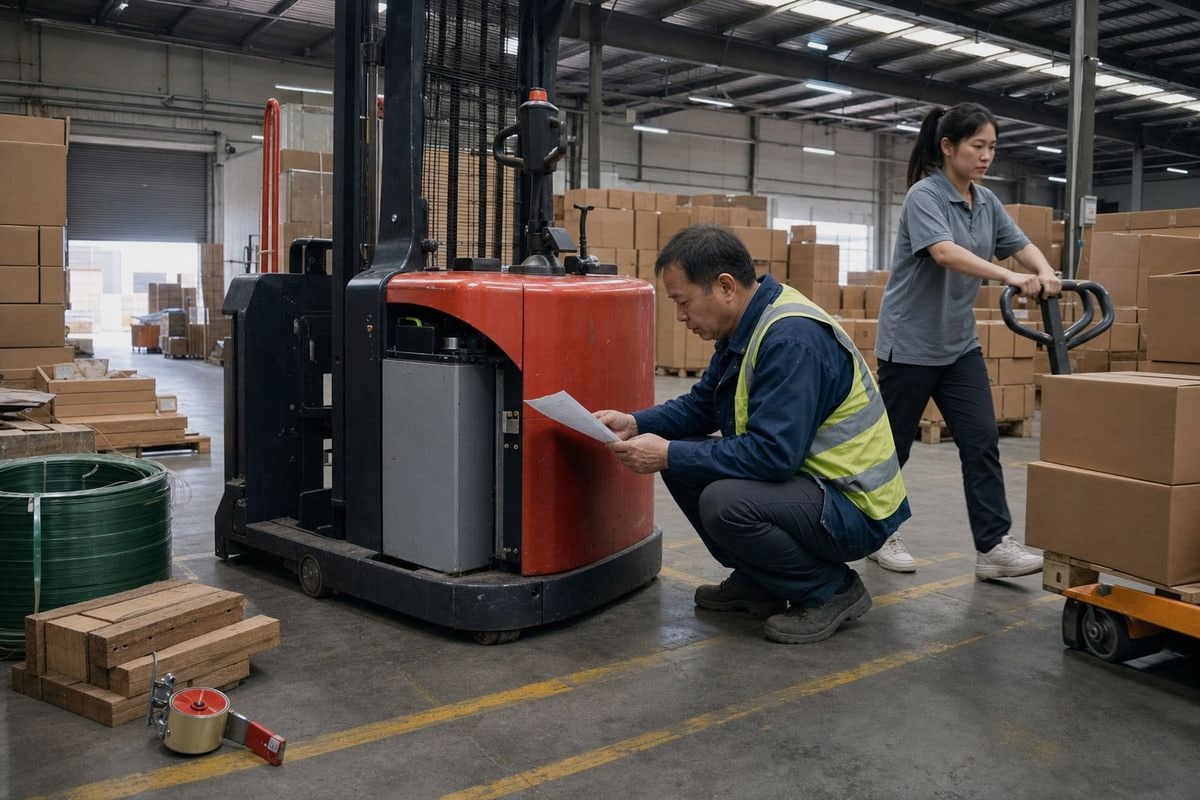
Shipping electric stackers from China looks simple until the lithium battery gets involved. At our Zhengzhou logistics base, we see bookings rejected every month because buyers treated stackers like ordinary boxed cargo. One missing document can strand a whole container at the port, burning storage fees while your customers wait.
To ship electric stackers from China, confirm the battery type first, then classify the cargo under HS Code 8427.10, prepare UN38.3 and MSDS documents for lithium units, choose FCL or LCL sea freight, secure the machines with timber blocking, and clear customs with matching paperwork.
That is the short version. Below, I will break down the cost, the documents, the container math, and the consolidation options. Each section answers one real question our clients ask us every week.
How much does it cost to ship electric stackers from China to my warehouse?
Last quarter, a US distributor sent me a supplier quote that looked great — until we added freight, duties, and trucking. The landed cost changed his entire margin calculation.
Shipping electric stackers from China typically costs $1,800–$4,500 for a full container to the US West Coast, or roughly $0.84–$2.00 per kg for LCL cargo, plus import duties, destination handling, and final trucking. Battery documentation and DG surcharges can add cost for lithium units.

Freight cost is never one number. It is a stack of charges, and cheap headline quotes usually hide the expensive ones. In our experience shipping material handling equipment to the United States, the ocean freight itself is often only half the total logistics bill.
La Carga Completa de Costos
Here is how the cost of shipping electric stackers actually breaks down:
| Componente de costo | Typical Range (China → USA) | Notas |
|---|---|---|
| China pickup & trucking | $150–$500 | Depends on factory location |
| Export declaration & port fees | $100–$300 | Handled by your freight forwarder China side |
| Ocean freight (20FT FCL) | $1,800–$3,000 | Varies by season and route |
| Ocean freight (40HQ FCL) | $2,500–$4,500 | Better per-unit economics |
| LCL sea freight | From ~$0.84/kg | Illustrative product-page rate; verify per shipment |
| Recargo por manipulación de DG | $200–$600 | Only for classified carga de baterías de litio 1 |
| Derechos e impuestos de importación | % of cargo value | Based on HS code and origin |
| Destination handling & trucking | $400–$1,200 | Port to your warehouse |
The transit time by sea freight logistics typically runs 17–24 days to the US West Coast, longer for East Coast or European ports.
Why the Battery Changes the Price
If your stacker uses a lithium battery pack, carriers may classify it as Class 9 dangerous goods. That triggers DG booking fees, special stowage, and stricter documentation. A lead-acid unit usually moves as standard machinery. So two identical-looking stackers can have very different freight bills. Always send your forwarder the battery type, capacity, and packed dimensions before asking for a quote. Vague cargo data produces vague quotes, and vague quotes produce surprise invoices.
What documents do I need to ship lithium battery stackers from China legally?
A client once shipped stackers with paperwork listing lead-acid batteries when the units carried lithium packs. Customs held the container for two weeks. We now verify battery chemistry against every document before departure.
To ship lithium battery stackers legally, you need a UN38.3 test summary, MSDS/SDS sheet, DG declaration, commercial invoice, packing list, bill of lading, and Certificate of Origin. The battery must be shipped at roughly 30% state of charge to meet maritime safety rules.
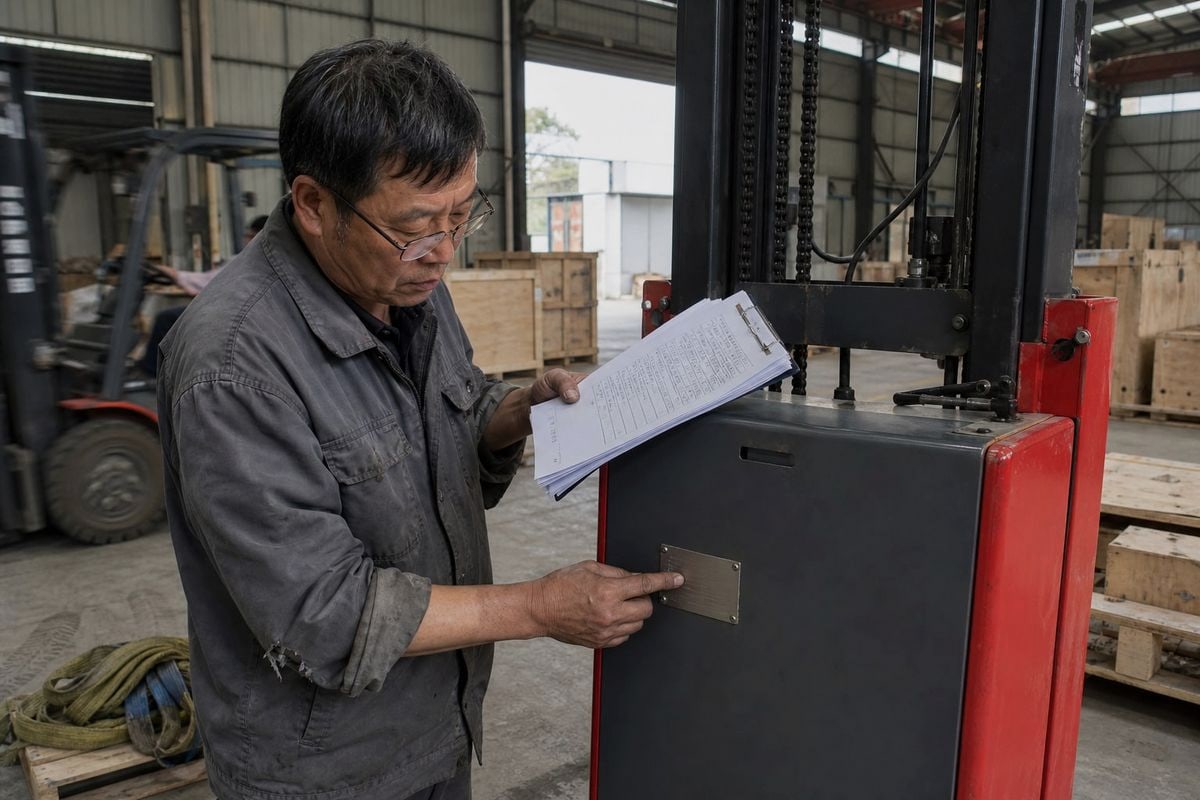
Documentation is where most shipping delays are born. In my years coordinating lithium battery cargo handling from Chinese factories, I have learned one rule: the documents must match the actual machine configuration exactly. A mismatch between the invoice, the MSDS, and the physical battery is the fastest route to a customs hold.
The Core Document Checklist
| Documento | Objetivo | ¿Quién lo proporciona? |
|---|---|---|
| Factura comercial | Declares cargo value for duties | Proveedor |
| Lista de embalaje | Details dimensions, weight, quantity | Proveedor |
| Conocimiento de embarque | Contract of carriage for sea freight | Carrier via forwarder |
| Certificado de origen (CO) | May qualify you for reduced duty rates | Proveedor / cámara de comercio |
| HS code classification | Tariff assessment; use 8427.10 for self-propelled electric trucks | Forwarder verifies |
| Resumen de prueba UN38.3 2 | Prueba de que la batería de litio pasó las pruebas de seguridad en el transporte | Fabricante de baterías |
| MSDS/SDS | Safety data required under lithium battery shipping regulations | Fabricante de baterías |
| Declaración de DG | Required for Class 9 dangerous goods bookings | Expedidor / transitario |
Destination-Specific Extras
For EU-bound stackers, request a CE Declaration of Conformity from the factory. For US-bound units, confirm the charger carries relevant UL certification and matches your local voltage — a 380V Chinese charger is useless on a 110V American dock. We check charger voltage on every booking now, because a stacker that arrives and cannot charge is a delivery failure in the customer's eyes, even if the freight went perfectly.
The 30% State of Charge Rule
Maritime safety regulations require lithium batteries to ship at a reduced state of charge, typically 30%. We ask factories to set this before crating. It satisfies the carrier and still leaves enough power to drive the stacker off the truck at your warehouse. One practical tip: perform a BMS equalization charge as soon as the unit arrives, because cell voltages drift during a long voyage.
How many electric stackers can I fit into one container?
Container math is a conversation I have almost daily. One buyer recently saved over 30% per unit simply by switching from two 20FT containers to one 40HQ with a smarter loading plan.
A 20FT container typically fits 4–6 electric stackers, a 40FT fits 8–12, and a 40HQ fits 10–14 depending on mast height and fork length. Masts can often be lowered or detached to improve loading density and avoid expensive Open Top equipment.
The honest answer depends on three numbers: packed length, packed width, and mast height. Electric stackers vary widely — a compact walkie stacker with a 1.6m collapsed mast loads very differently from a high-lift model with a 2.5m mast.
Container Capacity Guide
| Tipo de contenedor | Altura interior | Typical Stacker Capacity | Lo mejor para |
|---|---|---|---|
| 20 pies | 2.39 m | 4–6 units | Small orders, trial shipments |
| 40FT | 2.39 m | 8–12 unidades | Mid-size fleet orders |
| 40HQ | 2.69 m | 10–14 units | Taller masts, best cost per unit |
| Open Top / Flat Rack | Open | Varía | Avoid if possible — much higher cost |
Watch the Mast Height
The mast is the deal-breaker. A 40HQ gives you an extra 30cm of internal height, which is often the difference between fitting a stacker upright and paying for Open Top or Flat Rack equipment at a significantly higher rate. Before booking, we collect the collapsed mast height from the factory. Many models allow the mast to be lowered, tilted, or shipped detached, which opens up standard container options.
Securing the Load
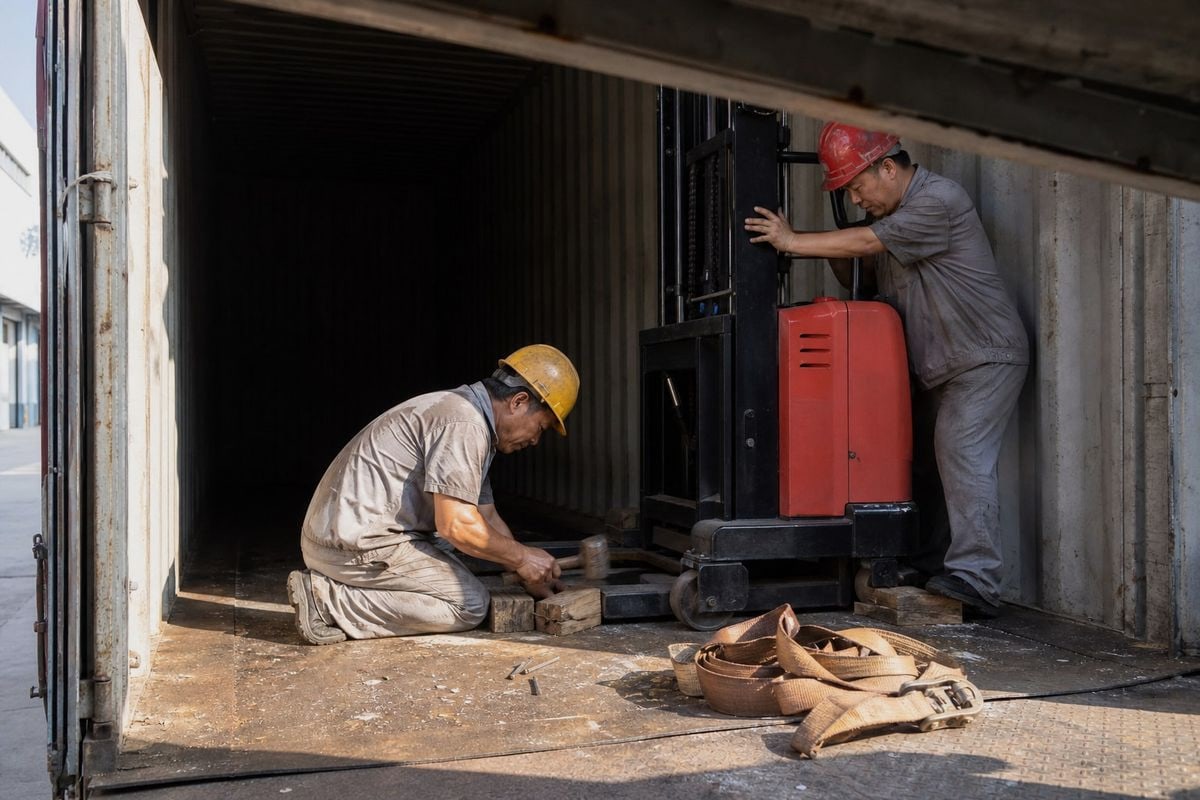
Stackers are heavy, top-biased machines. We coordinate custom timber blocking and steel wire lashing at loading so units cannot shift during ocean transit. Weight distribution matters too — heavy units go low and centered, and unused floor space can carry spare parts, chargers, or batteries in crates. Exposed hydraulic cylinders and electrical contactors should get a VCI coating before loading, because salt air will pit unprotected metal over a three-week voyage. Wood packaging must be ISPM 15 compliant, or customs can reject the entire shipment at destination.
Can I consolidate electric stackers with other equipment from different Chinese suppliers?
Multi-supplier orders are our specialty. A typical client buys stackers from one factory, spare batteries from another, and chargers from a third — then asks us to make it one shipment.
Yes, you can consolidate electric stackers with forklifts, batteries, chargers, and spare parts from multiple Chinese suppliers into one container. A China-based freight forwarder picks up from each factory, consolidates at a warehouse, loads one container, and ships under a single set of documents.

Consolidation is often the single biggest cost lever for importers who buy from several factories. Shipping three separate LCL shipments from three suppliers means paying three sets of handling fees, three customs clearance entries 3, and three delivery charges. Consolidating everything into one FCL container removes that duplication.
How the Consolidation Process Works
- You share each supplier's location, cargo details, and readiness date with your forwarder.
- The forwarder arranges pickup from each Chinese factory — Factory A for stackers, Factory B for batteries, Factory C for chargers, and so on.
- All cargo arrives at a consolidation warehouse, where it is checked, measured, and photographed.
- The forwarder plans the container load: stackers on the floor, crated parts filling the gaps above and around them.
- One container ships under one bill of lading, clears customs once, and delivers to your warehouse in one truck.
LCL vs FCL for Consolidated Cargo
En LCL vs FCL shipping decision comes down to volume. If your combined cargo from all suppliers fills more than roughly half a 20FT container, FCL consolidation usually wins on both cost and safety. LCL still makes sense for a single small stacker plus a few parts boxes.
One caution from experience: consolidation does not erase compliance rules. If any item in the container carries a lithium battery, the whole booking must follow DG procedures. We also align Incoterms early — buying EXW or FOB 4 from each supplier keeps control with you and your forwarder, while mixing DDP terms across suppliers creates coordination chaos. Some buyers also explore a Semi-Knocked Down approach, crating batteries separately from the machines, which in some markets can reclassify parts under lower-duty categories — but this must be verified against destination customs rules before you rely on it.
Conclusión
Shipping electric stackers from China succeeds on preparation: confirm the battery, match the documents, plan the container, and consolidate smartly. Get those right, and delivery becomes predictable.
Notas al pie
1. Official IMO page detailing international regulations for transporting dangerous goods, including lithium batteries, by sea. ↩︎
2. The UNECE manages the transport of dangerous goods standards, including the UN38.3 testing requirements for lithium batteries. ↩︎
3. Official EU Commission landing page for customs procedures, covering declarations and clearance entries. ↩︎
4. The International Chamber of Commerce (ICC) is the official body that defines Incoterms like EXW and FOB. ↩︎




