
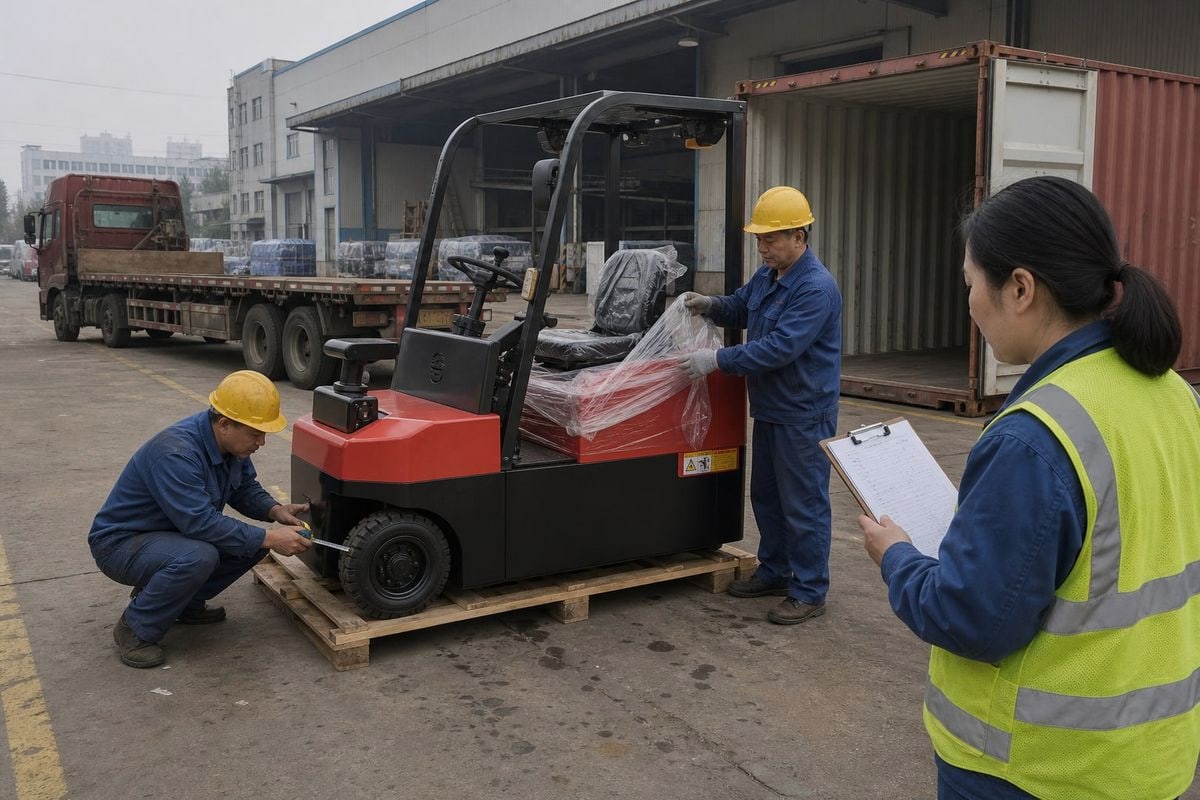
Enviar tractores eléctricos de remolque desde China parece simple hasta que la documentación de la batería, los códigos HS y los cargos ocultos del puerto aparecen. Nuestro equipo de logística en Zhengzhou ve a compradores tropezar aquí cada mes.
Para enviar tractores eléctricos de remolque desde China, confirma las dimensiones de la unidad, el peso y el tipo de batería, prepara documentos UN38.3 y MSDS para modelos de litio, elige un contenedor FCL o envío Ro-Ro, acuerda los Incoterms y reserva a través de un agente de carga con experiencia en equipos de manejo de materiales con batería.
Esa es la versión corta. A continuación, te guiaré a través de los documentos, los costos reales, las reglas de la batería y la decisión de [FCL versus LCL](https://mbmlog.com/?p=12390), paso a paso.
¿Qué documentos necesito para enviar tractores eléctricos de remolque desde China?
La primavera pasada, nuestro equipo retuvo un contenedor en el puerto de Qingdao durante seis días porque un proveedor envió una factura con el código HS incorrecto. Un documento. Seis días. Esa lección se me quedó grabada.
Necesita una factura comercial, lista de embalaje, conocimiento de embarque, certificado de origen, declaración de exportación de China, resumen de prueba UN38.3, MSDS y una declaración de mercancías peligrosas para los modelos de litio. Agregue un seguro de carga marítima y cualquier certificado de destino como EPA/DOT o marcado CE.

La documentación es donde la mayoría de los envíos tienen éxito o fracaso. En nuestra experiencia coordinando la documentación de aduanas para carretillas elevadoras eléctricas y tractores remolcadores, el problema rara vez es un papel faltante. Generalmente es una discrepancia entre los documentos. La factura menciona un número de modelo. La lista de empaque dice otro. La hoja de especificaciones de la batería menciona un tercero. Los oficiales de aduanas notan estas inconsistencias y retienen la carga cuando lo hacen.
El Conjunto de Documentos Clave
Cada envío de tractor remolcador eléctrico desde China necesita la misma base. La factura comercial indica el valor y términos. La lista de empaque indica las dimensiones y el peso bruto. El conocimiento de embarque prueba que el transportista recibió la carga. El certificado de origen apoya el tratamiento de derechos en el destino. La declaración de exportación libera las mercancías de China.
Documentos específicos de batería y vehículo
Los tractores de remolque eléctricos tienen requisitos adicionales porque son vehículos alimentados por batería. Aquí está cómo se desglosan los documentos:
| Documento | Objetivo | ¿Quién lo proporciona? |
|---|---|---|
| Resumen de prueba UN38.3 | Prueba de que la batería de litio pasó las pruebas de seguridad en el transporte | Fabricante de la batería o del tractor |
| MSDS / SDS | Detalles de la química de la batería y los peligros | Fabricante de baterías |
| Declaración de DG | Declara la unidad como UN3171 para reserva de transportista | Expedidor / transitario |
| Licencia de exportación | Requerida para exportadores chinos de vehículos eléctricos y maquinaria industrial a partir de 2026 | Proveedor chino |
| certificados CE / EPA-DOT | conformidad del mercado de destino | Fabricante |
Ese último punto merece atención. A partir de 2026, los exportadores chinos de vehículos eléctricos y maquinaria industrial deben tener una licencia de exportación específica emitida por el gobierno. Ahora le digo a cada comprador: verifique este permiso antes de pagar el anticipo. Si su proveedor no puede producirlo, su carga puede no salir legalmente de China, sin importar cuán buen precio haya sido.
También verificamos el código HS antes de realizar la reserva. Muchos tractores de remolque caen bajo Código HS 870911 1, que cubre camiones de trabajo eléctricos que no están equipados con equipos de elevación. Obtener este código correcto desde el principio influye en su tasa de arancel y en la velocidad de desaduanización en el destino.
¿Cuánto cuesta enviar un tractor de remolque eléctrico desde China a EE. UU.?
Un distribuidor en Texas me mostró una vez dos cotizaciones para el mismo tractor. Una parecía más barata en $800. Excluía el manejo en destino, tarifas de chasis y agencia de aduanas 2. La cotización "barata" le costó más al final.
Enviar un tractor eléctrico de remolque de China a EE. UU. cuesta típicamente entre $1,500 y $4,500 por flete marítimo en un contenedor compartido o completo, más derechos de importación e impuestos, agencia de aduanas, manejo en destino y transporte terrestre. El costo total de logística hasta el destino a menudo alcanza entre $3,000 y $7,000 por unidad.

El precio de fábrica es solo el punto de partida. Lo que importa es el costo total, y he visto a demasiados importadores calcular márgenes sobre el número equivocado. Cuando nuestro equipo elabora un presupuesto, desglosamos el trayecto en etapas para que nada se oculte en la letra pequeña.
La Estructura de Costo Completo
| Artículo de Costo | Rango Típico | Notas |
|---|---|---|
| Transporte terrestre en China | $200–$600 | Fábrica al puerto, dependiendo de la distancia |
| Declaración de exportación y manejo | $100–$300 | Incluye recargo por DG si es litio |
| Transporte marítimo | $1,200–$3,500 | FCL 20FT or 40FT, route dependent |
| Marine cargo insurance | 0.2%–0.4% of value | Strongly recommended for high-value units |
| US destination charges | $400–$900 | Port handling, chassis, drayage |
| Customs brokerage | $150–$350 | Per entry |
| Derechos e impuestos de importación | Varía según el código HS | Confirm HS Code 870911 classification early |
| Entrega final | $300–$1,000 | Liftgate or forklift needed at delivery |
Time Is Also a Cost
Ocean transit is only one part of the schedule. A realistic end-to-end plan includes 2–3 days for booking and documentation, 1–3 days for inland transport to the Chinese port, 2–4 days for China export operations, then the ocean voyage itself, followed by 2–5 days at the destination port, 3–7 days for customs clearance, and 1–3 days for final delivery. Some listed routes for electric tow tractors quote 17–24 days of ocean transit, but treat that as a sample, not a promise. Build buffer into your delivery commitments.
Incoterms Decide Who Pays What
Your Incoterms 2020 3 choice determines which legs sit in your quote and which appear later as surprises. FOB gives experienced buyers control over freight and cost transparency. DDP puts everything on the seller's side, which feels simpler for first-time importers but often hides the true cost structure inside a bundled price. My honest view after years of running both: FOB with a forwarder you trust usually beats DDP on transparency, but DDP is a fair choice for your first one or two shipments while you learn the process.
¿Cómo manejo los requisitos de baterías de litio al enviar tractores de remolque eléctricos?
The trade-off I discuss most with buyers is not price. It is battery chemistry. Lithium gives better runtime and lighter weight, but it turns your shipment into regulated dangerous goods. Lead-acid ships more simply but adds weight.
Electric tow tractors with lithium batteries ship as UN3171 Class 9 dangerous goods under the IMDG Code. You must provide a UN38.3 test summary and MSDS, keep the battery state of charge at 30% or below, and secure carrier DG acceptance before booking.

Battery compliance has become the single biggest gatekeeper in this trade. Freight guides used to treat lithium paperwork as an edge case. Today it is a standard planning item, and carriers reject non-compliant bookings without apology. Our team coordinates these requirements with the factory weeks before cargo moves, because fixing a battery document after the tractor reaches the port is expensive and slow.
The UN3171 Classification
An electric tow tractor with an installed lithium-ion battery is classified as UN3171, battery-powered vehicle, under the IMDG Code. That classification brings Class 9 hazardous material 4 labeling and specialized DG stowage requirements on the container ship. It also means your booking goes through the carrier's dangerous goods desk, which takes longer than a normal booking. Plan for it.
The Compliance Checklist We Run
- Confirm the battery chemistry and capacity with the factory in writing.
- Collect the lithium battery UN38.3 certification test summary and the MSDS.
- Verify the battery state of charge will be reduced to 30% or less before loading, which sharply cuts thermal runaway risk in the cargo hold.
- Submit the DG declaration and wait for carrier acceptance before fixing the sailing date.
- Photograph the battery labels and disconnection before the container doors close.
Lithium Versus Lead-Acid: A Practical Trade-Off
Lead-acid units often skip the heaviest DG requirements, which simplifies booking. But they weigh more, which can affect container weight limits and handling. Neither choice is universally right. If you run a rental fleet and value uptime, lithium is usually worth the paperwork. If you want the simplest possible first import, lead-acid removes friction.
Two more points worth noting. First, confirm the charger voltage matches your destination market; a 380V Chinese charger is useless on a US 480V supply. Second, for European buyers, watch the emerging digital Battery Passport requirement. A QR code tracking chemical composition and recyclability will soon be mandatory in the EU, so asking for it now future-proofs your fleet. Some importers of high-value fleets also add IoT telematics inside the container to monitor battery temperature and voltage during the voyage, which supports specialized EV cargo insurance claims if anything goes wrong.
¿Debería elegir envío FCL o LCL para mi pedido de tractor de remolque eléctrico?
A forklift dealer in Ohio once asked me to quote LCL for a single tow tractor to "save money." When we ran the numbers, FCL in a 20FT container was barely more expensive and far safer. He was surprised. Most buyers are.
Choose FCL container shipping for one or more electric tow tractors whenever possible; it offers better protection, faster handling, and predictable costs. LCL only makes sense for spare parts and accessories. For large fleet orders, Ro-Ro shipping can beat FCL on cost.

The FCL versus LCL question is really a question about risk. Tow tractors are heavy, high-value machines with paint, hydraulics, and electronics that do not enjoy being handled repeatedly. LCL cargo gets consolidated, deconsolidated, moved by unfamiliar warehouse crews, and stacked near other people's freight. That is fine for boxed goods. It is a bad environment for a two-ton machine.
A Quick Comparison
| Factor | FCL Container Shipping | LCL Consolidation | Ro-Ro Shipping |
|---|---|---|---|
| Lo mejor para | 1–4 tractors per container | Parts, chargers, accessories | Large fleet orders |
| Handling risk | Low, sealed at origin | High, multiple touches | Medium, driven on and off |
| Cost predictability | Alta | Moderate, CBM-based fees add up | Route dependent |
| Battery DG acceptance | Widely available | Often restricted for DG cargo | Requires ports that handle live EV loading |
| Oversized units | Flat rack / open top options | Not suitable | Very suitable |
How We Decide in Practice
Our team starts with dimensions. A compact tow tractor usually fits a 20FT container. Two to three units, or units plus batteries and chargers, often justify a 40FT or 40HQ. This is where multi-supplier consolidation earns its keep: we regularly fill unused container space with spare parts, chargers, and attachments from other factories, which drops the average logistics cost per unit. Good material handling equipment logistics is mostly about using every cubic meter you have already paid for.
Ro-Ro shipping deserves a fair look for fleet buyers. For large-scale orders, Ro-Ro is often more cost-effective than multiple containers, provided both the origin and destination ports can handle live electric vehicle loading. The tractor is driven onto the vessel, so it must be operational and the ports must accept EV units. For oversized tractors that exceed container door dimensions, flat rack or open top containers bridge the gap between standard FCL and breakbulk.
One more angle for tariff-sensitive markets: shipping in a semi-knocked-down state, with the battery separated from the chassis, can sometimes reclassify the shipment under different HS codes and reduce "complete vehicle" tariffs. This needs careful confirmation with a customs broker before you commit, but it is a legitimate lever that experienced importers use.
Whatever mode you choose, insist on container loading photos and proper blocking, bracing, and lashing. We document every loading with photos before sealing, and we add desiccants and waterproof wrapping to fight container rain and salt-air corrosion during the ocean leg.
Conclusión
Shipping electric tow tractors from China is a compliance project first. Nail the documents, the battery rules, and the container choice, and your landed cost stays predictable.
Notas al pie
1. Official WCO nomenclature for electric works trucks and tractors used in international trade. ↩︎
2. U.S. Customs and Border Protection information regarding the role and requirements of customs brokers. ↩︎
3. Official ICC rules for the use of domestic and international trade terms for shipping. ↩︎
4. IMO standards for the classification and maritime transport of dangerous goods including lithium batteries. ↩︎




