
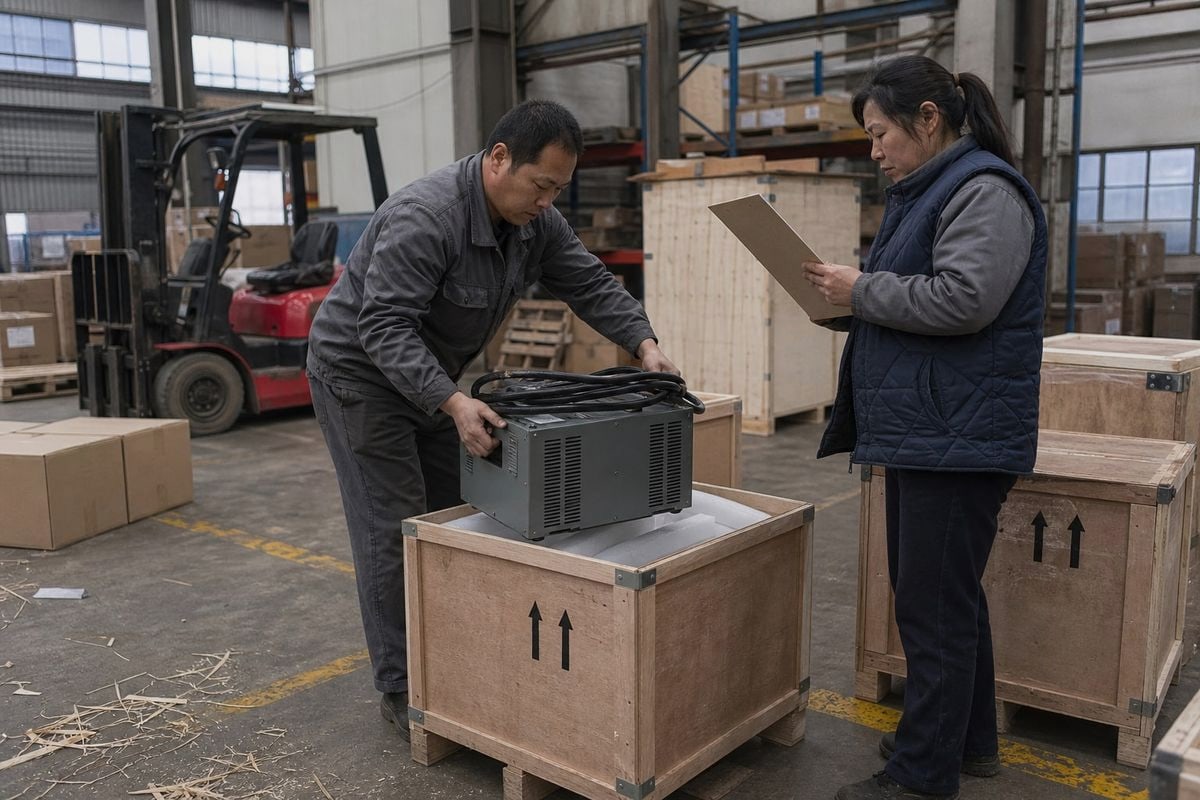
Enviar cargadores de batería de carretilla elevadora desde China parece simple hasta que un envío queda retenido en la aduana. En nuestro almacén de consolidación en Zhengzhou, vemos ese error cada semana — y es evitable.
Para enviar cargadores de batería de carretilla elevadora desde China, clasifíquelos bajo el código HS 8504.40, prepare una factura comercial, una lista de empaque y un conocimiento de embarque, verifique las marcas UL o CE, empaquételos en cajas reforzadas y elija transporte marítimo para pedidos grandes o transporte aéreo para unidades urgentes y compactas.
El cargador en sí suele ser carga eléctrica estándar. Pero las especificaciones de voltaje, certificaciones y cualquier batería de litio en el mismo envío cambian rápidamente las reglas. Déjame guiarte a través del proceso completo, del costo a la liberación.
¿Cuánto cuesta enviar cargadores de batería de carretilla elevadora desde China a los EE. UU.?
Un distribuidor en Texas me preguntó una vez por qué su cotización de flete para el cargador se duplicó después de reservar. La respuesta fue simple: su primera cotización ignoró los cargos de destino. Reconstruimos su costo total línea por línea.
El envío de cargadores de baterías de montacargas desde China a los EE. UU. cuesta típicamente entre $80 y $200 por unidad por flete marítimo LCL, entre $150 y $400 por flete aéreo, y entre $1,500 y $3,500 por un contenedor FCL compartido o dedicado, antes de los aranceles de importación, impuestos y cargos de manejo de destino.

La tarifa de flete es solo una parte del total. Cuando cotizamos a los clientes, siempre desglosamos el número en segmentos, porque los bajos costos de flete marino en la cabecera pueden aún producir un costo en destino doloroso si ignoras lo que sucede después de que el buque llega.
Lo que realmente compone tu costo en destino
Aquí está la estructura que usamos para cada cotización de cargador en nuestra oficina:
| Componente de costo | Rango Típico (USD) | Quién suele pagar (FOB) |
|---|---|---|
| Recogida en fábrica en China y transporte | $50–$200 por envío | Vendedor |
| Declaración de exportación en China | $30–$80 | Vendedor |
| Flete marítimo (LCL, por CBM) | $40–$120 por CBM | Comprador |
| Flete aéreo (por kg) | $4–$8 por kg | Comprador |
| Duties e impuestos de importación en EE.UU. | Varía según código HS 1 y el calendario de tarifas | Comprador |
| Manipulación y entrega de destino | $150–$500 | Comprador |
Un cargador de montacargas industrial estándar pesa entre 30 y 150 kg dependiendo de la capacidad de salida. Las unidades trifásicas más pesadas casi siempre favorecen el transporte marítimo. Una tendencia a seguir: los cargadores más nuevos basados en GaN pueden reducir el peso de la unidad hasta en un 40 por ciento, lo que a veces hace viable el envío exprés aéreo donde antes no lo era.
Por qué el código HS es importante para el costo
El código HS para los cargadores de baterías es 8504.40, que cubre los convertidores estáticos. Declarar incorrectamente bajo un código diferente invita a sanciones y reevaluación de impuestos durante la entrada en aduana. Confirmamos este código en la factura comercial antes de que cualquier carga salga de China, porque corregirlo en un puerto de EE. UU. es mucho más caro que hacerlo bien desde el principio. Algunos importadores también exploran enviar cargadores como kits semi-desmontados — separando los módulos de potencia del chasis — para acceder a tasas de impuestos más bajas sobre componentes, pero esto requiere asesoramiento adecuado sobre clasificación primero.
¿Qué documentación necesito para enviar cargadores de montacargas con baterías de litio desde China?
La lección más difícil que aprendimos al principio: un cargador por sí solo es un trámite fácil, pero una batería de litio en la misma caja reescribe todo el archivo de documentos. Los transportistas se negarán a reservar sin ella.
Necesitas una factura comercial, lista de empaque, conocimiento de embarque o carta de porte aéreo, y prueba de certificación UL o CE. Si las baterías de litio se envían con los cargadores, añade un resumen de prueba UN38.3, hoja MSDS/SDS, declaración de mercancías peligrosas y etiquetado CLASE 9 UN3481.

La mayoría de los cargadores de carretillas elevadoras no son mercancías peligrosas. Eso sorprende a muchos importadores primerizos. El cargador es carga eléctrica estándar. La complicación comienza en el momento en que las baterías, celdas de litio de repuesto o módulos de batería entran en el mismo envío. Entonces, toda la consignación pasa a ser mercancías peligrosas, y tu documentación de despacho de aduana debe expandirse en consecuencia.
Las dos pistas de documentos
| Documento | Solo Cargador | Cargador + Batería de Litio |
|---|---|---|
| Factura comercial | Requerido | Requerido |
| Lista de embalaje | Requerido | Requerido |
| Conocimiento de embarque / guía aérea | Requerido | Requerido |
| Prueba de certificación UL / CE | Muy recomendable | Muy recomendable |
| Resumen de prueba UN38.3 | No necesario | Requerido |
| Hoja MSDS / SDS | No necesario | Requerido |
| Declaración de mercancías peligrosas | No necesario | Requerido |
| Etiquetas de peligro de Clase 9 (UN3481) | No necesario | Requerido en el embalaje |
Cuando los cargadores se envían en la misma caja que las baterías, todo el envío se rige por las regulaciones UN3481. Eso significa UN38.3 test summaries 2, Class 9 hazard labeling, and carrier pre-approval. MSDS requirements trip up many buyers because the document must come from the battery manufacturer, not the charger factory, and it must match the exact cell model shipped.
Certifications customs actually checks
US customs officials frequently seize non-compliant industrial electrical equipment. So we verify two things before booking. First, valid and verifiable UL marks 3 for North America, or CE for Europe, matching the units in the crate. Second, if the chargers include smart fleet IoT modules with wireless connectivity, we confirm separate FCC certification for the US or RED certification for the EU. A missing wireless certification can detain an otherwise perfect shipment for telecommunications violations. We collect these documents from the factory during pickup coordination, then cross-check them against the invoice before export declaration in China.
¿Puedo consolidar los cargadores de montacargas con mi envío de montacargas eléctricos desde China?
Last quarter, we handled a US dealer buying forklifts from one factory in Hangzhou and chargers from another in Guangdong. Consolidating both into one 40HQ cut his per-unit logistics cost sharply.
Yes, forklift chargers can be consolidated with electric forklift shipments from China. A freight forwarder collects cargo from multiple suppliers, consolidates it at one warehouse, and loads chargers into unused container space around the forklifts, reducing per-unit freight cost significantly.

Consolidation is one of the smartest moves for charger buyers, because chargers rarely justify their own container. A 40HQ loaded with carretillas elevadoras eléctricas almost always has dead space above and between the machines. Chargers, spare parts, and attachments fill that space almost for free. This is basic container shipping logistics, but many importers never think to ask for it.
How multi-supplier consolidation works in practice
Here is the process we run for consolidated shipments:
- Confirm cargo readiness with each factory. We contact the forklift plant and the charger supplier directly, in Chinese, and align production and packing dates.
- Arrange pickup from each supplier. Domestic trucks collect cargo from different provinces and deliver it to one consolidation warehouse.
- Inspect and re-pack if needed. We check packing quality, take photos, and reinforce charger cartons before loading.
- Plan the container load. Heavy forklifts go on the floor with proper weight distribution. Chargers get palletized and braced in remaining space, never stacked loose against machinery.
- File one export declaration. One combined document set covers the whole container, which simplifies customs on both ends.
- Ship, clear, and deliver as one shipment. One bill of lading, one clearance, one delivery appointment.
One critical caution
If the forklifts are lithium battery models, the consolidated container inherits the battery documentation requirements. The chargers themselves stay simple, but the container booking needs carrier acceptance for the battery-powered equipment before freight is confirmed. As a freight forwarder China buyers rely on for exactly this cargo mix, we always secure that acceptance first, then finalize the loading plan. Booking freight before carrier approval is how containers end up stuck at origin.
¿Cuál es el mejor método de envío para cargadores de baterías de montacargas, FCL, LCL o flete aéreo?
Every week a buyer asks me for the "cheapest" option, and every week my answer starts with three questions: how many units, how heavy, and when do you need them?
LCL sea freight is best for 1–20 chargers, FCL is best when consolidating chargers with forklifts or shipping 20+ units, and air freight suits urgent orders under roughly 300 kg. Choose based on volume, weight, deadline, and total landed cost — not the freight rate alone.

There is no single best method. There is only the best method for your order profile. Here is the comparison framework we use with customers before every booking:
| Factor | LCL Sea Freight | FCL Sea Freight | Carga aérea |
|---|---|---|---|
| Best order size | 1–20 chargers | 20+ units or mixed with forklifts | 1–5 urgent units |
| Transit time (China–US) | 30-45 días | 25-35 días | 5-10 días |
| Cost basis | Por CBM | Por envase | Por kg |
| Handling risk | Higher (multiple touches) | Lower (sealed container) | Bajo |
| Battery cargo flexibility | Limited | Best option | Most restricted |
| Typical use case | Trial orders, restocking | Fleet purchases, consolidation | Breakdown replacement |
When each method wins
LCL works when you only need a few chargers and can wait. But your cargo shares a container with strangers' goods, so packaging must survive extra handling and possible outdoor terminal storage. We insist on moisture-proof wrapping, desiccants, and reinforced wooden crates, because internal transformers and PCBs do not forgive humidity and vibration over a 35-day ocean voyage.
FCL wins on control and per-unit economics. If you are already importing forklifts, adding chargers to the same container is nearly always the right call, and it is the safest route for battery-related cargo under Incoterms 2020 arrangements 4 like FOB, where you control carrier selection.
Air freight wins on speed alone. A customer's warehouse cannot run when a charger fails, and a rental fleet sitting uncharged bleeds money daily. For those cases, courier services like DHL, UPS, or FedEx handle compact single units well.
A note on Incoterms and control
Many suppliers push DDP shipping from China because it looks effortless: one price, delivered. DDP is genuinely useful when a specialized forwarder manages it transparently, since it shifts export licensing, freight, and import duties and taxes onto the seller's side. But supplier-arranged DDP can hide costs and remove your visibility on carrier choice. For first-time importers of electrical equipment that must meet industrial electrical standards — remember, US sites often need 480V three-phase input while EU sites use 400V — we usually recommend FOB with a forwarder you choose. You keep control where it matters most.
Conclusión
Shipping forklift battery chargers from China comes down to correct HS coding, complete documentation, battery-aware handling, and the right freight mode for your volume and deadline.
Get one of these wrong and you face customs holds, storage fees, or damaged units. Get them right and chargers become one of the easiest items in your import mix. Before your next order, confirm voltage specs and certifications with your factory, decide whether batteries ship alongside, and build a full landed cost — not just a freight quote. If you want one China-based team to handle pickup, consolidation, export, and door delivery for chargers, forklifts, or both together, we are ready to help you plan it properly from day one.
Notas al pie
1. The World Customs Organization (WCO) maintains the Harmonized System (HS) nomenclature used for global trade classification. ↩︎
2. IATA provides the global standards and safety regulations for transporting lithium batteries and required test documentation. ↩︎
3. UL Solutions is the leading authority for safety certification and standards for electrical and industrial equipment. ↩︎
4. The International Chamber of Commerce (ICC) is the official body that defines Incoterms rules for international trade. ↩︎




