
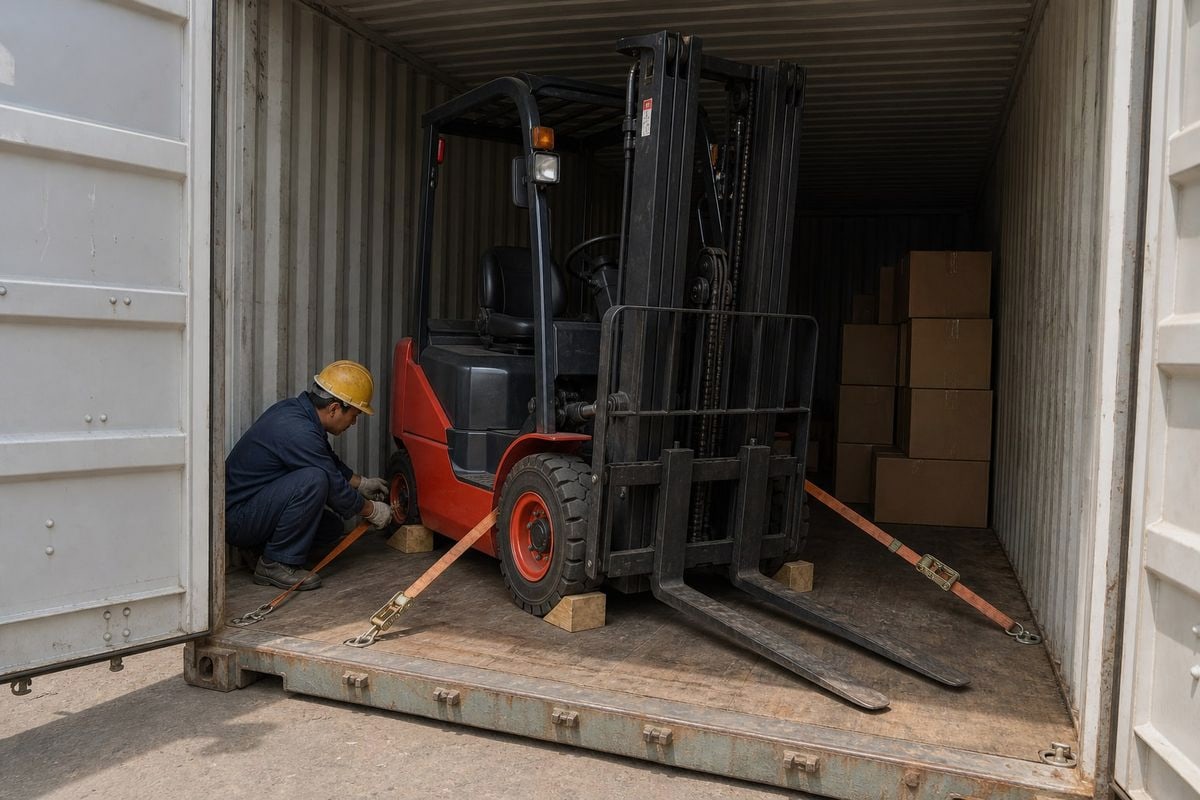
Preventing forklifts from tipping over inside containers is a question our loading team in Zhengzhou answers weekly. One bad tip-over can wreck a $15,000 machine before the vessel even sails.
To prevent forklifts from tipping over inside containers, keep the center of gravity inside the stability triangle, verify floor and ramp ratings, drive slowly with forks 2–4 inches off the floor, and secure the parked forklift with wheel chocks, lashing straps, and blocking before ocean transit.
That short answer covers the core idea. But container work compresses every rollover risk into a tight steel box. So let me walk you through each stage, from loading day to arrival at your dock.
How Should I Secure Electric Forklifts Inside a Shipping Container?
Last year, our team unpacked a container where a supplier had used only two thin ropes on a 3-ton electric forklift. The machine had shifted half a meter. We changed that supplier's loading process the next week.
Secure an electric forklift by lowering the forks flat to the floor, tilting the mast forward, engaging the parking brake, chocking all wheels, and lashing the chassis to container lashing points with rated straps or chains at four or more anchor points.
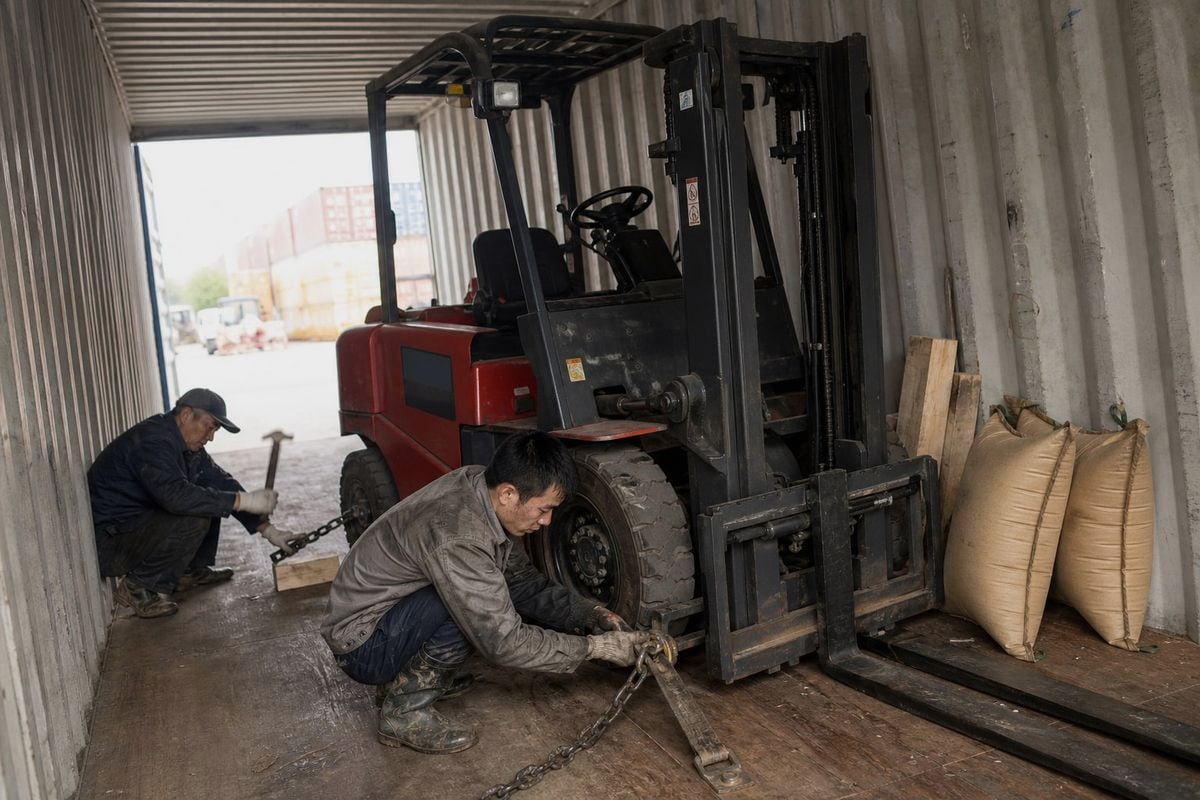
The goal of securing is simple. The forklift must not move in any direction during three to five weeks at sea. A container on a vessel rolls, pitches, and slams. If the machine can slide even a few centimeters, it will build momentum and eventually tip or punch through the container wall.
La Séquence de Sécurisation que Nous Suivons
Our loading coordinators in China follow a fixed order. First, we drain or disconnect the battery according to the carrier's lithium battery requirements. Second, we position the forklift with its counterweight balance 1 considered, usually facing the doors or reversed depending on the loading plan. Third, we lower the forks completely and tilt the mast forward so no component sits under spring tension. Fourth, we chock and lash.
| Securing Step | What We Use | Pourquoi c'est important |
|---|---|---|
| Wheel immobilization | Hardwood wheel chocks, nailed to the floor | Stops rolling from vessel motion |
| Chassis lashing | Rated polyester straps or chains, 4–6 points | Prevents sliding and lateral tip-over |
| Mast and forks | Lowered flat, tilted forward | Removes stored energy and lowers the load center of gravity |
| Battery | Disconnected, terminals insulated | Meets lithium battery cargo handling rules |
| Gaps | Timber blocking and dunnage bags | Eliminates free movement space |
Lashing Points Matter More Than Strap Count
A common mistake is adding many straps to weak points. Container corner castings and floor lashing rings 2 are rated. Plastic body panels and the overhead guard are not. We always anchor to the chassis or designated tie-down points shown near the forklift capacity plate area, never to the mast chains or hydraulic lines. Cross the straps at opposing angles so the forklift is pulled down and inward from every direction. Then re-tension every strap after the container is jolted once, because straps settle.
What Loading Techniques Prevent Forklift Movement During Ocean Freight?
There is a real trade-off we weigh on every shipment: pack forklifts tighter to cut freight cost per unit, or leave more working room for safe driving and securing. We never sacrifice the second for the first.
Prevent forklift movement during ocean freight by centering weight over the container floor, driving in slowly with forks low and mast tilted back, avoiding sharp steering, using nose jacks at the container front, and filling all gaps with blocking and dunnage.

Movement prevention starts before the forklift is even parked. The way the machine enters the container decides whether the loading itself becomes the accident. Tip-overs account for roughly 42% of forklift accidents in safety guidance, and a container concentrates the causes: tight clearance, threshold transitions, and no room to recover from a mistake.
Entry Technique on Container Loading Ramps
Container loading ramps and dock levelers create a height change and a gap. Our loading teams verify that the ramp is rated for the combined weight of the driving forklift plus any load it carries. We also deploy nose jacks or stabilizer stands at the front of a grounded container. Without them, the container can see-saw when the forklift enters the front half, and that sudden dip is enough to start a longitudinal tip-over.
Driving Discipline Inside the Box
Inside the container, the rules tighten. Speed drops to a crawl. Forks stay 2–4 inches off the floor. Turns happen outside the container whenever possible, because the rear counterweight arc, called tail-swing, can strike a container wall and create a pivot force that destabilizes the chassis. Sharp steering also generates centrifugal force that pushes the load center of gravity outside the stability triangle, which is exactly how lateral tip-overs begin.
Some buyers assume slow speed alone removes rollover risk. It does not. Even a crawling forklift tips if the floor is uneven, the load shifts, or the mast is raised at the wrong moment. Speed control is one input, not the whole answer.
Weight Distribution Along the Container
We plan weight placement before loading day. Heavy units go over the container's strong floor cross-members, and the total load is balanced front to back so the container itself stays within road and rail axle limits after loading.
How Do I Choose the Right Container Type for Heavy Forklift Cargo?
A US distributor once asked us to squeeze four counterbalance forklifts into a 20FT container to save money. We ran the numbers on floor loading and mast heights, then recommended a 40HQ instead. He thanked us at destination.
Choose the container type by matching forklift mast height to door clearance, total weight to the container payload limit, and front-tire point-load pressure to the floor's concentrated weight rating. A 40HQ suits most multi-unit electric forklift shipments; flat racks suit oversized units.

Container choice is where tip-over prevention actually begins, weeks before loading day. A forklift that barely fits is a forklift that will snag its overhead guard on the door header, force awkward steering, and stress the floor in the wrong places.
Quick Comparison of Container Options
| Type de conteneur | Adaptation typique | Meilleur pour | Key Risk to Check |
|---|---|---|---|
| 20FT | 1–2 chariots élévateurs électriques compacts | Single-unit or heavy short loads | Concentrated floor loading |
| 40FT | 3–4 medium forklifts | Mixed forklift and parts shipments | Weight distribution along length |
| 40HQ | 3–5 forklifts plus accessories | Taller masts, better cube utilization | Door header clearance during entry |
| Flat rack | Oversized or non-collapsible masts | Units too tall or wide for box doors | Requires full lashing and weather protection |
Point-Load Pressure and Floor Surface Integrity
Here is the check most first-time importers skip. A container floor has a total payload rating, but it also has a concentrated weight limit. A 3-ton electric forklift puts most of its weight on two small front-tire contact patches. If that point-load pressure 3 exceeds the floor's concentrated rating, the plywood floor can crack or collapse, and a collapsing floor is an instant tip-over. Before loading, our team inspects floor surface integrity for rot, delamination, previous repairs, and soft spots. We reject containers that fail this inspection, even if it delays loading by a day.
Match the Machine, Not Just the Box
We also verify the reverse fit: if a forklift will be driven inside, its mast height, fork length, and turning envelope must suit the container's internal dimensions. Size alone is not a guarantee of safety, but a mismatch guarantees trouble.
What Cargo Securing Materials Do I Need for Safe Forklift Shipping?
Early in our export work, we learned a hard lesson: securing materials that look adequate at the warehouse can fail at sea. Since then, we specify every strap, chock, and timber piece in the loading plan.
Safe forklift shipping requires rated lashing straps or chains, hardwood wheel chocks, timber blocking, dunnage bags, edge protectors, anti-slip rubber mats, corner castings or floor ring anchors, and desiccant packs, all matched to the forklift's weight on its capacity plate.

Materials are cheap compared to the machine they protect. A full securing kit for one electric forklift usually costs a small fraction of one percent of the equipment value. Yet under-securing remains the top cause of transit damage we see when we open containers loaded by inexperienced suppliers.
The Core Materials List
| Material | But | Sizing Guideline |
|---|---|---|
| Polyester lashing straps or chains | Hold the chassis against vessel motion | Combined rated capacity above forklift weight, at 4–6 points |
| Hardwood wheel chocks | Block rolling in both directions | Height of at least one quarter of tire diameter |
| Timber blocking | Brace the chassis against walls and floor | Nailed into the container floor, not loose |
| Dunnage air bags | Fill voids between units and walls | Inflated after all lashing is complete |
| Anti-slip rubber mats | Increase friction under tires | Placed before the forklift parks |
| Edge protectors | Stop straps cutting on sharp chassis edges | At every strap contact point |
| Desiccant packs | Control condensation on electrical components | Hung along container walls |
Match Materials to the Capacity Plate
Every securing calculation starts with the forklift capacity plate. It tells you the service weight, and the lashing system must exceed that figure with margin. This principle mirrors OSHA safety standards thinking at destination: rated equipment, verified numbers, no guesswork. We also warn buyers about a false economy. Non-approved attachments or modified forks change a forklift's handling and lateral stability, and they complicate securing too, because standard tie-down geometry no longer applies. If your supplier fitted aftermarket parts, tell your forwarder before loading day.
One Final Human Note
Train whoever unloads at destination. If a tip-over starts during unloading, the operator must stay seated, grip the wheel, brace, and lean away from the fall. Jumping out is the deadliest instinct in this industry.
Conclusion
Tip-over prevention starts weeks before loading: match the container, respect the stability triangle, drive slow, and secure with rated materials. Get these right, and your forklifts arrive standing.
Notes de bas de page
1. Updated OSHA eTool page explaining forklift stability principles and counterweight balance. ↩︎
2. IMO standards for cargo securing devices, including lashing rings and point ratings. ↩︎
3. Technical details on intermodal container floor construction and point-load weight distribution. ↩︎




