
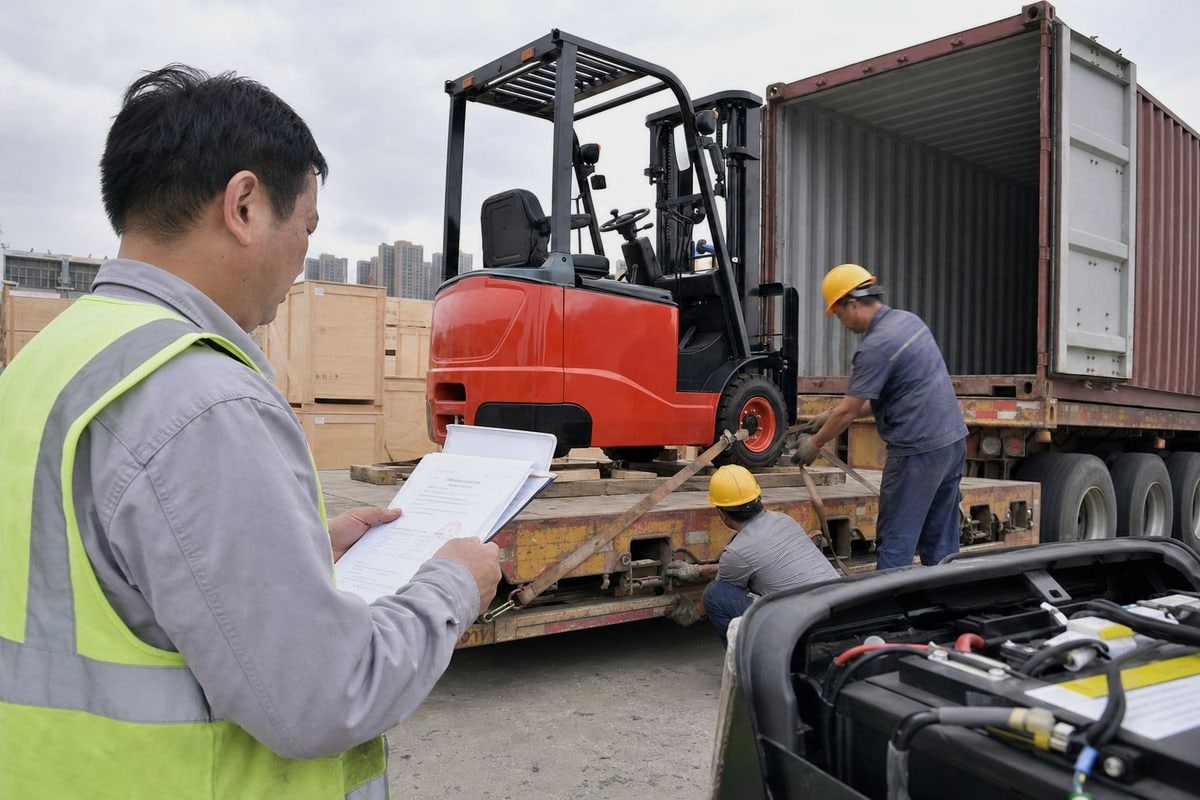
Shipping three-wheel electric forklifts from China looks simple until the lithium battery paperwork stalls your container at the port. I have watched buyers lose weeks — and thousands in demurrage — over one missing UN38.3 report. At our Zhengzhou logistics office, we built our entire forklift shipping process to prevent exactly that.
To ship three-wheel electric forklifts from China, confirm battery compliance documents (UN38.3, MSDS), book FCL sea freight with a carrier that accepts lithium battery cargo, secure the forklift with blocking and lashing inside the container, and clear customs using HS code 8427.10.10 with a qualified broker.
That is the short version. The full process has more moving parts. Let me walk you through each stage, based on the shipments we handle every month for forklift importers.
What Documents Do I Need to Ship Three-Wheel Electric Forklifts from China?
One of our US clients once emailed me in a panic. His forklift supplier had shipped a previous order with another forwarder, and customs held the cargo because the battery documents did not match the invoice. Paperwork is where most forklift shipments go wrong.
You need a commercial invoice, packing list, bill of lading, certificate of origin, export declaration, UN38.3 test report, MSDS for the lithium battery, and a dangerous goods declaration where required. EU-bound units also need a CE Declaration of Conformity; US-bound units need correct HTS classification and import filings.

The document package for a three-wheel electric forklift splits into two groups: standard trade documents and battery compliance documents. Both must be complete and consistent before the container leaves the factory. In our experience exporting to the US, the battery documents cause almost all the delays, so we collect them during production rather than after.
Standard Trade Documents
Every shipment needs a commercial invoice, a packing list, and a bill of lading. The certificate of origin matters more than many buyers realize. It can qualify you for preferential trade agreement rates 1 in some markets, and customs will check that it matches the invoice details. We review these documents against the supplier's data before booking, because a mismatch between the packing list weight and the actual container weight is a common inspection trigger.
Battery and Compliance Documents
The lithium battery is the sensitive part of the cargo. Here is what carriers and customs expect:
| Document | But | Qui le fournit |
|---|---|---|
| rapport d'essai UN38.3 | Proves the battery passed transport safety testing | Battery or forklift manufacturer |
| FDS/SDS | Describes battery chemistry and hazards | Manufacturer |
| DG declaration | Required for IMDG-classified lithium battery cargo | Shipper/forwarder |
| Certification de chargeur | Confirms charger safety and voltage compliance | Manufacturer |
| CE Declaration of Conformity | Required for EU-bound machines | Manufacturer |
| HTS/HS classification sheet | Supports customs clearance and duty calculation | Broker/forwarder |
Some suppliers now also offer a battery passport or digital traceability file. This is an emerging requirement for lithium-ion lifecycle transparency 2, and we recommend requesting it if your market is moving in that direction. My advice: verify the machine classification and the battery classification separately, because both affect your costs and your clearance speed.
How Many Three-Wheel Electric Forklifts Can I Fit in One Container?
Container planning is where I spend the most time with new clients. Last quarter, we reworked a loading plan for a US distributor and fit an extra forklift plus spare parts into the same 40HQ — that one change cut his per-unit freight cost noticeably.
A 20FT container typically holds 2 three-wheel electric forklifts, a 40FT holds 3–4, and a 40HQ holds 4–5, depending on mast height and counterweight size. Partial knock-down shipping, with the mast packed separately, can add one more unit per container.

Three-wheel electric forklifts are compact compared to four-wheel counterbalance models, which works in your favor. Still, the mast height is the deciding factor. A standard container door opening is about 2.28 meters high, so a tall mast may need to be lowered, tilted, or removed before loading. We confirm the shipped dimensions — not the catalog dimensions — with the factory before we choose the container type.
Container Options Compared
| Conteneur | Typical Capacity | Meilleur pour |
|---|---|---|
| 20FT | 2 units | Small orders, heavy compact units |
| 40FT | 3–4 units | Mid-size fleet orders |
| 40HQ | 4–5 unités | Taller masts, max volume orders |
| Flat rack | 1–2 oversized units | Units that exceed standard container dimensions |
How to Squeeze More Value from the Space
Requesting Partial Knock-Down (PKD) shipping is the single best optimization. The factory packs the mast and sometimes the overhead guard separately, which reduces dead space and lets units nest more tightly. We also help clients fill the remaining gaps with chargers, forklift batteries, attachments, and spare parts — often consolidated from multiple Chinese suppliers into one container. That consolidation is a core part of our service, because buying forklifts from Factory A and chargers from Factory B should not mean paying for two shipments.
Securing matters as much as fitting. We insist on heavy-duty lashing points, timber blocking around the three-wheel base, and dunnage between units. A three-wheel chassis has a different weight distribution than a four-wheel machine, so bracing must account for the concentrated rear load. Some clients now add IoT shock and tilt sensors to the chassis for real-time handling data during transit — a smart move for high-value fleet orders.
How Do I Handle Lithium Battery Shipping Rules for Three-Wheel Electric Forklifts?
The trade-off I discuss most with buyers is speed versus compliance. A carrier booking without proper DG paperwork might sail sooner — until it gets rejected at the terminal. We have learned to treat electric forklift shipping as battery compliance first and freight second.
Handle lithium battery regulations by obtaining the UN38.3 test report and MSDS from the manufacturer, filing a dangerous goods declaration under IMDG rules where required, confirming the battery's state of charge before sealing the container, and securing carrier acceptance for lithium battery cargo before booking.

An integrated lithium battery can change everything about your booking. Not every carrier accepts lithium battery machinery, and those that do require documentation review before they confirm space. This is why we always confirm DG booking acceptance with the carrier before the factory finishes production — reversing that order is how importers end up with finished forklifts sitting in a warehouse with no vessel to load them on.
The Compliance Workflow We Follow
- Confirm the battery chemistry and charger voltage with the factory at order stage.
- Collect the UN38.3 test summary and MSDS during production, not after.
- Determine whether the shipment requires full IMDG dangerous goods handling or qualifies for an exemption based on how the battery is installed.
- Submit documents to the carrier for lithium battery cargo approval.
- Verify the battery's state of charge before the container is sealed.
- Attach required labels and include the DG declaration in the shipping file.
Some supplier pages make forklift shipping sound flexible and easy. In practice, lithium battery documentation and carrier acceptance are the real bottlenecks — not the freight itself. I raise this with every new client because the objection I hear most is "my supplier says shipping is no problem." Suppliers build forklifts; they do not always track IMDG amendments 3 or individual carrier policies. A freight forwarder who handles battery-powered material handling equipment regularly will catch gaps a general forwarder misses.
For US-bound shipments, add one more layer: import security filing and vehicle-related compliance checks can apply, so loop in your customs broker before departure, not at arrival.
How Much Does It Cost to Ship a Three-Wheel Electric Forklift from China to the USA?
A buyer in Texas once told me his forklift quote looked great until the invoices started arriving — port fees, chassis fees, broker fees, duties. His landed cost ran far above his budget. Transparent cost planning is why importers come to us.
Shipping a three-wheel electric forklift from China to the USA typically costs $1,500–$4,000 per unit all-in, covering ocean freight, DG surcharges, port charges, customs brokerage, duties, and delivery. Loading multiple units per FCL container significantly lowers the cost per forklift.
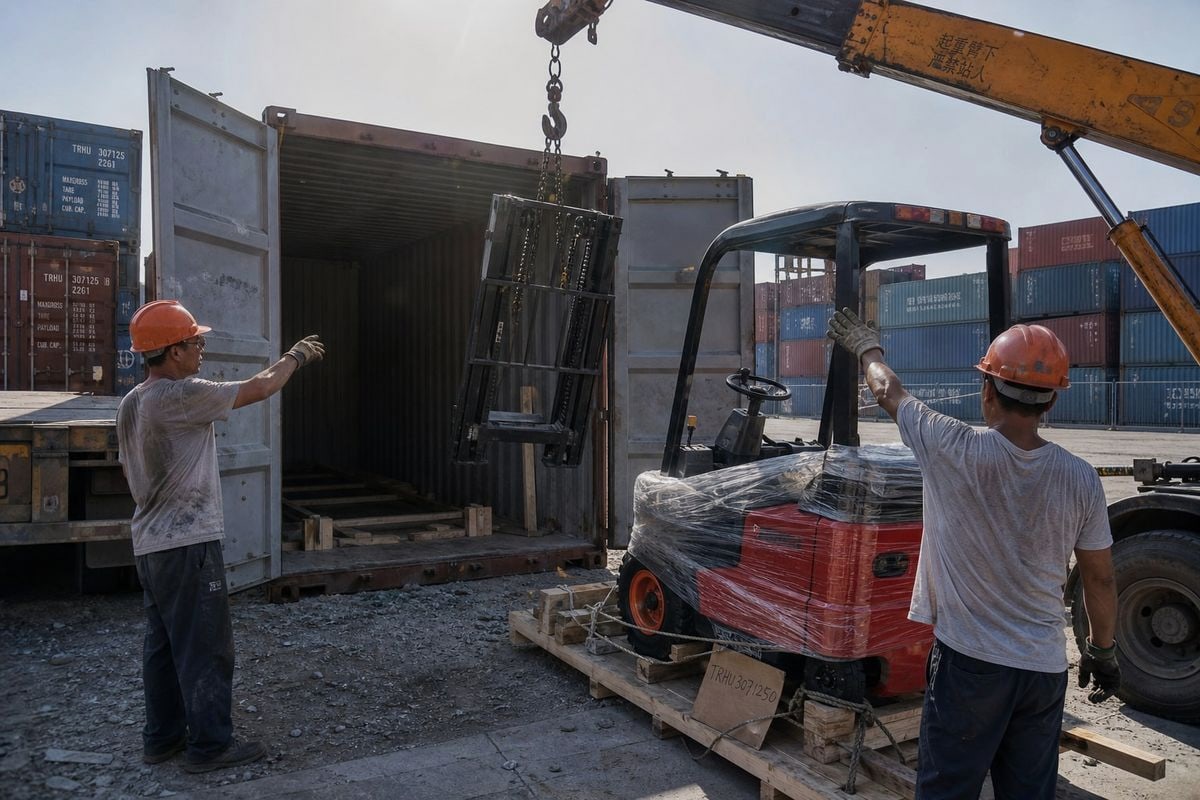
Let me break the landed cost into its real components, because a port-to-port rate alone tells you very little. With three-wheel electric forklifts often priced around US$5,500–6,500 at the factory, logistics can add 20–40% to your true acquisition cost if you plan poorly — or far less if you plan well.
The Cost Drivers That Matter
| Composante de coût | What Affects It |
|---|---|
| Machine price | Capacity, mast height, battery size, configuration |
| Inland pickup in China | Factory location relative to the port |
| fret maritime | Container type, route, season, carrier |
| DG surcharges | Lithium battery classification and carrier policy |
| Port and terminal charges | Origin and destination port fees |
| Customs brokerage | Broker fees plus import security filing |
| Droits à l'importation | HS code 8427.10.10 classification, plus any anti-dumping or countervailing duties |
| Final-mile delivery | Distance from port, liftgate or crane needs |
Incoterms and Who Pays What
Your Incoterms decide who controls and pays for each stage. FOB is the standard choice for experienced importers who want control over sea freight logistics 4 and insurance. DDP looks simpler for beginners, but I always flag the tension: DDP can hide cost and compliance complexity inside one bundled price. We offer DDP and DAP door-to-door options, and we itemize every charge, because an opaque DDP quote is where surprise destination fees hide. EXW, CFR, and CIF sit between those extremes.
Timing Expectations
Factory production commonly runs around 20 days after advance payment for standard models, though lead times vary widely with order urgency. Ocean transit from China to the USA adds roughly three to six weeks depending on the coast, with some full delivery estimates running 32–43 business days. Air freight is realistic only for spare parts and urgent accessories — a complete forklift is far too heavy to fly economically. Ro-Ro shipping exists on some routes, but FCL remains the safer default for complete electric forklifts because it gives better cargo protection and cost predictability. Get your HS code verified by a broker before shipment; misclassification creates customs clearance delays and potential penalties that dwarf the broker's fee.
Conclusion
Shipping three-wheel electric forklifts from China rewards preparation: complete battery documents, smart FCL loading, verified HS codes, and clear Incoterms. Get those four right, and your forklifts arrive on time and on budget.
Notes de bas de page
1. The World Trade Organization (WTO) provides information on regional and preferential trade agreements and their rules. ↩︎
2. The European Commission's official page on battery regulations and lifecycle sustainability requirements. ↩︎
3. The International Maritime Organization (IMO) sets the global standards for the IMDG Code. ↩︎
4. The International Chamber of Commerce (ICC) defines the Incoterms used in international trade. ↩︎




