
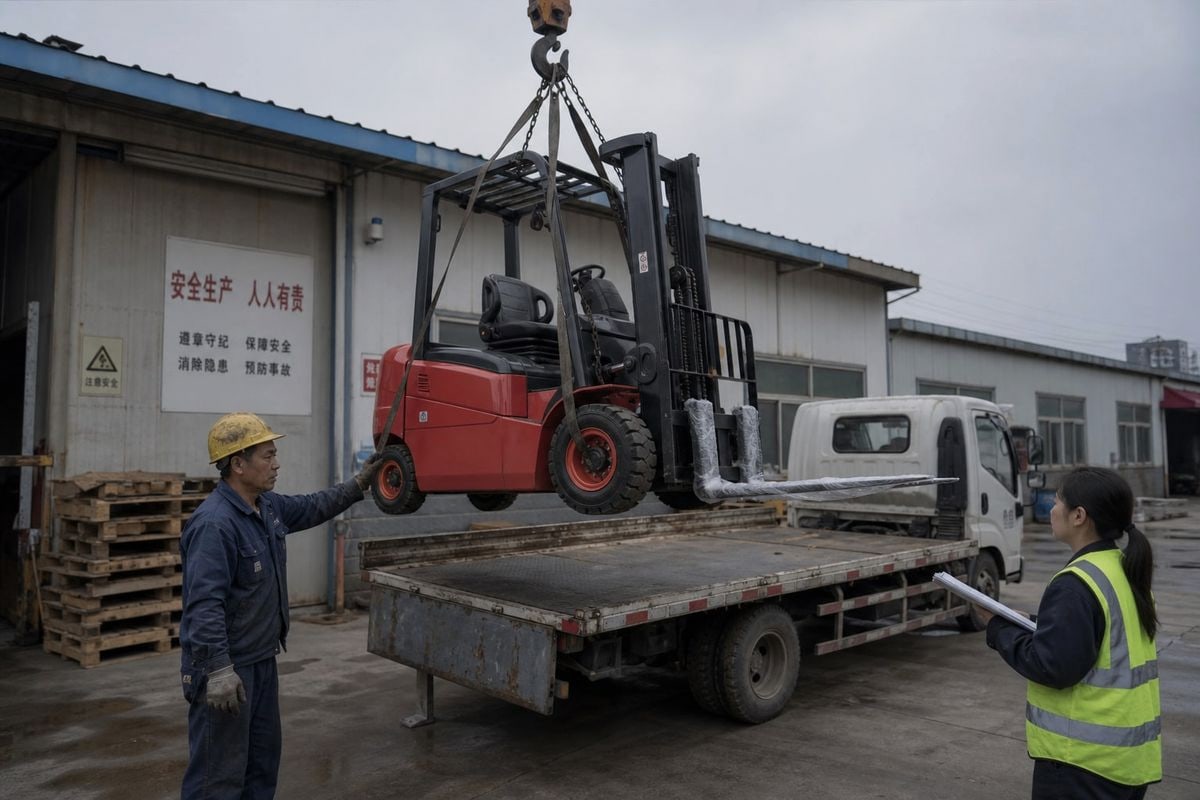
[Hidden costs](https://mbmlog.com/?p=11847) in EXW forklift shipping from China catch buyers constantly. At our Zhengzhou logistics office, I see cheap factory quotes turn into expensive shipments almost every week. The pattern is painful and avoidable.
To avoid hidden costs in EXW forklift shipping from China, demand a written origin-cost breakdown before booking: factory loading, inland trucking, export customs clearance, documentation, and Terminal Handling Charges. Confirm battery compliance early, insure the first mile, and compare the EXW total against an FOB quote.
EXW looks simple on paper. In practice, it moves the hardest part of the shipment onto you. Let me walk you through where the money leaks out, step by step.
What Hidden Costs Should I Watch for When Buying Forklifts EXW from China?
Last spring, our team rescued a US dealer's shipment after his supplier refused to load two lithium forklifts. His "great" EXW price suddenly needed a crane, a truck, and a customs agent.
Under EXW, watch for factory loading fees, inland trucking to the port, export customs clearance, documentation charges, origin Terminal Handling Charges, warehouse fees, and delay penalties. For electric forklifts, add battery certification costs and heavy-cargo lashing charges that sellers rarely mention upfront.

EXW means the seller's job ends at the factory gate, often before the forklift is even loaded onto a truck. Under the Incoterms 2020 rules, everything after that point is your responsibility. That includes risk, paperwork, and cost. The factory price is not the עלות נחתית. One study suggests EXW can represent only 64–70% of the buyer's actual landed cost. That gap is where the surprises live.
The Origin-Side Cost Stack
Here is what typically sits between the factory gate and the vessel:
| Hidden Cost Category | טווח טיפוסי | Why It Appears |
|---|---|---|
| Factory pickup | $50–$200 | Buyer arranges collection under EXW |
| Inland trucking costs | $100–$500 | Factory-to-port transport, higher for remote factories |
| שחרור מכס ליצוא 1 | $50–$150 | Requires a licensed Chinese agent |
| עמלות תיעוד | $30–$100 | Bill of Lading, export forms, certificates |
| Warehouse handling | $20–$80 | CFS or consolidation warehouse charges |
| Loading and lashing charges | משתנה | Cranes, securing labor, bracing materials |
Forklifts magnify every one of these lines. A forklift is heavy, awkward, and often cannot be lifted with standard warehouse equipment. Some factories charge separately for crane use. Some refuse loading responsibility entirely, because under strict EXW they are not obligated to load at all.
Then there is the battery problem. Electric forklifts with lithium batteries need תִעוּד UN38.3 2 and correct dangerous-goods handling. Miss that paperwork and your cargo sits at the port while port storage fees climb. In our experience coordinating lithium battery cargo, fixing compliance after the forklift reaches the terminal always costs more than fixing it before pickup.
How Can I Get an Accurate All-In Quote Before Shipping My Forklift?
Before we quote any forklift shipment, my team asks suppliers for exact dimensions, weight, and battery specifications. When those answers come back vague, I already know the buyer's original quote was incomplete.
Get an accurate all-in quote by supplying exact forklift dimensions, weight, and battery type, then requesting an itemized quotation covering pickup, loading, trucking, export customs clearance, documentation, ocean freight, and destination charges. Insist that each line is priced separately, not bundled as "logistics."

An accurate quote starts with accurate cargo data. Freight forwarder fees for heavy equipment depend on real numbers, not estimates. If the forklift weight is understated, you may face heavy-lift surcharges when the crane or low-boy trailer limits are exceeded. If the battery type is wrong, the carrier may reject the booking at the last minute.
The Information You Must Provide First
Follow this sequence before asking anyone for a price:
- Confirm the forklift model, quantity, dimensions, and gross weight from the factory nameplate, not the brochure.
- Confirm the battery chemistry. Lithium batteries need UN38.3 certification; lead-acid units have their own handling rules.
- Confirm the exact factory pickup address. A remote inland factory can double your inland trucking costs.
- Confirm who loads the cargo and whether the factory has a crane or heavy-duty forklift on site.
- Confirm the HS Code classification, because it drives export declaration accuracy and destination import duties and taxes.
What a Complete Quote Should Itemize
Then demand line items, not a lump sum. A real all-in quote separates factory pickup, loading and lashing charges, inland trucking, export customs clearance, documentation, origin Terminal Handling Charges 3, ocean freight, marine cargo insurance, and destination costs. One more tip from our daily work: ask whether local CNY charges are locked or floating. Some forwarders add a quiet currency-adjustment buffer on USD invoices. A fixed exchange-rate clause removes that markup.
Finally, compare the full EXW total against an FOB quote from the same supplier. The FOB vs EXW comparison often reveals that FOB is cleaner for China exports, because it aligns origin logistics with the party who can actually control them: the supplier.
What Destination Charges Are Often Left Out of My Freight Quotation?
A distributor in Texas once told me his forklift "arrived free" and then forwarded me a $1,400 destination invoice he never expected. His origin quote had simply stopped at the Chinese port.
Freight quotations often omit destination Terminal Handling Charges, customs brokerage, import duties and taxes, ISF or entry filing fees, chassis and drayage charges, demurrage, port storage fees, and final-mile trucking. For forklifts, add liftgate or crane offloading costs at your warehouse.

The shipment does not end when the vessel departs China. A quote that stops at the origin port hides an entire second cost stack on your side of the ocean. In our door-to-door DDP and DAP work to the United States, we price these items upfront, because they routinely shock first-time importers.
The Destination Cost Stack
| Destination Charge | מה זה מכסה | Commonly Quoted? |
|---|---|---|
| Destination Terminal Handling Charges | Unloading and moving the container at the arrival port | לפעמים |
| סוכן מכס | Import entry filing and clearance | Rarely under EXW |
| מיסי יבוא ומסים | Tariffs based on HS Code classification and value | נדיר |
| Chassis and drayage | Container trucking from port to warehouse | לפעמים |
| עיכוב ומעצר | Container held too long at port or at your site | Almost never |
| Port storage fees | Cargo waiting due to paperwork or booking delays | Almost never |
| Warehouse offloading | Crane or heavy forklift to unload your forklift | Almost never |
Delay charges deserve special attention. When export documents arrive late or customs holds the container, demurrage and storage can reach $100–$250 per container per day. A one-week paperwork problem can cost more than the ocean freight itself. This is why we verify the Bill of Lading details, battery documents, and commercial invoice consistency before departure, not after arrival.
Also confirm who arranges marine cargo insurance 4 for the full journey. Under EXW, risk transfers to you at the factory, so a policy that starts at the port leaves your most fragile leg, the first mile, completely uncovered.
How Do I Choose a Freight Forwarder That Won't Surprise Me With Extra Fees?
The hardest lesson I learned in this business came early: a forwarder who quotes fast without asking questions is usually planning to bill the questions later. Good forklift forwarders interrogate the cargo details first.
Choose a forwarder with proven heavy-equipment and lithium battery experience, itemized written quotations, direct factory coordination in China, first-mile insurance options, and proactive shipment updates. Avoid anyone who quotes an EXW forklift shipment without asking for weight, dimensions, and battery specifications.

Not every forwarder can handle a forklift. Parcel-focused agents often underestimate loading requirements, misclassify battery cargo, or skip the lashing plan entirely. Then the damage, the delay, or the surcharge lands on you. Here is how I would vet a partner if I were the buyer.
A Practical Vetting Checklist
| Vetting Question | Good Answer | Red Flag |
|---|---|---|
| האם שלחתם עגלות חשמליות בעבר? | Yes, with battery documentation examples | "Cargo is cargo" |
| Who handles export customs clearance? | Named licensed Chinese agent, fee stated | "The factory will sort it" |
| How is the forklift secured in the container? | Lashing plan with bracing and weight distribution | No answer |
| Are origin Terminal Handling Charges itemized? | Yes, with a line-by-line breakdown | Bundled "port fees" |
| Do you offer marine cargo insurance from the factory? | Yes, first-mile coverage included | Coverage starts at port |
| Are CNY charges fixed? | Locked exchange rate in the quote | Floating "adjustments" |
Why On-the-Ground Presence Matters
The pro-EXW argument says buyers gain control over freight selection. That control is often illusory in China. You have no leverage over a factory in another province, no access to local paperwork channels, and no eyes on the loading dock. Our team in Zhengzhou communicates directly with factories about cargo readiness, packing, battery specs, and loading arrangements, because problems solved before pickup cost almost nothing. Problems discovered at the port cost hundreds per day.
EXW is not always wrong. It can work well if you have a strong China-side logistics partner, written loading terms, and confirmed document timing. Without those three things, an FOB deal or a managed door-to-door service will almost always produce a cleaner landed cost.
מַסְקָנָה
EXW forklift shipping from China hides its real cost between the factory gate and your warehouse. Demand itemized quotes, verify battery paperwork early, and partner with a China-based forwarder before booking.
הערות שולים
1. Authoritative government resource explaining the mandatory procedures and documentation required for clearing goods through export customs. ↩︎
2. Official United Nations standards for the testing and classification of lithium batteries for safe international transport. ↩︎
3. Official site of the FMC, which regulates the U.S. international ocean transportation system and shipping fees. ↩︎
4. Comprehensive overview of insurance coverage for cargo loss or damage during transit across international waters. ↩︎




