- +8618603825129
- [email protected]


Choosing between LCL vs FCL cost when [shipping forklifts from China](https://mbmlog.com/?p=11621) confuses many importers. At our Zhengzhou logistics office, we see buyers overpay for the wrong mode every single week.
Choose LCL only when your crated forklift stays well below 15 CBM and destination fees are transparent. Choose FCL when total volume approaches 14–18 CBM, when shipping multiple units, or when the forklift is high-value, electric, or fragile.
That is the short answer. Now let me show you how to actually run the numbers, because the details decide whether you save money or lose it.
Last month, a buyer sent us a forklift spec sheet and asked for an LCL quote. Once we added the crate dimensions, his "small" machine became a 12 CBM shipment.
Your shipment qualifies for LCL if the packed, crated volume is under roughly 13–15 CBM, the forklift fits standard container height, and it carries no restricted batteries. Above that volume, or with lithium batteries onboard, FCL pricing usually applies or wins.
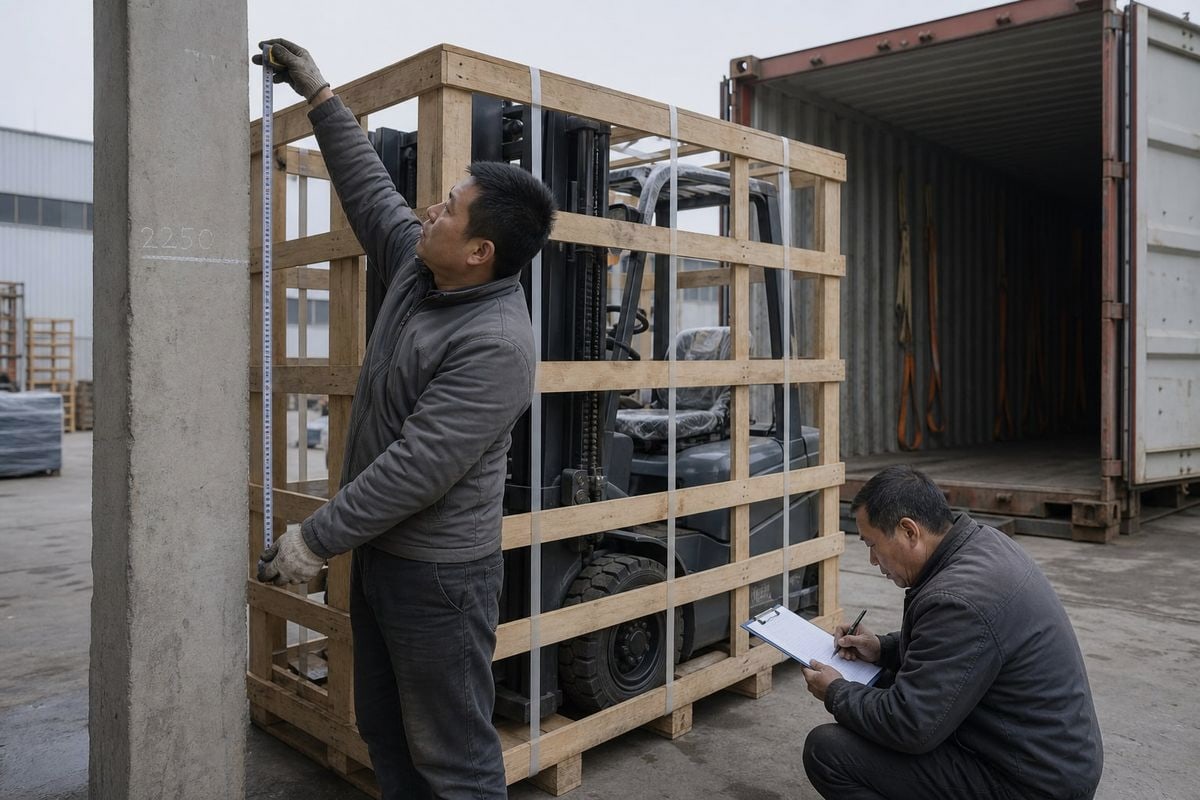
The first step is accurate CBM measurement. LCL is priced per cubic meter or per weight ton, whichever is higher. This is the Weight/Measure (W/M) rule. Forklifts are heavy machines. If your unit exceeds roughly 1,000 kg per CBM, the consolidator bills you by weight tons instead of volume. Many buyers miss this and get shocked by the invoice.
We always tell clients: quote the packed dimensions, never the bare machine. A crate adds height, length, and dunnage. A forklift that measures 8 CBM naked can easily become 11–12 CBM crated. LCL charges are extremely sensitive to that packed volume.
Standard containers have an internal height around 2.38 meters. High-visibility masts often exceed that, which pushes you into a 40ft High Cube container — effectively mandating FCL. Electric forklifts with lithium or lead-acid batteries 1 also face Dangerous Goods scrutiny. Many LCL consolidators simply refuse them to protect other cargo in the box. In our experience handling lithium battery forklifts, FCL is often the only practical path for electric models.
| Qualifying Factor | LCL Friendly | FCL Required or Preferred |
|---|---|---|
| Packed volume | Under 13 CBM | 14 CBM and above |
| Mast height | Under 2.2 m crated | Over 2.3 m (needs 40HQ) |
| Battery | Removed or non-DG | Lithium installed |
| Density | Under 1,000 kg/CBM | Very heavy counterweights |
| Stackability | Crated, top-loadable | Non-stackable open unit |
Non-stackable cargo triggers another trap. Because nothing can sit on top of a forklift, LCL providers often apply a height-limit surcharge and bill you for the full vertical space — up to 2.4 meters — even if your machine stands only 2 meters tall.
The trade-off I weigh most often for clients is a low LCL ocean rate against the pile of destination fees hiding behind it. The cheap quote is rarely the cheap shipment.
Compare total landed cost, not ocean freight. LCL adds origin consolidation fees, destination CFS charges of roughly $80–$150, deconsolidation, and non-stackable surcharges. FCL adds terminal handling charges and chassis fees, but its flat rate hides far fewer surprises.

Here is the pattern we see constantly in heavy machinery logistics: an importer receives an LCL quote at $90 per CBM and an FCL quote at $3,500 flat. LCL looks like a bargain. Then the arrival notice lands, and the CFS fees, port of discharge fees, and handling charges at destination sometimes exceed the original ocean freight for a heavy unit like a forklift.
| Cost Item | LCL | FCL |
|---|---|---|
| Ocean freight | $60–$180 per CBM (lane dependent) | $2,300–$5,500 flat per container |
| Destination CFS fee | $80–$150 per shipment | Not applicable |
| Deconsolidation and stripping | Charged, often per CBM | Not applicable |
| Terminal handling charges | Built in or itemized | Itemized at origin and destination |
| Non-stackable surcharge | Common for forklifts | Not applicable |
| Damage exposure | Multiple handling points | Sealed at factory |
Your Incoterms matter here too. Under FOB vs CIF terms 2, the party controlling freight changes, and a supplier's "cheap" CIF rate frequently masks inflated destination charges. We advise buyers to control freight under FOB so every line item stays visible. Also budget for import duties and taxes, marine insurance coverage on a high-value machine, and clean Bill of Lading 3 documentation. An error on the Bill of Lading can hold a forklift at the port and rack up storage fees fast. When we coordinate DDP shipments to the US, we check these documents before the vessel departs, because fixing them after arrival is always more expensive.
A distributor in Texas once asked me this exact question with two pallet stackers and one counterbalance forklift on his order. We ran the math together, and the answer surprised him.
FCL usually becomes cheaper than LCL at roughly 14–18 CBM, with 15 CBM as the common rule of thumb. For forklifts, that often means just one large crated unit, or two compact units, is enough to justify a 20ft container.
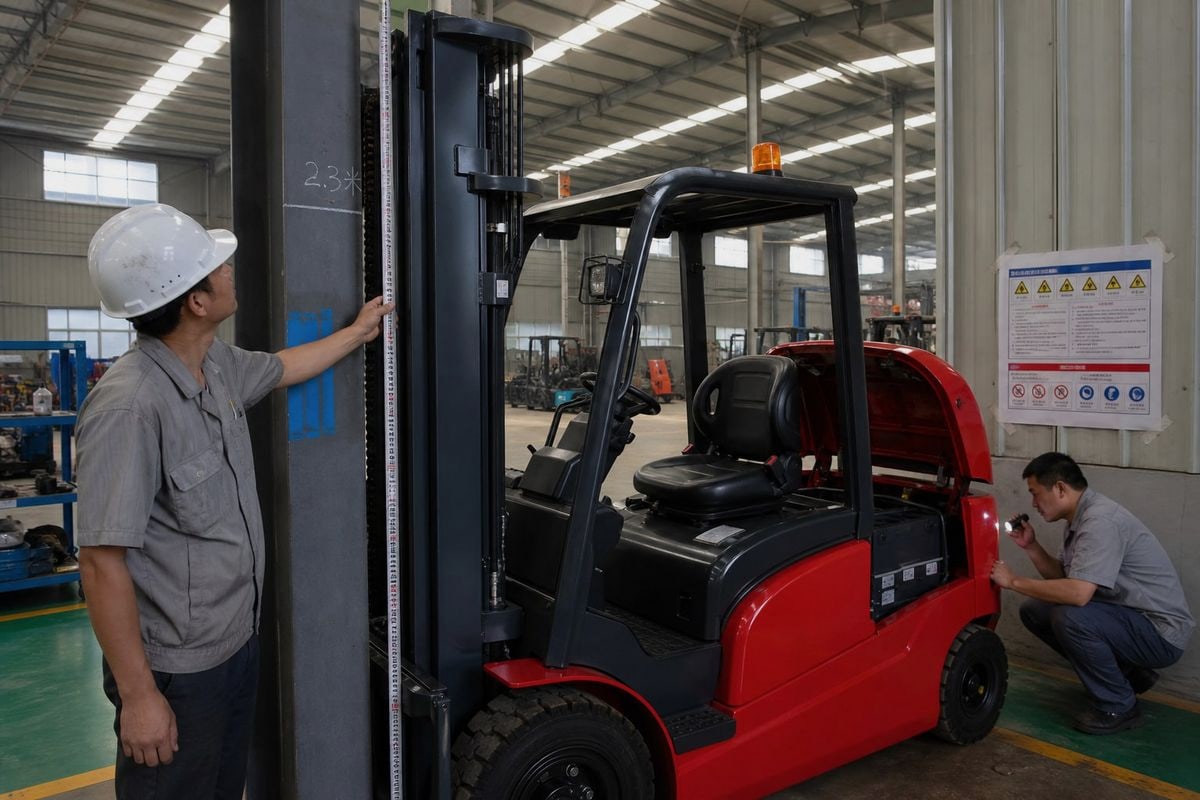
The break-even logic is simple. LCL cost climbs with every cubic meter. FCL is a flat rate. At some volume, the lines cross. Across the lanes we serve, that crossover sits between 13 and 16 CBM depending on route and spot rates. On China-to-US East Coast, break-even often lands around 15–18 CBM, while China to Northern Europe can break even closer to 12–15 CBM because LCL per-CBM rates there run lower.
Take current benchmark figures: a 20ft FCL at roughly $2,800–$4,800 to the US East Coast, and LCL at $100–$180 per CBM on the same lane.
| Shipment | Packed Volume | LCL Estimate (at $130/CBM + $150 fees) | FCL 20ft Estimate |
|---|---|---|---|
| One compact stacker | 5 CBM | ~$800 | ~$3,500 |
| One crated counterbalance forklift | 12 CBM | ~$1,710 | ~$3,500 |
| Two crated forklifts | 22 CBM | ~$3,010 + surcharges | ~$3,500 |
| Three forklifts + parts | 30 CBM | Not economical | ~$3,500 (near full) |
At two units, LCL and FCL are nearly tied on paper — and once non-stackable surcharges and W/M weight billing hit, FCL wins outright. Remember that a 20ft container offers roughly 25–30 CBM usable space, so two or three forklifts fill it efficiently. For higher counts, partial disassembly changes the game: removing masts, overhead guards, or wheels can let a 40ft High Cube fit up to six units. That density play is impossible in an LCL environment, which is one more reason FCL scales so well for dealers.
One lesson our team learned early: buyers sourcing from three or four factories almost always ship worse than they could, because each supplier quotes freight separately and nobody sees the whole picture.
Yes. You can consolidate cargo from multiple Chinese suppliers into one FCL container at a bonded or forwarder warehouse, ship overflow items via LCL, and reserve Ro-Ro transport or flat rack equipment for oversized units that will not fit a standard box.

This is the multi-supplier consolidation model we run daily from Zhengzhou. A typical client buys forklifts from Factory A, lithium batteries 4 from Factory B, chargers from Factory C, and spare parts from Factory D. Shipped separately, that is four sets of documentation, four destination fee stacks, and four deliveries. Consolidated, it becomes one container, one Bill of Lading, and one customs entry.
Some machines are simply too tall or too wide even for a 40HQ. For those, flat rack equipment or Ro-Ro transport becomes the answer, though Ro-Ro requires the machine to be driveable and exposes it to more weather and handling. We treat these as exceptions, not defaults, because standard FCL with proper securing usually protects the equipment better and prices lower.
One caution: mixing lithium battery forklifts into consolidated loads still demands correct DG classification before the cargo reaches port. We check battery specifications, packaging, and carrier acceptance during the warehouse stage, precisely so nothing gets rejected at the terminal.
The cheapest headline quote is a trap. Compare total landed cost: LCL wins below roughly 13 CBM, FCL wins near 15 CBM, with multiple units, or with electric forklifts.
1. The IMO regulates the maritime transport of hazardous materials, including lithium and lead-acid batteries. ↩︎
2. Authoritative source for Incoterms rules governing international trade and freight responsibility. ↩︎
3. Official US government site for customs regulations and required shipping documentation like bills of lading. ↩︎
4. Comprehensive overview of lithium-ion battery technology and safety standards for transport. ↩︎