

A buyer once asked our Zhengzhou team if cargo insurance when shipping electric forklifts was really worth it. Two weeks later, a shipment he booked elsewhere arrived with a bent mast. Nobody paid him back in full. That gap between "someone is liable" and "someone pays" is exactly why this question matters.
Cargo insurance is not legally required when shipping electric forklifts, but it is strongly recommended. Carrier liability limits often pay only $0.50–$2.00 per pound, far below a forklift's replacement value, so cargo insurance is usually the only way to recover the full cost of transit loss, theft, or damage.
Let me break this down properly. I will cover what the insurance costs, what it actually pays for, why carrier liability alone is a trap, and how to file a claim if something goes wrong. This is the same advice I give every forklift dealer we work with.
How Much Does Cargo Insurance Cost for Shipping My Electric Forklift from China?
Last month, a Texas forklift distributor asked me for an insurance quote on a container of four lithium battery forklifts. When I told him the number, he thought I had missed a zero.
Cargo insurance for shipping an electric forklift from China typically costs 0.2%–0.5% of the declared cargo value. A $20,000 forklift usually costs about $40–$100 to insure per shipment. Most policies insure 110% of the invoice value to cover freight and buffer costs, with rates varying by route and coverage type.

The cost of cargo insurance is one of the smallest line items in the entire heavy equipment transport bill. Ocean freight, destination charges, and duties will each cost far more. Yet insurance is the line item buyers question most often. I think that is because the value feels invisible until something goes wrong.
What Drives the Premium Up or Down
Several factors move the rate within that 0.2%–0.5% band. Route risk matters. A direct China-to-US West Coast sailing is cheaper to insure than a multi-transshipment route. Coverage type matters too. All-risk coverage costs more than named-perils coverage, but it protects against far more scenarios. The freight class and cargo description also matter, because electric forklifts with lithium-ion batteries fall under Class 9 hazardous goods, and some underwriters price that risk higher.
Sample Premium Estimates
| Forklift Shipment Value | Insured Value (110%) | Rate at 0.3% | Approximate Premium |
|---|---|---|---|
| $12,000 (one compact unit) | $13,200 | 0.3% | ~$40 |
| $45,000 (three units, LCL) | $49,500 | 0.3% | ~$149 |
| $110,000 (full 40HQ container) | $121,000 | 0.3% | ~$363 |
| $250,000 (multi-container fleet order) | $275,000 | 0.3% | ~$825 |
One more point. If you ship forklifts regularly, an annual open policy 1 usually beats buying single-trip cover each time. Dealers we work with who import monthly almost always save money this way, and it removes the risk of forgetting to insure one shipment. Compare that premium against the repair bill for one damaged battery pack or controller, and the math answers itself.
What Does Cargo Insurance Actually Cover If My Forklift Is Damaged in Transit?
Early in my forwarding career, I learned a hard lesson: a policy is only as good as its exclusions. A client's forklift arrived looking perfect, but the controller software was scrambled. His basic policy called that "no physical damage."
Cargo insurance covers physical loss or damage to your forklift during transit, including theft, drops during loading, container flooding, storm damage, and general average contributions. All-risk policies cover most external causes, but common exclusions include improper packing, undocumented battery charge states, and sometimes concealed electronic damage.

Coverage depends heavily on whether you buy all-risk coverage or a cheaper named-perils policy. All-risk covers everything except listed exclusions. Named-perils only covers what is specifically listed, such as vessel sinking or fire. For electric forklifts, I always recommend all-risk. These machines carry expensive batteries, sensors, and control electronics that can fail from causes a named-perils policy never mentions.
Electric Forklifts Have Special Coverage Traps
Electric models bring risks that gas or diesel units do not. Lithium-ion battery safety is the big one. Batteries fall under Class 9 hazardous materials classification 2, and many insurers now require the battery to be shipped at 30% state of charge or less. If you cannot document that charge level, a fire-related claim can be denied outright. We photograph and record battery specs before every loading for exactly this reason.
There are three more clauses worth checking:
- Concealed damage. Transit vibration can damage electrical components or hydraulics with no visible dents. Basic policies often exclude this unless a concealed damage clause is added.
- Functional loss. High G-force shocks can corrupt control software or knock sensors out of calibration. You want a policy that covers functional loss, not just physical damage.
- Loading equipment exclusions. Electric forklifts often have lower ground clearance than internal combustion models. Some insurers deny claims if damage occurred while using standard ramps instead of low-profile loading gear or drop-deck trailers.
Covered vs. Commonly Excluded
| Typically Covered (All-Risk) | Commonly Excluded |
|---|---|
| Theft or total loss of the unit | Improper or insufficient packing |
| Drop or impact during loading and unloading | Inherent vice or pre-existing defects |
| Seawater or flood damage in the container | Battery fire with undocumented state of charge |
| Storm damage and Acts of God | Software corruption, unless functional loss is covered |
| General average contributions | Damage from unsuitable ramps or rigging methods |
For high-value fleets, ask about environmental endorsements too. A lithium battery fire can create toxic runoff and third-party health claims that standard cargo cleanup terms do not touch.
Can I Skip Cargo Insurance If My Freight Forwarder Already Offers Carrier Liability?
Every week I weigh this trade-off with buyers: save a small premium now, or protect the full landed value of the machine. On low-value spare parts, skipping is sometimes defensible. On an electric forklift, it almost never is.
No — carrier liability is not a substitute for cargo insurance. Carrier liability limits often pay only $0.50–$2.00 per pound, require you to prove carrier negligence, and exclude Acts of God like storms. For a high-value electric forklift, that payout rarely covers even a replacement battery.

Here is the direct comparison I walk buyers through:
| Caratteristica | Carrier Liability | Assicurazione Cargo | Inland Marine / Equipment Cover |
|---|---|---|---|
| Who it protects | The carrier's legal exposure | The cargo owner's full interest | The equipment owner, broadly |
| Payout basis | Often $0.50–$2.00 per pound | Up to 110% of invoice value | Agreed or actual equipment value |
| Fault requirement | You must prove carrier negligence | Pays regardless of fault | Pays per policy terms |
| Acts of God (storms, floods) | Almost always excluded | Covered under all-risk | Often covered |
| Il furto | Limited or disputed | Covered | Covered |
| Typical claim timeline | Months of dispute | Weeks with proper documents | Weeks |
Run the numbers on a real machine. A compact electric forklift weighing 6,000 pounds, insured only through carrier liability limits at $0.60 per pound, would return about $3,600 on a total loss. The machine may have cost $18,000. That is an $14,400 gap the buyer eats. In the US, the Carmack Amendment governs interstate motor carrier claims 3, and typical limits fall in the $0.50–$2.00 per pound range. Ocean carriers have their own per-package limits, which can be even less favorable.
There is a second problem beyond the money. Carrier liability requires proving the carrier was negligent. Loading and unloading are the highest-risk phases for material handling equipment 4, and carriers frequently dispute or deny responsibility for exactly those phases. Cargo insurance pays regardless of fault, which keeps your business moving while liability arguments play out in the background. If a third-party logistics provider tells you their liability coverage makes separate insurance unnecessary, ask them to state, in writing, the maximum payout for your specific shipment. The number usually ends the debate.
To be fair, some sellers genuinely include real transit insurance in the purchase price, and a short domestic haul of a low-value used unit might not justify extra cover. But for an imported electric forklift crossing an ocean, multiple ports, and several handoffs, that exception does not apply.
How Do I File a Cargo Insurance Claim If My Electric Forklift Arrives Damaged?
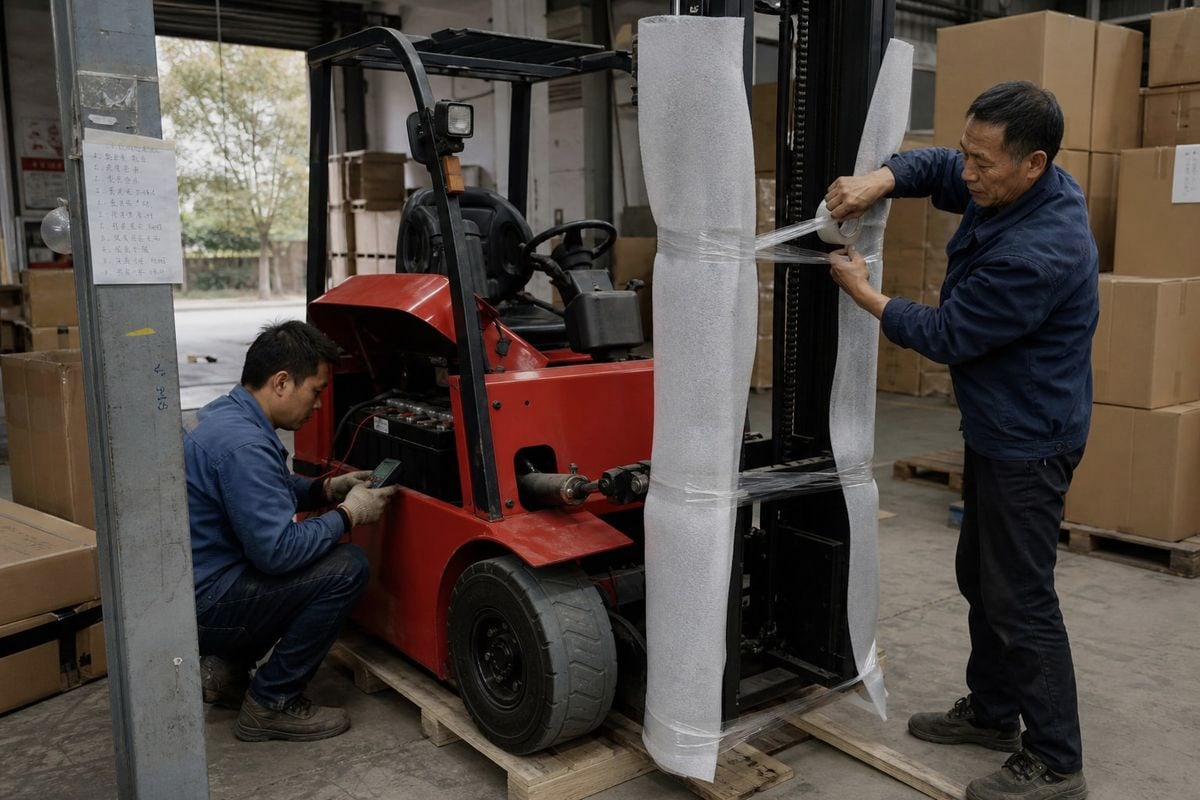
Before any forklift leaves a factory we work with, our loading team photographs it from six angles and logs the serial number. That habit exists because claims are won or lost on documentation, not on who is right.
To file a cargo insurance claim, note the damage on the delivery receipt before signing, photograph everything before moving the forklift, notify your insurer and forwarder within the policy deadline, then submit the bill of lading, commercial invoice, packing list, damage survey, and a repair estimate.
Freight damage claims fail for procedural reasons far more often than for coverage reasons. Follow a strict sequence and your odds improve dramatically. Here is the process I coach every importer through:
- Inspect at delivery, before signing. Walk around the machine. Check the mast, forks, overhead guard, battery compartment, and controls. A clean signature on the delivery receipt is the single most damaging thing you can do to a future claim.
- Write exceptions on the receipt. Note every visible issue, even small paint damage. "Subject to inspection" is better than nothing if time is short.
- Photograph before moving anything. Capture the forklift, the container interior, the lashing points, and any broken securing straps. Damage position tells the surveyor what happened.
- Report within the deadline. Visible damage should be reported immediately. Concealed damage often has a short window, sometimes only a few days after delivery, so power up and test the machine quickly. Do not wait a month to discover a fault.
- Preserve the evidence. Do not repair, discard packaging, or put the forklift into service before the insurer approves or a surveyor inspects it.
- Assemble the document pack. You will need the original bill of lading, commercial invoice, packing list, insurance certificate, photos, the exception-noted delivery receipt, and a repair quote or replacement invoice. For electric units, include the battery documentation showing the shipped state of charge.
- File and follow up. Submit through your forwarder or directly to the insurer. A well-documented claim on an all-risk policy typically settles in weeks, not months.
Why Pre-Shipment Records Decide Post-Shipment Claims
The strongest claims are built before the forklift ever moves. Serial numbers, condition reports, and loading photos prove the machine left China intact. That is why we treat documentation as part of cargo securing, not paperwork. When our team handles the pre-loading survey and the destination inspection, the insurer sees a clean, continuous evidence chain, and the payment conversation gets much shorter.
1. Provides an overview of marine insurance types, including open policies for frequent cargo shippers. ↩︎
2. Official IMO resource for international regulations on shipping dangerous goods and hazardous materials classifications. ↩︎
3. The FMCSA is the governing body for US motor carrier regulations and interstate liability standards. ↩︎
4. Wikipedia provides a comprehensive and accessible overview of material handling equipment, which is a direct match for the anchor text. ↩︎




