
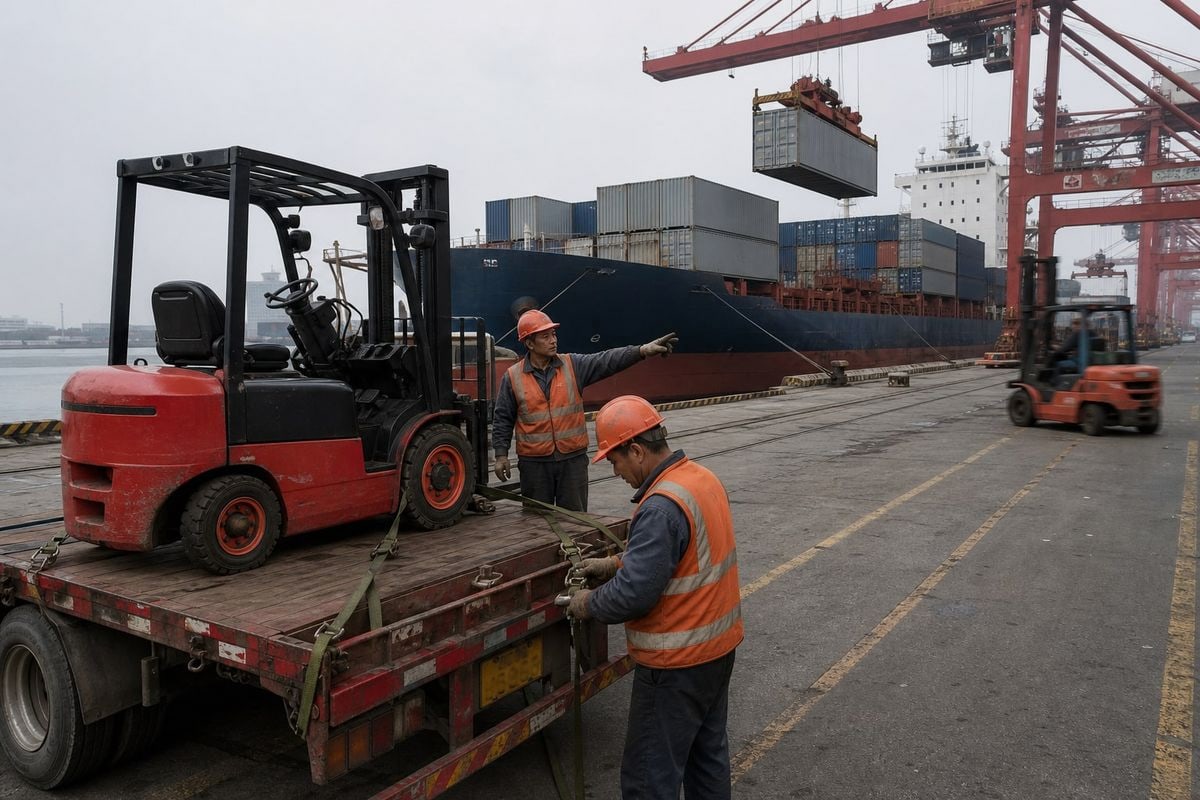
FOB forklift shipping from China confuses many buyers. Our team in Zhengzhou sees the same problem weekly: importers sign FOB contracts, then discover the quote covers far less than they assumed.
FOB forklift shipping from China splits responsibility at the Chinese port: the factory delivers the forklift to the port, clears export customs, and loads it onto the vessel. Once on board, the buyer pays ocean freight, marine insurance, import clearance, duties, and final delivery.
That short answer hides a lot of detail. Below, I walk through the full FOB process, the exact cost split, forwarder coordination, and the lithium battery risks that trip up new importers.
How does the FOB shipping process work when I buy an electric forklift from a Chinese factory?
Last month, our coordination team handled a shipment of six red 3-ton electric forklifts from a factory in Anhui. The buyer's contract said FOB Shanghai, and every step followed that responsibility split.
Under FOB terms, the Chinese factory trucks the forklift to the named port of loading, completes export customs clearance, and loads it on board the vessel. Risk transfers to the buyer at loading. The buyer then manages ocean freight, insurance, import clearance, and delivery.

FOB is not a shipping method. It is a responsibility split defined under Incoterms 2020. Once you see it that way, the whole process becomes easier to plan. The seller handles the China side up to the ship's rail. You handle everything after that. Here is how a typical FOB electric forklift shipment moves from order to arrival.
The step-by-step FOB workflow
- Confirm specifications. You verify the forklift model, dimensions, weight, battery type, and mast height with the factory. These details decide the container type and carrier acceptance.
- Get a named-port quote. A proper quote says FOB Shanghai or FOB Ningbo, never just "FOB China." The named port matters because it defines exactly where the seller's duty ends.
- Seller arranges inland transport. The factory trucks the forklift to the port of loading and pays for that leg.
- Seller clears export customs. Export declaration, port handling, and documentation before loading are the seller's cost.
- Loading on board. The forklift is loaded into a container or onto a RoRo shipping vessel for oversized units. The moment it is safely on board, risk and ownership transfer to you.
- Buyer takes over. Your nakliye acentesi 1 books the vessel, arranges marine insurance, handles import clearance, and delivers to your warehouse.
Ocean transit typically runs 15–40 days to North America, 25–45 days to Europe, and 18–30 days to Oceania. In my experience shipping forklifts to the US West Coast, the sea leg alone often lands in the 15–30 day window before port congestion and inland trucking. Remember: FOB defines who does what, not how long the total journey takes.
What costs am I responsible for under FOB terms versus my supplier's responsibility?
A US forklift dealer once emailed me in frustration. His "great" FOB price ballooned by thousands of dollars at the destination port. Nobody had explained the cost split to him before he signed.
Under FOB, the supplier pays factory-to-port trucking, export customs clearance, port handling, and loading. The buyer pays ocean freight, marine insurance, destination terminal handling charges, import duties and taxes, customs brokerage, and inland delivery to the final warehouse.

The cleanest way to understand FOB is to ask one question: who pays for what? The table below shows the standard split we use when quoting forklift shipments for our US and European clients.
FOB cost responsibility table
| Maliyet Kalemi | Supplier (Seller) | Buyer (You) |
|---|---|---|
| Forklift ex-factory price | ✔ | |
| Inland trucking to Chinese port | ✔ | |
| İhracat gümrük işlemleri | ✔ | |
| Origin port handling and loading | ✔ | |
| Deniz taşımacılığı | ✔ | |
| Deniz sigortası | ✔ | |
| Destination terminal handling charges | ✔ | |
| Import customs clearance and brokerage | ✔ | |
| İthalat vergileri ve harçlar | ✔ | |
| Inland delivery to your warehouse | ✔ |
What the numbers look like in practice
Real figures help. A 3-ton electric forklift shipped to Europe typically carries an FOB price of $8,000–$15,000, with ocean freight adding roughly $1,500–$4,000 for a 40HQ container. For US West Coast routes, recent spot rates for a 40ft container have run around $2,100–$2,805, though rates move constantly.
Forklifts are classified under HS Kodu 8427 2, and your duty rate depends on your destination country. US buyers should also check for Bölüm 301 tarifeleri 3 and any anti-dumping duties before ordering, because these can materially change the landed cost. Your Ticari fatura 4 and Certificate of Origin determine which rates apply.
The lesson I repeat to every new client: your FOB quote is not your landed cost. Add every buyer-side line above before you calculate your resale margin.
How do I coordinate factory pickup and container loading with my China freight forwarder under FOB?
Coordination is where our Zhengzhou team spends most of its working hours. We talk directly with forklift factories about cargo readiness, packing, dimensions, battery specs, and loading dates, so overseas buyers do not chase suppliers across time zones.
Under FOB, your freight forwarder books the vessel and container, then coordinates with the factory on cargo readiness, loading dates, and securing. The factory delivers and loads at the port, but your forwarder controls the booking, schedule, documentation, and everything after departure.

Here is the practical reality most FOB guides skip. Even though the supplier handles the China-side legwork, your freight forwarder is the one who books the sailing and issues the shipping instructions. Bad coordination between these two parties causes missed cut-offs, rolled bookings, and demurrage.
Choosing the right container plan
Most forklifts ship by sea in a 40ft container. Compact electric models may fit multiple units per container, while heavy diesel machines may only allow one or two. Tall masts sometimes require partial disassembly to clear the container door, and everything must be blocked, braced, and lashed to prevent movement at sea. Large or oversized units skip containers entirely and travel on RoRo vessels, where they are driven on and off.
| Forklift Type | Typical Method | Notlar |
|---|---|---|
| Compact electric (1–2 ton) | 40HQ container, multiple units | Best cost per unit; check combined weight |
| Standard electric (3 ton) | 40ft / 40HQ container | Mast may need lowering or disassembly |
| Heavy diesel (5+ ton) | 40ft container or RoRo | Weight limits may force one unit per box |
| Oversized / high-mast units | RoRo gönderimi | Driven on board; no container constraints |
The coordination checklist we run for clients
Before any FOB loading, we confirm with the factory: exact dimensions and weight, battery type and documents, packing method, pickup or delivery schedule to the port, and shipping documents. Then we align the vessel booking, container positioning, and loading supervision. One practical tip from our bookings: negotiate 7–14 days of free time at the destination port during the booking phase. Heavy machinery draws frequent customs intensive exams, and free time protects you from heavy demurrage charges while an exam runs.
Finally, verify your documents before departure. You should receive a Bill of Lading, commercial invoice, packing list, and Certificate of Origin. We check these for consistency before the vessel sails, because a mismatch between the invoice and the Bill of Lading is one of the most common causes of customs clearance delays.
What risks should I watch for when shipping lithium battery forklifts under FOB terms?
A hard lesson from our early lithium battery cargo handling work: a client's forklift reached the port without UN38.3 test reports, and the carrier refused the booking. The container sat for two weeks while paperwork was chased.
Lithium battery forklifts face IMDG dangerous goods rules. Key risks include missing UN38.3 certification and SDS documents, carrier rejection, dangerous goods surcharges excluded from FOB quotes, improper securing that damages battery packs, and customs delays at the destination port.

Here is the uncomfortable truth about FOB and batteries. Risk transfers to you at loading, but battery compliance problems usually surface before or after that exact moment — and they still become your problem. The supplier may prepare export paperwork, yet the carrier acceptance, DG declaration, and destination clearance sit on your side of the split. This is why battery-powered equipment needs more pre-shipment planning than a diesel unit.
The main risk areas and how to control them
| Risk | Neden Olur | Bunu Nasıl Önleyebilirsiniz? |
|---|---|---|
| Carrier rejects the booking | Missing UN38.3 test report or SDS/MSDS | Collect battery documents from the factory before booking |
| Surprise DG handling fees | Basic FOB quotes exclude dangerous goods charges | Ask your forwarder to quote DG acceptance fees upfront |
| Battery damage in transit | Poor lashing lets the forklift shift at sea | Supervise blocking, bracing, and weight distribution at loading |
| Destination customs delay | Incomplete or inconsistent battery paperwork | Pre-check documents against destination rules before sailing |
| Uninsured ocean-leg loss | Buyer forgets FOB puts transit risk on them | Buy marine insurance the day the booking is confirmed |
Why documentation timing matters most
Under the IMDG code 5, lithium battery forklifts may need dangerous goods declarations, and carriers run acceptance checks before confirming space. We always collect UN38.3 reports and SDS sheets from the factory during the quoting stage, not after cargo reaches the port. Fixing paperwork at the port means storage fees, missed vessels, and angry downstream customers.
Also think past the port. Forklifts are heavy, and your delivery site needs a loading dock, crane, or equipment to unload safely. Some buyers even add IoT smart container sensors to monitor tilt, humidity, and G-force impacts across the ocean leg — useful for high-value electric fleets. And if you sell into the EU or North America, note that emerging ESG reporting expectations increasingly ask importers to account for the carbon footprint of their chosen sea route, which makes carrier selection part of your FOB responsibility, not just a price decision.
One honest tradeoff to close on: FOB rewards buyers who can manage all this. If you would rather hand the coordination burden to one team, a seller-managed or forwarder-managed DDP arrangement may cost slightly more per unit but removes most of these failure points.
Sonuç
FOB forklift shipping from China splits duties at the port: the factory delivers and loads, and you manage freight, insurance, customs, and delivery afterward.
Plan the buyer-side costs, verify battery documents early, and work with a China-based freight forwarder who knows electric forklifts. Do that, and FOB gives you control without unpleasant surprises. If you want help coordinating your next FOB forklift shipment, our team is ready to walk you through it.
Dipnotlar
1. Definition and role of a freight forwarder in coordinating international cargo movements. ↩︎
2. Official tariff schedule for classifying forklifts to determine correct import duty rates. ↩︎
3. Authoritative CBP FAQ page providing official guidance on Section 301 trade remedies and tariffs for Chinese imports. ↩︎
4. Official US government guidance on the requirements and purpose of a commercial invoice in trade. ↩︎
5. International standards for the safe maritime transport of dangerous goods like lithium batteries. ↩︎




