
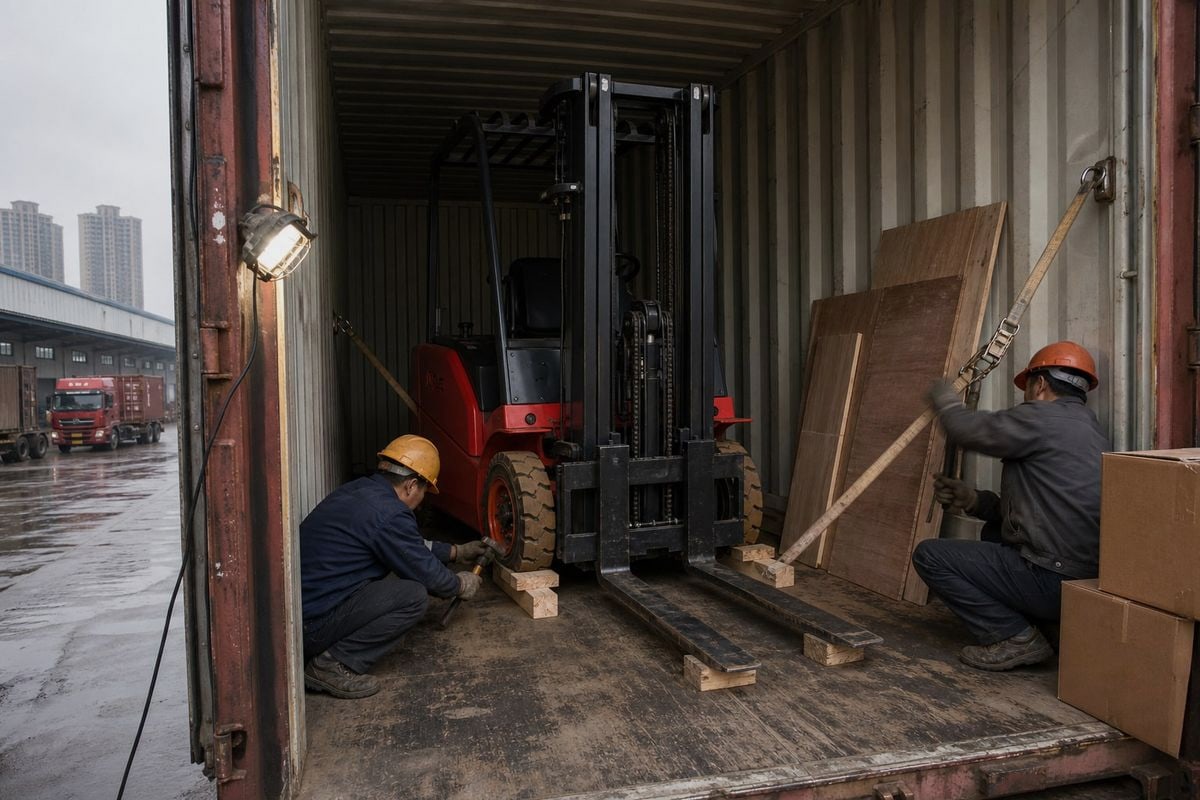
Η μάθηση πώς να ασφαλίσετε ένα γερανό μέσα σε ένα κοντέινερ με τον λάθος τρόπο κοστίζει πραγματικά χρήματα στους εισαγωγείς. Στην αποθήκη φόρτωσης μας στη Ζένγκζου, έχω δει αμελής προσαρμογές να καταστρέφουν καινούργιες μηχανές.
Για να ασφαλίσετε ένα γερανό μέσα σε ένα κοντέινερ, κατεβάστε την καδένα και τις λεπίδες, κεντράρετε τη μηχανή για ισοκατανομή του βάρους, εγκαταστήστε μπλόκα στον τροχό και ξύλινα μπλοκάκια γύρω από όλους τους τροχούς, στη συνέχεια συνδέστε τουλάχιστον τέσσερις εγκεκριμένες ιμάντες ρύθμισης ή αλυσίδες βαθμού 70 σε γωνίες 45 μοιρών στα σημεία ανέλκυσης του κοντέινερ.
Αυτή είναι η σύντομη απάντηση. Η πλήρης διαδικασία έχει περισσότερα βήματα. Θα σας καθοδηγήσω μέσα από το καθένα, χρησιμοποιώντας αυτά που κάνει η ομάδα μου σε πραγματικές αποστολές γερανών από την Κίνα κάθε εβδομάδα.
Ποια εργαλεία και υλικά χρειάζομαι για να ασφαλίσω σωστά έναν γερανό για αποστολή;
Ένας αγοραστής στο Τέξας με ρώτησε γιατί η προσφορά φόρτωσης ανέφερε το ξύλο και την κόντρα πλακέ ως επιμέρους στοιχεία. Υπέθεσε ότι οι ιμάντες ήταν αρκετοί. Αυτή η ερώτηση αξίζει μια πλήρη απάντηση.
Χρειάζεστε τουλάχιστον τέσσερις ιμάντες ρύθμισης βαρέως τύπου με οριακή χωρητικότητα 5,000 lb έκαστος ή αλυσίδα μεταφοράς Γραμμής 70, σκληρό ξύλο για αποκλεισμό και στήριξη, τροχοστάτες, φύλλα κόντρα πλακέ για προστασία δαπέδου, προστατευτικά άκρων, νυχάκια, σακούλες χαρτονιού για κάλυψη κενών και εκπομπούς VCI για έλεγχο διάβρωσης.
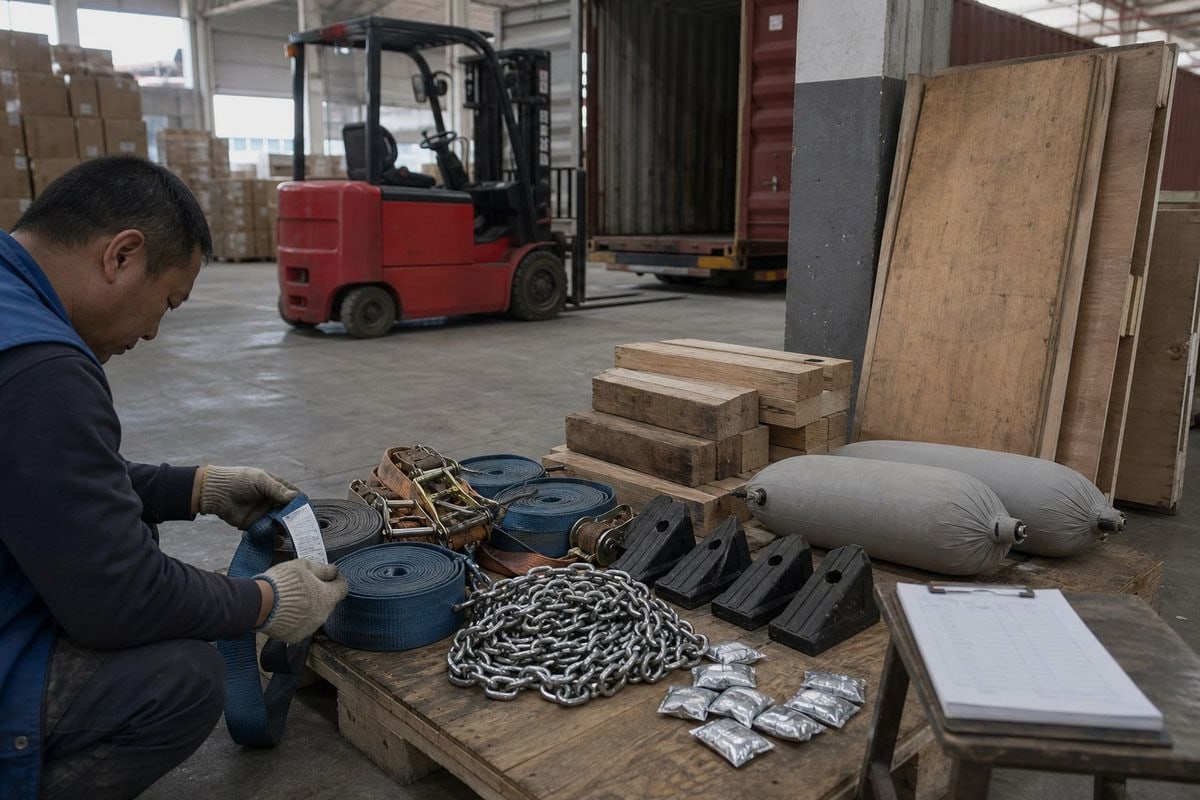
Η ομάδα μου διατηρεί ένα τυπικό κιτ ασφάλισης στην αποθήκη μας στη Κίνα. Το συναρμολογούμε πριν ακόμη φτάσει το κοντέινερ. Το να βιάζεσαι να βρεις υλικά αφού φτάσει το φορτηγό είναι πώς γίνονται τα λάθη. Ορίστε η λίστα ελέγχου που χρησιμοποιούμε πραγματικά.
Το Κύριο Κιτ Ασφάλισης
| Είδος | Ελάχιστες Προδιαγραφές | Σκοπός |
|---|---|---|
| Ζώνες ρακέτας | Ικανότητα εργασίας 5.000 lb, 4 ή περισσότερα | Θετική περιοριστική δύναμη κατά της ολίσθησης |
| Αλυσίδα μεταφοράς βαθμού 70 1 | Ταυτισμένο με το μικτό βάρος του γερανού | Στήριξη για βαρύτερες μηχανές |
| Σκληρό ξύλο | 2" x 6" λaminated μπλοκάρισμα | Αποκλεισμός και στήριξη γύρω από τους τροχούς |
| Σφήνες τροχών | Βαθμολογημένο για μέγεθος ελαστικού | Σταματά την κύλιση πριν τοποθετηθούν οι ιμάντες |
| Πλακέτες από κόντρα πλακέ ή χάλυβα | Βαρέου τύπου | Κατανέμει το βάρος του άξονα σε όλη την επιφάνεια του κοντέινερ |
| Σακούλες δουνάζης | Σωστή πίεση πλήρωσης | Γεμίζει τα κενά, σταματά την πλάγια μετακίνηση |
| Εκπομπείς VCI | Μεγέθους για τον όγκο του κοντέινερ | Αποτρέπει τη διάβρωση από θαλασσινό αέρα στα υδραυλικά |
Γιατί κόντρα πλακέ; Ένα ανυψωτικό φορτίου συγκεντρώνει το μεικτό του βάρος σε μικρές περιοχές επαφής ελαστικών. Τα δάπεδα των κοντέινερ είναι κόντρα πλακέ θαλάσσιας ποιότητας και μια βαριά μηχανή εξισορρόπησης μπορεί να τα διατρύσει. Τοποθετούμε πρώτα φύλλα ή ατσάλινα πλαίσια και μετά οδηγούμε το ανυψωτικό φορτίο πάνω σε αυτά.
Γιατί εκπομποί VCI αντί μόνο σακουλών αποξηραντών; Οι τυπικές αποξηραντικές ύλες συχνά αποτυγχάνουν σε μεγάλες θαλάσσιες μεταφορές. Ο θαλάσσιος αέρας επιτίθεται σε υδραυλικούς κυλίνδρους και σε ηλεκτρονικά ελέγχου. Τοποθετούμε εκπομπούς VCI κοντά σε αυτά τα στοιχεία σε κάθε ηλεκτρικό ανυψωτικό φορτίο που στέλνουμε στις Ηνωμένες Πολιτείες.
Ένα ακόμη σημείο. Ο Κώδικας CTU, ο διεθνής κώδικας πρακτικής για την συσκευασία μονάδες μεταφοράς φορτίου 2, είναι το αναφερόμενο πρότυπο που ακολουθούμε. Εάν προκύψει ποτέ διαφωνία με έναν ασφαλιστή, η συμμόρφωση με τον Κώδικα CTU σας προστατεύει.
Πώς μπορώ να τοποθετήσω και να στηρίξω ένα ανυψωτικό μέσα σε ένα κοντέινερ για να αποτρέψω την μετατόπιση;
Κάθε σχέδιο φόρτωσης που εκπονούμε ξεκινά με την ίδια συμβιβαστική απόφαση: η προώθηση του γερανού πιο βαθιά εξοικονομεί χώρο για ανταλλακτικά, αλλά η μηχανή πρέπει να παραμένει στο σημείο ισορροπίας του κοντέινερ.
Οδηγήστε το γερανό αργά στο ακριβές εγκάρσιο κέντρο του κοντέινερ, χαμηλώστε τον ιστό και τα δαγκάνες πάνω σε δαπεδόστρωμα, στη συνέχεια κατασκευάστε μια ξύλινη βάση καρτελών νailing 2" x 6" σε όλα τα τροχούς για να σταματήσετε την κίνηση μπροστά-πίσω και πλευρά-πλευρά πριν εφαρμοστούν οποιοιδήποτε ιμάντες.
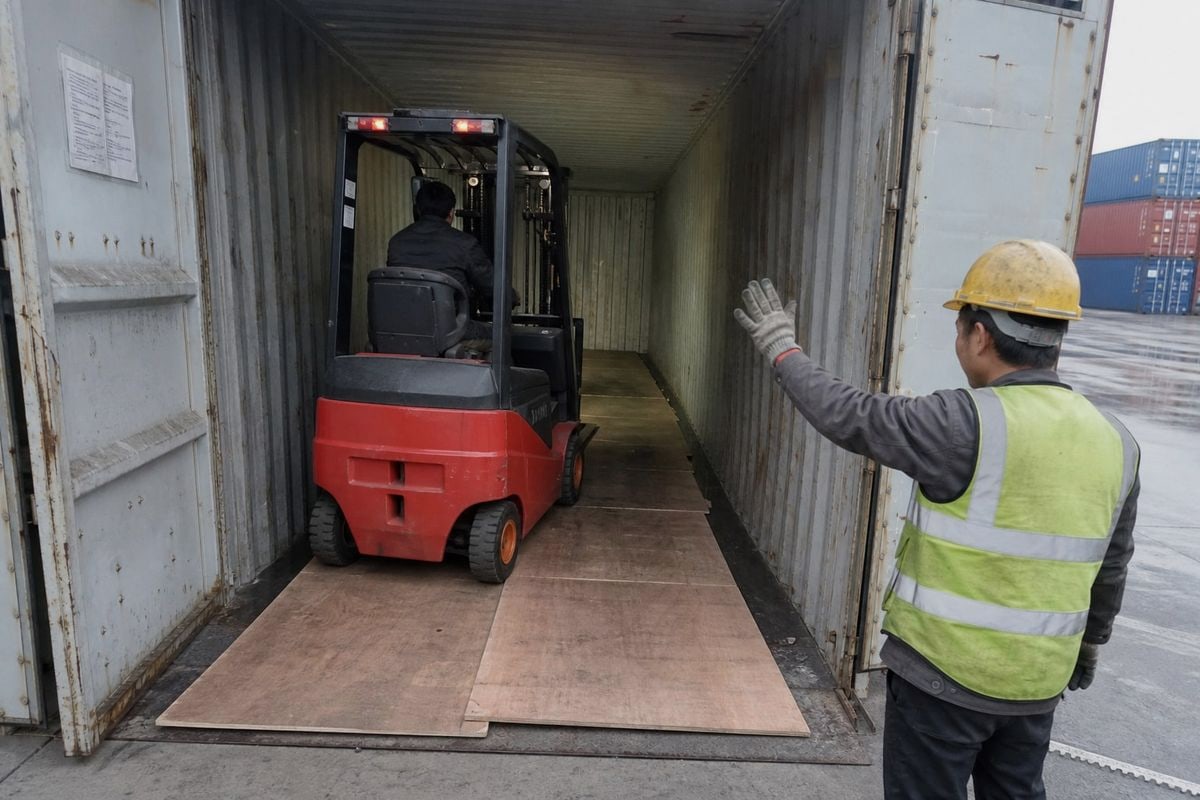
Η τοποθέτηση έρχεται πριν από την κράτηση. Εάν κάνετε λάθος στην τοποθέτηση, δεν υπάρχει καμία ποσότητα σκλήρυνσης που να το διορθώσει. Εδώ είναι η σειρά που ακολουθούν οι ομάδες φόρτωσής μου στην προέλευση.
Διαδικασία Τοποθέτησης Βήμα-Βήμα
- Επιβεβαιώστε ότι το κοντέινερ βρίσκεται σε σταθερό και επίπεδο έδαφος. Ποτέ μην φορτώνετε σε κλίση ή μαλακή επιφάνεια.
- Τοποθετήστε προστατευτική κόντρα πλακέ δαπέδου κατά μήκος της διαδρομής οδήγησης.
- Οδηγήστε ευθεία και αργά. Κρατήστε τους ανθρώπους έξω από το κοντέινερ ενώ η μηχανή κινείται. Η ανάμειξη εργατών και κινητού εξοπλισμού μέσα σε ένα κοντέινερ είναι γνωστή αιτία ατυχημάτων.
- Σταματήστε στο κατά μήκος κέντρο. Ένα κεντρικά τοποθετημένο φορτίο διατηρεί την ισορροπία του κέντρου βάρους, πράγμα που είναι σημαντικό για τη διαχείριση του γερανού στο λιμάνι και για τη σταθερότητα του πλοίου.
- Κατεβάστε τον mast και τις σιαγόνες πλήρως στο πάτωμα. Ξαπλώστε τα σε ένα wooden pallet or dunnage. This protects the floor and drops the vertical center of gravity.
- Set wheel chocks against every wheel immediately.
Building the Timber Cradle
Blocking and bracing turns the container floor into part of the restraint system. We nail kiln-dried lumber directly into the floor to create a physical cradle around each wheel. Rail guidance on floor blocking calls for 2" x 6" laminated blocking with staggered nails and enough nail penetration, using multiple nails per block matched to the load weight. We follow the same principle for ocean containers.
Timber shoring can also run from the wheels or frame to the container's corner posts for very heavy machines. Any remaining voids get filled with dunnage bags inflated to the correct pressure. The goal is simple: even before straps go on, the forklift physically cannot slide in any direction.
Ποιες είναι οι καλύτερες πρακτικές για την ασφαλή μεταφορά των μπαταριών και των εξαρτημάτων του ανυψωτικού;
Lithium battery forklifts make up most of what we ship now, and battery handling is where I see the most confusion from first-time importers.
Isolate or disconnect the forklift battery before loading, verify lithium battery documentation meets carrier and IMO requirements, remove or separately strap loose attachments, insert a mast block to support the lifting assembly, and cross-lash the rear counterweight to resist pendulum forces during vessel rolling.
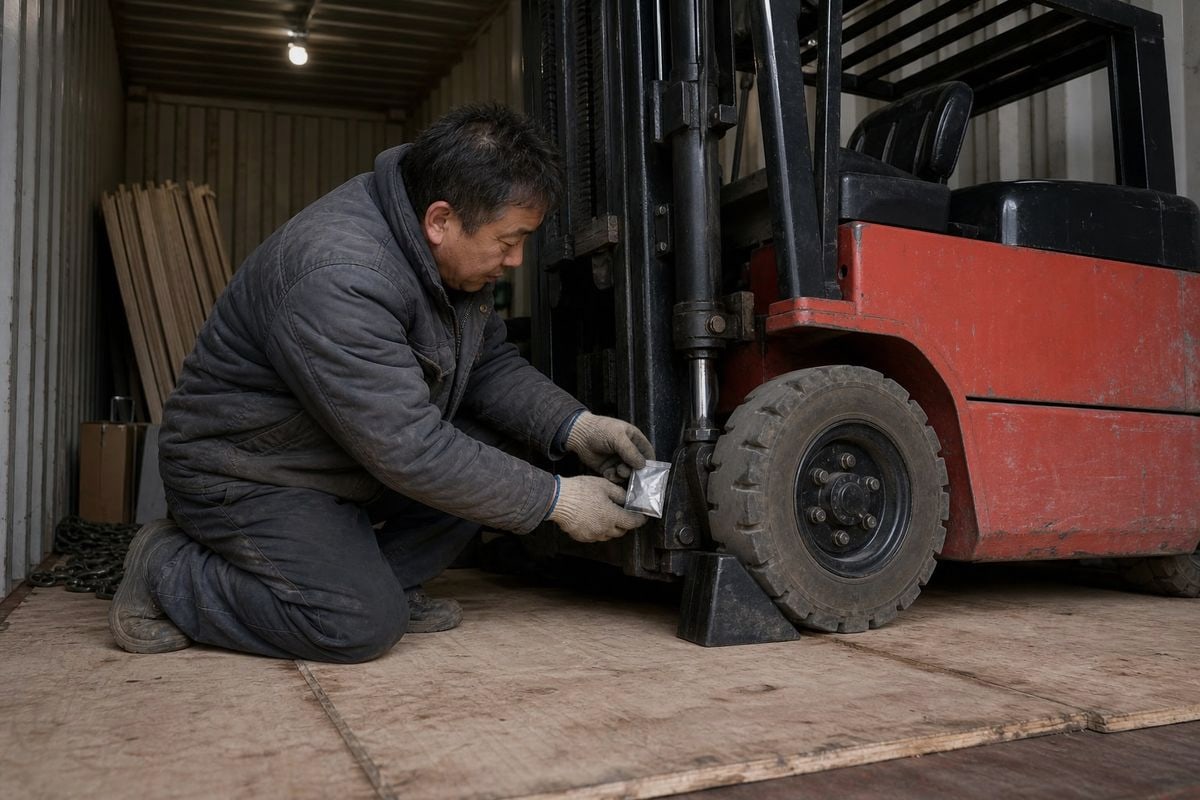
Shipping an electric forklift is not the same as shipping ordinary cargo. Batteries, hydraulics, and heavy attachments each need their own attention. I break it down into three areas.
Battery Preparation
For electric forklifts, disconnect or isolate the battery before the machine enters the container. This prevents electrical fires and accidental activation. For any internal-combustion units in a mixed shipment, drain fuel to 25% of tank capacity to comply with International Maritime Organization 3 hazardous materials rules. Lithium battery forklifts also need correct cargo classification and documents before the cargo reaches the port. We check battery specifications with the factory early, because carrier rejection at the terminal is expensive and slow to fix.
Mast, Hydraulics, and Attachments
| Component | Risk During Ocean Transit | Best Practice |
|---|---|---|
| Mast assembly | Hydraulic seal fatigue from vertical pounding of swells | Insert a mechanical mast block or secondary locking pin |
| Forks | Sliding, floor gouging | Lower fully, rest on pallet or dunnage, strap if removable |
| Rear counterweight | Pendulum effect can snap parallel lashings | Apply cross-lashing across the counterweight |
| Side shifters, clamps | Loosening from vibration | Remove where possible; crate and strap separately |
| Chargers and spares | Impact damage | Palletize, shrink-wrap, and lash to separate lashing points 4 |
The counterweight point deserves emphasis. Its high-density mass sits behind the rear axle. During extreme vessel rolling, it acts like a pendulum. Standard parallel lashings can snap. Cross-lashing spreads that force across opposing anchor points.
Monitoring Options
For high-value fleet shipments, some of our clients add IoT impact and tilt sensors to the forklift frame. These give real-time alerts and a digital record of any excessive G-forces during the voyage, which helps enormously with insurance claims.
Πώς μπορώ να διασφαλίσω ότι το ανυψωτικό μου θα φτάσει χωρίς ζημιές μετά την φόρτωση και την ασφάλιση στο κοντέινερ;
A hard lesson shaped our final-inspection routine. Years ago, a client's machine arrived with tension marks because a strap was routed over a hydraulic hose. Now nothing ships without a photographed sign-off.
Attach every strap only to designated structural points and rated container lashing points, re-tension all restraints after settling, confirm the machine touches no walls or ceiling, then photograph the finished securement from multiple angles and keep the images with your shipping documents.

The last hour before the container doors close decides whether the first seven steps actually worked. This is our verification routine, and it is the part I refuse to shortcut.
Anchor Points Matter More Than Strap Count
Straps must connect to structural points on the forklift, never to fragile parts. Hoses, the steering column, plastic covers, and the overhead guard uprights are not anchor points. On the container side, use only the rated D-rings and lashing points built into the floor rails and corner posts. A 5,000 lb strap attached to a weak point protects nothing.
The Pre-Sealing Inspection Checklist
| Check | What We Verify |
|---|---|
| Strap tension | Each ratchet strap is tight, at roughly 45 degrees, with no twists |
| Chock and blocking contact | Wheel chocks and nailed timber sit firm against every tire |
| Clearance | No part of the mast, guard, or counterweight touches walls or ceiling |
| Edge protection | Padding sits between straps and painted surfaces |
| Battery status | Isolated, with documentation matching the cargo declaration |
| Weight distribution | Load sits centered along length and across both sides |
| Photos | Wide shots plus close-ups of every lashing point and blocking cluster |
One nuance importers should understand: straps versus chains is not a universal choice. For lighter warehouse machines on shorter routes, four or more ratchet straps over solid blocking work well. For heavier counterbalance forklifts or long trans-Pacific voyages, we upgrade to Grade 70 transport chain and heavier timber shoring. The right system depends on the forklift's gross weight, the container type, and the voyage length. Also consider when not to drive the machine in at all: if the container is not on firm level ground, or clearance is too tight, use a rated ramp setup at a proper dock or switch to a flat rack.
Finally, document everything. Photos taken at loading are your evidence if damage appears at destination. We send them to every client before the vessel departs.
Συμπέρασμα
Securing a forklift inside a shipping container is a system, not a single tool. Combine fit checks, preparation, blocking and bracing, and rated restraints, then verify and photograph everything.
Υποσημειώσεις
1. US government agency providing standards for transport chain and cargo securement. ↩︎
2. Official international code of practice for packing cargo transport units safely. ↩︎
3. The UN agency responsible for the safety and security of international shipping. ↩︎
4. International organization that sets standards for shipping container structural components. ↩︎




