
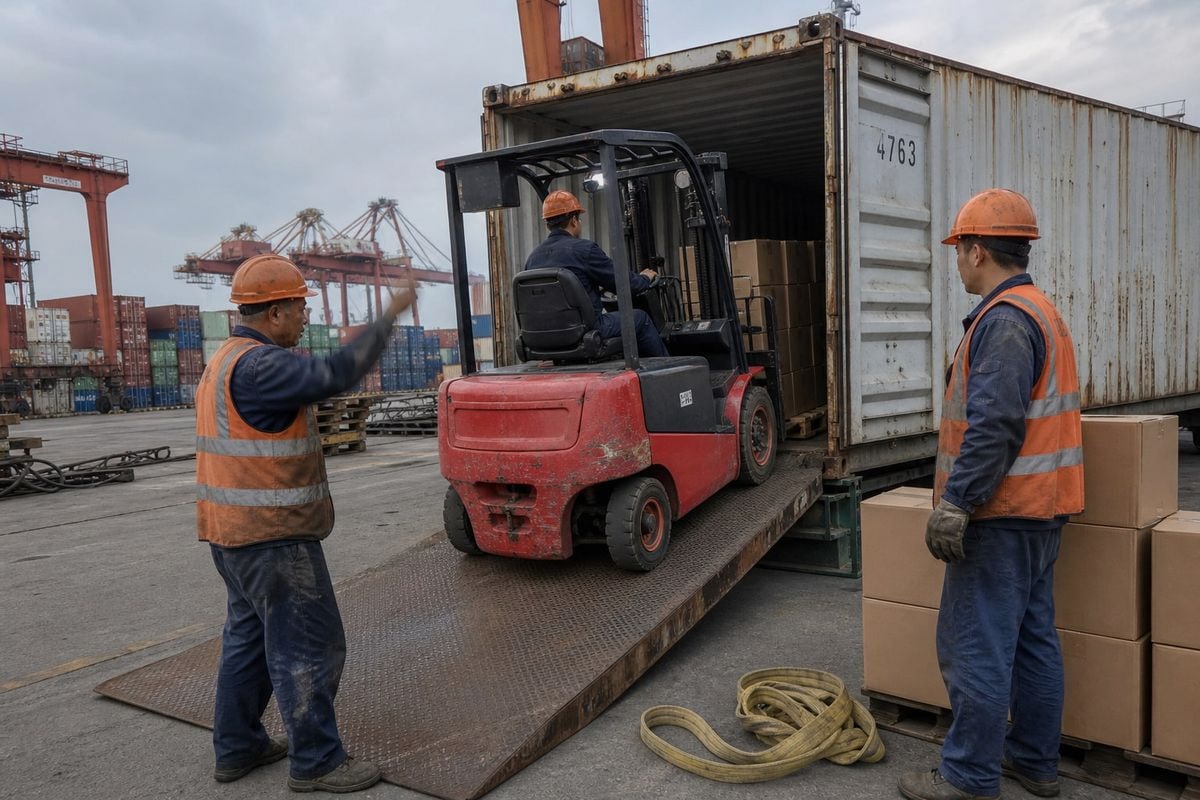
Shipping electric forklifts from China to Houston sounds simple until the battery paperwork stalls your container at the port. Our team in Zhengzhou has watched buyers lose weeks over one missing document. The fix is planning the freight, compliance, and delivery as one process.
To ship electric forklifts from China to Houston, book FCL ocean freight to the Port of Houston, prepare UN38.3 and MSDS battery documents, classify under HS Code 8427.10, file ISF 24 hours before departure, clear U.S. customs, and arrange drayage to your final Houston address.
That is the short version. Below, I break down the real costs, the documents, the lithium battery rules, and the FCL vs LCL decision so you can plan with confidence.
How much does it cost to ship an electric forklift from China to Houston?
A dealer in Texas once told me his forklift quote looked great until the destination charges arrived. When our team builds quotes, we always model the full landed cost first.
Ocean freight for a 40' container from China to Houston typically runs $3,100–$4,400. Add inland trucking in China, export clearance, a 25% Section 301 tariff plus standard duty, Harbor Maintenance Fees, customs brokerage, port handling, and Houston drayage to calculate your true landed cost.

Freight is only one line on the invoice. When I quote a shipment, I break the cost into every stage from the factory floor in China to your warehouse door in Houston. Buyers who only compare ocean freight rates often get surprised later. Buyers who compare landed costs make better decisions.
The Full Landed-Cost Model
Here is the cost structure I walk every new client through:
| Ítem de costo | Who Usually Pays (FOB Terms) | Notas |
|---|---|---|
| Supplier FOB price | Comprador | Negotiated with the factory |
| Inland trucking to export port | Seller (included in FOB) | We verify this is truly covered |
| Aduanas y documentación de exportación | Seller (included in FOB) | DG declaration may add cost |
| Ocean freight (40' FCL) | Comprador | Roughly $3,100–$4,400 currently |
| Seguro de carga marítima | Comprador | Small cost, large protection |
| U.S. customs brokerage | Comprador | Includes ISF filing |
| Duties and tariffs | Comprador | Standard HTSUS rate + 25% Section 301 |
| Harbor Maintenance Fee | Comprador | Charged on ocean imports |
| Port terminal handling | Comprador | Bayport or Barbours Cut terminals |
| Houston drayage and final mile | Comprador | Overweight permits may apply |
Duties Deserve Special Attention
Chinese-origin machinery carries a 25% Tarifa de la sección 301 1 on top of the standard duty rate under the HTS code for forklifts. That single line item can exceed your entire ocean freight bill. I always tell clients to budget for it before signing the purchase contract, not after.
One more Houston-specific option is worth knowing. If your forklifts are destined for storage, display, or re-export to Mexico or South America, Houston's Foreign Trade Zone #84 2 can defer Section 301 duties indefinitely. For pure resale into the U.S. market, you pay duty at entry, but for regional distributors, the FTZ route can free up serious cash flow.
Also watch heavy units on the drayage leg. High-capacity electric forklifts can exceed standard Texas axle weight limits on a standard chassis, which means Overweight Corridor permits and extra trucking cost from the terminal.
What documents do I need to clear customs for my electric forklift in Houston?
Last year, we caught a mismatched HS code on a client's commercial invoice two days before sailing. Fixing it dockside in Houston would have cost him storage fees and a week of delays.
You need a commercial invoice, packing list, Bill of Lading, Certificate of Origin, correct HS code classification (8427.10), UN38.3 battery test report, MSDS/SDS, a dangerous goods declaration where applicable, ISF filing details, and complete importer and consignee information for U.S. customs entry.

The customs clearance process rewards preparation and punishes gaps. In my experience coordinating shipments to the Port of Houston, almost every clearance delay traces back to a document that was missing, inconsistent, or filed late. So let me walk you through the paperwork in the order it matters.
The ISF Deadline Comes First
Before your container even leaves China, your U.S. customs broker must file the Importer Security Filing. The ISF filing requirements 3 are strict: it must be submitted at least 24 hours before the vessel departs China. Miss it, and you face a penalty of up to $5,000. We coordinate with Houston-based brokers early so the ISF is filed as soon as booking details are confirmed, never at the last minute.
El Conjunto de Documentos Básicos
| Documento | Propósito | Error común |
|---|---|---|
| Factura comercial | Declara el valor para el cálculo de derechos | Value or description mismatched with packing list |
| Lista de embalaje | Details weights, dimensions, quantities | Missing battery weight breakdown |
| Conocimiento de embarque | Contract of carriage and title | Consignee details entered incorrectly |
| Certificado de origen | Confirms Chinese origin for tariff purposes | Not requested from the supplier in time |
| HS code classification | Determines duty rate under 8427.10 | Classified as generic machinery instead |
| Informe de prueba UN38.3 | Proves lithium battery transport safety | Supplier cannot produce a valid report |
| MSDS documentation | Chemical safety data for the battery | Outdated or incomplete SDS versions |
| DG declaration | Required for Class 9 dangerous goods | Skipped because the "forklift is a machine" |
Consistency Is the Real Test
Customs officers cross-check documents against each other. If your invoice says two forklifts and your packing list says two forklifts plus two spare batteries, expect questions. Before every departure, our team checks that the model numbers, weights, values, and battery details match across every document. This one habit prevents most clearance delays at Port of Houston arrival.
How should I handle lithium battery shipping requirements for my forklift order?
Here is the trade-off I weigh on every battery-powered shipment: booking a DG-accepting carrier costs a bit more upfront, but a rejected container at the port costs far more in time and demurrage.
Treat the lithium battery as the regulated cargo. Classify the shipment as Class 9 dangerous goods under UN3171, obtain UN38.3 certification and MSDS from the factory, keep battery state of charge at or below 30%, and book with a carrier that accepts DG cargo under IMDG rules.

Lithium battery shipping regulations are the single biggest risk point in this whole process. An electric forklift is two things at once: a machine and a battery. Customs and carriers care mostly about the battery. Our team learned early that the compliance work must start before the purchase order is even finalized, because not every Chinese factory can supply the required test reports.
Understand the Classification
An electric forklift shipped with a lithium battery installed is classified as Class 9 dangerous goods under UN3171, which covers battery-powered vehicles and equipment. This triggers the IMDG-related handling rules 4 for ocean transport. The forklift itself under HS 8427.10 is ordinary machinery. The lithium cells inside are what change the game.
The Battery Compliance Checklist
- Verify UN38.3 certification exists. Ask the factory for the test report before you pay a deposit. If the battery cells were never tested, no forwarder can legally ship them by sea.
- Collect current MSDS documentation. The safety data sheet must match the actual battery chemistry and be up to date.
- Confirm the state of charge. Batteries should be at or below 30% SoC during transit. This complies with international safety standards and reduces thermal runaway risk in the cargo hold. We document the SoC before the container is sealed.
- File the DG declaration. The carrier needs an accurate dangerous goods declaration to accept the booking.
- Book DG-capable space early. Not every vessel or carrier accepts Class 9 cargo on every route, so lead time matters.
Extra Protection Worth Considering
Some clients now deploy IoT impact and temperature sensors inside the container. The Gulf of Mexico leg is humid, and salt-air moisture ingress can affect electronics. Sensors give you a record of what the cargo experienced. A few buyers also schedule a post-voyage battery check with a Houston-based EV specialist to confirm that weeks of sea vibration have not loosened cell connections or thrown off BMS calibration. For fleet purchases, that small inspection cost buys real peace of mind.
Should I choose FCL or LCL shipping for my electric forklifts to Houston?
A distributor once asked me to quote LCL for a single 3-ton forklift to save money. I ran both numbers for him, and the FCL option won on cost and safety.
Choose FCL for electric forklifts to Houston. A 40HQ container fits one to four units depending on size, allows professional blocking and bracing of the heavy counterweight, and avoids the extra handling and damage risk of LCL. Use Flat Rack or RoRo only for oversized units.

En el envío FCL vs LCL question comes up in almost every first call I have with a new forklift importer. Here is how the main options compare for the China-to-Houston lane:
| Método | Lo mejor para | Capacidad | Nivel de Riesgo | Relative Cost |
|---|---|---|---|---|
| FCL 40HQ | Standard electric forklifts | 1–4 units depending on model | Bajo | Best value per unit |
| FCL 20FT | One smaller 3-ton unit | 1 unit | Bajo | Good for single machines |
| LCL | Small parts and accessories only | Shared space | High for machinery | Often false economy |
| Flat Rack | Oversized or over-height units | 1 unit typically | Medio | Higher |
| RoRo shipping services | Very large driveable equipment | Per unit | Medio | Route dependent |
Why FCL Wins for Most Buyers
Forklift counterweights concentrate enormous weight in a small footprint. In an FCL container, we control the loading: the forklift is driven in, positioned for weight distribution, and secured with straps, chocks, and wooden blocks. Forks are often removed to save space and reduce damage risk. That blocking and bracing protects the sensitive electric drive systems from shifting during the voyage. In LCL, your machine shares space with strangers' cargo and passes through extra handling points. Each touch is a damage opportunity.
Filling the Container Pays
Here is where good planning cuts your cost per unit. If your forklifts fill only part of a 40HQ, we consolidate chargers, spare batteries, attachments, and spare parts from multiple suppliers into the remaining space. One of our clients sources forklifts, batteries, and chargers from three different factories, and consolidating them into one container consistently lowers his average logistics cost per machine.
Plan the Timeline Honestly
The all-water route from Shanghai or Ningbo to Houston via the Canal de Panamá 5 avoids West Coast rail congestion, but plan for a 35–50 day window. Some lanes run faster at 28–38 days port-to-port, and others quote 31–45 days for FCL. Treat these as planning ranges, not promises. Vessel frequency, transshipment, and customs all move the date. As a freight forwarder China to USA shippers rely on, I always build buffer into delivery commitments so your downstream customers are never left waiting.
One final objection I hear: "Isn't DDP easier?" It can be, especially for first-time importers who lack a broker. But DDP can obscure the true landed cost, since import duties and taxes get bundled into one opaque number. Experienced importers usually choose FOB, control the forwarder and broker themselves, and see every cost line. We support both, and I tell clients honestly which fits their situation.
Conclusión
Shipping electric forklifts from China to Houston succeeds when freight, battery compliance, and customs work as one plan. Get the documents right early, choose FCL, and your machines arrive predictably.
Notas al pie
1. Official USTR resource for Section 301 trade enforcement actions and tariff information. ↩︎
2. Official Port of Houston guide to Foreign Trade Zone benefits for importers and distributors. ↩︎
3. Official U.S. Customs and Border Protection guidance on mandatory Importer Security Filing rules. ↩︎
4. International Maritime Organization standards for the safe maritime transport of dangerous goods. ↩︎
5. Overview of the Panama Canal's role in international shipping and maritime logistics. ↩︎




