
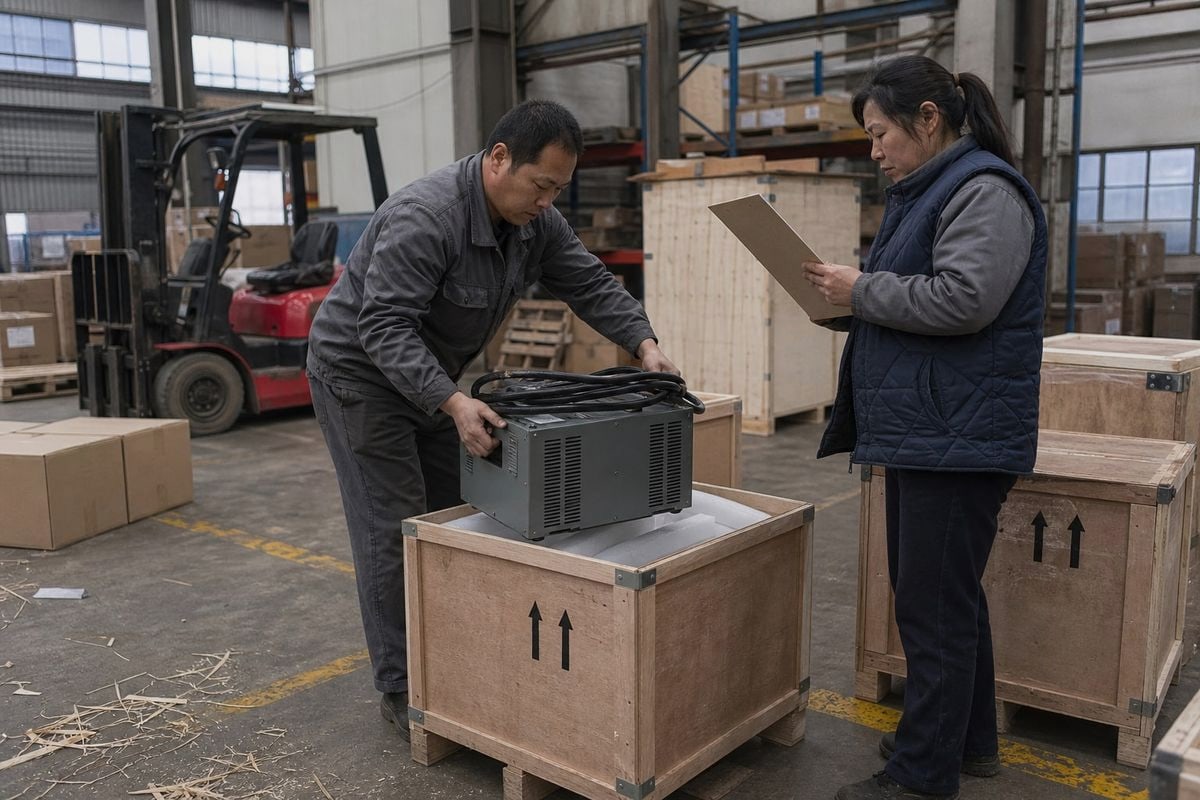
Shipping forklift battery chargers from China looks simple until a shipment gets held at customs. At our Zhengzhou consolidation warehouse, we see that mistake weekly — and it is avoidable.
To ship forklift battery chargers from China, classify them under HS code 8504.40, prepare a commercial invoice, packing list, and bill of lading, verify UL or CE marks, pack in reinforced crates, and choose sea freight for volume orders or air freight for urgent, compact units.
The charger itself is usually standard electrical cargo. But voltage specs, certifications, and any lithium batteries in the same shipment change the rules fast. Let me walk you through the full process, cost to clearance.
How much does it cost to ship forklift battery chargers from China to the USA?
A distributor in Texas once asked me why his charger freight quote doubled after booking. The answer was simple: his first quote ignored destination charges. We rebuilt his landed cost line by line.
Shipping forklift battery chargers from China to the USA typically costs $80–$200 per unit by LCL sea freight, $150–$400 by air freight, and $1,500–$3,500 for a shared or dedicated FCL container, before import duties, taxes, and destination handling charges.

The freight rate is only one slice of the total. When we quote customers, we always break the number into segments, because low headline sea freight costs can still produce a painful landed cost if you ignore what happens after the vessel arrives.
What actually makes up your landed cost
Here is the structure we use for every charger quotation at our office:
| Componente de costo | Rango Típico (USD) | Who Usually Pays (FOB) |
|---|---|---|
| China factory pickup and trucking | $50–$200 per shipment | Vendedor |
| Export declaration in China | $30–$80 | Vendedor |
| Ocean freight (LCL, per CBM) | $40–$120 per CBM | Comprador |
| Air freight (per kg) | $4–$8 per kg | Comprador |
| US import duties and taxes | Varies by código HS 1 and tariff schedule | Comprador |
| Destination handling and delivery | $150–$500 | Comprador |
A standard industrial forklift charger weighs 30 to 150 kg depending on output capacity. Heavier three-phase units almost always favor sea freight. One trend worth watching: newer GaN-based chargers can cut unit weight by up to 40 percent, which sometimes makes air express viable where it never was before.
Why the HS code matters for cost
The HS code for battery chargers is 8504.40, covering static converters. Mis-declaring under a different code invites penalties and reassessed duty during customs entry. We confirm this code on the commercial invoice before any cargo leaves China, because correcting it at a US port is far more expensive than getting it right upfront. Some importers also explore shipping chargers as semi-knocked-down kits — separating power modules from chassis — to access lower component duty rates, but this needs proper classification advice first.
What documentation do I need to ship forklift chargers with lithium batteries from China?
The hardest lesson we learned early on: a charger alone is easy paperwork, but one lithium battery in the same crate rewrites the entire document file. Carriers will refuse booking without it.
You need a commercial invoice, packing list, bill of lading or air waybill, and proof of UL or CE certification. If lithium batteries ship with the chargers, add a UN38.3 test summary, MSDS/SDS sheet, dangerous goods declaration, and UN3481 Class 9 labeling.

Most forklift chargers themselves are not dangerous goods. That surprises many first-time importers. The charger is standard electrical cargo. The complication starts the moment batteries, spare lithium cells, or battery modules enter the same shipment. Then the whole consignment shifts into dangerous goods territory, and your customs clearance documentation must expand accordingly.
The two document tracks
| Documento | Charger Only | Charger + Lithium Battery |
|---|---|---|
| Factura comercial | Requerido | Requerido |
| Lista de embalaje | Requerido | Requerido |
| Bill of lading / air waybill | Requerido | Requerido |
| UL / CE certification proof | Strongly recommended | Strongly recommended |
| Resumen de la prueba UN38.3 | No necesario | Requerido |
| MSDS / SDS sheet | No necesario | Requerido |
| declaración de mercancías peligrosas | No necesario | Requerido |
| Class 9 hazard labels (UN3481) | No necesario | Required on packaging |
When chargers ship in the same crate as batteries, the entire shipment falls under UN3481 regulations. That means UN38.3 test summaries 2, Class 9 hazard labeling, and carrier pre-approval. MSDS requirements trip up many buyers because the document must come from the battery manufacturer, not the charger factory, and it must match the exact cell model shipped.
Certifications customs actually checks
US customs officials frequently seize non-compliant industrial electrical equipment. So we verify two things before booking. First, valid and verifiable UL marks 3 for North America, or CE for Europe, matching the units in the crate. Second, if the chargers include smart fleet IoT modules with wireless connectivity, we confirm separate FCC certification for the US or RED certification for the EU. A missing wireless certification can detain an otherwise perfect shipment for telecommunications violations. We collect these documents from the factory during pickup coordination, then cross-check them against the invoice before export declaration in China.
Can I consolidate forklift chargers with my electric forklift shipment from China?
Last quarter, we handled a US dealer buying forklifts from one factory in Hangzhou and chargers from another in Guangdong. Consolidating both into one 40HQ cut his per-unit logistics cost sharply.
Yes, forklift chargers can be consolidated with electric forklift shipments from China. A freight forwarder collects cargo from multiple suppliers, consolidates it at one warehouse, and loads chargers into unused container space around the forklifts, reducing per-unit freight cost significantly.

Consolidation is one of the smartest moves for charger buyers, because chargers rarely justify their own container. A 40HQ loaded with electric forklifts almost always has dead space above and between the machines. Chargers, spare parts, and attachments fill that space almost for free. This is basic container shipping logistics, but many importers never think to ask for it.
How multi-supplier consolidation works in practice
Here is the process we run for consolidated shipments:
- Confirm cargo readiness with each factory. We contact the forklift plant and the charger supplier directly, in Chinese, and align production and packing dates.
- Arrange pickup from each supplier. Domestic trucks collect cargo from different provinces and deliver it to one consolidation warehouse.
- Inspect and re-pack if needed. We check packing quality, take photos, and reinforce charger cartons before loading.
- Plan the container load. Heavy forklifts go on the floor with proper weight distribution. Chargers get palletized and braced in remaining space, never stacked loose against machinery.
- File one export declaration. One combined document set covers the whole container, which simplifies customs on both ends.
- Ship, clear, and deliver as one shipment. One bill of lading, one clearance, one delivery appointment.
One critical caution
If the forklifts are lithium battery models, the consolidated container inherits the battery documentation requirements. The chargers themselves stay simple, but the container booking needs carrier acceptance for the battery-powered equipment before freight is confirmed. As a freight forwarder China buyers rely on for exactly this cargo mix, we always secure that acceptance first, then finalize the loading plan. Booking freight before carrier approval is how containers end up stuck at origin.
Which shipping method is best for forklift battery chargers, FCL, LCL, or air freight?
Every week a buyer asks me for the "cheapest" option, and every week my answer starts with three questions: how many units, how heavy, and when do you need them?
LCL sea freight is best for 1–20 chargers, FCL is best when consolidating chargers with forklifts or shipping 20+ units, and air freight suits urgent orders under roughly 300 kg. Choose based on volume, weight, deadline, and total landed cost — not the freight rate alone.

There is no single best method. There is only the best method for your order profile. Here is the comparison framework we use with customers before every booking:
| Factor | LCL Sea Freight | FCL Sea Freight | Carga aérea |
|---|---|---|---|
| Best order size | 1–20 chargers | 20+ units or mixed with forklifts | 1–5 urgent units |
| Transit time (China–US) | 30-45 días | 25-35 días | 5-10 días |
| Cost basis | Por CBM | Por envase | Por kg |
| Handling risk | Higher (multiple touches) | Lower (sealed container) | Bajo |
| Battery cargo flexibility | Limited | Best option | Most restricted |
| Typical use case | Trial orders, restocking | Fleet purchases, consolidation | Breakdown replacement |
When each method wins
LCL works when you only need a few chargers and can wait. But your cargo shares a container with strangers' goods, so packaging must survive extra handling and possible outdoor terminal storage. We insist on moisture-proof wrapping, desiccants, and reinforced wooden crates, because internal transformers and PCBs do not forgive humidity and vibration over a 35-day ocean voyage.
FCL wins on control and per-unit economics. If you are already importing forklifts, adding chargers to the same container is nearly always the right call, and it is the safest route for battery-related cargo under Incoterms 2020 arrangements 4 like FOB, where you control carrier selection.
Air freight wins on speed alone. A customer's warehouse cannot run when a charger fails, and a rental fleet sitting uncharged bleeds money daily. For those cases, courier services like DHL, UPS, or FedEx handle compact single units well.
A note on Incoterms and control
Many suppliers push DDP shipping from China because it looks effortless: one price, delivered. DDP is genuinely useful when a specialized forwarder manages it transparently, since it shifts export licensing, freight, and import duties and taxes onto the seller's side. But supplier-arranged DDP can hide costs and remove your visibility on carrier choice. For first-time importers of electrical equipment that must meet industrial electrical standards — remember, US sites often need 480V three-phase input while EU sites use 400V — we usually recommend FOB with a forwarder you choose. You keep control where it matters most.
Conclusión
Shipping forklift battery chargers from China comes down to correct HS coding, complete documentation, battery-aware handling, and the right freight mode for your volume and deadline.
Get one of these wrong and you face customs holds, storage fees, or damaged units. Get them right and chargers become one of the easiest items in your import mix. Before your next order, confirm voltage specs and certifications with your factory, decide whether batteries ship alongside, and build a full landed cost — not just a freight quote. If you want one China-based team to handle pickup, consolidation, export, and door delivery for chargers, forklifts, or both together, we are ready to help you plan it properly from day one.
Notas al pie
1. The World Customs Organization (WCO) maintains the Harmonized System (HS) nomenclature used for global trade classification. ↩︎
2. IATA provides the global standards and safety regulations for transporting lithium batteries and required test documentation. ↩︎
3. UL Solutions is the leading authority for safety certification and standards for electrical and industrial equipment. ↩︎
4. The International Chamber of Commerce (ICC) is the official body that defines Incoterms rules for international trade. ↩︎




