

Rejected lithium forklift shipments are painful. I have watched a fully booked container sit at a Chinese port because one battery document failed the carrier's dangerous goods audit 1. Our team at MBMLOG now checks every battery file before cargo ever leaves the factory, because a rejection at the terminal costs far more than a review at the warehouse.
Shipping lines reject some lithium forklift shipments because lithium batteries are Class 9 hazardous materials with real fire risk. Rejections usually happen when the shipment has wrong UN classification, missing UN38.3 certification, weak packaging, damaged batteries, or fails a carrier's own stricter acceptance policy.
The good news is that most rejections are preventable. Let me walk you through what carriers check, why they check it, and how to pass every check the first time.
How can I avoid carrier rejection when shipping lithium battery forklifts from China?
Last year, a US forklift distributor came to us after two failed bookings with another forwarder. The problem was not his forklifts. It was his paperwork sequence.
Avoid carrier rejection by classifying the battery correctly, securing a valid UN38.3 test summary, completing an accurate Dangerous Goods declaration, using compliant packaging with protected terminals, and confirming the specific carrier's lithium battery acceptance policy before booking, not after cargo reaches the port.

The core idea I explain to every customer is this: carriers are not rejecting forklift batteries as a category. They are rejecting shipments that fail to prove they are safe, correctly declared, and allowed under the line's current policy. Your job is to remove every reason for doubt before tendering the cargo.
The four breakdowns that cause rejection
In our experience handling electric forklift exports from Zhengzhou and major Chinese ports, almost every rejection traces back to one of four failures:
| Breakdown | What it looks like | Who catches it |
|---|---|---|
| Misidentified battery | Wrong UN number, wrong chemistry, wrong description | Document audit at booking |
| Incomplete documentation | חסר סיכום מבחן UN38.3 2, mismatched DG declaration, no emergency contact | Carrier DG desk |
| Unsafe preparation | Exposed terminals, damaged cartons, poor load restraint | Terminal or loading inspection |
| Carrier policy conflict | Route restrictions, internal acceptance limits, extra paperwork demands | Booking confirmation stage |
Work backwards from the strictest rule
My advice is simple. Design the shipment for the strictest applicable rule set, not the legal minimum. The IMDG Code compliance baseline gets you into the regulatory conversation. The carrier's house rules decide whether your container actually loads. We always request the battery specification sheet, the גילוי מידע בטיחותי (SDS), and the UN38.3 test summary from the factory before we even ask a shipping line for space. If any document is expired, inconsistent, or missing, we fix it in China, where fixes take days instead of weeks.
We also verify the battery's condition physically. A swollen or leaking battery will be refused no matter how perfect the paperwork looks.
What documentation do shipping lines require before accepting my lithium forklift cargo?
Documentation is where I see the most avoidable failures. One customer's supplier sent us a UN38.3 report for a different battery model than the one installed in the forklifts. We caught it three days before loading.
Shipping lines typically require a valid UN38.3 test summary, a complete Dangerous Goods declaration, a Safety Data Sheet, a commercial invoice and packing list that match the DG paperwork, battery specifications, and a 24-hour emergency contact. Every document must be consistent across the file.

Carriers do not read your documents in isolation. They cross-check them. A mismatch between the DG declaration and the invoice can trigger refusal just as fast as a missing document. So consistency matters as much as completeness.
סט המסמכים המרכזי
| מִסְמָך | What carriers check | Common failure |
|---|---|---|
| סיכום מבחן UN38.3 | Battery passed vibration, shock, and thermal stability testing | Missing, expired, or covers the wrong battery model |
| הצהרת טובי הנאה מסוכנים 3 | Correct UN number, proper shipping name, packing group data | Handwritten errors, wrong classification, missing signature |
| גילוי מידע בטיחותי (SDS) | Chemistry, hazards, emergency response guidance | Outdated version or generic template not matching the cell |
| חשבונית מסחרית 4 & packing list | Descriptions match the DG paperwork | Battery not mentioned, or watt-hour rating inconsistent |
| דף מפרט סוללה | Voltage, capacity, watt-hours, manufacturer identity | Refurbished cells with no verifiable manufacturing pedigree |
| Emergency contact details | Reachable 24-hour number | Placeholder numbers or missing contact |
Why the UN38.3 test summary carries so much weight
The UN38.3 certification proves the battery survived a defined series of abuse tests. Without it, the carrier has no evidence the battery will tolerate the vibration and temperature swings of a three-week ocean voyage. Missing or expired UN38.3 test summaries are one of the best-documented rejection reasons in the industry.
I also warn buyers about second-life or refurbished batteries. Carriers increasingly reject batteries without a verifiable manufacturing pedigree, because internal cell degradation cannot be seen from the outside. Some lines now even ask for BMS data logs to verify the battery was never overcharged or exposed to extreme heat before loading. If your supplier cannot produce clean records, expect problems at the DG desk.
Why do some carriers refuse lithium battery shipments while others accept them?
A buyer once asked me, half frustrated: "How can Carrier A refuse the exact booking that Carrier B accepted last month?" It is a fair question, and the answer shaped how we plan every routing.
Carriers refuse lithium battery shipments differently because each line sets its own house rules above the IMDG Code baseline. Vessel age, fire suppression capability, insurer pressure, route risk, and hazardous cargo capacity limits all vary, so acceptance decisions differ from carrier to carrier.

This is the hidden gap between legal compliance and carrier acceptance. Regulations set the floor. Shipping lines build their own walls on top of it. After repeated lithium battery fire incidents across the supply chain, ocean carriers have tightened acceptance policies significantly, and some now restrict or refuse certain lithium battery types outright.
The factors that make each carrier different
- Vessel fire suppression systems. Standard CO2 systems are largely ineffective against lithium fires. Lines operating older ships often decline large industrial batteries because their vessels cannot manage thermal runaway risk once it starts.
- Hazardous aggregate limits. A vessel has a maximum insured capacity for Class 9 hazardous materials. If earlier bookings already filled that limit, your booking gets refused even with perfect paperwork.
- Insurer and P&I club pressure. Maritime fire safety incidents involving lithium cargo have pushed insurers to demand stricter screening, and carriers pass that pressure down to shippers.
- Route and season. Some lines narrow acceptance during high-risk periods or on specific trade lanes, independent of baseline law.
- Internal risk appetite. Two lines can read the same file and reach different decisions, because acceptance is ultimately a commercial risk judgment.
What this means for your booking strategy
Here is a nuance worth stating plainly. Some shippers argue lithium forklift batteries are routine industrial products and carriers are being too conservative. I understand that view, and forklift batteries from reputable Chinese factories are indeed well-engineered. But carriers are managing low-frequency, high-consequence fire risk at sea, where there is no fire department to call. They are entitled to set rules stricter than the legal minimum, and they do. That is also why a rejected shipment is not necessarily an illegal shipment. It often just failed one carrier's policy.
Our approach at MBMLOG is to maintain current knowledge of which lines accept lithium forklift cargo on the China to US lanes, and to match each shipment with a carrier whose policy it actually satisfies. That single routing decision prevents most refusals before they happen.
How can I prepare my lithium forklift shipment to meet carrier safety requirements?
Preparation is where China-side coordination earns its keep. Before loading, our team photographs battery terminals, packaging, and lashing points at the factory, because a carrier inspection will look at exactly the same things.
Prepare your shipment by confirming the correct UN classification, protecting battery terminals against short circuits, using compliant packaging in sound condition, securing forklifts firmly inside the container, labeling every package correctly, and verifying the battery shows no damage, swelling, or leakage before tender.
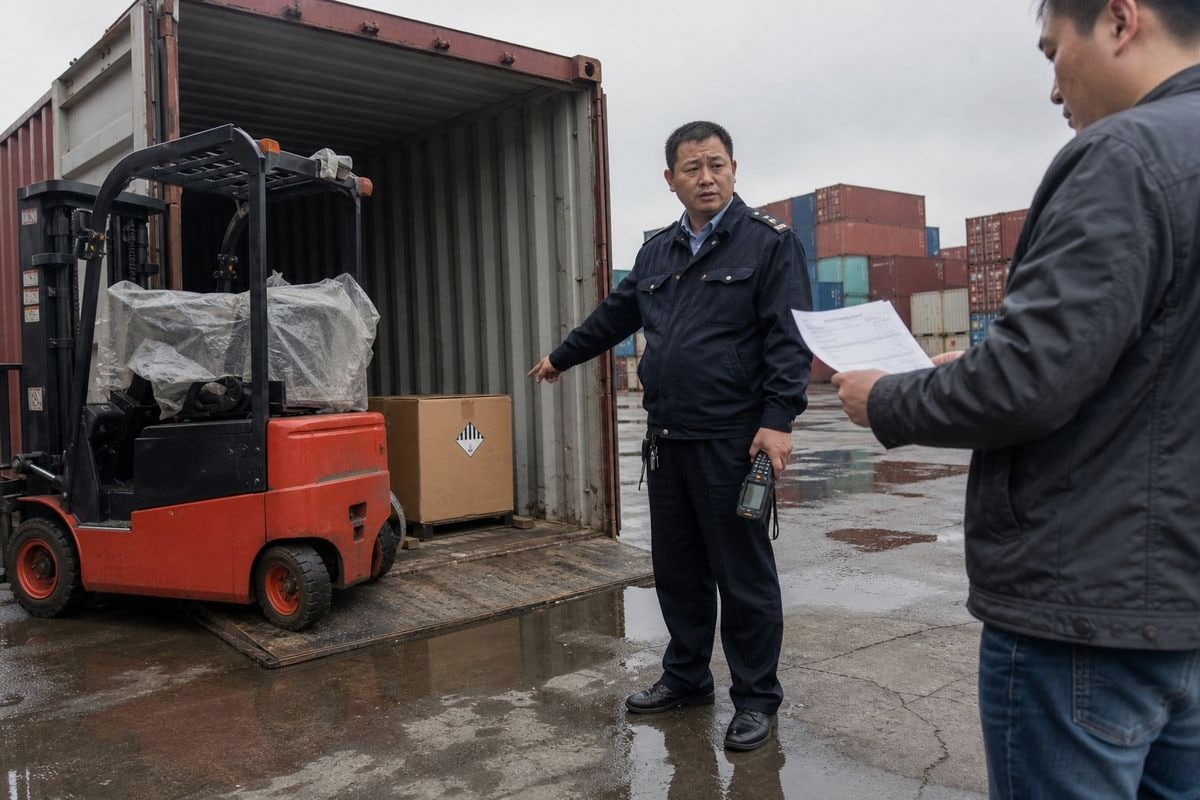
Physical preparation and classification go hand in hand. Get the category wrong and even flawless packaging will not save the booking.
Classify the shipment correctly first
Forklift batteries ship in three configurations, and the configuration changes the UN number and the transport requirements:
| תצורה | מספר ה-UN | Typical scenario |
|---|---|---|
| Standalone lithium-ion batteries | UN3480 | Spare or replacement batteries shipped separately |
| Batteries packed with equipment | UN3481 | Forklift and battery in the same consignment, battery not installed |
| Batteries contained in equipment | UN3481 | בטריה מותקנת בטרקטורון |
Confusing UN3480 with UN3481 leads to immediate rejection during the document audit phase, because the marks, labels, and paperwork differ between the two. Small cells and batteries may qualify for relief under Special Provision 188, but large industrial forklift batteries almost never do, so plan for full dangerous goods handling.
Physical preparation checklist
- Insulate and protect terminals so nothing can bridge them during transit.
- Use UN-certified packaging where required, and never reuse damaged cartons.
- Apply lithium battery marks and hazard labels correctly, and never cover them with tape or straps. Hidden labels are a routine rejection cause.
- Block and brace the forklift so the battery cannot shift or take physical shock. Damage and short circuits are the main paths to thermal runaway.
- Inspect for swelling, leaks, or bulging. Carriers hold a zero-tolerance position on compromised batteries.
- For any air freight legs, respect State of Charge limits. Lithium-ion batteries above the 30% state-of-charge threshold are likely to be refused without specific approval, and some ocean carriers now ask for SoC confirmation too.
We run this checklist with the factory before pickup. Fixing an exposed terminal in a supplier's workshop takes an hour. Fixing it at a container terminal can cost you the sailing.
מַסְקָנָה
Rejections rarely come from bad luck. They come from gaps in classification, documentation, packaging, or carrier policy awareness. Close those gaps in China, and your lithium forklift shipments sail on schedule. If you want help checking a shipment before booking, reach out to me at MBMLOG and we will review it together.
הערות שולים
1. The IMO is the primary international body governing the maritime transport of dangerous goods. ↩︎
2. The UNECE provides the regulatory framework for the UN Manual of Tests and Criteria, including battery testing. ↩︎
3. Wikipedia overview of dangerous goods regulations and the required documentation for transport. ↩︎
4. Official U.S. government resource explaining the requirements and purpose of a commercial invoice in international trade. ↩︎




