
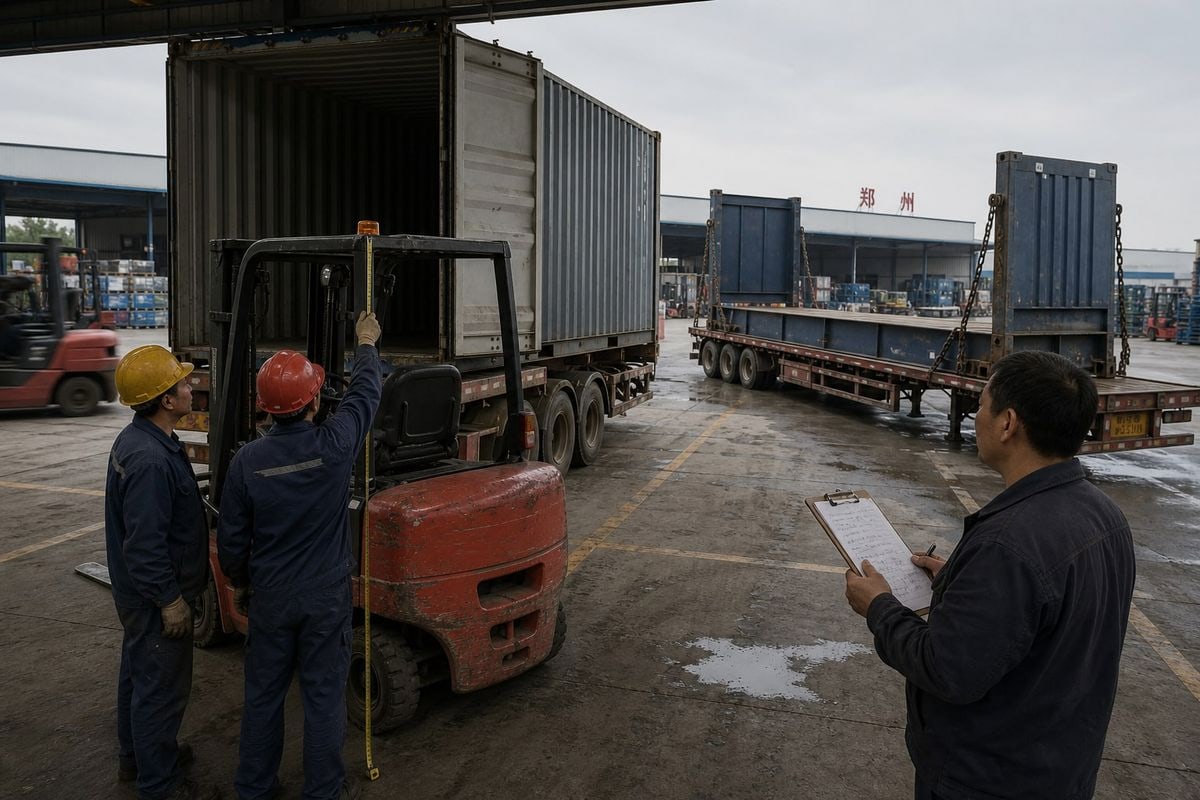
Choosing between a standard container 1 and a flat rack for shipping forklifts confuses many importers. At our Zhengzhou loading warehouse, we see this mistake cost buyers thousands every month.
Choose a standard container if your forklift fits within roughly 2.34m internal width and 2.38m height and can be driven or winched through the doors. Choose a flat rack if the forklift is over-width, over-height, over 28 tons, or needs crane loading.
The wrong choice adds surcharges, damage risk, or port delays. Below, I break down the decision step by step so you can measure first and book second.
How Do I Know If My Forklift Fits in a Standard Container?
Last spring, a US dealer sent us a spec sheet for six electric forklifts. Two would not clear the door opening height. We caught it before booking, and that saved him a full re-plan at the port.
Compare your forklift's lowered mast height, overall width, and weight against the container's internal dimensions: about 2.34m wide and 2.38m high for a standard 40ft box, with a payload capacity near 28 tons. If all three fit with clearance, a standard container works.

The most common error I see is measuring the forklift's travel height instead of its full lowered mast height. The mast channels, overhead guard, and even the amber beacon light on top all count. You need real clearance, not a paper match. We ask factories in China for three numbers before we quote anything: overall width, height with the mast fully lowered, and service weight including the battery.
The Three Checks That Matter
First, check the door opening height. The container doors 2 are slightly shorter than the interior, so a forklift that "fits inside" on paper may still hit the door frame going in. Second, check width. You need working room on both sides for lashing and securing, not a zero-margin squeeze. Third, check weight against payload capacity and floor loading, because forklifts concentrate weight on small solid tires.
Typical Container Limits for Forklift Shipping
| Container Type | Internal Width | Internal Height | Door Opening Height | Payload Capacity |
|---|---|---|---|---|
| 20ft Standard | ~2.34 m | ~2.38 m | ~2.28 m | ~28 tons |
| 40ft Standard | ~2.34 m | ~2.38 m | ~2.28 m | ~28 tons |
| 40ft High Cube | ~2.35 m | ~2.69 m | ~2.58 m | ~28 tons |
High Cube dimensions give you roughly 30cm of extra mast height clearance, and that difference alone often keeps a warehouse forklift out of Out of Gauge (OOG) territory. Most compact electric forklifts and pallet stackers we ship from China fit a 40HQ easily. Reach trucks with tall masts are the borderline cases. If your forklift misses the limit by a small margin, do not jump straight to a flat rack. Ask whether the mast can be lowered further, tilted, or removed. We handle that conversation with the factory directly, because the answer changes your freight cost dramatically.
When Should I Choose a Flat Rack Container Instead?
A trade-off we weigh on almost every heavy machinery transport booking is this: force the cargo into a box, or accept flat rack surcharges. There is a clear line where the flat rack wins, and it is worth knowing exactly where it sits.
Choose a flat rack when the forklift exceeds standard internal dimensions, weighs more than the ~28-ton box container payload, cannot pass through the door opening, or requires top or side crane loading. Flat racks handle Out of Gauge cargo up to roughly 45 tons.

A flat rack is an open platform with reinforced end walls and no roof or side walls. That design exists for one reason: cargo that a closed box cannot accept. For forklifts, this usually means large rough-terrain units, heavy-duty industrial forklifts with high capacities, or machines with fixed masts that cannot be lowered or dismantled.
Clear Triggers for a Flat Rack
Use this quick list. If any point applies, a flat rack is likely your answer:
- The forklift is wider than about 2.3m and cannot be reduced
- The lowered mast still exceeds High Cube door clearance
- The unit weighs more than 28 tons
- The machine cannot be driven, and no loading ramp or winch setup is practical
- The origin factory can only load by crane from the top or side
There is a counterargument I hear from cost-focused buyers: "Flat racks are built for machinery, so why fight with a box at all?" I understand the appeal. Top loading is genuinely easier, and external lashing angles stabilize a dense machine against vertical bounce better than the restricted tie-down points inside a box. But defaulting to flat racks means paying OOG surcharges and lost slot fees on cargo that never needed them. In my experience shipping forklifts from China to the US, the flat rack is the right tool only after the standard container has genuinely failed the fit test. Ro-Ro shipping is a third option for drivable machines on some routes, but sailing schedules and port coverage are far more limited than containerized services.
One more practical point: flat racks are specialized assets. Availability at your origin port is not guaranteed, so booking lead time matters. We usually advise customers to confirm flat rack availability two to three weeks earlier than they would for a standard box 3.
What Are the Cost Differences Between Standard and Flat Rack Shipping?
A buyer in Texas once asked me why his flat rack quote was nearly triple the standard container rate for the same route. The answer was not greed. It was slots, cranes, and lashing labor, and it is worth understanding each piece.
Flat rack shipping typically costs significantly more than standard container shipping. Beyond higher base ocean freight rates, flat racks incur OOG surcharges, lost slot fees for over-dimension cargo, crane handling charges, professional lashing costs, and often specialized heavy-haul trucking before the port.

Ocean freight rates for a standard box are commoditized and competitive. Flat rack pricing is not. When your forklift overhangs the platform's width or height, the carrier cannot stack containers in the adjacent slots, and you pay for those lost slots. That single mechanism explains most of the price gap.
Where the Extra Costs Hide
| Cost Item | Standard Container | Flat Rack |
|---|---|---|
| Base ocean freight | Lower, market rates | Higher, specialized pricing |
| OOG surcharge | None | Common for over-dimension units |
| Lost slot fees | None | Applied when cargo overhangs |
| Loading equipment | Loading ramp or winch | Crane time at origin |
| Lashing and securing | Internal blocking and bracing | Professional external lashing, certified materials |
| Pre-port trucking | Standard container chassis | Possible heavy-haul or flatbed movement |
| Weather protection | Included in the box | Shrink-wrap, tarping, or VCI film extra |
The Disassembly Math
Here is the analysis we run for borderline forklifts: compare the labor cost of dismantling and reassembly against the total flat rack premium. It is often cheaper to pay mechanics to lower or remove the mast and ship in a standard 40HQ than to pay OOG surcharges. But the math is not automatic. Dismantling adds crating cost, reassembly time at destination, and some damage risk at the joints and hydraulic connections. For a single unit, disassembly usually wins. For a fleet of identical oversized machines, negotiated flat rack rates sometimes come out ahead. We calculate the total landed cost both ways before the customer books, because the "cheap" ocean rate that ignores destination handling and reassembly labor is not actually cheap.
How Do I Protect My Forklift From Damage on a Flat Rack?
The lesson that shaped our loading procedures came from an inspection photo years ago: surface corrosion on an exposed mast after a Pacific crossing. The machine worked fine, but the buyer's customer rejected it on appearance. Protection is not optional on an open platform.
Protect a flat rack forklift with certified lashing chains at proper angles, wooden blocking and bracing under the wheels, shrink-wrapping or VCI film against salt spray, drained or secured fluids to prevent deck contamination, and marine cargo insurance covering the exposed transit.

A flat rack gives up the six-sided shielding of a box, so you must rebuild that protection layer by layer. We treat it as a checklist, and we supervise the loading in China because the destination survey happens after the damage, not before it.
The Protection Checklist We Follow
- Lashing and securing. Use rated chains and tensioners anchored to the flat rack's lashing points. The lashing angles should counter both horizontal shift 4 and vertical bounce. Forklifts are dense, with a low center of gravity concentrated at the counterweight, so the lashing plan must reflect the true weight distribution, not a generic diagram.
- Blocking and bracing. Timber blocks nailed to the platform floor stop the wheels from rolling. The parking brake alone is never enough for a four-week ocean voyage.
- Corrosion protection. Salt spray attacks exposed hydraulic rods, chains, and electrical connectors. We apply VCI film or shrink-wrap on sensitive assemblies and grease the exposed mast channels. For lithium battery forklifts, the battery compartment and connectors get extra sealing attention.
- Fluid control. A standard container acts as a secondary containment sump if hydraulics drip. A flat rack does not, and hydraulic leaks onto the vessel deck can trigger port fines. Check and seal fittings before loading.
- Insurance and documentation. Photograph the unit from all angles at loading. Buy cargo insurance that explicitly covers open-top and flat rack stowage, because some standard policies exclude exposed cargo.
Standard Box vs Flat Rack Protection at a Glance
| Protection Factor | Standard Container | Flat Rack |
|---|---|---|
| Weather and salt spray | Fully enclosed | Exposed, wrapping required |
| Theft risk | Sealed doors | Open access, higher risk |
| Securing method | Internal tie-downs, blocking | External chains, better angles |
| Fluid containment | Floor acts as sump | Direct deck exposure |
| Inspection at destination | Open doors, drive out | Crane offload, full survey |
One final check: verify that the destination port can actually handle a loaded flat rack. Smaller ports sometimes lack heavy-lift spreaders, and we have redirected shipments to larger gateways for exactly this reason.
Conclusion
Measure the forklift first, then choose the container. If it fits a standard box, take the box. If it truly cannot, secure a flat rack properly. We help buyers run that decision every week, from factory floor in China to final delivery.
Footnotes
1. Wikipedia offers a comprehensive history and technical overview of the standard container used in modern intermodal freight. ↩︎
2. ISO standards specify the dimensions and structural requirements for container doors to ensure international intermodal compatibility. ↩︎
3. The ICC establishes international trade standards and Incoterms that govern the shipment of goods in a standard box. ↩︎
4. The IMO's CSS Code provides guidelines for securing cargo to prevent horizontal shift and tipping during sea voyages. ↩︎




