

Choosing FCL vs LCL for shipping electric forklifts confuses many importers. At our [Zhengzhou forwarding office](https://mbmlog.com/?p=11541), we answer this question almost every week from forklift dealers overseas.
Choose FCL for electric forklift shipments above roughly 15 CBM, for high-value units, or when delivery is urgent. Choose LCL for a single compact unit or spare parts under that threshold, but account for weight-based billing, battery surcharges, and 5–10 extra transit days.
That short answer hides real money. A wrong choice can add thousands of dollars in hidden charges or weeks of delay. Below, I break down the full decision, step by step, using what we see on real [China-to-USA forklift shipments](https://mbmlog.com/?p=11792).
How do I decide between FCL and LCL for my electric forklift shipment?
Last month, a US dealer asked me to quote two 2.5-ton lithium forklifts both ways. The comparison surprised him, and it starts with four simple questions our team always asks first.
Decide by checking four things: total shipment volume in CBM, cargo value, delivery urgency, and battery compliance complexity. If your forklifts exceed about 15 CBM, are expensive, time-sensitive, or lithium-powered, FCL is usually the smarter default; otherwise, LCL deserves a real quote comparison.
Here is the quick comparison we walk every customer through before quoting:
| Factor | FCL (Full Container Load) | LCL (Less than Container Load) |
|---|---|---|
| Best for | 15+ CBM, multiple units | Small volume, single compact unit |
| Pricing | Flat rate per container | Per CBM or per 1,000 kg, whichever is higher |
| Handling | Sealed at factory, opened at destination | Loaded and unloaded at shared warehouses |
| Transit time | Faster, more predictable | Typically 5–10 days longer |
| Damage risk | Lower | Higher due to extra handling |
| Battery cargo | Easier to control | Subject to consolidator acceptance and surcharges |
Start With Your CBM Calculation
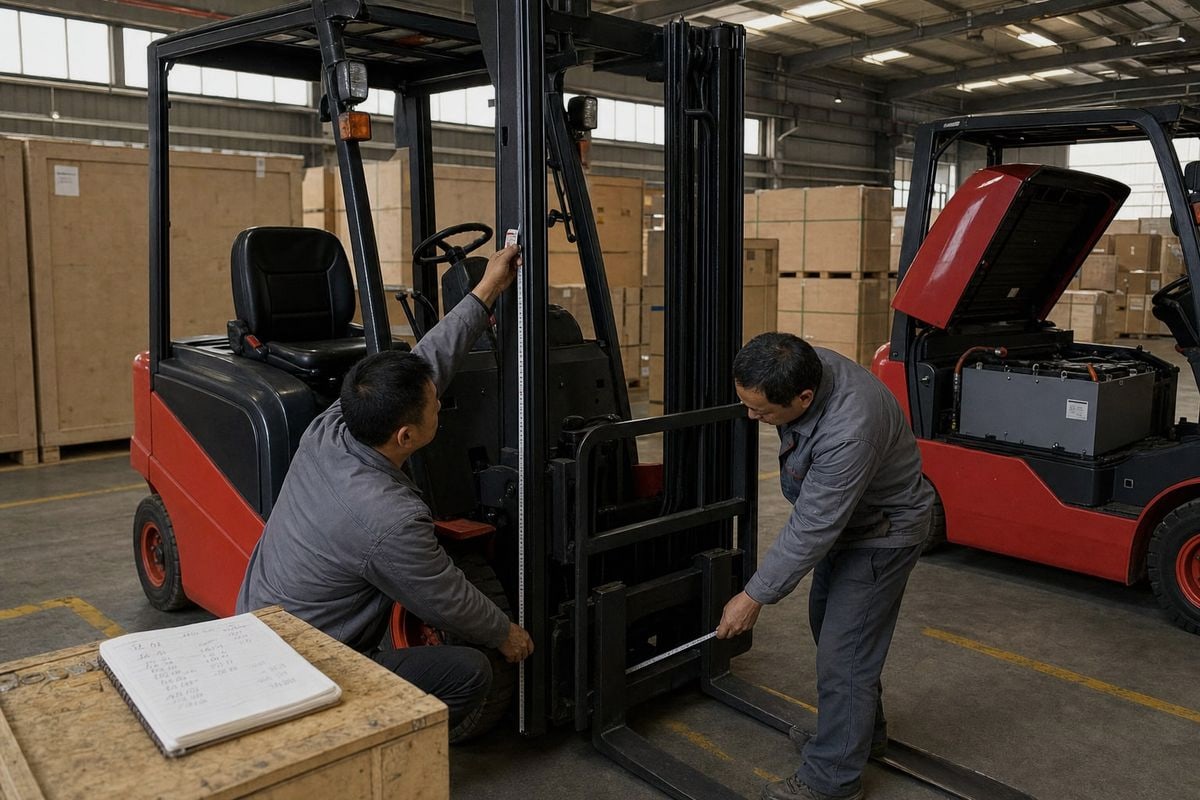
The cubic meter (CBM) calculation is your foundation. Measure the forklift with its mast, forks, and overhead guard. Multiply length by width by height in meters. A typical 2-ton electric forklift 1 often takes 5–7 CBM once crated. Industry guidance places the LCL-to-FCL break-even at roughly 13–18 CBM, with 15 CBM as a practical midpoint. Two or three full-size forklifts usually push you past it fast.
Then Layer In Risk and Urgency
But CBM alone is not enough. I have seen a single high-value reach truck ship FCL profitably because the buyer needed it for a warehouse opening and could not risk deconsolidation delays. The cost-first view says LCL always wins below the threshold. The risk-first view says FCL wins whenever the cargo is expensive or urgent. In our experience, both views are half right. You need the total picture: freight rate, transit time comparison, damage exposure, and battery rules together. That is why we never quote one mode without showing the other.
What factors affect the cost difference between FCL and LCL for forklifts?
The hardest trade-off we weigh when quoting is not the ocean rate itself. It is the hidden charges on both sides that most first-time forklift importers never see coming.
Five factors drive the cost gap: the LCL weight/measure rule that bills 1,000 kg as 1 CBM, battery surcharges on consolidated cargo, destination port handling charges, FCL accessorials like chassis and detention fees, and the risk-adjusted cost of damage or delay.

Ocean freight rates are only the visible tip. Let me unpack what actually moves the total landed cost.
The Weight/Measure Trap for Heavy Machinery
LCL pricing uses the higher of volume or weight, where 1,000 kg counts as 1 CBM. This rule punishes forklifts badly. A counterbalance forklift with its battery can weigh 3,500–4,500 kg while occupying only 6 CBM of space. The consolidator may bill you on weight, not volume. On paper, LCL looked cheap. On the invoice, it is not. We caught this for a Texas customer last year and moved him to a 20FT container, which also solved his loading concerns.
Charges Beyond the Freight Rate
| Cost item | FCL exposure | LCL exposure |
|---|---|---|
| Ocean freight rate | Flat per container | Per CBM or per metric ton |
| Battery surcharge | Rare when container is dedicated | Increasingly common for mixed-cargo stowage |
| Destination handling | Terminal charges only | CFS deconsolidation and warehouse fees |
| Chassis, bobtail, wait time | Yes, at destination | Usually not applicable |
| Detention/demurrage risk | Higher if pickup is slow | Lower, but CFS storage fees exist |
Note the honest counterpoint: FCL can trigger more destination accessorials, including chassis fees and driver wait time. Some buyers assume FCL is friction-free. It is not. But LCL adds port handling charges at the container freight station on top of freight. Carriers are also imposing battery surcharges on LCL shipments to fund fire-suppression stowage for mixed-cargo containers. Add marine cargo insurance 2, which prices higher for LCL due to handling exposure, and the "cheap" option often loses. Always compare total landed logistics cost, never the headline rate.
How many electric forklifts do I need to justify a full container?
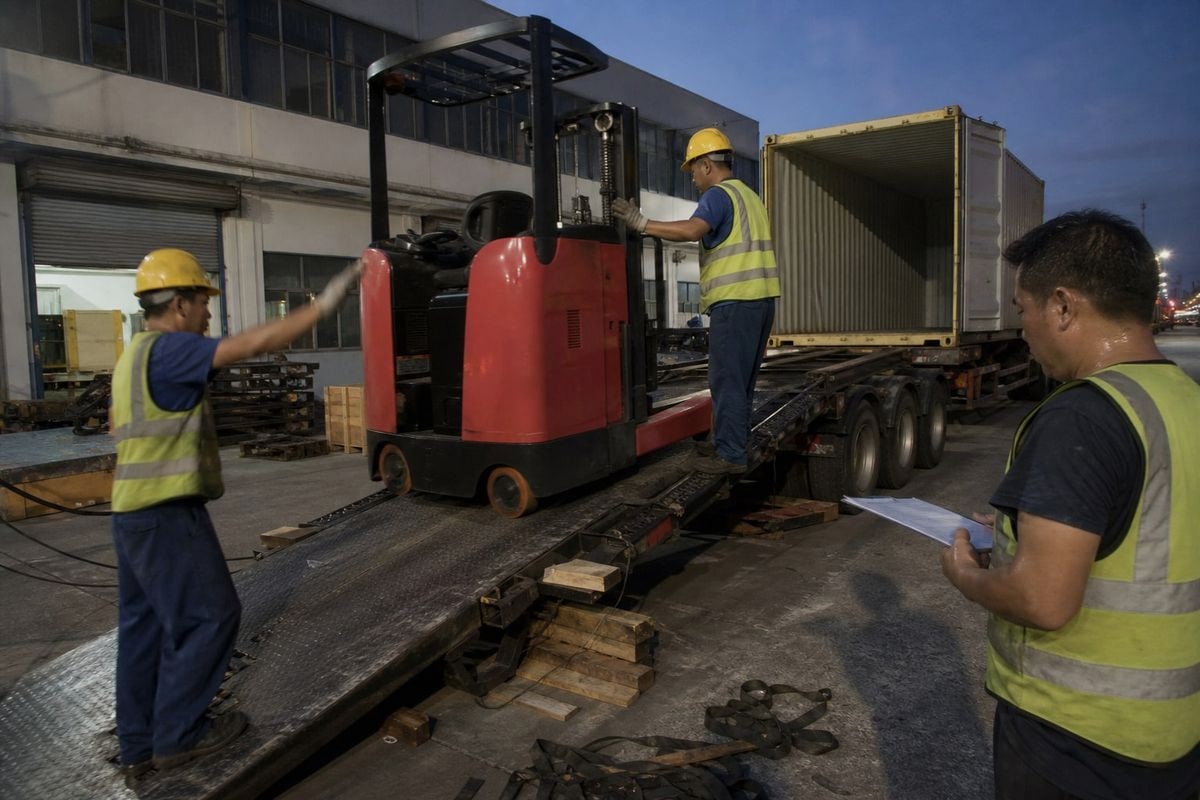
During a container loading last spring at a partner warehouse in Shanghai, we fit three 2-ton electric forklifts plus chargers into one 20FT box. That single load taught the buyer more than any quote sheet.
One full-size electric forklift often justifies FCL because of its weight and value; two or three almost always do. A 20FT container typically holds 2–3 standard counterbalance forklifts, a 40FT holds 4–6, and a 40HQ adds vertical clearance for taller masts.
Here is the loading capacity framework we use when planning container consolidation for forklift shipments:
| Container type | Typical forklift capacity | Usable volume | Best use case |
|---|---|---|---|
| 20FT | 2–3 standard units | ~28 CBM | Small orders, heavy dense cargo |
| 40FT | 4–6 standard units | ~58 CBM | Fleet orders, mixed equipment |
| 40HQ | 4–6 units plus parts | ~68 CBM | Tall masts, pallet trucks stacked, spare parts filler |
Run the Break-Even Math
Take a real scenario. One compact electric stacker at 3 CBM and 1,200 kg fits LCL economics comfortably. But one 2.5-ton counterbalance forklift at 6 CBM and 4,000 kg gets billed as 6 CBM by volume or 4 CBM by weight, whichever is higher, plus CFS fees and possible battery surcharges. At that point, the gap to a flat 20FT rate shrinks dramatically. Add a second forklift, and FCL wins nearly every time on our China-to-USA lanes.
Fill the Dead Space
Container utilization is where importers recover real margin. Unused space in an FCL box is free cargo room. We routinely help dealers fill gaps with forklift batteries, chargers, spare forks, tires, and attachments from multiple Chinese suppliers through warehouse consolidation before loading. Partial disassembly helps too. Lowering or removing the mast can cut the height enough to double-stack pallet trucks in a 40HQ. Blocking and bracing is then engineered around the actual load plan, with weight distributed over the container floor. This is protective crating and packaging thinking applied to the whole container, not just one machine.
Can I combine LCL forklift shipments with batteries or spare parts safely?
A costly lesson from our early years: a customer's spare lithium battery pack, booked separately from his forklift, sat at origin for two weeks waiting for dangerous goods approval. We now front-load every battery check.
Yes, but only with proper compliance. Lithium batteries require Class 9 Dangerous Goods documentation, including MSDS and UN38.3 certification, under IMDG Code rules. LCL consolidators may refuse battery cargo or add surcharges, so confirm carrier acceptance before booking any combined shipment.

This is the section where electric forklifts stop being ordinary machinery and become semi-special cargo. Lithium battery shipping regulations shape the entire logistics design, sometimes more than the freight rate does.
Battery Chemistry Changes Everything
Lead-acid and lithium-ion batteries follow different rules. Lead-acid units generally face simpler requirements around terminal protection and secure mounting. Lithium-ion batteries fall under hazardous materials handling 3 as Class 9 dangerous goods. The paperwork stack includes the MSDS, the UN38.3 test summary, and a dangerous goods declaration aligned with IMDG Code compliance. Whether the battery is installed in the forklift, disconnected, or shipped separately also changes the classification and packaging requirements. Newer safety protocols heading into 2026 also emphasize maintaining a 30% state of charge on lithium-ion batteries during long sea voyages, which is far easier to verify and control in a dedicated FCL container than in a shared LCL box.
Why LCL Makes Battery Cargo Harder
In an LCL container, your battery-powered forklift shares space with strangers' cargo. Consolidators must plan fire-suppression stowage for mixed loads, which is why battery surcharges on LCL are spreading. Some consolidators simply refuse lithium cargo. There is also collateral risk: if another shipper's goods in your shared container trigger a customs inspection 4, your forklift waits too. We have seen clean cargo held ten days for someone else's problem.
Combining spare parts with a forklift is usually safe and smart in both modes. Non-battery parts like forks, tires, filters, and seats consolidate easily. Chargers are generally straightforward. Batteries are the checkpoint. Our standing advice: send us the battery specification sheet before you confirm the purchase order, not after the cargo reaches the port. We verify carrier acceptance, prepare the DG documentation, and decide whether the battery ships installed or crated separately with protective crating and packaging. That single step prevents most battery-related delays we see in this trade.
Conclusion
Guessing wrong between FCL and LCL wastes money and time. Use the 15 CBM benchmark, weigh value and urgency, verify battery compliance early, and compare total landed cost before booking.
Footnotes
1. ISO is the international authority for industrial truck safety and classification standards. ↩︎
2. The ICC sets global standards for international trade, including insurance and Incoterms. ↩︎
3. The IMO manages the IMDG Code governing hazardous materials handling for maritime transport. ↩︎
4. Official site for U.S. Customs and Border Protection, the authority for cargo inspections. ↩︎




