- +8618603825129
- [email protected]


The [cost to ship an electric forklift](https://mbmlog.com/?p=11523) in a 20ft container confuses many buyers. Our team at MBMLOG sees importers budget for freight, then get shocked by the final invoice.
Shipping an electric forklift in a 20ft container typically costs $1,200–$4,800 for ocean freight alone. Add lithium battery surcharges of $200–$500, terminal handling, customs clearance, and inland delivery, and the realistic all-in budget lands between $2,500 and $7,000 per container.
That gap between the base rate and the final bill is where most importers lose money. Let me break down each layer of cost, so you can budget with confidence before you place your order.
Last quarter, our Zhengzhou team quoted three nearly identical forklifts to three different US ports. The per-unit cost varied by over 40%. Route and loading plan explained everything.
A full 20ft container from China to the USA costs roughly $2,800–$5,500 in ocean freight. If you load two compact electric forklifts, the per-unit ocean cost drops to about $1,400–$2,750 each, before battery surcharges, port fees, and inland trucking are added.

The math is simple, but the inputs matter. Ocean freight rates for a 20ft FCL container are charged per box, not per forklift. So the more units you fit safely inside, the lower your cost per machine. This is why we always ask buyers for exact dimensions before quoting.
Here is what 20ft container pricing looks like on major lanes right now. These figures reflect ocean freight only.
| Route | 20ft Container Rate | Typical Transit Time |
|---|---|---|
| Shanghai – Los Angeles | $2,800 – $4,500 | 14–20 days |
| Shanghai – New York | $3,500 – $5,500 | 28–35 days |
| Shanghai – Rotterdam | $2,000 – $3,500 | 30–38 days |
| Broader market range (major lanes) | $1,500 – $5,000 | Varies |
Some rate guides show general 20ft container costs stretching from $2,500 up to $13,000. But those aggregate consumer moves, remote destinations, and peak-market spikes. For a forklift-specific shipment on a major China–USA lane, the narrower $1,200–$4,800 ocean freight band is far more actionable.
When we plan a loading for a US forklift dealer, we look at three things: forklift count, spare parts, and unused space. A 20ft box that carries one forklift plus batteries, chargers, and spare parts often delivers better landed economics than two half-empty containers. Filling dead space with accessories is one of the easiest ways to cut your effective freight cost per forklift.
There is a real trade-off we weigh on every booking: a cheaper carrier that hesitates on lithium cargo, or a slightly pricier one that accepts battery-powered equipment without drama. We usually choose the latter.
Five factors drive your total cost: battery type, forklift weight and dimensions, route and season, service level (port-to-port vs door-to-door), and destination charges. Lithium battery forklifts classified as Class 9 dangerous goods add $200–$500 per shipment in surcharges alone.

Let me unpack each driver, because this is where quotes go wrong.
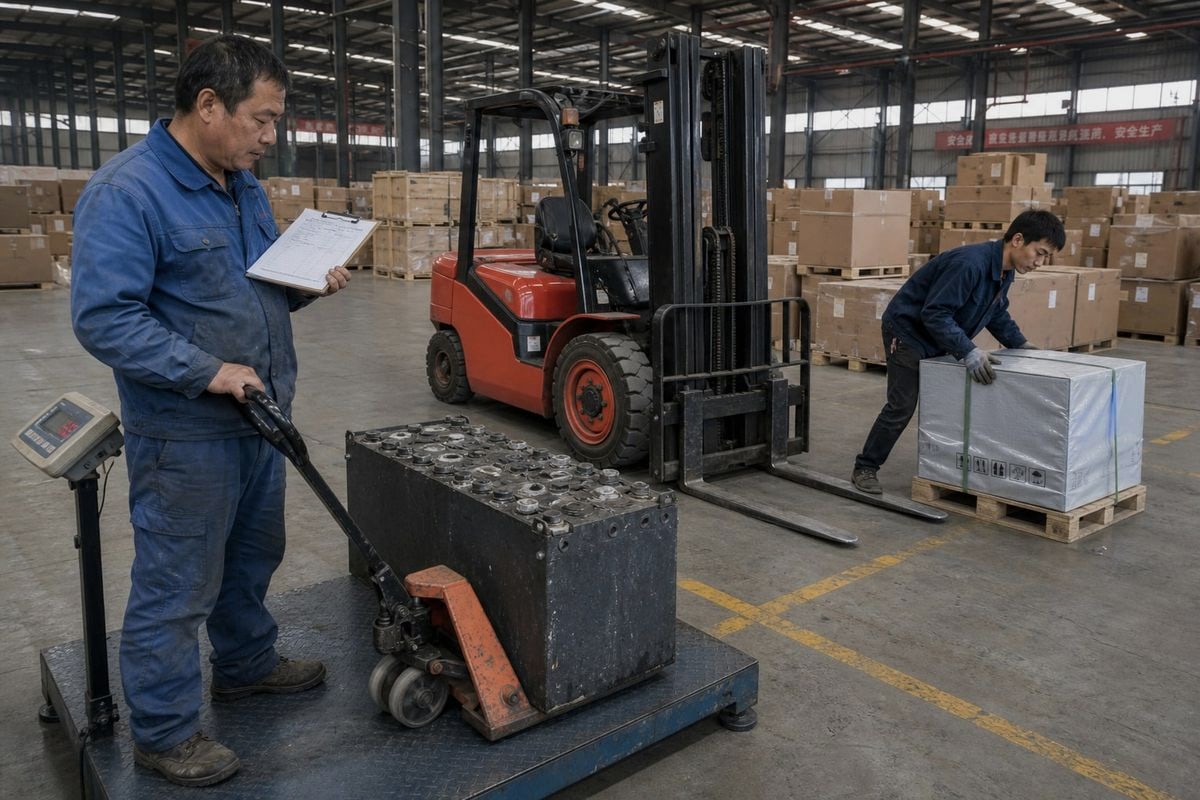
Electric forklifts with lithium-ion batteries are classified as Class 9 dangerous goods 1 under UN3481. Lead-acid units fall under UN2800. Lithium-ion battery regulations require specialized documentation, DG labeling, and carrier approval. Carriers commonly add a $200–$500 dangerous goods surcharge per booking. Increasingly, carriers also require a battery state of charge at or below 30% for safety. That means discharge services at origin and recharging at destination — a hidden operational cost most first-time importers never budget for.
A standard 2.5-ton electric counterbalance forklift weighs around 3,500 kg. That weight can trigger heavy cargo surcharges and often requires a tilt-bed truck for final-mile delivery. Timing matters too. Peak Season Surcharges in Q3 and Q4 can lift base ocean freight rates by 10–25%.
| Cost Driver | Typical Impact | How to Control It |
|---|---|---|
| Lithium battery (Class 9 DG) | +$200–$500 per shipment | Confirm UN classification and MSDS before booking |
| Heavy cargo (3,500 kg+) | Heavy-lift or handling surcharge | Declare accurate weight upfront |
| Peak season (Q3/Q4) | +10–25% on base rate | Book early or ship off-peak |
| Door-to-door vs port-to-port | +$800–$2,500 | Compare Incoterms carefully |
| EU ETS carbon surcharges | Route-dependent fee | Factor in for Europe-bound cargo |
A port-to-port quote looks cheap because it excludes half the journey. Door-to-door DDP shipping covers factory pickup, export declaration 2, ocean freight, customs clearance, import duties and taxes, and delivery to your warehouse. It costs more upfront but eliminates surprise invoices. We handle both, and we always tell buyers to compare quotes on the same Incoterms basis — otherwise you are comparing apples to oranges.
A dealer in Texas once sent us a purchase order for three counterbalance forklifts, assuming they would all fit in one 20ft box. After measuring, only two fit safely — and only with the masts lowered.
A 20ft container fits one to two standard electric counterbalance forklifts, depending on dimensions. Compact 1.5–2 ton units may fit two; a 2.5–3.5 ton machine usually ships alone with spare parts. Mast height must clear the 7'8" container door opening.

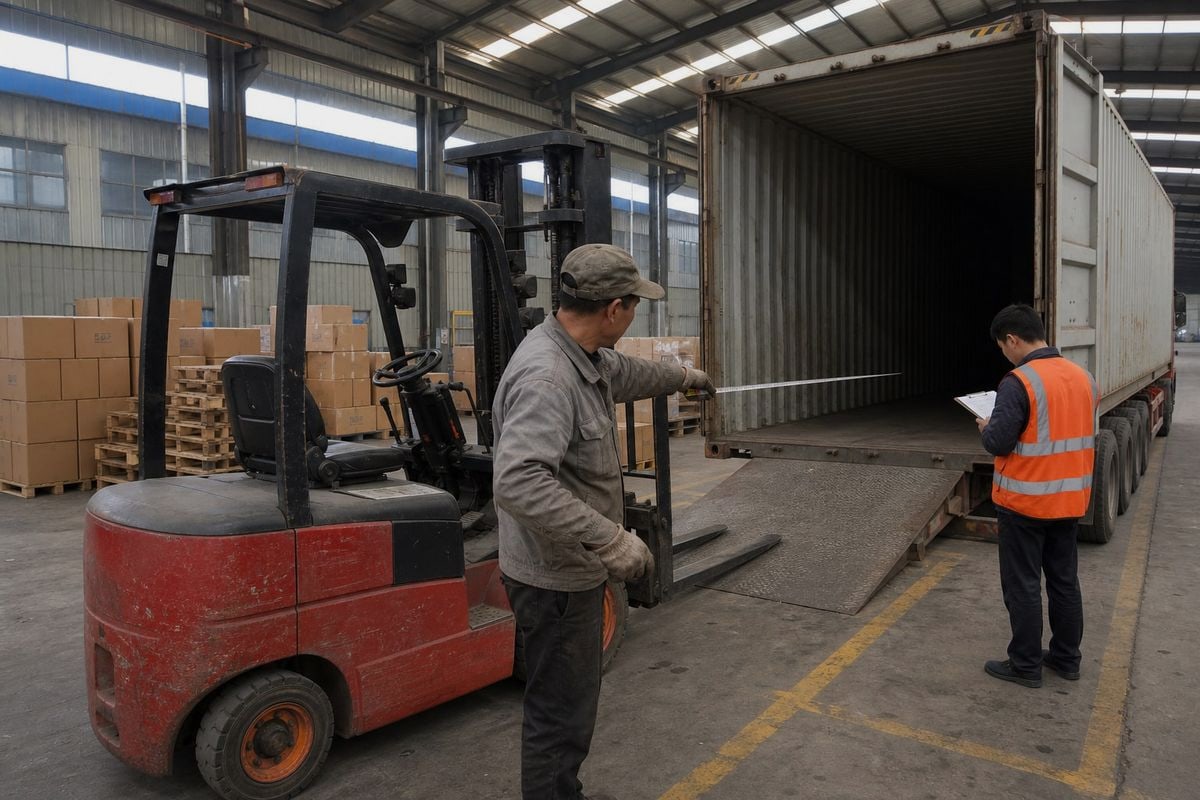
The interior of a 20ft container measures roughly 5.9m long, 2.35m wide, and 2.39m high — but the door opening is the real constraint at about 2.34m high (7'8"). Most forklift masts exceed that when raised, so machines are driven in with masts fully lowered. Some taller units need the mast or overhead guard removed entirely, which adds labor costs for disassembly at origin and reassembly at destination.
| Equipment Type | Approx. Weight | Units per 20ft Container |
|---|---|---|
| Electric pallet truck | 300–600 kg | 10–20+ |
| Electric stacker | 800–1,500 kg | 4–8 |
| 1.5–2 ton counterbalance forklift | 2,800–3,200 kg | 2 |
| 2.5–3.5 ton counterbalance forklift | 3,500–4,800 kg | 1 (+ parts/chargers) |
| Reach truck | 2,500–4,000 kg | 1–2 |
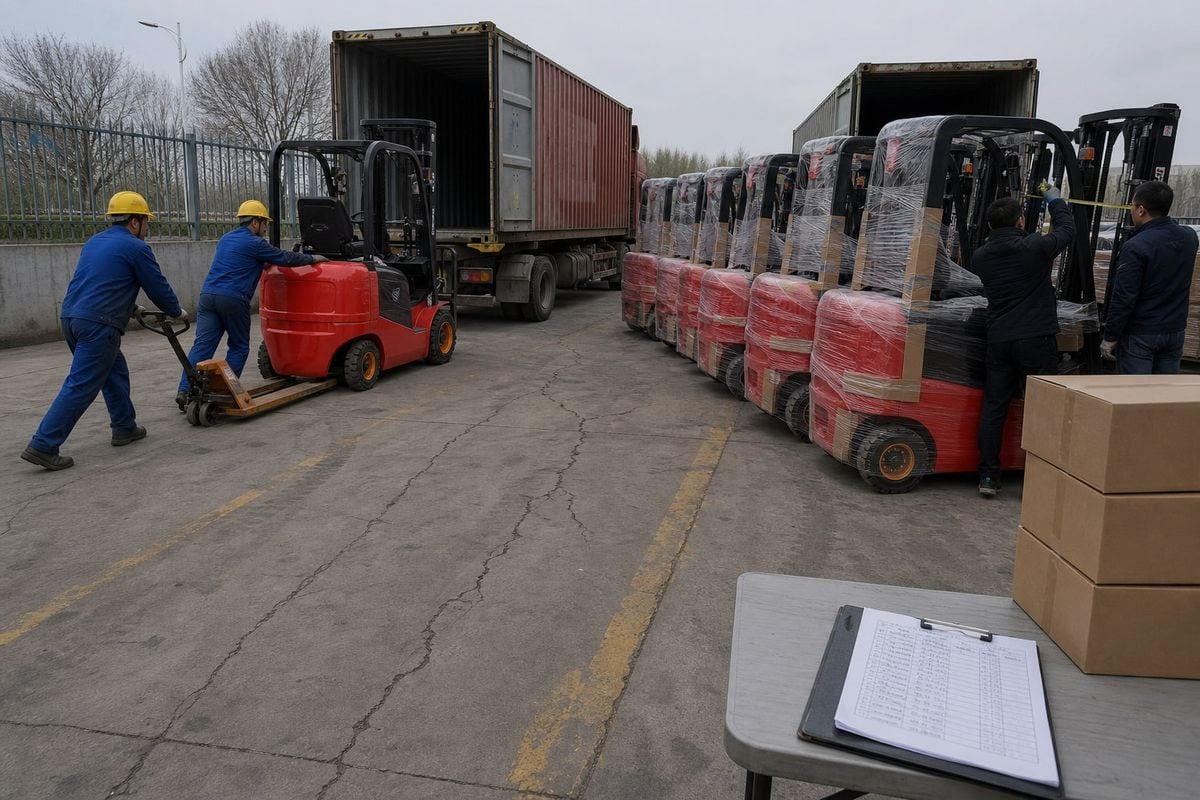
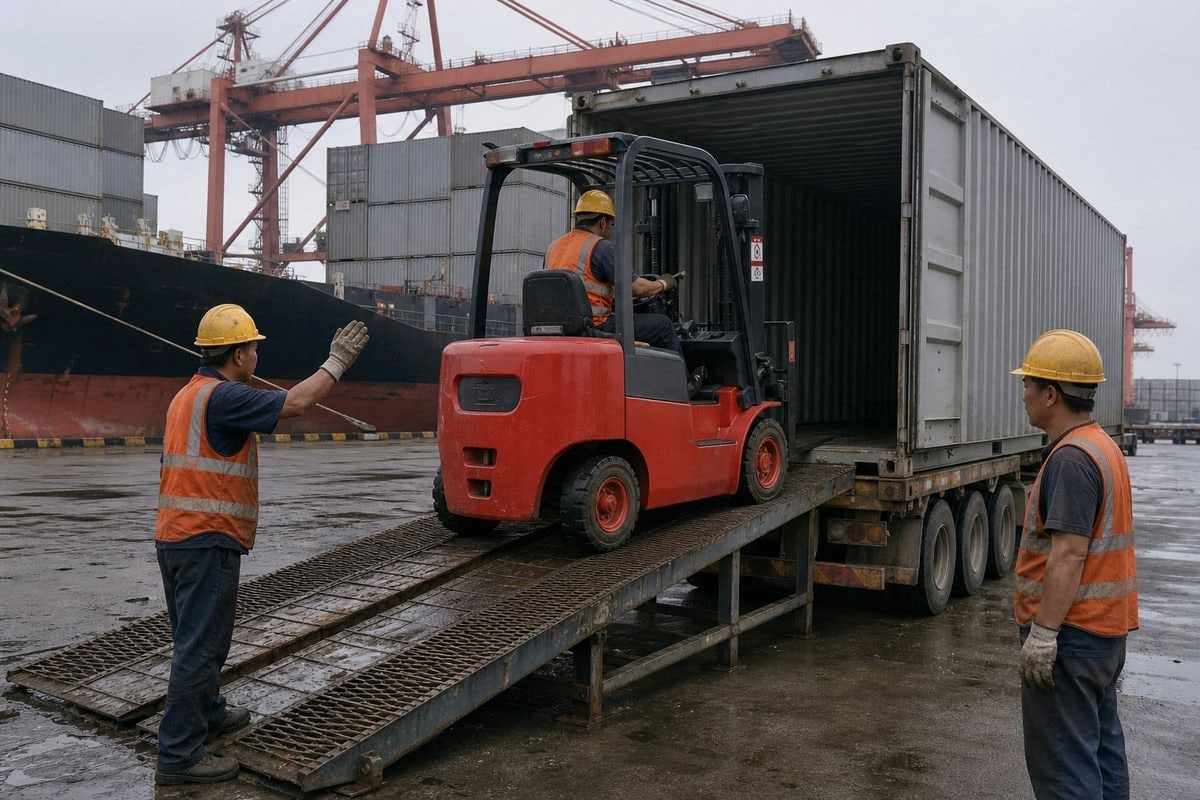
Weight distribution matters as much as fit. A 3,500 kg machine concentrated on one end of a container can fail port weight checks or shift in heavy seas. Our loading teams use blocking and bracing — timber chocks, lashing straps, and steel brackets welded or bolted to the container floor — to lock each forklift in place. We photograph every loading before the doors close, so buyers see exactly how their equipment was secured.
If your forklift is over-height or over-width even after disassembly, a 20ft box is the wrong tool. A flat rack or open-top container becomes the better fit, though at a different cost structure. We evaluate this before quoting, not after the cargo reaches the port.
The hardest conversation we have with new importers is explaining why the invoice is bigger than the ocean rate they Googled. So now we itemize every line before booking, not after.
Yes. Beyond base ocean freight, expect terminal handling charges ($150–$400 per end), customs brokerage ($150–$350), DG surcharges ($200–$500), documentation fees, marine insurance at 0.3–1% of cargo value, and inland drayage of $500–$3,000 depending on distance.
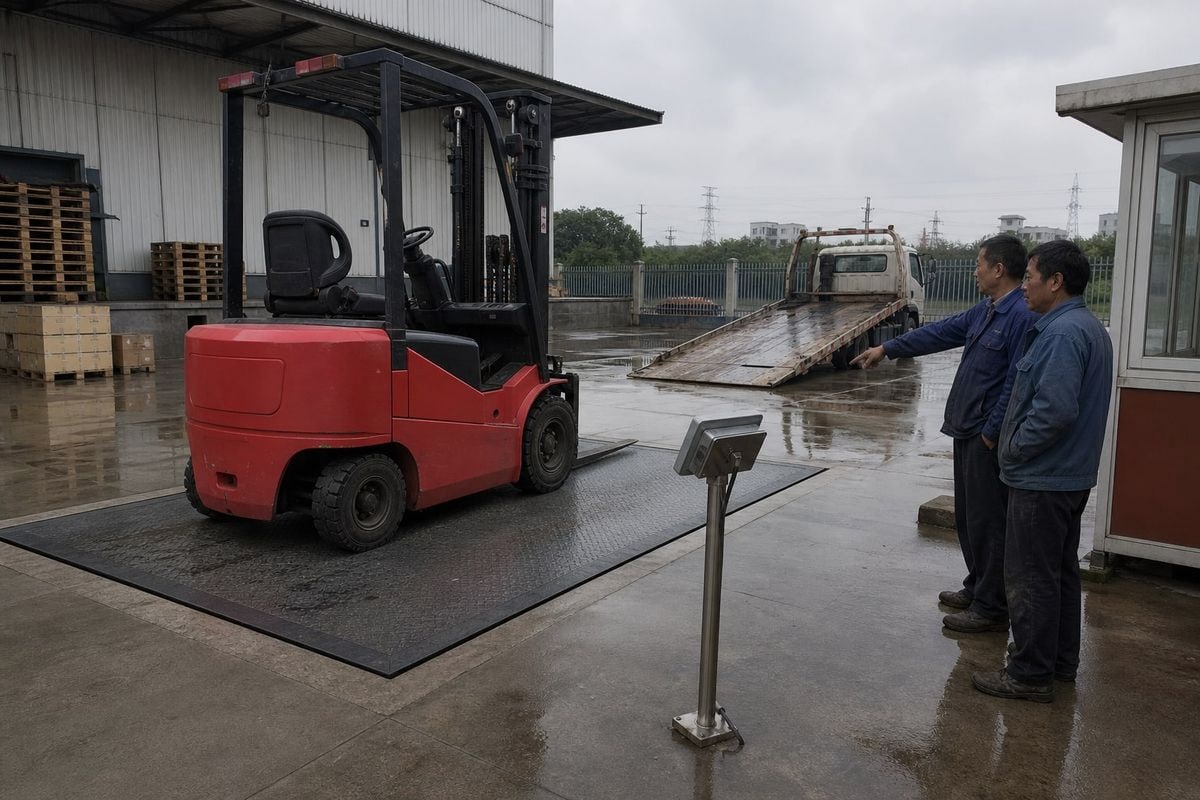
Here is a realistic sample cost stack for one lithium battery forklift shipped from a Chinese factory to a US warehouse in a 20ft container:
Two emerging fees deserve attention. Europe-bound shipments now face carbon-based surcharges under the EU Emissions Trading System 4. And used or refurbished electric forklifts increasingly carry a pricing premium because of stricter fire safety protocols for non-new battery systems. If you are importing refurbished units, flag this early.
Our freight forwarder services exist precisely to consolidate these line items into one transparent quotation. When a quote looks suspiciously cheap, some of these charges are almost always missing — and you will pay them at destination, usually with a demurrage clock ticking.
Budgeting only the container rate leaves you exposed. Plan $2,500–$7,000 all-in, confirm battery classification early, and let our MBMLOG team quote your forklift shipment door-to-door — transparently.
1. Authoritative maritime organization defining regulations for hazardous materials like lithium batteries. ↩︎
2. Official US government resource explaining the requirements for international trade documentation and export processes. ↩︎
3. The World Customs Organization manages the global standard for classifying traded products. ↩︎
4. Official European Commission site detailing the carbon pricing system affecting maritime shipping costs. ↩︎