
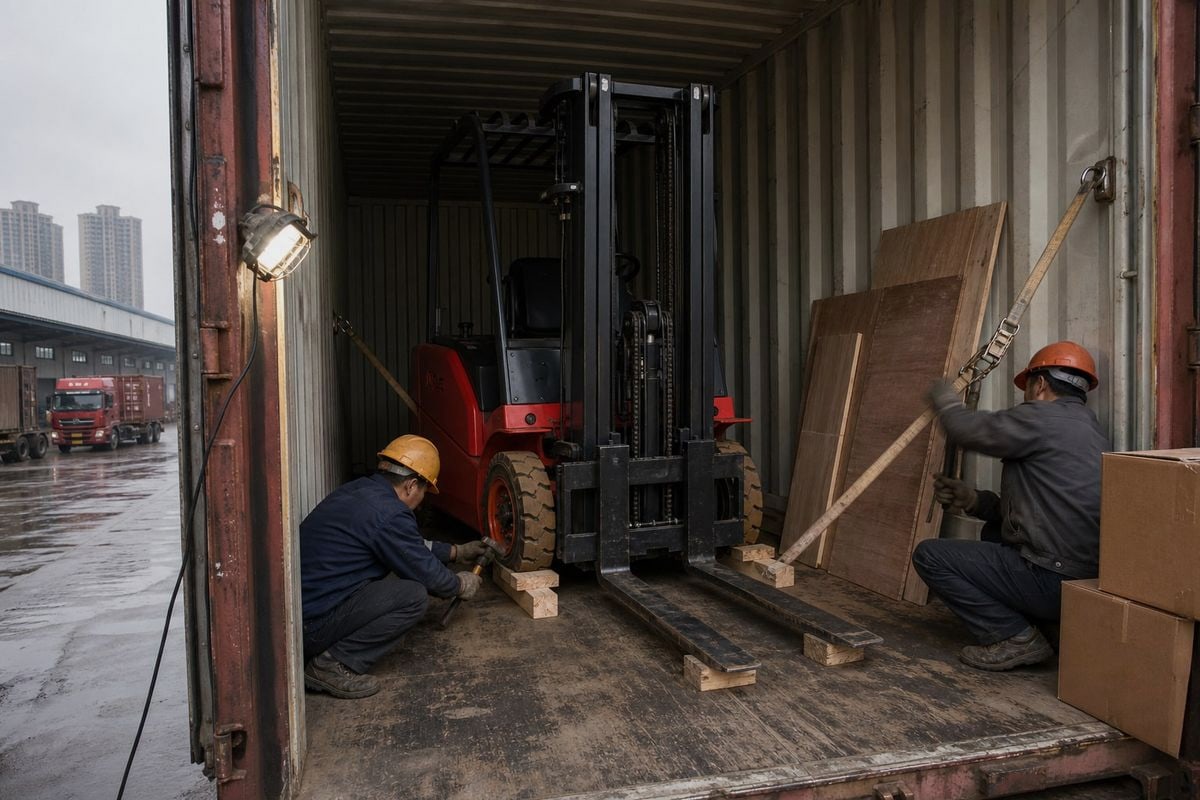
Leren hoe je een heftruck op de verkeerde manier binnen een zeecontainer kunt vergrendelen kost importeurs echt geld. In ons laadmagazijn in Zhengzhou heb ik gezien hoe slordig lashing gloednieuwe machines beschadigde.
Om een heftruck binnen een zeecontainer te vergrendelen, verlaag je de mast en vorken, centreer je de machine voor een evenwichtige gewichtsverdeling, installeer je wielblokken en houtblokkering rond alle wielen, en bevestig je ten minste vier gekeurde ratelbanden of Grade 70 kettingen onder een hoek van 45 graden aan de lashingpunten van de container.
Dat is het korte antwoord. Het volledige proces heeft meer stappen. Ik zal je door elk van deze stappen leiden, gebruikmakend van wat mijn team elke week doet bij echte heftruckzendingen uit China.
Welke gereedschappen en materialen heb ik nodig om een heftruck correct voor verzending te beveiligen?
Een koper in Texas vroeg me ooit waarom onze laadofferte hout en multiplex als regellijnen vermeldde. Hij ging ervan uit dat straps voldoende waren. Die vraag verdient een volledig antwoord.
Je hebt ten minste vier zware ratelbanden nodig met een beoordeling van 5.000 lb elk of een Grade 70 transportketting, hardhouten balken voor blokkering en versteviging, wielblokken, multiplexplaten voor vloerbescherming, kantbeschermers, spijkers, dunnage zakken voor het vullen van gaten, en VCI-emitters voor corrosiebeheersing.
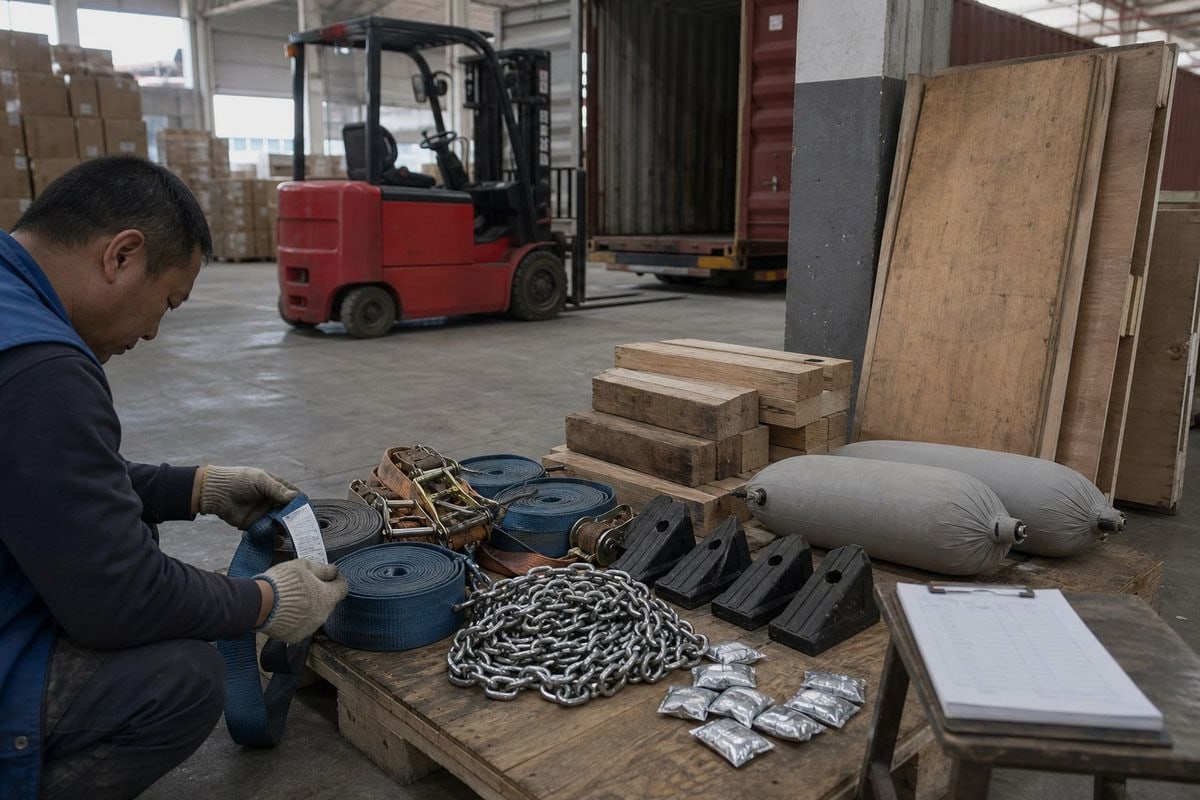
Mijn team houdt een standaard beveiligingskit op onze consolidatieplaats in China. We stellen deze samen voordat de container zelfs maar arriveert. Haastig materialen zoeken nadat de vrachtwagen arriveert, is hoe fouten ontstaan. Hier is de checklist die we daadwerkelijk gebruiken.
De Kernbeveiligingskit
| Item | Minimale specificatie | Doel |
|---|---|---|
| Rateltuigbanden | 5.000 lbs werkcapaciteit, 4 of meer | Positieve beperking tegen schuiven |
| Ketting van klasse 70 voor transport 1 | Afgestemd op het brutogewicht van de heftruck | Beveiliging voor zwaardere machines |
| Hardhout | 2" x 6" gelamineerde blokkering | Blokkering en versteviging rondom wielen |
| Wielblokken | Beoordeeld voor bandmaat | Voorkomt rollen voordat de banden aanbrengen |
| Laagplaat of stalen platen | Zware kwaliteit | Verspreidt asgewicht over containervloer |
| Dunnage zakken | Correcte vuldruk | Vult leegtes, stopt laterale verschuiving |
| VCI-uitstralers | Grootte afgestemd op containervolume | Voorkomt corroderen door zoutlucht op hydralica |
Waarom multiplex? Een heftruck concentreert zijn bruto gewicht op kleine contactpunten van de banden. Containerbodems zijn van marienkwaliteit multiplex, en een zware tegenwichtmachine kan deze doorboren. We leggen eerst platen of stalen platen, en rijden de heftruck daarop.
Waarom VCI-uitstralers in plaats van alleen vochtabsorberende zakken? Standaard vochtabsorberende middelen falen vaak tijdens lange zeetransporten. Zoutlucht valt hydraulische cilinders en controle-elektronica aan. We plaatsen VCI-uitstralers nabij deze componenten op elke elektrische heftruck die we naar de Verenigde Staten verzenden.
Nog een punt. De CTU Code, de internationale gedragscode voor het verpakken van cargo transporteenheden 2, is de referentienorm die we volgen. Als er ooit een geschil ontstaat met een verzekeraar, beschermt het aantonen van naleving van de CTU Code u.
Hoe positioneer en verstevig ik een heftruck binnen een container om verschuiven te voorkomen?
Elk laadplan dat wij opstellen begint met dezelfde afweging: de vorkheftruck dieper plaatsen bespaart ruimte voor reserveonderdelen, maar de machine moet op het balanspunt van de container blijven.
Rijd de vorkheftruck langzaam naar het exacte longitudinale midden van de container, laat de mast en de vorken op het dunnage zakken, en bouw vervolgens een houten cradle door 2" x 6" gelamineerde blokken tegen alle wielen te spijkeren om voorwaartse-achterwaartse en zijwaartse bewegingen te stoppen voordat er ook maar één riem wordt aangebracht.
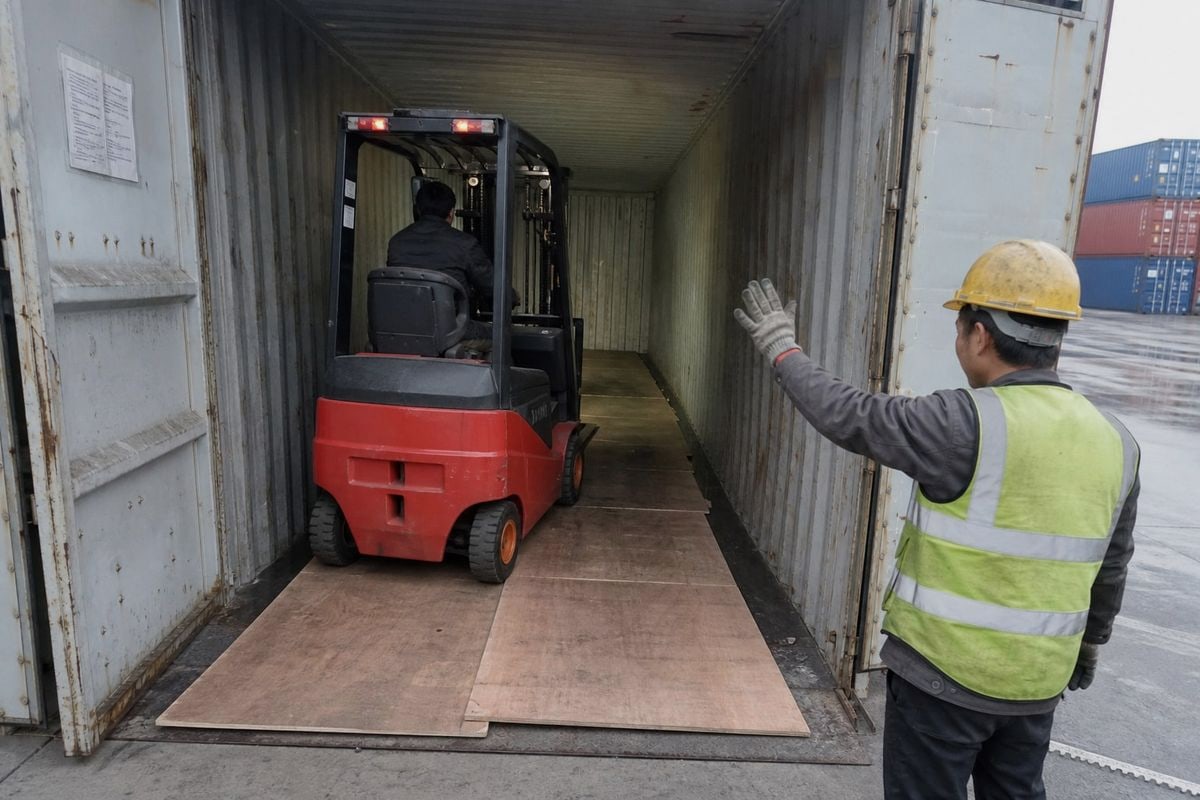
Positioneren komt vóór bevestigen. Als de positie verkeerd is, kan geen enkele lashing dit oplossen. Hier is de volgorde die mijn laadploegen volgen bij de oorsprong.
Stap voor Stap Positioneringsproces
- Bevestig dat de container op stevige, vlakke grond staat. Laad nooit op een helling of zachte ondergrond.
- Leg vloerbescherming multiplex langs het rijpad.
- Rijd langzaam recht vooruit. Houd mensen uit de container terwijl de machine beweegt. Het mengen van werknemers en mobiele machines binnen een container is een bekende oorzaak van ongevallen.
- Stop at the longitudinal center. A centered load keeps the center of gravity balanced, which matters for crane handling at the port and for vessel stability.
- Lower the mast and forks fully to the floor. Rest them on a wooden pallet or dunnage. This protects the floor and drops the vertical center of gravity.
- Set wheel chocks against every wheel immediately.
Building the Timber Cradle
Blocking and bracing turns the container floor into part of the restraint system. We nail kiln-dried lumber directly into the floor to create a physical cradle around each wheel. Rail guidance on floor blocking calls for 2" x 6" laminated blocking with staggered nails and enough nail penetration, using multiple nails per block matched to the load weight. We follow the same principle for ocean containers.
Timber shoring can also run from the wheels or frame to the container's corner posts for very heavy machines. Any remaining voids get filled with dunnage bags inflated to the correct pressure. The goal is simple: even before straps go on, the forklift physically cannot slide in any direction.
Wat zijn de beste praktijken voor het beveiligen van heftruckbatterijen en accessoires tijdens transport?
Lithium battery forklifts make up most of what we ship now, and battery handling is where I see the most confusion from first-time importers.
Isolate or disconnect the forklift battery before loading, verify lithium battery documentation meets carrier and IMO requirements, remove or separately strap loose attachments, insert a mast block to support the lifting assembly, and cross-lash the rear counterweight to resist pendulum forces during vessel rolling.
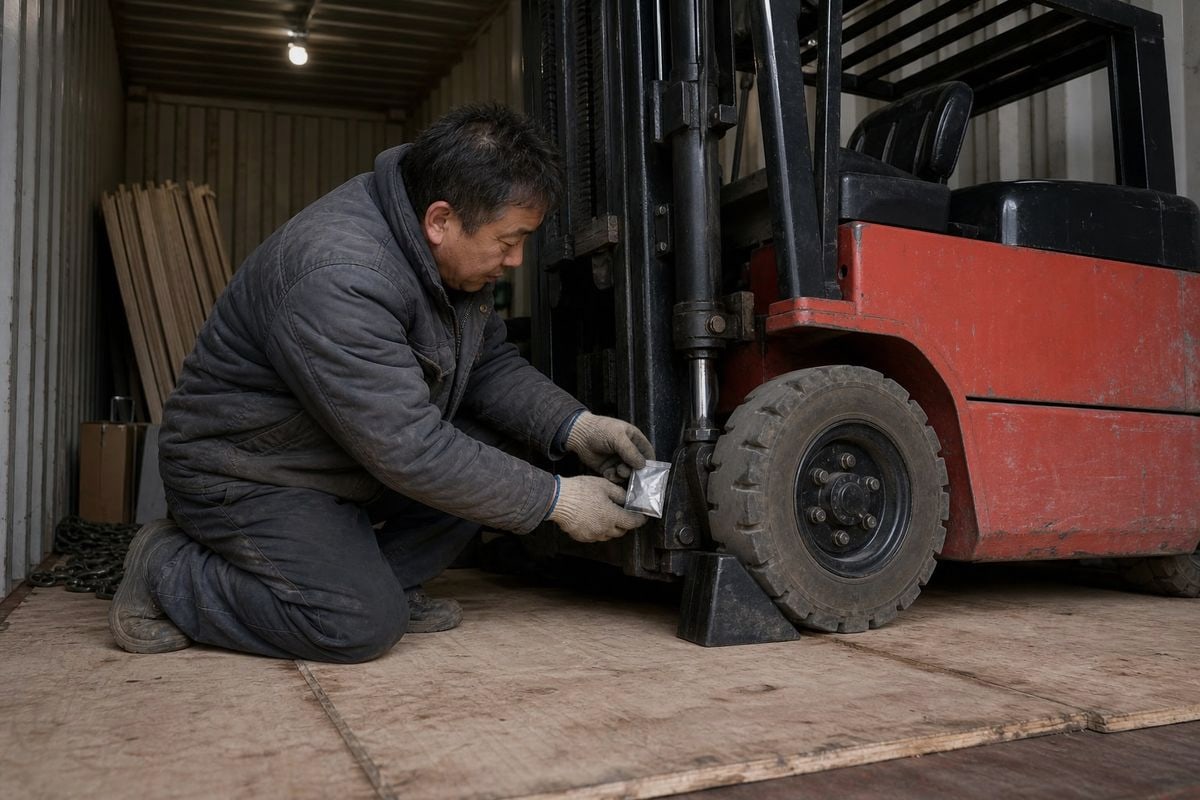
Shipping an electric forklift is not the same as shipping ordinary cargo. Batteries, hydraulics, and heavy attachments each need their own attention. I break it down into three areas.
Battery Preparation
Voor elektrische heftrucks, disconnect or isolate the battery before the machine enters the container. This prevents electrical fires and accidental activation. For any internal-combustion units in a mixed shipment, drain fuel to 25% of tank capacity to comply with International Maritime Organization 3 hazardous materials rules. Lithium battery forklifts also need correct cargo classification and documents before the cargo reaches the port. We check battery specifications with the factory early, because carrier rejection at the terminal is expensive and slow to fix.
Mast, Hydraulics, and Attachments
| Component | Risk During Ocean Transit | Best Practice |
|---|---|---|
| Mast assembly | Hydraulic seal fatigue from vertical pounding of swells | Insert a mechanical mast block or secondary locking pin |
| Forks | Sliding, floor gouging | Lower fully, rest on pallet or dunnage, strap if removable |
| Rear counterweight | Pendulum effect can snap parallel lashings | Apply cross-lashing across the counterweight |
| Side shifters, clamps | Loosening from vibration | Remove where possible; crate and strap separately |
| Chargers and spares | Impact damage | Palletize, shrink-wrap, and lash to separate lashing points 4 |
The counterweight point deserves emphasis. Its high-density mass sits behind the rear axle. During extreme vessel rolling, it acts like a pendulum. Standard parallel lashings can snap. Cross-lashing spreads that force across opposing anchor points.
Monitoring Options
For high-value fleet shipments, some of our clients add IoT impact and tilt sensors to the forklift frame. These give real-time alerts and a digital record of any excessive G-forces during the voyage, which helps enormously with insurance claims.
Hoe kan ik ervoor zorgen dat mijn heftruck schadevrij aankomt na het laden en vergrendelen in de container?
A hard lesson shaped our final-inspection routine. Years ago, a client's machine arrived with tension marks because a strap was routed over a hydraulic hose. Now nothing ships without a photographed sign-off.
Attach every strap only to designated structural points and rated container lashing points, re-tension all restraints after settling, confirm the machine touches no walls or ceiling, then photograph the finished securement from multiple angles and keep the images with your shipping documents.

The last hour before the container doors close decides whether the first seven steps actually worked. This is our verification routine, and it is the part I refuse to shortcut.
Anchor Points Matter More Than Strap Count
Straps must connect to structural points on the forklift, never to fragile parts. Hoses, the steering column, plastic covers, and the overhead guard uprights are not anchor points. On the container side, use only the rated D-rings and lashing points built into the floor rails and corner posts. A 5,000 lb strap attached to a weak point protects nothing.
The Pre-Sealing Inspection Checklist
| Controleer | What We Verify |
|---|---|
| Strap tension | Each ratchet strap is tight, at roughly 45 degrees, with no twists |
| Chock and blocking contact | Wheel chocks and nailed timber sit firm against every tire |
| Ontheffing | No part of the mast, guard, or counterweight touches walls or ceiling |
| Edge protection | Padding sits between straps and painted surfaces |
| Battery status | Isolated, with documentation matching the cargo declaration |
| Weight distribution | Load sits centered along length and across both sides |
| Photos | Wide shots plus close-ups of every lashing point and blocking cluster |
One nuance importers should understand: straps versus chains is not a universal choice. For lighter warehouse machines on shorter routes, four or more ratchet straps over solid blocking work well. For heavier counterbalance forklifts or long trans-Pacific voyages, we upgrade to Grade 70 transport chain and heavier timber shoring. The right system depends on the forklift's gross weight, the container type, and the voyage length. Also consider when not to drive the machine in at all: if the container is not on firm level ground, or clearance is too tight, use a rated ramp setup at a proper dock or switch to a flat rack.
Finally, document everything. Photos taken at loading are your evidence if damage appears at destination. We send them to every client before the vessel departs.
Conclusie
Securing a forklift inside a shipping container is a system, not a single tool. Combine fit checks, preparation, blocking and bracing, and rated restraints, then verify and photograph everything.
Voetnoten
1. US government agency providing standards for transport chain and cargo securement. ↩︎
2. Official international code of practice for packing cargo transport units safely. ↩︎
3. The UN agency responsible for the safety and security of international shipping. ↩︎
4. International organization that sets standards for shipping container structural components. ↩︎




