- +8618603825129
- [email protected]


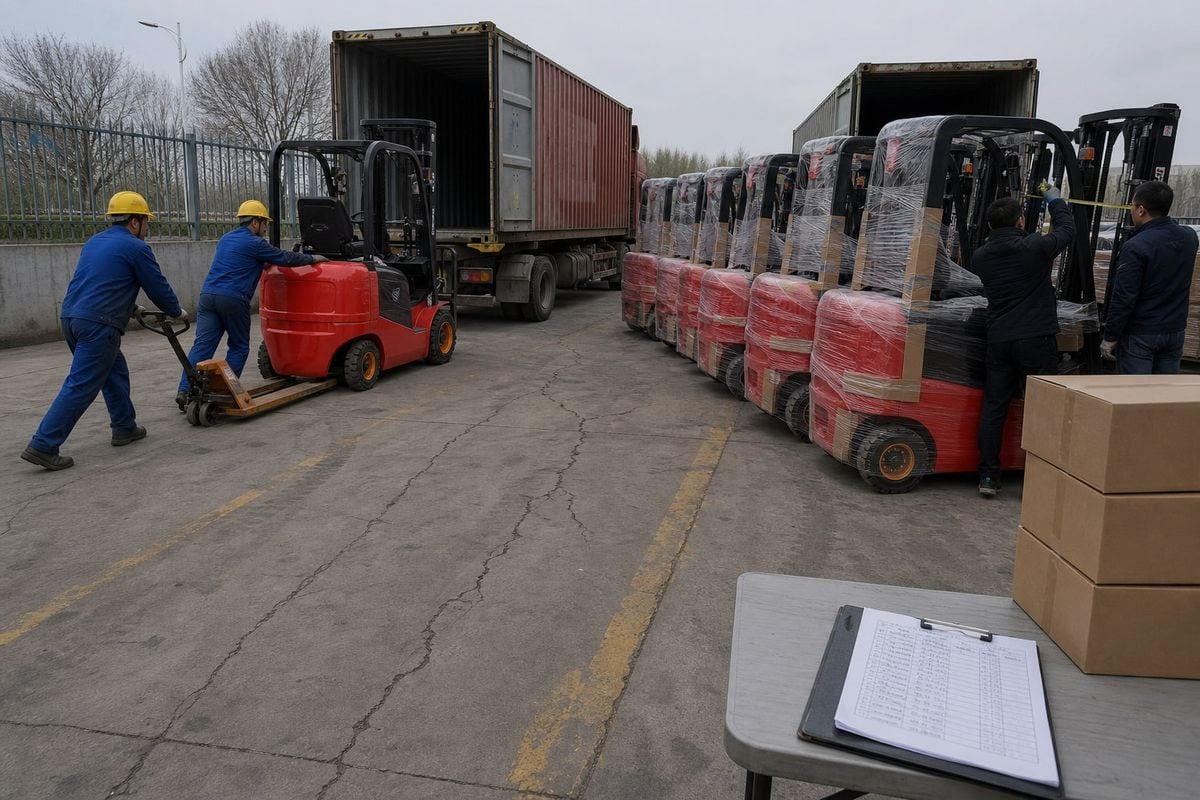
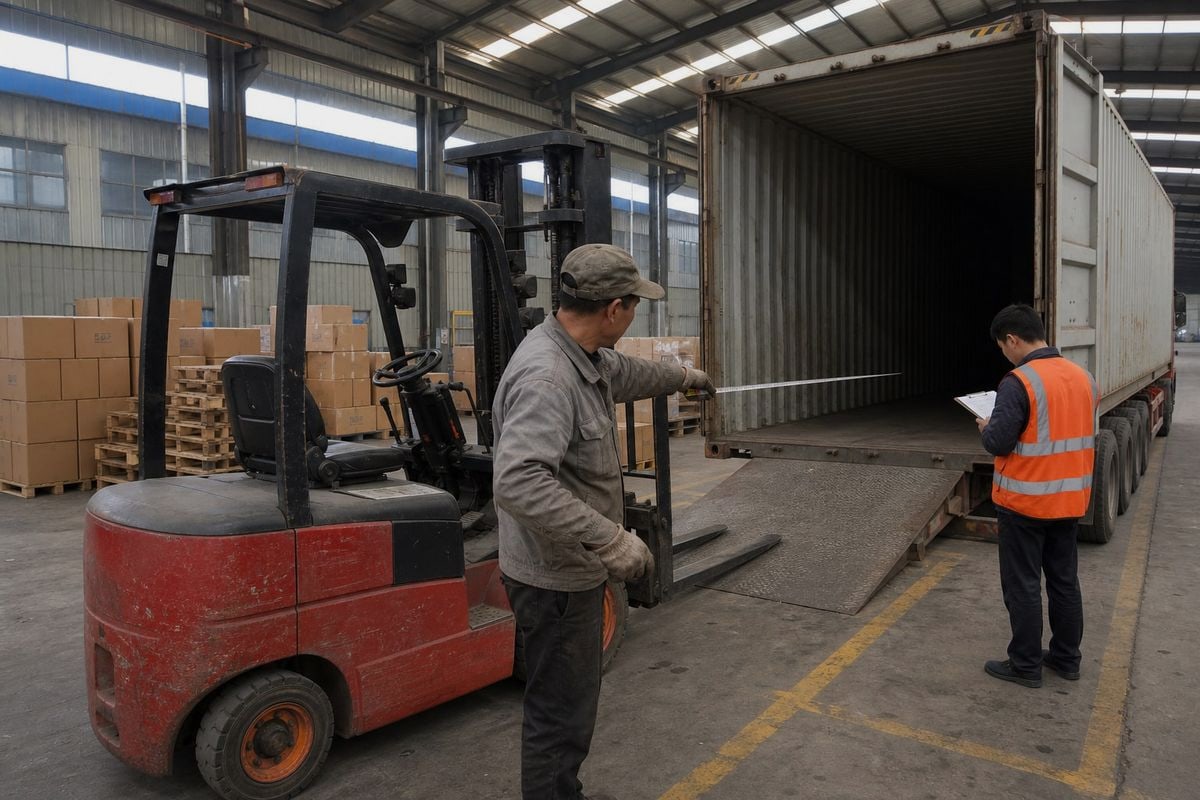
Shipping an electric forklift with the battery installed worries many importers. At our Zhengzhou warehouse, we load these machines weekly, and I have seen shipments delayed simply because nobody checked the battery rules first. One overlooked document, and your forklift sits at the port racking up storage fees while your customer waits. The good news is that the rules are manageable once you break them down by battery type and transport mode.
Yes, you can ship an electric forklift with the battery installed. Wet lead-acid units qualify for a DOT exception under 49 CFR 173.220 when secured, upright, and terminal-protected. Lithium-ion forklifts ship installed as UN 3171 Class 9 dangerous goods with UN38.3 documentation.
That short answer hides several layers. Let me walk you through the paperwork, the safety risks, the cost impact, and whether removing the battery ever makes sense.
Last year, a US distributor sent us a booking with zero battery paperwork. Our team caught it three days before the container closed. That near miss taught him what I will show you here.
You need the UN38.3 test summary, a Safety Data Sheet for the battery, a dangerous goods declaration listing UN 3171 (Battery-Powered Vehicle), battery specification sheets, and a 24-hour emergency response contact number. Ocean carriers will not accept the booking without these documents.

Documentation is where most lithium-ion battery 1 transport problems begin. The carrier does not care how well the forklift is built. It cares whether the paperwork proves the cargo is safe and correctly classified under hazmat shipping regulations.
Here is the checklist we run through with every lithium forklift shipment before the cargo leaves the factory:
| Document | What It Proves | Who Provides It |
|---|---|---|
| UN38.3 Test Summary 2 | The battery passed transport safety tests (vibration, altitude, thermal) | Battery or forklift manufacturer |
| Safety Data Sheet (SDS/MSDS) | Chemical composition and emergency handling data | Battery manufacturer |
| Dangerous Goods Declaration | Correct classification, usually UN 3171 | Shipper, prepared with the forwarder |
| Battery Specification Sheet | Voltage, capacity (Wh), chemistry | Forklift factory |
| 24-Hour Emergency Contact | Hazmat communication compliance during transit | Shipper or forwarder |
An installed lithium battery in a forklift is treated as a battery-powered vehicle, UN 3171, not as a standalone battery. This is different from UN3481 classification, which covers lithium batteries packed with or contained in smaller equipment. Getting this wrong on the dangerous goods declaration is one of the fastest ways to have a booking rejected.
Note one change coming: international maritime rules are moving lithium-ion powered vehicles toward a new UN 3556 classification starting in 2026 for more granular risk control. We already prepare clients for this so their 2026 bookings do not stall.
We collect and cross-check all of these documents from Chinese factories before the container is even booked. In our experience, factories provide them quickly when asked early — and slowly when asked at the port.
The real trade-off we weigh at loading is simple: an installed battery saves handling, but it concentrates risk inside the container. Managing that risk is a process, not a guess.
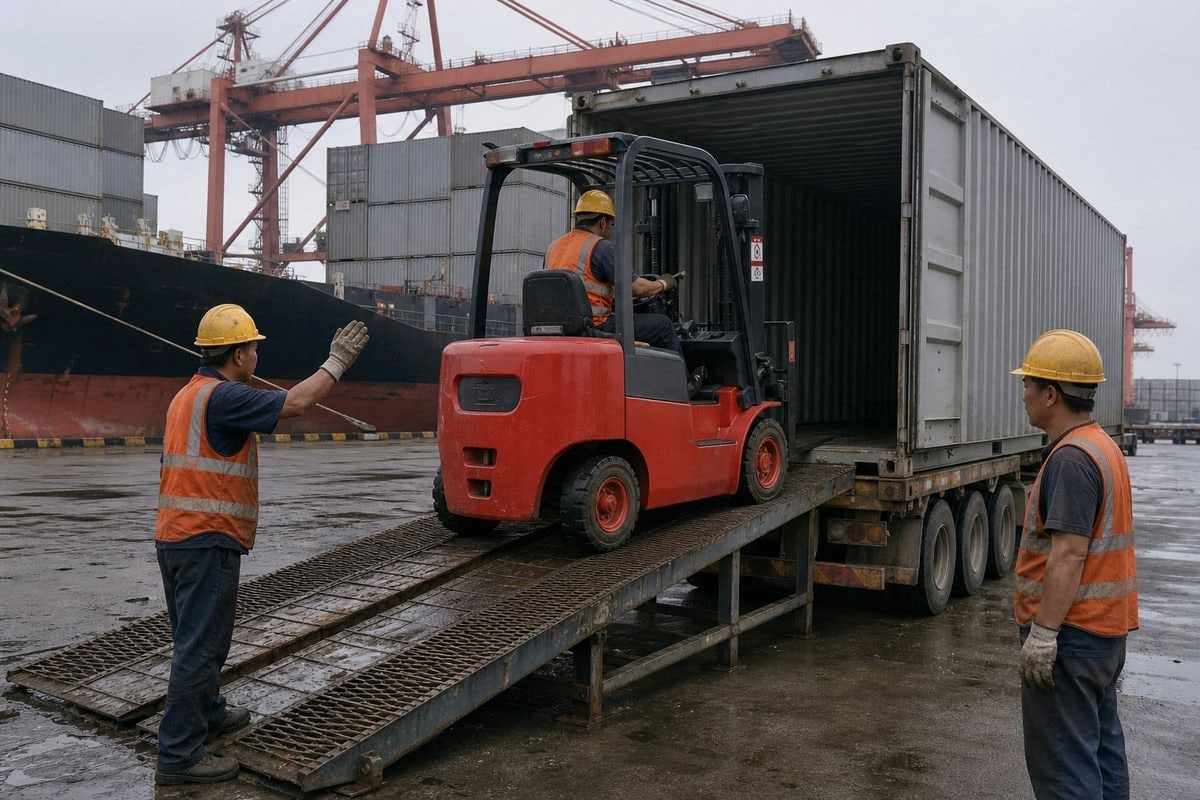
Yes, there are real risks: short circuits from exposed terminals, acid leakage from tilted wet-cell batteries, thermal runaway in lithium packs, and battery movement during rough seas. All of these are controllable through terminal protection, secure mounting, upright orientation, and proper lashing inside the container.
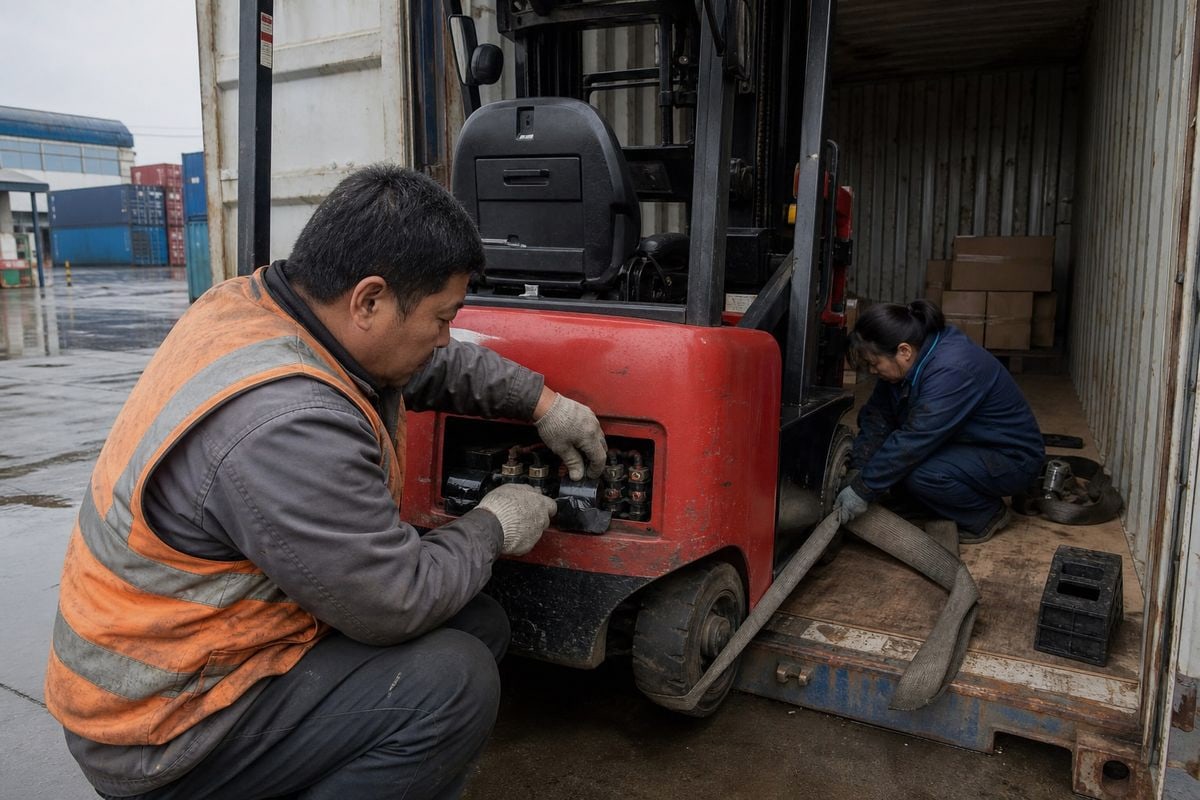
Safety risk depends heavily on battery chemistry, so I will split the discussion in two.
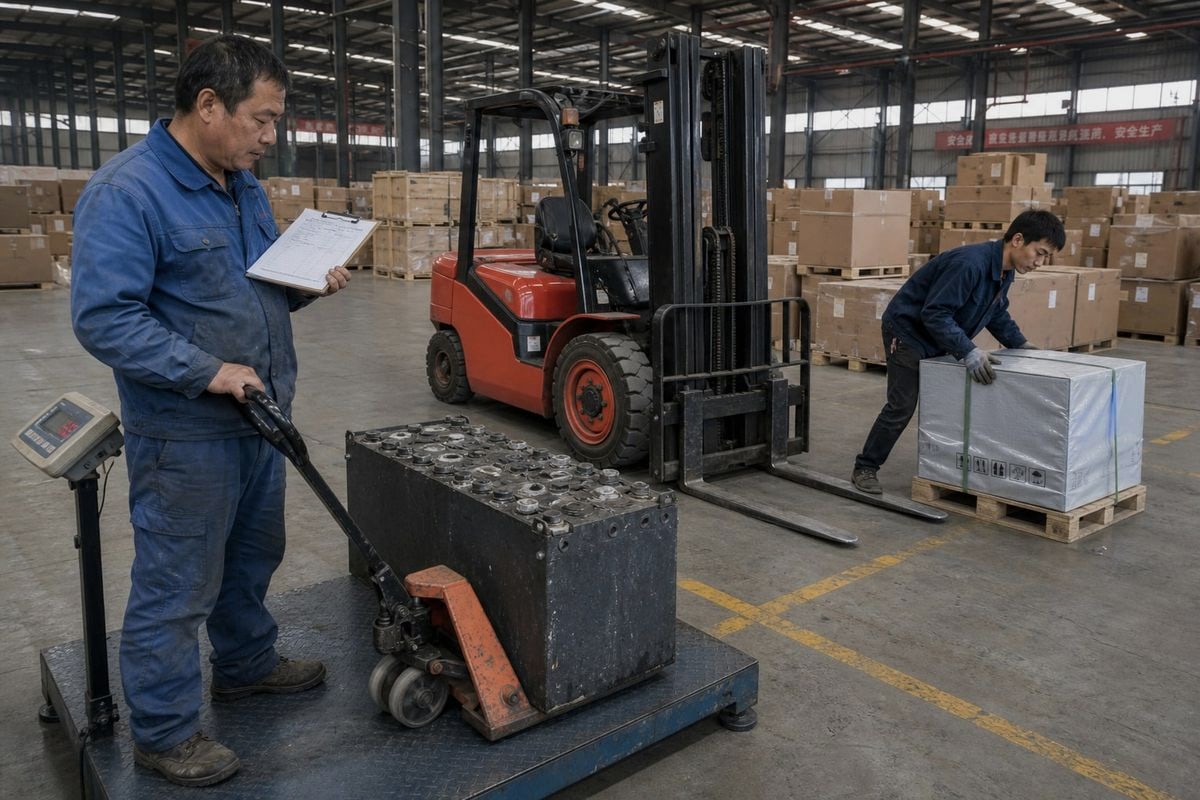
Lead-acid battery safety centers on two things: the acid and the terminals. A wet-cell battery must stay upright at all times, because tipping allows corrosive sulfuric acid to leak onto the container floor and other cargo. Spill-proof battery requirements exist precisely because carriers have seen what leaked acid does to a steel container. Terminals must be shielded with non-conductive material — we use rubber caps or heavy tape — so a stray chain or tool cannot bridge them and start an electrical fire.
There is also a quieter risk. Long-haul transport vibration can cause internal plate shedding in lead-acid batteries, which reduces capacity. That is why we advise buyers to run a diagnostic capacity test after delivery, before the forklift goes to an end customer.
Lithium packs do not leak acid, but thermal runaway 3 is the concern that drives Class 9 dangerous goods treatment. Our loading protocol addresses it in layers:
Some newer forklifts include integrated telematics that can monitor battery temperature and state of charge during transit. Where the factory supports it, that is a useful early-warning tool against thermal issues — although for ocean freight, prevention at loading matters far more than monitoring afterward.
A buyer in Texas once asked me to quote his forklift two ways — battery in, battery out — convinced the removed battery would save him money. The numbers surprised him.
Usually not by much for ocean freight. The installed battery adds weight, but ocean rates are driven by container space, not small weight changes. Extra costs come from dangerous goods surcharges on lithium units and documentation fees, typically far less than shipping the battery separately.
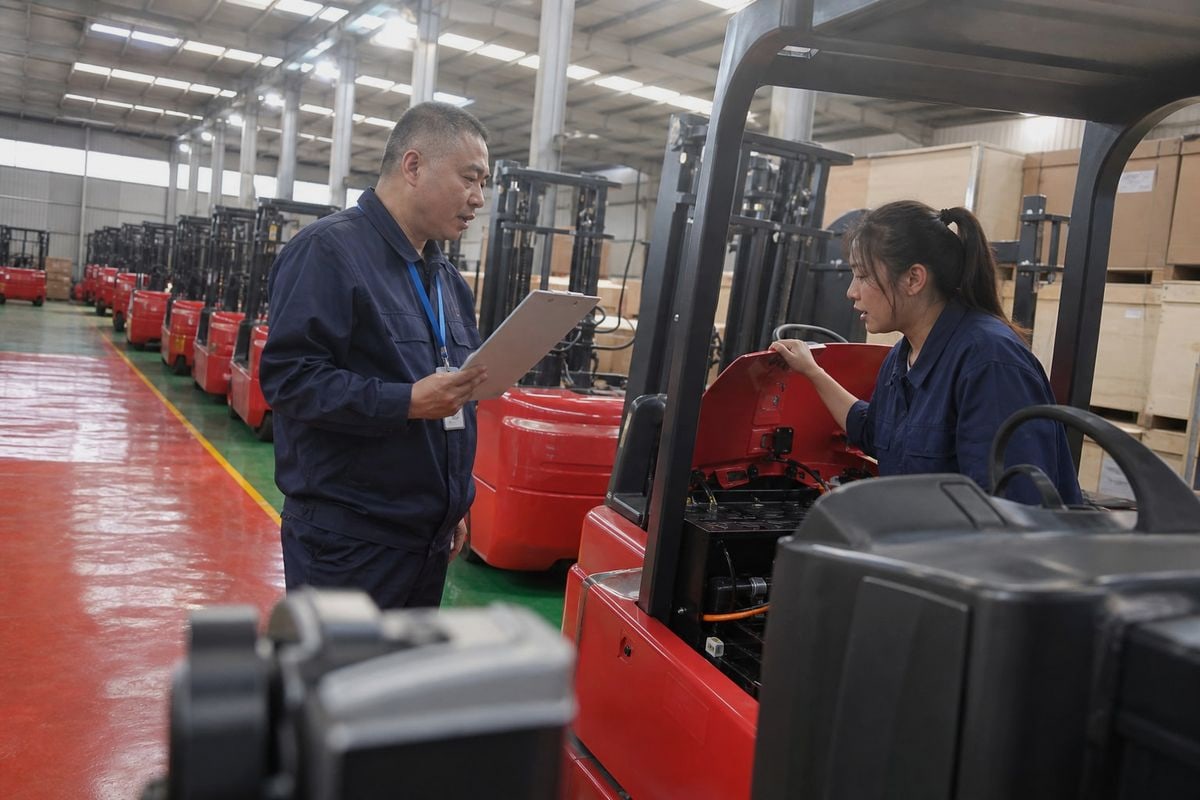
Let me break the cost question into its real components, because "freight cost" hides several separate line items.
An electric forklift battery is heavy — it often doubles as the machine's counterweight. So yes, the installed battery adds significant weight to the load, and freight weight distribution inside the container must be planned so the floor loading stays legal and the container rides balanced. On the trucking legs in China and the US, a heavier unit can occasionally push a shipment toward heavy-haul territory, though standard counterbalance forklifts in a 20FT or 40FT container rarely trigger special permits.
For ocean FCL, however, you pay for the container, not per kilogram within normal limits. The battery's weight seldom changes the ocean rate itself.
| Cost Item | Wet Lead-Acid Forklift | Lithium-Ion Forklift |
|---|---|---|
| Ocean freight base rate | Standard | Standard |
| DG surcharge | Often none (DOT exception applies domestically) | Common for Class 9 cargo |
| Documentation fees | Minimal | DG declaration + UN38.3 handling |
| Loading and securing | Standard lashing | Standard lashing + terminal protection |
| Separate battery shipment | Not needed | Not needed |
Now compare that against removing the battery. A removed lithium battery becomes a standalone dangerous goods shipment with its own packaging, its own DG paperwork, and its own handling fees. A removed wet battery loses the equipment exception entirely and must ship under full battery-specific DOT hazardous materials rules. In almost every case we quote, one consolidated shipment with the battery installed lands cheaper than two compliant shipments. That is exactly what the Texas buyer found: battery-in was the lower total.
Early in our forklift shipping work, we assumed carriers would prefer batteries removed. Experience taught us the opposite: removal usually multiplies the compliance burden instead of shrinking it.
No, in most cases you should not. An installed, secured battery ships as battery-powered equipment under one set of rules. A removed battery becomes a separate hazardous materials shipment with its own packaging, classification, and paperwork. Keep it installed unless your carrier or air freight rules force removal.

Here is the decision framework we use with clients, mode by mode.
First, an important distinction. Under DOT interpretations, a battery-powered forklift meeting the conditions of 49 CFR 173.220 4(c) — battery secured, upright, protected against short circuits and leakage, no other hazardous material aboard — is not subject to the full HMR for highway and rail transport. There is no blanket regulatory requirement to disconnect the battery.
But carriers can be stricter than the regulation. Some ocean lines and truckers ask for the battery disconnect switch to be engaged or terminals to be taped even when the rule does not demand it. We always confirm the carrier's internal policy before pickup, because "the regulation allows it" does not help you if the carrier refuses the container at the gate.
| Scenario | Keep Installed? | Notes |
|---|---|---|
| Ocean FCL, lead-acid forklift | Yes | Secure, upright, terminals protected |
| Ocean FCL, lithium forklift | Yes | Ship as UN 3171 with full DG documentation |
| Air freight, lithium battery | Usually avoid air | State-of-charge limits tightening; a 30% SOC cap applies to lithium batteries packed with equipment from 1 January 2026 |
| Battery disconnected, left in truck | Yes | Still must be protected from shorts and damage |
| Battery removed entirely | Separate shipment | Full battery-specific hazmat rules apply |
If you answer all six, shipping with the battery installed is almost always the simpler, cheaper, and safer path. We coordinate these checks directly with Chinese forklift factories so buyers like David never have to chase battery specs across time zones.
You can ship an electric forklift with the battery installed. Confirm the chemistry, secure the battery, complete the dangerous goods paperwork, and check carrier policy before booking. We handle all of it daily from China.
1. Background reference on the battery chemistry central to the article's shipping classification discussion. ↩︎
2. ISO-related transport testing standards underpin the UN38.3 certification referenced for lithium batteries. ↩︎
3. Background concept explaining the lithium battery safety hazard discussed in the article. ↩︎
4. Direct citation of the exact DOT regulation governing battery-powered vehicle transport exceptions. ↩︎