- +8618603825129
- [email protected]


Every week, our logistics team in Zhengzhou handles hundreds of cartons bound for Amazon FBA warehouses 1 in the United States. One recurring headache? Shipments rejected at the dock because of missing or incorrect "Team Lift" labels Team Lift labeling standards 2. It sounds like a small detail, but a missing sticker on a 55-pound box can trigger refusals, costly repack fees, and weeks of delay. If you ship heavy products from China to the US, this is a problem you cannot afford to ignore.
FBA Team Lift labeling standards require sellers to place warning labels on cartons exceeding specific weight thresholds — 50 lbs in North America, 15 kg in Europe — alerting warehouse workers to use two-person or mechanical handling. Failing to comply risks rejection, fees, or shipment bans at Amazon fulfillment centers.
In this guide, we break down every rule you need to know: weight thresholds by region, exact label placement, consequences of non-compliance, and how your freight forwarder can keep your shipments clean European sites 3. Let's get into it.
When we pack cartons at our consolidation warehouse, the first thing our team checks is the gross weight of each box Seller Central account 4. Many sellers overlook this step. They focus on product labels and FNSKU barcodes 5 but forget the safety labels that Amazon's receiving crew looks for first. A single overweight, unlabeled carton can hold up your entire pallet.
If your carton weighs between 50 and 100 lbs (22.7–45.4 kg) for US FBA, it requires a "Team Lift" label. Cartons over 100 lbs need a "Mechanical Lift" label. European sites trigger "Heavy Package" labeling at just 15 kg, with "Mech Lift" required at 30 kg.
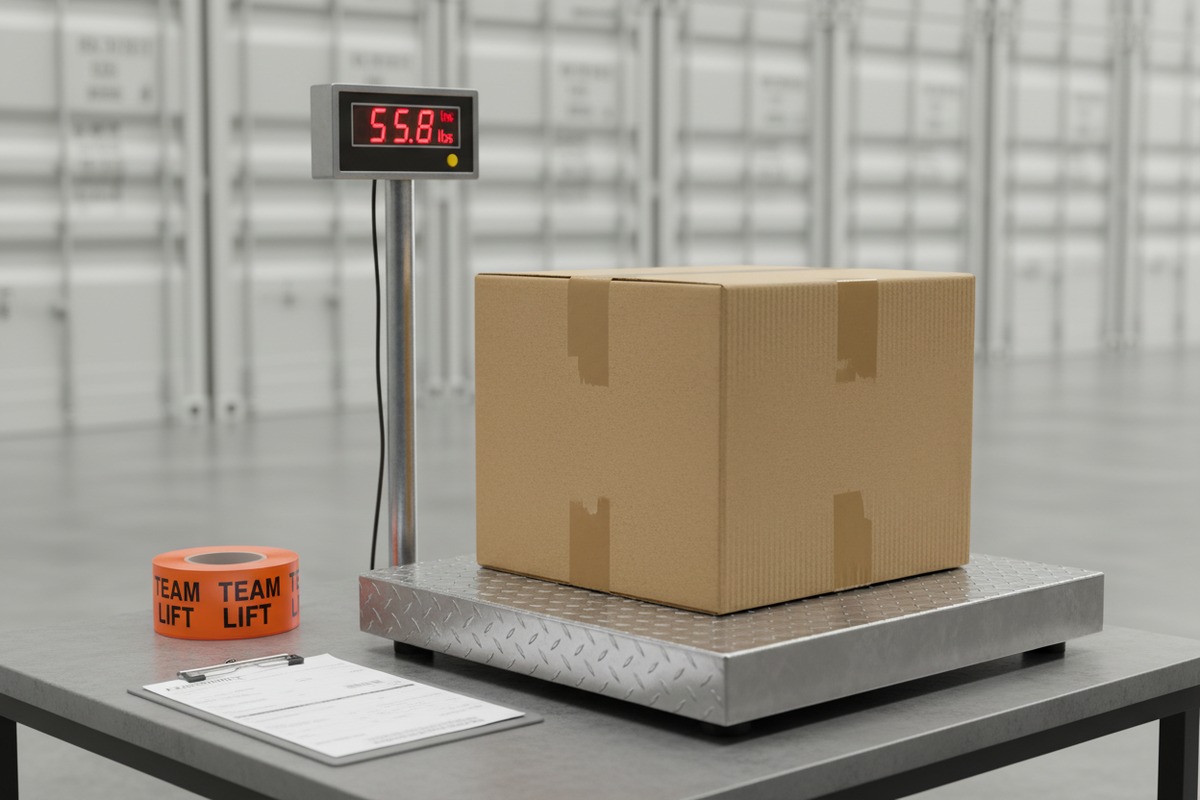
The rules are not the same everywhere. The weight that triggers a label depends on which country you are shipping to. Here is a clear breakdown:
| Region / Marketplace | No Label Needed | Team Lift / Heavy Package | Mechanical Lift |
|---|---|---|---|
| US & Canada (North America) | Under 50 lbs (≈22.7 kg) | 50–100 lbs (≈22.7–45.4 kg) | Over 100 lbs (≈45.4 kg) |
| Europe (UK, DE, FR, IT, ES) | Under 15 kg (≈33 lbs) | 15–30 kg (≈33–66 lbs) | Over 30 kg |
| Japan | Under 15 kg | 15–30 kg (Japanese text required) | Over 30 kg (must palletize) |
| General International Freight | Under 30 kg | 30–50 kg | Over 50 kg |
Amazon's standard maximum carton weight 6 for FBA in the US is 50 lbs. That means if all your items inside weigh less than 50 lbs total, you do not need a Team Lift label. But here is where sellers get confused: this 50-lb limit is also the maximum allowed weight for a multi-SKU or mixed carton. You can only exceed 50 lbs if the carton contains a single oversized unit that inherently weighs more.
We see this mistake constantly. A seller in the US measures carton weight in pounds and everything looks fine. Then they ship to Germany, where the threshold is 15 kg — roughly 33 lbs. That same 40-lb carton that needed no label in the US now requires a "Heavy Package" label on five sides for the European warehouse. Always confirm the destination marketplace's rules before packing.
At our facility, we generate printable labels automatically based on the destination. If you are shipping to the US, you get the imperial-weight Team Lift sticker. If you are going to the EU, you get the metric Heavy Package version. This removes guesswork and prevents mislabeling.
If one product unit weighs over 50 lbs by itself, you must still box it and label it. Amazon does not waive the labeling requirement just because the product cannot be split into lighter cartons. The label alerts the warehouse team to bring a partner or a forklift before attempting to move it.
Our quality control team has a saying: "A label in the wrong spot is the same as no label at all." We have seen shipments delayed because a Team Lift sticker was placed on a seam, or only applied to the top of the box. Amazon's rules on placement are strict and specific.
Team Lift and Heavy Package labels must be placed on at least the top and all four sides of the carton — five labels total for cartons over 15 kg in the EU or over 50 lbs in the US. Labels must sit on flat surfaces, away from seams, edges, and curves, and must not cover FNSKU or shipping barcodes.
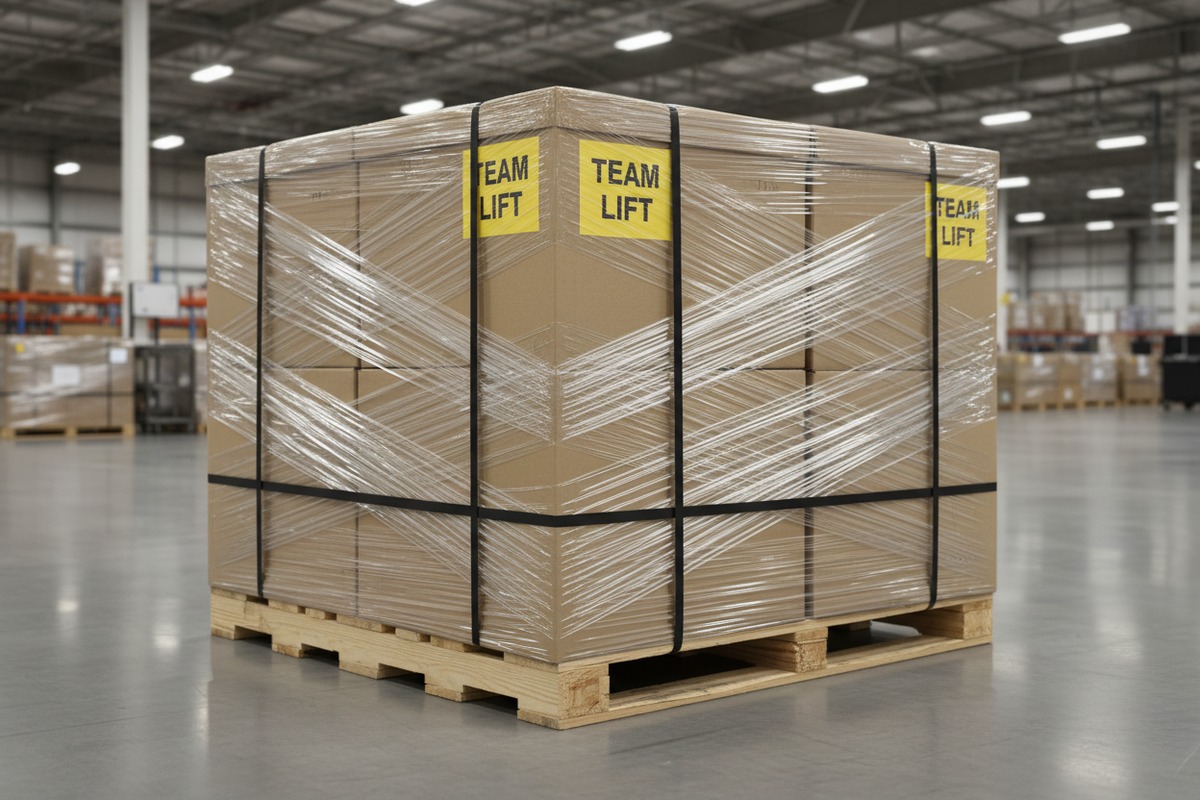
Here is exactly where each label goes:
| Label Type | Placement Location | Number of Labels | Surface Requirement |
|---|---|---|---|
| Team Lift (US/CA) | Top + 4 sides | 5 minimum | Flat, non-seam area |
| Heavy Package (EU) | Top + 4 sides | 5 minimum | Flat, non-seam area |
| Mechanical Lift | Top + 4 sides | 5 minimum | Flat, non-seam area |
| FNSKU Barcode | Flat exterior surface | 1 per unit (visible) | Away from seams, ≥50×30mm |
| Box ID / Shipping Label | Exterior side | As required per shipment plan | Flat, scannable surface |
Think about how boxes are stacked in a warehouse or container. When a pallet arrives, workers may approach from any angle. A label only on top is useless when the carton is at the bottom of a stack. By placing labels on all five accessible surfaces (top and four sides), any worker who encounters the box will see the warning immediately — regardless of orientation.
Amazon does not publish an exact minimum dimension for Team Lift labels the way it does for FNSKU barcodes (which must be at least 50×30mm). However, the label must be clearly visible and legible from a reasonable distance. In practice, most compliant labels are at least 3×5 inches. The text "TEAM LIFT" or "Caution: Heavy Package" should be bold and printed in a contrasting color — black text on a bright yellow or orange background is the industry standard.
Your Team Lift labels must not overlap or obscure:
If your carton is small and surface space is tight, plan your label layout before printing. We typically design a label map for each carton size we handle so that every sticker has a designated zone.
Beyond labels, Amazon also enforces packaging specifications for heavy cartons. Boxes over 50 lbs should use double-wall or triple-wall corrugated cardboard 7 (at least 5mm thick). Single-wall cardboard is too weak for heavy loads and can collapse during transit or stacking. For bulky and heavy items like furniture or appliances, reinforced edges and corner protectors are recommended. No single side of a standard carton should exceed 25 inches (63.5 cm) unless the box contains one oversized unit.
If you ship via LTL or FTL 8 (less-than-truckload or full truckload), your pallets need their own labels too. Each pallet should display weight, height, and handling instructions 9 on both the center and the side. This is separate from the carton-level Team Lift labels. Both layers of labeling are required.
We learned this lesson early in our business. A client shipped 200 cartons to an Amazon FBA warehouse in California. Every box weighed 52 lbs. Not one had a Team Lift label. The entire shipment was flagged at receiving. The result? A two-week delay, repackaging fees, and an inbound performance defect on the seller's account. It was an expensive lesson.
Non-compliance with FBA labeling standards can result in shipment refusal at the fulfillment center, mandatory repackaging at the seller's expense, inbound performance defects on your Seller Central account, and in repeated cases, suspension of your ability to send future inbound shipments.
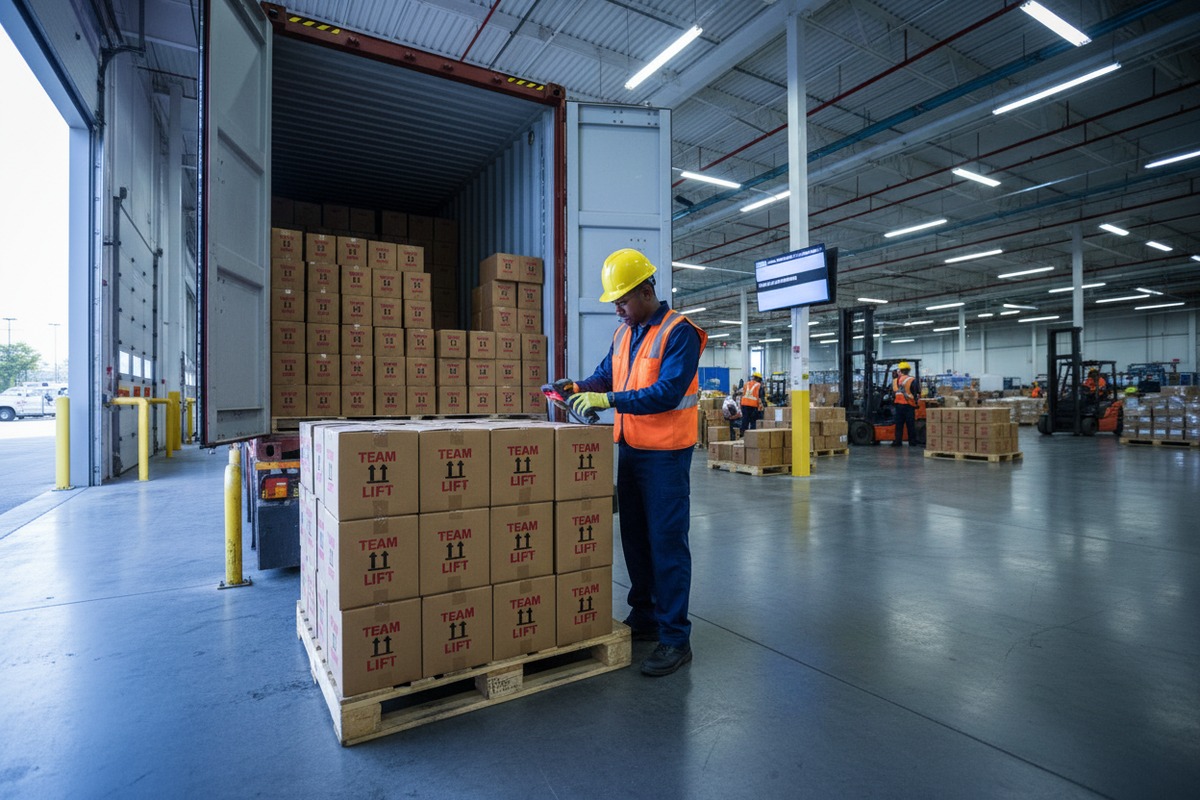
Amazon has been tightening enforcement steadily. As of 2026, the company has phased out its own FBA prep services. This means Amazon no longer fixes your labeling mistakes for a fee. If your cartons arrive mislabeled, they are rejected outright. There is no safety net.
The consequences escalate:
Let's put real numbers on this. Suppose you ship a 40-foot container of goods from China to a US FBA warehouse. The freight cost alone might be $4,000–$8,000. If that container is rejected at the Amazon dock because of missing Team Lift labels, you now face:
The total cost of a labeling mistake can easily exceed $3,000–$5,000 — far more than the cost of doing it right the first time.
Labeling issues do not only cause problems at Amazon. If your cartons lack proper handling labels, customs officials in the destination country may flag them for additional inspection. In the US, CBP (Customs and Border Protection 10) can hold shipments that appear improperly marked. In Europe, local health and safety regulations treat missing heavy-load warnings as a compliance violation. This can add days or even weeks to your transit time.
Amazon tracks inbound performance metrics closely. Every defect — whether it is a missing label, an overweight unlabeled carton, or an oversized box — counts against your account. Too many defects and you lose access to certain shipping methods or FBA features. For high-volume sellers, this is a serious operational risk.
In our Zhengzhou consolidation warehouse, we treat FBA compliance as a built-in step — not an afterthought. Every carton that passes through our facility is weighed, measured, and checked for the correct labels before it is loaded into a container. This is not optional. It is part of our standard operating procedure for every Amazon-bound shipment.
Your freight forwarder should verify carton weights, generate marketplace-specific labels (Team Lift, Heavy Package, or Mech Lift), confirm box dimensions, and perform pre-shipment quality inspections — all before cargo leaves the origin country. This prevents rejections, customs delays, and costly corrections at the destination.
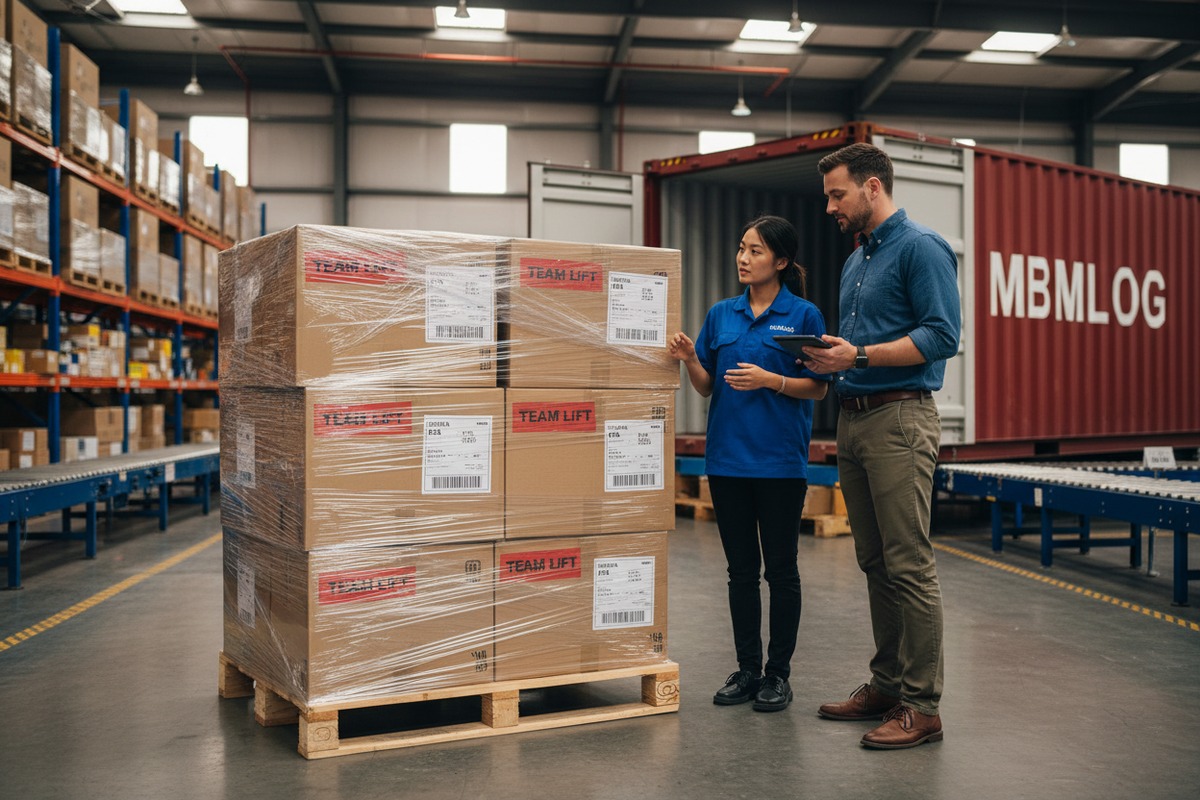
The key principle is simple: fix everything in China before the container ships. Correcting a labeling error in Zhengzhou costs a few cents. Correcting it in Los Angeles costs hundreds of dollars. Here is the checklist we use:
| Compliance Step | What We Check | Action If Non-Compliant |
|---|---|---|
| Carton gross weight | Weigh every carton on calibrated scale | Repack to stay under 50 lbs or apply Team Lift label |
| Carton dimensions | Measure all three sides | Repack if any side exceeds 25 inches (for standard) |
| Team Lift / Heavy labels | Verify presence on 5 sides if over threshold | Print and apply correct labels for destination market |
| FNSKU barcodes | Scan each barcode for readability | Reprint and reapply if damaged or unreadable |
| Box ID / Shipment labels | Match to Amazon shipment plan | Regenerate from Seller Central if mismatched |
| Packaging integrity | Check for double-wall cardboard, sealing quality | Reinforce or rebox weak cartons |
| Pallet labels (LTL/FTL) | Weight, height, handling labels on center and side | Add pallet-level labels before loading |
The most effective way to prevent compliance issues is communication. Before your Chinese supplier even starts production, share your Amazon marketplace's labeling and weight requirements with them. Send them the exact label templates. Specify the maximum carton weight. Tell them which side of the box to leave clear for FNSKU placement. Many factories are willing to print labels directly onto cartons during production — but only if they receive the specifications early.
We use logistics management software that automatically generates the correct labels based on the shipment destination. When a seller tells us they are shipping to FBA US, the system knows to check for the 50-lb Team Lift threshold. When the destination is FBA Germany, it switches to the 15-kg Heavy Package standard and prints labels in the correct format. This eliminates human error and speeds up the process.
For high-value or high-volume shipments, we recommend AQL Level II sampling inspections. This means we randomly select a statistically significant number of cartons from the shipment and inspect them for:
If defects are found in the sample, we flag the entire batch for re-inspection. This catches problems before they leave China — not after they arrive at an Amazon dock in the US.
Not all freight forwarders understand Amazon's requirements. A general cargo forwarder might ship your container safely from port to port but will not check whether your Team Lift labels are in the right place. That is why working with a forwarder who specializes in FBA shipments makes a real difference. We handle the entire process — from warehouse pickup in China, through consolidation and compliance checks, to DDP delivery at the Amazon fulfillment center in the US. Every step includes built-in compliance verification.
One additional benefit of proper carton weight management: it reduces packaging waste. When you optimize carton sizes and weights to stay under thresholds, you use less void fill, fewer oversized boxes, and less corrugated material. This aligns with Amazon's evolving environmental initiatives and can also reduce your dimensional weight charges on shipping.
FBA Team Lift labeling is a small detail with big consequences. Know your weight thresholds, label all five sides, and work with a freight forwarder who checks compliance before your cargo leaves China. Getting it right at the source saves you time, money, and your Amazon account health.
1. Explains FBA warehouses and their function. ↩︎
2. Found authoritative Amazon Seller Central page detailing FBA shipping and routing requirements, including Team Lift labels. ↩︎
3. Details FBA heavy package labeling requirements for Europe. ↩︎
4. Official portal for Amazon sellers to manage their business. ↩︎
5. Explains what FNSKU barcodes are and their necessity for FBA. ↩︎
6. Provides official Amazon FBA standard weight limits. ↩︎
7. Explains different types and construction of corrugated fiberboard. ↩︎
8. Defines and differentiates Less-than-Truckload (LTL) and Full Truckload (FTL) shipping. ↩︎
9. Provides guidelines for safe pallet handling and loading. ↩︎
10. Official government agency responsible for border security and trade. ↩︎