
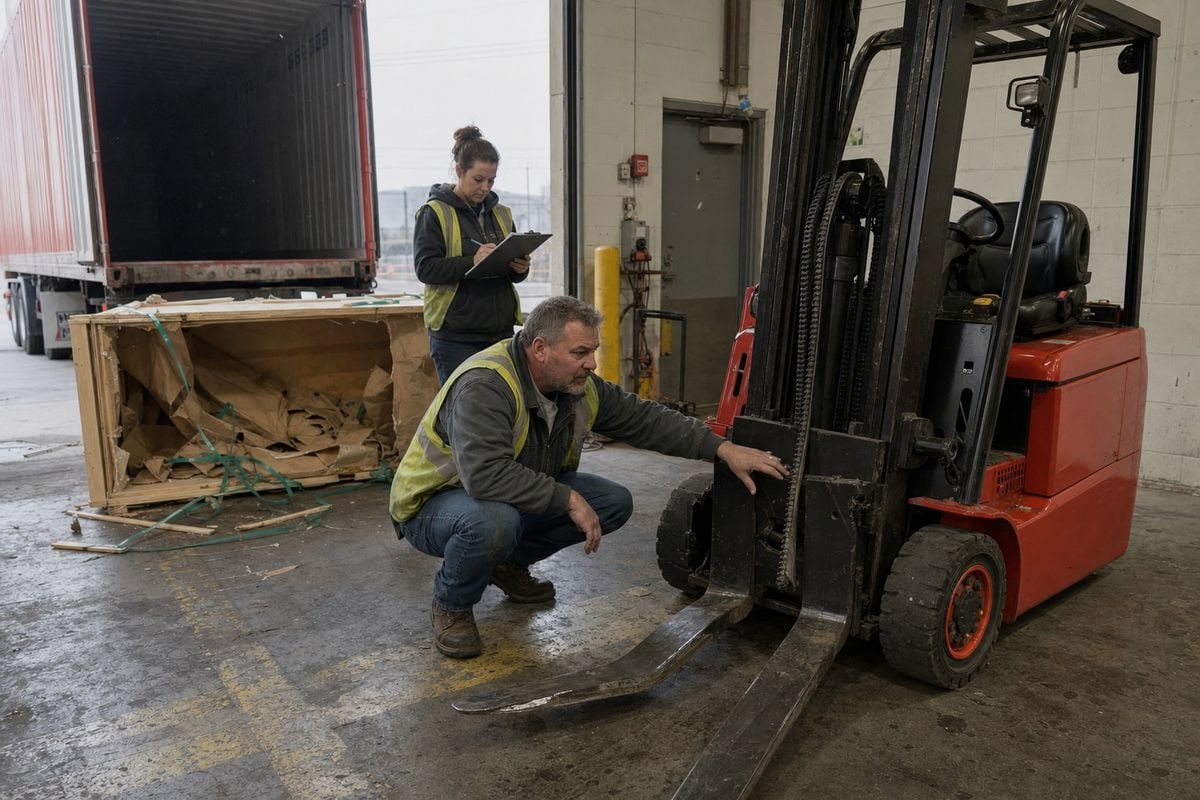
Marine cargo insurance for forklift shipments is a question I answer almost weekly at our Zhengzhou logistics office. A forklift can be damaged before it ever lifts a single pallet. One rough crane move at the port, one hard braking event on the inland truck, and a $15,000 machine arrives with a bent mast. The carrier then offers you a few hundred dollars. That gap is exactly why our team at MBMLOG pushes every forklift importer to understand transit insurance before the container leaves the factory.
Marine cargo insurance for forklift shipments is a transit insurance policy that pays the owner for physical loss or damage to a forklift while it moves by sea, road, rail, or air. It covers the machine's declared value from warehouse to warehouse, filling the gap left by limited carrier liability.
The word "marine" confuses many buyers. It does not mean ocean only. Modern marine cargo policies, including inland marine insurance products 1, cover the full multimodal journey. Let me break down cost, coverage, claims, and whether you truly need it.
How Much Does Marine Cargo Insurance Cost for My Forklift Shipment?
A distributor in Texas once told me he skipped insurance on a two-forklift container to save about $180. He got lucky. I told him the math rarely rewards that gamble twice.
Marine cargo insurance typically costs 0.5% to 1.0% of declared cargo value for standard goods, and 1.0% to 2.0% for higher-risk cargo like forklifts. Insuring a $20,000 forklift shipment usually costs roughly $100 to $400, depending on route, packaging, and policy type.

The premium is a percentage of the insured value, and forklifts sit at the higher end of the range. Insurers see them as heavy machinery transport risk 2: expensive, top-heavy, awkward to secure, and often battery-powered. Here is how the main pricing factors play out in real quotations we arrange for clients.
What Drives the Premium Up or Down
| Pricing Factor | Lower Premium | Higher Premium |
|---|---|---|
| Declared value | Invoice value only | Invoice + freight + 10% |
| Coverage type | Named perils / total loss only | All-risk coverage |
| Transit legs | Port-to-port ocean only | Warehouse-to-warehouse, multimodal |
| Packaging | Professionally crated and lashed | Loose loading, no securing plan |
| Battery type | Lead-acid or battery removed | Lithium-ion installed |
| Route | Direct China–US West Coast | Transshipment, high-risk destinations |
Invoice Value vs. Agreed Value
New forklifts are usually insured at CIF value plus 10%. Refurbished units are trickier. Book value on a rebuilt machine is heavily depreciated, so we recommend an agreed value clause. It locks the payout to the machine's actual market value, not a depreciation table. That matters when a five-year-old reach truck was just fully rebuilt.
Per-Shipment vs. Open Cargo Policy
If you import one container a year, buy a single-shipment transit insurance policy. If you move forklifts monthly, an open cargo policy gives blanket coverage for all shipments in a year at a discounted fixed rate. Several of our regular US distributors switched to open cover and cut their per-unit insurance cost noticeably while removing the risk of forgetting to insure one shipment.
What Does Marine Cargo Insurance Actually Cover When Shipping Forklifts from China?
Every time our loading team photographs a forklift being lashed inside a 40HQ container, I am reminded that coverage wording decides everything if that lashing ever fails at sea.
Marine cargo insurance covers physical loss or damage to a forklift from external causes during transit, including dropping during loading, crushing, collision, theft, seawater or weather damage, and General Average charges. It excludes wear and tear, inherent defects, poor packaging, and usually delay.

Policy wording matters more than the sales pitch. Most quality forklift cover is written under the Institute Cargo Clauses (A) 3, the broadest "all-risk" wording. But even all-risk coverage has hard exclusions, and forklift buyers need to know both sides.
Covered vs. Not Covered
| Typically Covered | Typically Excluded |
|---|---|
| Forklift dropped during crane loading | Ordinary wear and tear |
| Crushed in a truck or vessel collision | Pre-existing mechanical defects |
| Seawater ingress and salt-water corrosion | Damage from insufficient packing or securing |
| Theft or non-delivery in transit | Delay and loss of market |
| Damage during warehouse transfer (if included) | Willful misconduct of the insured |
| General Average and salvage contributions | Strikes and war unless added by clause |
The Clauses That Matter Most for Forklifts
A warehouse-to-warehouse clause is essential. In our experience, the first and last mile — factory loading in China and final delivery trucking in the US — carry the highest physical damage risk, not the ocean leg itself. Port-to-port cover leaves you exposed exactly where forklifts get hurt.
General Average deserves special attention. If the vessel's crew jettisons cargo or incurs salvage costs to save the ship, every cargo owner on board must pay a proportional share of the loss, even if their forklift is untouched. Cargo insurance is the only practical protection against that bill, and it can be enormous.
Electric Forklifts and Batteries
Lithium-ion forklifts are our core cargo at MBMLOG, and they add a layer. Some insurers now offer environmental liability endorsements covering hazmat cleanup if lithium-ion or lead-acid batteries are compromised in a maritime incident. Confirm whether batteries are covered installed, packed separately, or both. Also confirm whether your policy covers RoRo shipping if the forklift is driven on rather than containerized, since handling exposure differs.
How Do I File a Claim If My Forklift Is Damaged During Ocean Freight?
The hardest lesson we learned came from a client who signed a clean delivery receipt, then found a cracked counterweight two days later. That signature nearly killed his claim.
To file a cargo damage claim, inspect the forklift immediately at delivery, note all damage on the delivery receipt, photograph everything, and notify the insurer in writing right away. Submit the commercial invoice, bill of lading, packing list, survey report, and policy certificate to support the claim.

Cargo damage claims live or die on documentation and speed. Insurers expect you to act like the damage matters from minute one. Here is the process we walk our forklift importers through.
The Claim Process, Step by Step
- Inspect before signing. Open the container and check the forklift while the driver is present. Look at the mast, forks, overhead guard, counterweight, tires, and battery compartment.
- Note exceptions on the delivery receipt. Write specific damage descriptions. Never sign clean if anything looks wrong. "Subject to inspection" is better than nothing.
- Photograph everything immediately. Shoot the container seal, the lashing condition, and the damage from multiple angles before moving the machine.
- Notify the insurer and forwarder in writing within the policy deadline. Most policies require prompt notice, often within days. Do not repair anything before the insurer responds.
- Request a survey for major damage. The insurer may appoint a marine surveyor to inspect the forklift and document the cause.
- Compile the document package. Commercial invoice, ocean bill of lading, packing list, insurance certificate, delivery receipt with exceptions, photos, survey report, and a repair estimate or replacement quote.
- File the formal claim and preserve recovery rights. The insurer pays you, then pursues the responsible carrier through subrogation.
Hidden Damage Is the Hard Case
Internal damage — a shock-loaded hydraulic pump or a jarred battery pack — may not show at delivery. Report suspected hidden damage as soon as it is found, ideally within three days. A newer development helps here: advanced insurers are beginning to accept forklift telematics data, using G-force and tilt sensor logs as forensic evidence of a transit impact. That data can dramatically speed up disputes over when damage occurred.
Do I Really Need Cargo Insurance for a Full Container Forklift Shipment?
Buyers often push back with this exact objection: "It's my own sealed FCL container — the shipping line is responsible, right?" I understand the logic. It is also the most expensive assumption in ocean freight.
Yes, you need it. Carrier liability under the Carriage of Goods by Sea Act is capped at just $500 per package or unit, far below any forklift's value. Cargo insurance is the only way to recover the full replacement value, even for sealed FCL shipments.

Ocean freight liability rules 4 were written to protect carriers, not shippers. COGSA's $500-per-unit limit means a $22,000 electric forklift crushed by a collapsed container stack might recover $500 from the carrier — and only if you can prove carrier negligence, which excludes perils of the sea, fire, and many other defenses. Freight forwarder liability is similarly limited by contract terms. The financial gap sits with you.
Carrier Liability vs. Cargo Insurance
| Question | Carrier / Forwarder Liability | Marine Cargo Insurance |
|---|---|---|
| Maximum recovery | ~$500 per unit under COGSA | Full declared or agreed value |
| Must you prove fault? | Yes, and carriers have many defenses | No, only that loss occurred in transit |
| Covers General Average? | No — you still owe your share | Yes, when included |
| Covers first/last mile? | Fragmented across parties | Yes, with warehouse-to-warehouse cover |
| Speed of payment | Slow, often disputed | Faster, insurer subrogates afterward |
Check Your Incoterms First
Before buying a policy, confirm who is obligated to insure. Under CIF, the Chinese seller must procure insurance — but often only minimum cover, and only to the destination port. Under EXW or FOB, the buyer carries the risk and must arrange cover for most or all of the journey. Many of our US clients buying FOB assumed the factory insured the cargo. It had not.
There are also soft costs. If a damaged or delayed forklift forces you to rent replacement material handling equipment, standard policies will not pay. Logistics-contingency riders now exist to cover daily rental fees when shipments are held up by port congestion or labor strikes. Delay coverage is not standard, so confirm it in writing. Given international shipping regulations, limited liability regimes, and forklift values, a premium of one to two percent is cheap risk transfer.
Conclusion
Marine cargo insurance for forklift shipments protects your machine's full value where carrier liability stops at $500. Insist on all-risk, warehouse-to-warehouse cover, document everything, and ship with confidence.
Footnotes
1. Authoritative industry body explaining the scope and application of inland transit insurance. ↩︎
2. Specialist insurer providing risk management insights for the international transport of heavy machinery. ↩︎
3. Official organization providing the standard wording for international cargo insurance clauses. ↩︎
4. United Nations body providing research and standards on international maritime transport regulations. ↩︎




