- +8618603825129
- [email protected]

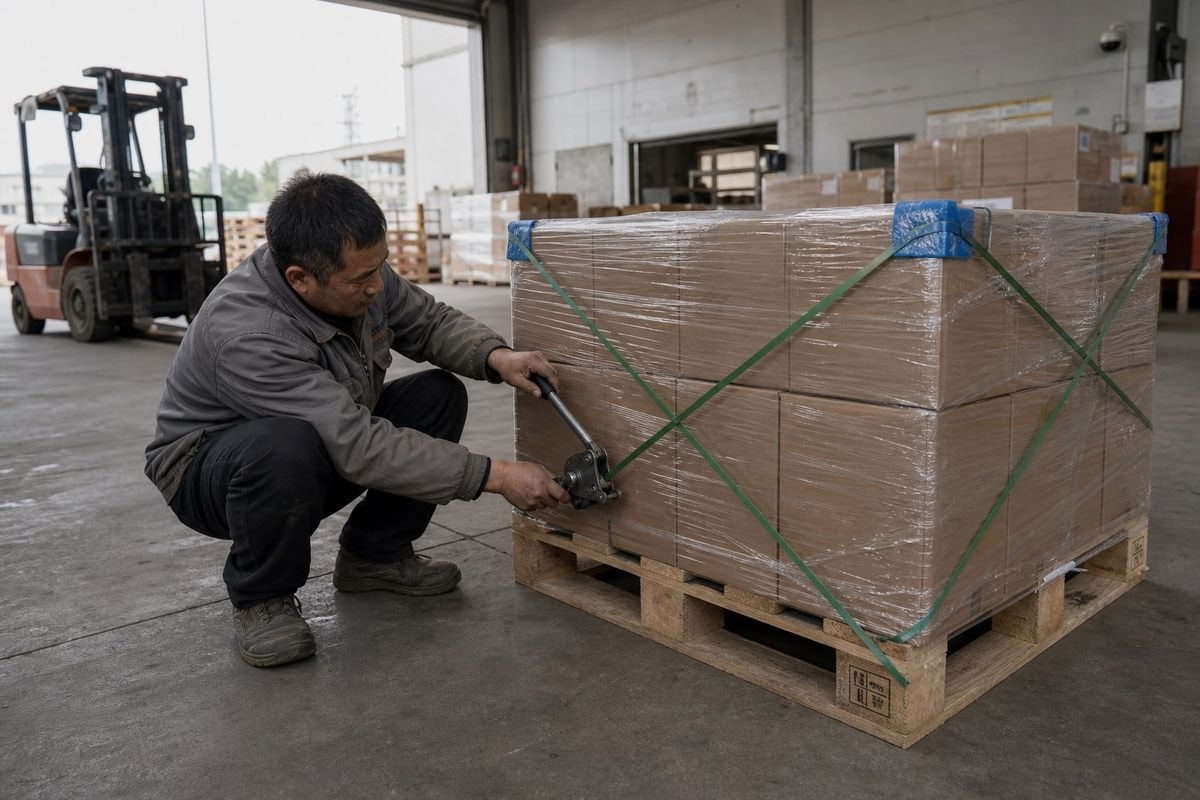
Learning how to palletize heavy cargo the best way saved my clients thousands in re-work fees. At our Zhengzhou consolidation warehouse, I see the same failure repeat: a factory stacks a ton of goods on a thin pallet, the deck cracks, boxes crush, and the shipment misses its vessel. Suddenly the seller faces re-palletizing charges, delayed inventory, and angry customers. The fix is a disciplined palletizing system, and I will walk you through the exact one we use.
To palletize heavy cargo the best way, use a reinforced double-faced wooden pallet rated for 1,000–1,500 kg dynamic load, place the heaviest items on the bottom layer, keep everything inside the pallet footprint, then secure with tight stretch wrap plus crossed strapping and corner protectors.
That is the short answer. Now let me break it down step by step, from pallet selection to Amazon FBA compliance, using real cases from our China to USA shipments.
A cracked pallet under a one-ton load is a disaster waiting for a forklift. In our warehouse, we reject thin single-face pallets for heavy freight before they ever reach a container.
Choose the pallet by dynamic load rating, not price. Standard single-face wooden pallets carry only 500 kg dynamically and fail under heavy cargo. For any pallet over 800 kg, use a thickened double-faced or stringer-reinforced solid wood pallet rated 1,000–1,500 kg, with IPPC heat treatment for export.
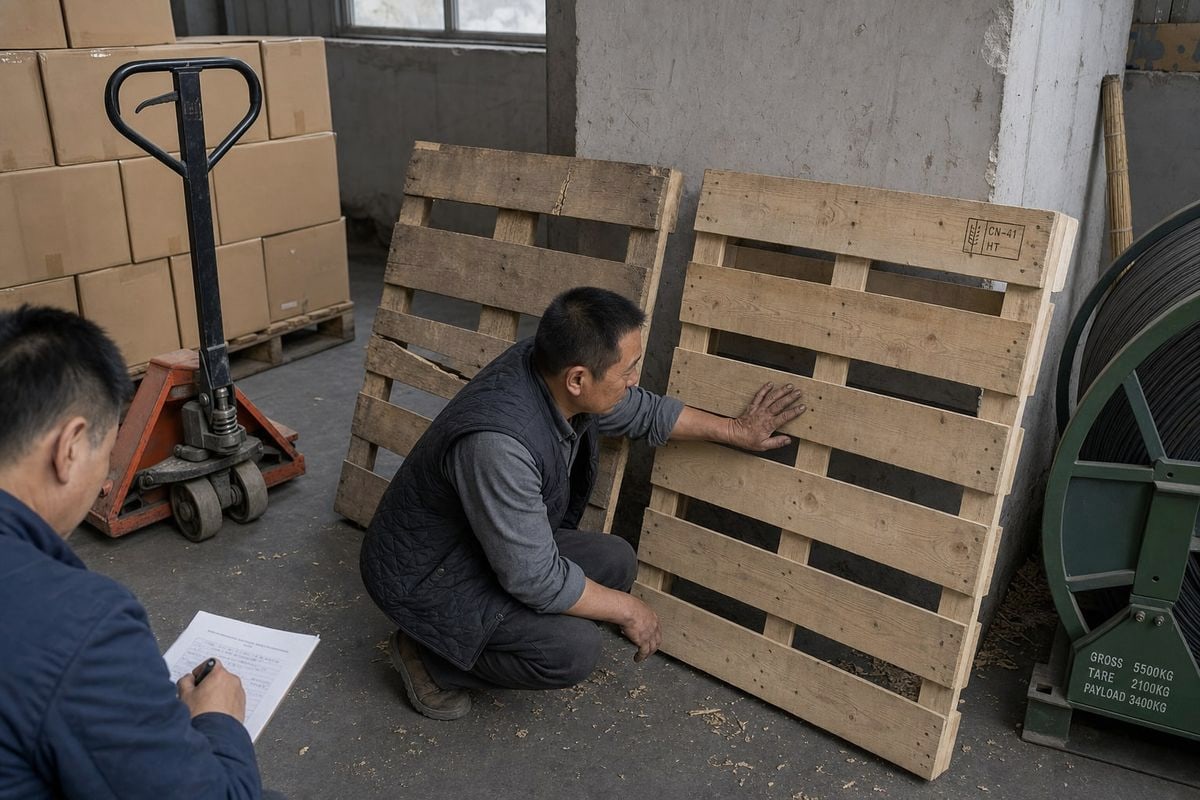
The most common mistake I see is treating all pallets as equal. They are not. A pallet has two load ratings. Static load is what it holds sitting still. Dynamic load is what it holds while a forklift moves it. Heavy cargo lives and dies by the dynamic number.
Here is the comparison we give every client before booking:
| Pallet Type | Dynamic Load | Best For | Notes |
|---|---|---|---|
| Standard single-face wood (1200×1000/1100) | ≤500 kg | Light general cargo | Not suitable for heavy freight; deck cracks easily |
| Thickened double-faced / stringer-reinforced wood | 1,000–1,500 kg | Loads of one ton — first choice | Add bottom runners if the single pallet weight is ≥1.2 tons |
| IPPC heat-treated export wood pallet | Varies by build | All wood exports to the USA | Must be the thickened version for heavy goods; thin ones collapse |
| Heavy-duty injection-molded plastic | 1–2 tons | Wet environments, repeat use | Waterproof but higher cost |
For China to USA shipping, wooden pallets must carry the IPPC stamp 1, or US customs can refuse the shipment. We verify this stamp on every pallet entering our warehouse. Plastic pallets skip fumigation rules entirely, which is why some of our machinery clients choose them despite the cost.
If your cargo goes into a US warehouse system, GMA pallet standards 2 matter: 48×40 inches, four-way forklift entry, intact deck boards and stringers. Never reuse thin, cracked, or board-missing old pallets for heavy freight. A broken pallet at the destination means detention fees and re-stacking charges. Our rule is simple: any single pallet over 800 kg gets a thickened stringer-reinforced solid wood pallet, no exceptions.
There is always a trade-off I weigh when supervising loading: column stacking gives the best vertical compression strength 3, while interlocked brick patterns give better lateral load stability. For heavy cargo, we usually combine both.
Stack heavy cargo bottom-heavy: heaviest items on the base layer, light items on top, weight distributed evenly across each layer. Keep boxes tight with minimal gaps, cross-stack layers for stability, allow zero overhang, and cap total height at 1.1–1.2 meters for containers.
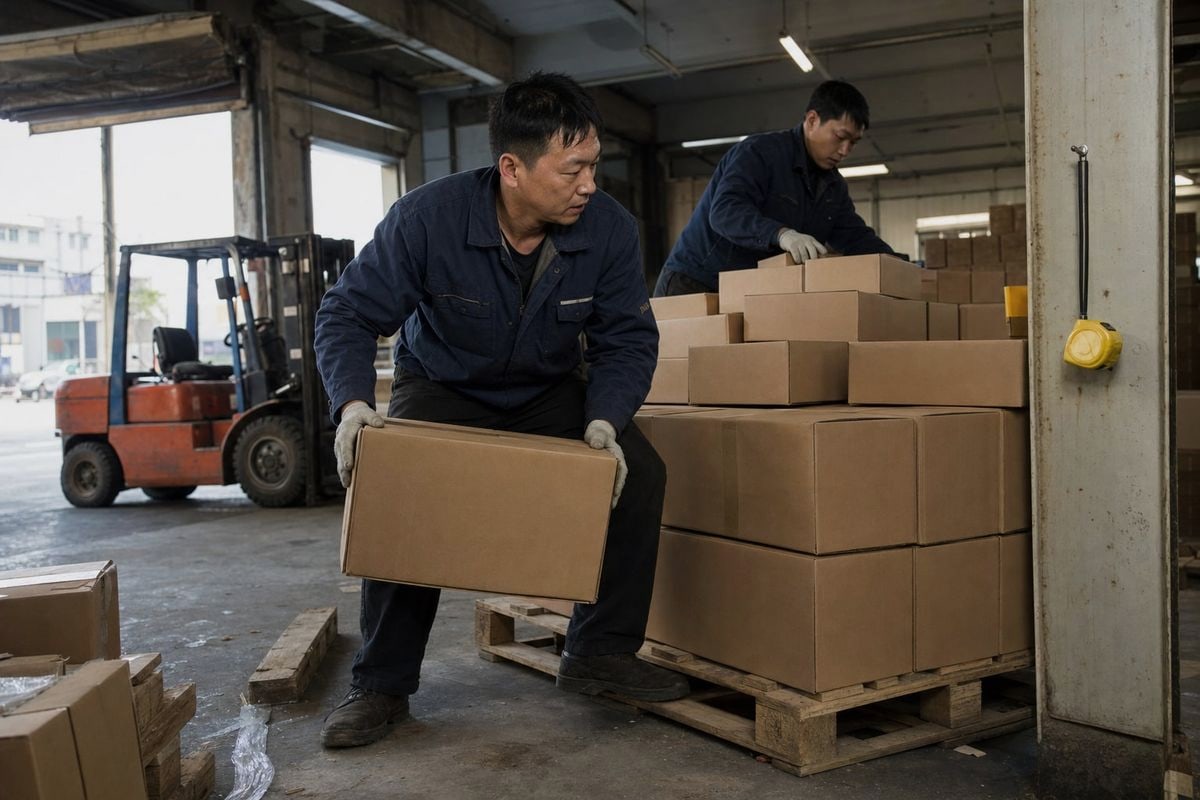
Good stacking is physics, not guesswork. Every rule below exists to control the center of gravity and spread pressure evenly through the load.
Some guides argue pure column stacking is stronger because boxes transfer load corner-to-corner straight down. That is true for compression. But heavy ocean freight also faces weeks of lateral vibration, so we cross-stack the upper layers to lock the load together while keeping heavy base cartons in aligned columns.
| Transport Scenario | Recommended Total Height (Including Pallet) | Why |
|---|---|---|
| Trucking / overseas warehouse | ≤1.2 m ideal, never over 1.4 m | Racking limits and forklift safety |
| Ocean container (FCL/LCL) | ≤1.1 m per pallet | Allows two-layer stacking; over-height wastes container space |
| Any heavy cargo | Never stack more than 3 layers of heavy items | A high center of gravity tips easily when the forklift turns |
A Canadian client of ours learned this lesson the hard way. His factory built pallets too tall and too heavy. By the time the goods reached our warehouse, the pallets were already leaning and the cartons had deformed. We re-palletized everything before loading, and the container shipped on schedule — but only because we caught it in time.
Prevent damage and weight shifting by reinforcing the pallet base with runners for loads over one ton, stretch wrapping tightly from base to top with extra bottom passes, adding crossed PP or steel strapping, fitting edge protectors on all corners, and filling every void with dunnage.
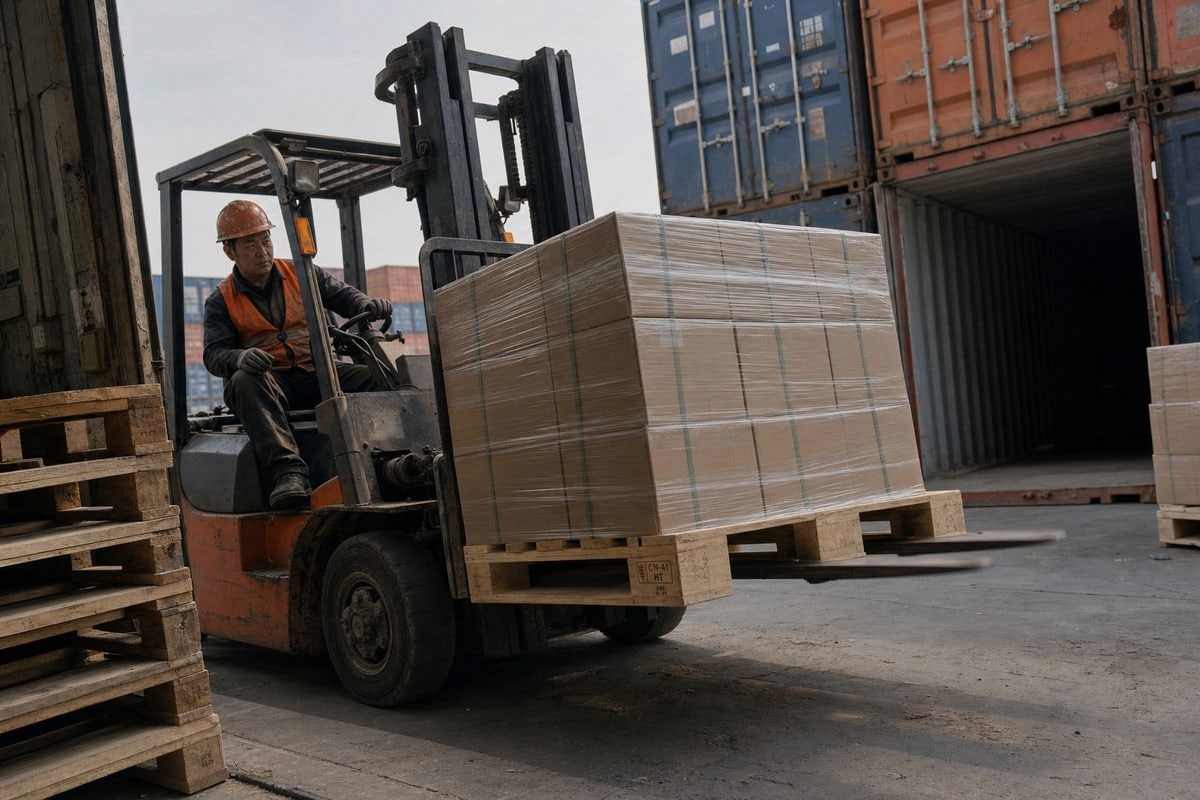
Wrap alone is never enough for heavy cargo on an 18–25 day China to USA journey. Ocean transit means constant vibration, crane lifts, and rough drayage. Here is the four-layer reinforcement system we apply in our warehouse.
For any single pallet over one ton, we nail 2–3 solid wood runners across the pallet bottom. These spread the forklift's fork pressure and stop the deck panel from snapping. For sharp metal parts or machinery, we place thick cardboard or plywood between the cargo and the pallet so nothing punches through the deck. Forklift safety improves too, because the forks meet a stiffer, flatter base.
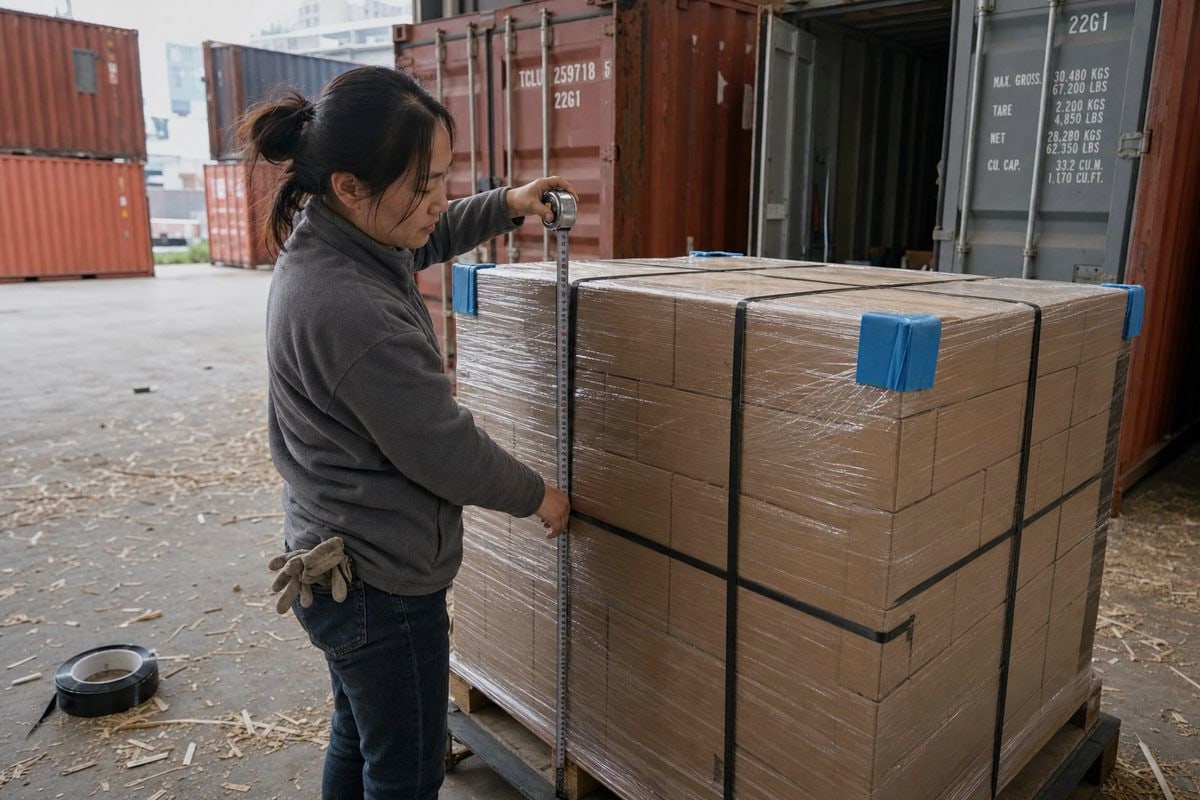
Stretch wrapping must anchor the cargo to the pallet, not just hug the boxes. Our standard: wrap the bottom layer 5–8 extra passes so the load and pallet become one unit, keep the film under full tension the whole way up, leave no loose gaps, and add extra passes at the top to cap the load. For cargo over one ton, we apply a double layer of film to survive long-haul vibration.
| Strapping Type | Use Case | Minimum Pattern |
|---|---|---|
| PP plastic strapping | Heavy cartons, general dense cargo | At least 2 horizontal + 2 vertical straps in a cross pattern |
| Steel banding | Heavy equipment over 2 tons | Crossed and pulled tight against cargo and pallet |
| Extra top-and-bottom straps | Machinery, hardware, metal parts | One band low and one high to stop layers sliding apart |
Straps under tension can slice into cartons. We slip cardboard edge protectors onto all four corners of boxed heavy cargo, and rubber corner guards onto metal items to stop slipping. Then we fill any remaining gaps with dunnage materials 4 — foam, cardboard, or airbags — so nothing can settle or rattle. Finally, we mark the single-pallet weight, fragile symbols, and center-of-gravity labels, and we confirm the pallet weight with the destination warehouse in advance, since many overseas warehouses cap single pallets at 1,500 kg.
Handling FBA freight every week has taught me that Amazon rejects pallets for small, avoidable reasons. A missing label or a two-inch overhang can send your whole shipment back to a holding area.
Amazon FBA requires GMA-standard 40×48 inch four-way pallets, heat-treated if wooden, with cargo inside the footprint, single-pallet height typically under 1.8 m (lower for clamp truck areas), clear pallet labels on all four sides, and no broken or leaning loads.
FBA compliance is really just disciplined palletizing plus Amazon's labeling layer. Let me connect the two.
Amazon fulfillment centers expect the GMA pallet standard: 40×48 inches, four-way forklift entry 5, and structurally sound wood or plastic. For shipments arriving from China, the wooden pallet must show the IPPC heat-treatment stamp. Damaged pallets — cracked stringers, missing boards — get refused at the dock, and refusal means costly re-delivery appointments.
Everything from the earlier sections applies, plus Amazon's specifics. Cargo must sit fully inside the pallet footprint with no overhang. The load must be stable and square, wrapped in clear stretch film 6 so labels stay scannable. Heavy cartons still go on the bottom for weight distribution, and each individual carton must also meet Amazon's per-box weight rules, with heavy-item warnings where required. A leaning pallet — like the one our Canadian client's factory built — would fail an FBA receiving check instantly.
Each pallet needs four pallet labels, one per side, plus the correct carton labels underneath the wrap or applied so they scan through it. Because we handle Amazon FBA shipping 7 daily, we double-check labels during consolidation in Zhengzhou. My advice to every seller: instruct your factory in writing to palletize correctly and use rigid, crush-resistant cartons. If the cartons deform in transit, you will pay for re-boxing and re-palletizing before Amazon accepts anything, and you may miss your delivery appointment window entirely.
Heavy cargo punishes shortcuts: weak pallets snap, tall stacks tip, loose wrap fails. Build bottom-heavy, reinforced, strapped, compliant pallets — or let an experienced China to USA freight partner build them for you.
1. Official IPPC standards page for international phytosanitary measures regarding wood packaging materials. ↩︎
2. Wikipedia entry detailing the Grocery Manufacturers Association (GMA) standard dimensions and specifications. ↩︎
3. Authoritative Wikipedia article explaining how vertical compression strength is measured for shipping containers and boxes. ↩︎
4. Wikipedia explanation of various dunnage materials used to secure cargo during transport. ↩︎
5. Wikipedia's comprehensive guide to pallet design, specifically detailing four-way entry and structural variations. ↩︎
6. Wikipedia article on stretch wrap, explaining its use as a clear film for securing palletized loads. ↩︎
7. Official Amazon portal for Fulfillment by Amazon services, detailing shipping and logistics requirements. ↩︎