
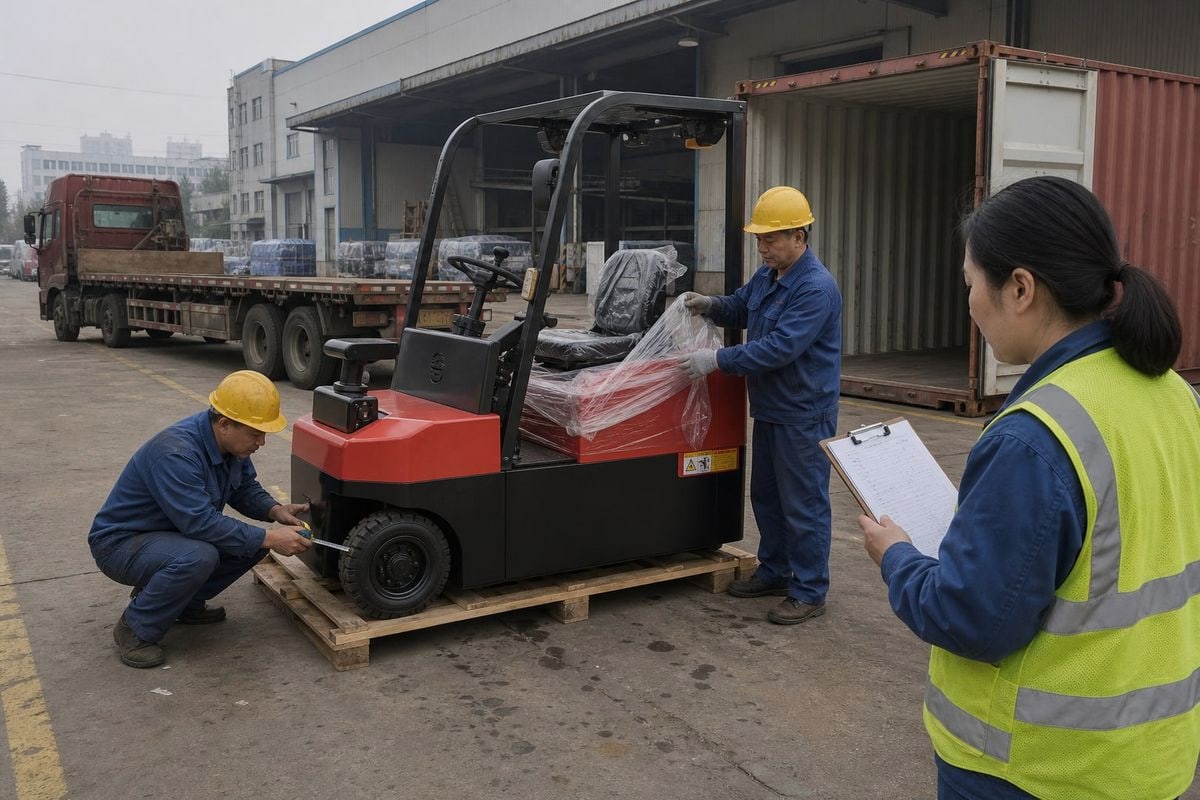
Vận chuyển xe kéo điện từ Trung Quốc có vẻ đơn giản cho đến khi giấy tờ về pin, mã HS và các khoản phí cảng ẩn xuất hiện. Đội ngũ logistics của chúng tôi tại Zhengzhou thấy người mua gặp khó khăn ở đây mỗi tháng.
Để vận chuyển xe kéo điện từ Trung Quốc, hãy xác nhận kích thước, trọng lượng và loại pin của đơn vị, chuẩn bị tài liệu UN38.3 và MSDS cho các mẫu lithium, chọn vận chuyển container FCL hoặc Ro-Ro, thỏa thuận về Incoterms, và đặt hàng thông qua một công ty giao nhận có kinh nghiệm với thiết bị xử lý vật liệu chạy bằng pin.
That is the short version. Below, I will walk you through the documents, the real costs, the battery rules, and the [FCL versus LCL](https://mbmlog.com/?p=12390) decision, step by step.
Tôi cần những tài liệu gì để vận chuyển xe kéo điện từ Trung Quốc?
Mùa xuân năm ngoái, nhóm của chúng tôi đã giữ một container tại cảng Thanh Đảo trong sáu ngày vì một nhà cung cấp đã gửi hóa đơn với mã HS sai. Một tài liệu. Sáu ngày. Bài học đó đã khắc sâu trong tôi.
Bạn cần một hóa đơn thương mại, danh sách đóng gói, vận đơn, chứng nhận xuất xứ, khai báo xuất khẩu Trung Quốc, tóm tắt kiểm tra UN38.3, MSDS, và một khai báo hàng hóa nguy hiểm cho các mẫu lithium. Thêm bảo hiểm hàng hải và bất kỳ chứng nhận đích nào như EPA/DOT hoặc nhãn CE.

Tài liệu là nơi hầu hết các chuyến hàng thành công hoặc thất bại. Theo kinh nghiệm của chúng tôi trong việc phối hợp tài liệu thông quan cho xe nâng điện và xe kéo, vấn đề hiếm khi là thiếu một giấy tờ. Thông thường, đó là sự không khớp giữa các giấy tờ. Hóa đơn ghi một số mô hình. Danh sách đóng gói ghi một số khác. Tài liệu thông số pin ghi một số thứ ba. Các nhân viên hải quan sẽ chú ý đến những thiếu sót này và họ sẽ giữ hàng hóa lại khi họ phát hiện ra.
Bộ Tài liệu Cốt lõi
Mỗi lô hàng xe kéo điện từ Trung Quốc cần cùng một nền tảng. Hóa đơn thương mại ghi giá trị và điều khoản. Danh sách đóng gói ghi kích thước và tổng trọng lượng. Vận đơn chứng minh rằng nhà vận chuyển đã nhận hàng hóa. Giấy chứng nhận nguồn gốc hỗ trợ việc xử lý thuế tại điểm đến. Tờ khai xuất khẩu giúp hàng hóa ra khỏi Trung Quốc.
Tài liệu Cụ thể về Pin và Xe
Xe kéo điện có yêu cầu bổ sung vì chúng là phương tiện sử dụng pin. Dưới đây là cách mà tài liệu được phân loại:
| Tài liệu | Mục đích | Ai cung cấp nó |
|---|---|---|
| Tóm tắt thử nghiệm UN38.3 | Chứng minh pin lithium đã vượt qua các bài kiểm tra an toàn vận chuyển | Nhà sản xuất pin hoặc xe kéo |
| MSDS / SDS | Chi tiết về hóa học pin và các mối nguy hiểm | Nhà sản xuất pin |
| Tuyên bố DG | Khai báo đơn vị là UN3171 cho việc đặt chỗ của hãng vận chuyển | Người gửi / người chuyển phát |
| Giấy phép xuất khẩu | Cần thiết cho các nhà xuất khẩu Trung Quốc của xe điện và máy móc công nghiệp từ năm 2026 | Nhà cung cấp Trung Quốc |
| Chứng chỉ CE / EPA-DOT | Sự phù hợp của thị trường đích | Nhà sản xuất |
Điểm cuối cùng đó cần được chú ý. Tính đến năm 2026, các nhà xuất khẩu xe điện và máy móc công nghiệp của Trung Quốc phải có giấy phép xuất khẩu do chính phủ cấp. Tôi giờ đây nhắc nhở mọi người mua: xác minh giấy phép này trước khi bạn thanh toán tiền đặt cọc. Nếu nhà cung cấp của bạn không thể xuất trình nó, hàng hóa của bạn có thể không bao giờ rời khỏi Trung Quốc một cách hợp pháp, bất kể giá có tốt đến đâu.
Chúng tôi cũng kiểm tra mã HS trước khi đặt chỗ. Nhiều xe kéo thuộc về Mã HS 870911 1, bao gồm các xe tải điện không được trang bị thiết bị nâng. Đúng mã này ngay từ đầu sẽ định hình mức thuế và tốc độ thông quan của bạn tại điểm đến.
Chi phí vận chuyển một xe kéo điện từ Trung Quốc sang Hoa Kỳ là bao nhiêu?
Một nhà phân phối ở Texas từng cho tôi thấy hai báo giá cho cùng một chiếc máy kéo. Một trong số đó rẻ hơn $800. Nó không bao gồm phí xử lý tại điểm đến, phí chassic, và dịch vụ hải quan 2. Bảng báo giá "rẻ" đã tốn của anh ấy nhiều hơn cuối cùng.
Vận chuyển một máy kéo điện từ Trung Quốc đến Hoa Kỳ thường có chi phí từ $1,500 đến $4,500 cho cước biển trong một container chia sẻ hoặc toàn phần, cộng với thuế nhập khẩu và thuế, dịch vụ hải quan, xử lý tại điểm đến và vận chuyển nội địa. Tổng chi phí logistics thường đạt từ $3,000 đến $7,000 cho mỗi đơn vị.

Giá của nhà máy chỉ là điểm khởi đầu. Điều quan trọng là chi phí đã hạ cánh, và tôi đã chứng kiến quá nhiều nhà nhập khẩu tính toán biên lợi nhuận dựa trên con số sai. Khi đội ngũ của chúng tôi xây dựng một bảng báo giá, chúng tôi chia hành trình thành nhiều đoạn để không có gì ẩn giấu trong phần in nhỏ.
Cấu trúc Chi phí Toàn diện
| Mục Chi phí | Phạm vi điển hình | Ghi chú |
|---|---|---|
| Vận tải nội địa Trung Quốc | $200–$600 | Từ nhà máy đến cảng, phụ thuộc vào khoảng cách |
| Khai báo xuất khẩu & xử lý | $100–$300 | Bao gồm phụ phí DG nếu là lithium |
| Cước vận chuyển biển | $1,200–$3,500 | FCL 20FT hoặc 40FT, tùy thuộc vào tuyến đường |
| Bảo hiểm hàng hải | 0.2%–0.4% giá trị | Rất được khuyến nghị cho các đơn vị có giá trị cao |
| Phí đích đến tại Mỹ | $400–$900 | Port handling, chassis, drayage |
| Thủ tục hải quan | $150–$350 | Mỗi lần nhập khẩu |
| Thuế và phí nhập khẩu | Varies by HS code | Confirm HS Code 870911 classification early |
| Giao hàng cuối cùng | $300–$1,000 | Liftgate or forklift needed at delivery |
Time Is Also a Cost
Ocean transit is only one part of the schedule. A realistic end-to-end plan includes 2–3 days for booking and documentation, 1–3 days for inland transport to the Chinese port, 2–4 days for China export operations, then the ocean voyage itself, followed by 2–5 days at the destination port, 3–7 days for customs clearance, and 1–3 days for final delivery. Some listed routes for electric tow tractors quote 17–24 days of ocean transit, but treat that as a sample, not a promise. Build buffer into your delivery commitments.
Incoterms Decide Who Pays What
Của bạn Incoterms 2020 3 choice determines which legs sit in your quote and which appear later as surprises. FOB gives experienced buyers control over freight and cost transparency. DDP puts everything on the seller's side, which feels simpler for first-time importers but often hides the true cost structure inside a bundled price. My honest view after years of running both: FOB with a forwarder you trust usually beats DDP on transparency, but DDP is a fair choice for your first one or two shipments while you learn the process.
Tôi nên xử lý yêu cầu về pin lithium như thế nào khi vận chuyển xe kéo điện?
The trade-off I discuss most with buyers is not price. It is battery chemistry. Lithium gives better runtime and lighter weight, but it turns your shipment into regulated dangerous goods. Lead-acid ships more simply but adds weight.
Electric tow tractors with lithium batteries ship as UN3171 Class 9 dangerous goods under the IMDG Code. You must provide a UN38.3 test summary and MSDS, keep the battery state of charge at 30% or below, and secure carrier DG acceptance before booking.

Battery compliance has become the single biggest gatekeeper in this trade. Freight guides used to treat lithium paperwork as an edge case. Today it is a standard planning item, and carriers reject non-compliant bookings without apology. Our team coordinates these requirements with the factory weeks before cargo moves, because fixing a battery document after the tractor reaches the port is expensive and slow.
The UN3171 Classification
An electric tow tractor with an installed lithium-ion battery is classified as UN3171, battery-powered vehicle, under the IMDG Code. That classification brings Class 9 hazardous material 4 labeling and specialized DG stowage requirements on the container ship. It also means your booking goes through the carrier's dangerous goods desk, which takes longer than a normal booking. Plan for it.
The Compliance Checklist We Run
- Confirm the battery chemistry and capacity with the factory in writing.
- Collect the lithium battery UN38.3 certification test summary and the MSDS.
- Verify the battery state of charge will be reduced to 30% or less before loading, which sharply cuts thermal runaway risk in the cargo hold.
- Submit the DG declaration and wait for carrier acceptance before fixing the sailing date.
- Photograph the battery labels and disconnection before the container doors close.
Lithium Versus Lead-Acid: A Practical Trade-Off
Lead-acid units often skip the heaviest DG requirements, which simplifies booking. But they weigh more, which can affect container weight limits and handling. Neither choice is universally right. If you run a rental fleet and value uptime, lithium is usually worth the paperwork. If you want the simplest possible first import, lead-acid removes friction.
Two more points worth noting. First, confirm the charger voltage matches your destination market; a 380V Chinese charger is useless on a US 480V supply. Second, for European buyers, watch the emerging digital Battery Passport requirement. A QR code tracking chemical composition and recyclability will soon be mandatory in the EU, so asking for it now future-proofs your fleet. Some importers of high-value fleets also add IoT telematics inside the container to monitor battery temperature and voltage during the voyage, which supports specialized EV cargo insurance claims if anything goes wrong.
Tôi nên chọn vận chuyển FCL hay LCL cho đơn hàng xe kéo điện của mình?
A forklift dealer in Ohio once asked me to quote LCL for a single tow tractor to "save money." When we ran the numbers, FCL in a 20FT container was barely more expensive and far safer. He was surprised. Most buyers are.
Choose FCL container shipping for one or more electric tow tractors whenever possible; it offers better protection, faster handling, and predictable costs. LCL only makes sense for spare parts and accessories. For large fleet orders, Ro-Ro shipping can beat FCL on cost.

The FCL versus LCL question is really a question about risk. Tow tractors are heavy, high-value machines with paint, hydraulics, and electronics that do not enjoy being handled repeatedly. LCL cargo gets consolidated, deconsolidated, moved by unfamiliar warehouse crews, and stacked near other people's freight. That is fine for boxed goods. It is a bad environment for a two-ton machine.
A Quick Comparison
| Nhân tố | FCL Container Shipping | LCL Consolidation | Ro-Ro Shipping |
|---|---|---|---|
| Tốt nhất cho | 1–4 tractors per container | Parts, chargers, accessories | Large fleet orders |
| Rủi ro xử lý | Low, sealed at origin | High, multiple touches | Medium, driven on and off |
| Cost predictability | Cao | Moderate, CBM-based fees add up | Route dependent |
| Battery DG acceptance | Widely available | Often restricted for DG cargo | Requires ports that handle live EV loading |
| Oversized units | Flat rack / open top options | Not suitable | Very suitable |
How We Decide in Practice
Our team starts with dimensions. A compact tow tractor usually fits a 20FT container. Two to three units, or units plus batteries and chargers, often justify a 40FT or 40HQ. This is where multi-supplier consolidation earns its keep: we regularly fill unused container space with spare parts, chargers, and attachments from other factories, which drops the average logistics cost per unit. Good material handling equipment logistics is mostly about using every cubic meter you have already paid for.
Ro-Ro shipping deserves a fair look for fleet buyers. For large-scale orders, Ro-Ro is often more cost-effective than multiple containers, provided both the origin and destination ports can handle live electric vehicle loading. The tractor is driven onto the vessel, so it must be operational and the ports must accept EV units. For oversized tractors that exceed container door dimensions, flat rack or open top containers bridge the gap between standard FCL and breakbulk.
One more angle for tariff-sensitive markets: shipping in a semi-knocked-down state, with the battery separated from the chassis, can sometimes reclassify the shipment under different HS codes and reduce "complete vehicle" tariffs. This needs careful confirmation with a customs broker before you commit, but it is a legitimate lever that experienced importers use.
Whatever mode you choose, insist on container loading photos and proper blocking, bracing, and lashing. We document every loading with photos before sealing, and we add desiccants and waterproof wrapping to fight container rain and salt-air corrosion during the ocean leg.
Phần kết luận
Shipping electric tow tractors from China is a compliance project first. Nail the documents, the battery rules, and the container choice, and your landed cost stays predictable.
Chú thích
1. Official WCO nomenclature for electric works trucks and tractors used in international trade. ↩︎
2. U.S. Customs and Border Protection information regarding the role and requirements of customs brokers. ↩︎
3. Official ICC rules for the use of domestic and international trade terms for shipping. ↩︎
4. IMO standards for the classification and maritime transport of dangerous goods including lithium batteries. ↩︎




